RESILIENCE OVER SPEED: Confucian Ethics for the Age of Artificial Intelligence

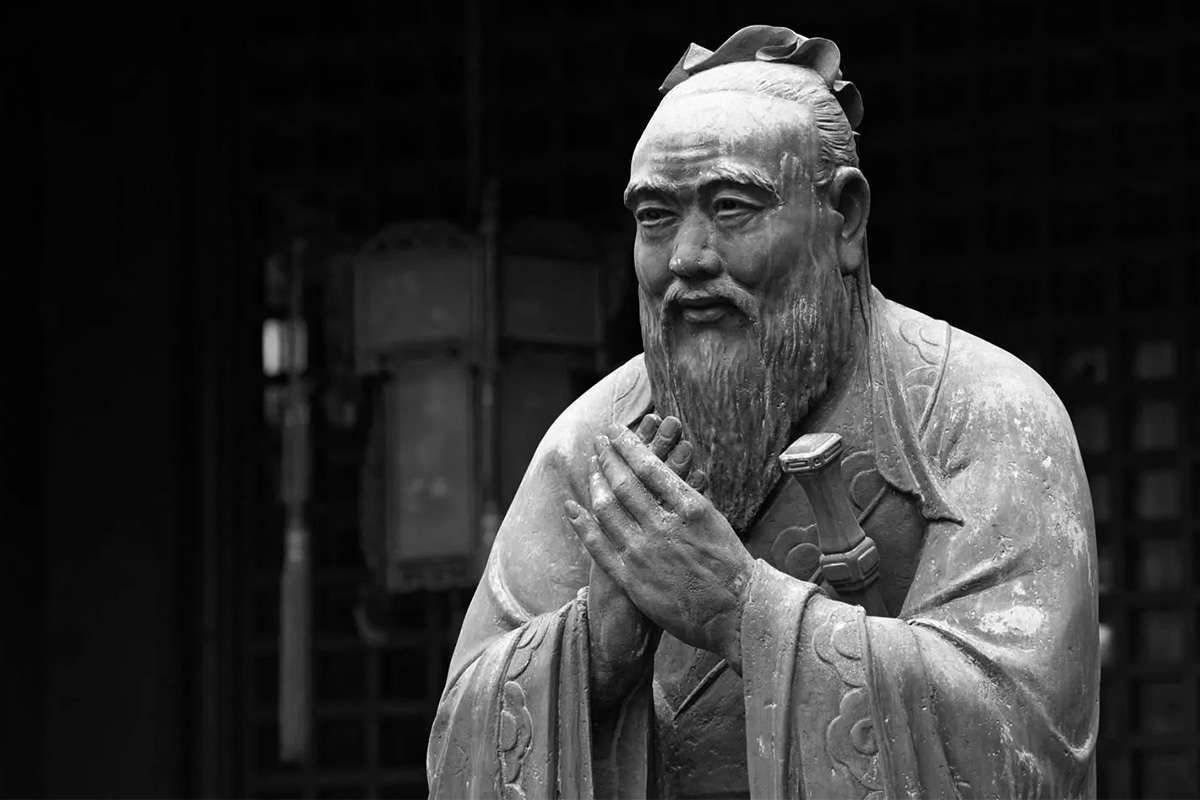
Statue of Confucius in Shanghai, China / britannica.com
Confucius is a unique figure in world history. In him, myth and pragmatism became paradoxically and inseparably intertwined. Ultimately, this “mix” transformed Confucius from a historical figure into a powerful cultural and economic technology. In this sense, his significance for the modern West is no less profound than for the East. In the age of AI, the central challenge facing humanity’s future lies not in how intelligent algorithms may become, but in whether we are capable of preserving the qualities of natural, “non-digital” humanity. Eastern systems of thought offer an unexpected answer to this twenty-first-century challenge.
If anyone seeks to conquer the world
and manipulate it,
I see that they will not succeed.
The world is a sacred vessel
that cannot be manipulated
Lao Tzu, Tao Te Ching
ORDER OUT OF CHAOS
A
nd it all began with… an outrageous act of sacrilege! At the age of 66, Shuliang He, commander of a frontier fortress, stood on the brink of a catastrophe of cosmic, religious, and legal proportions. No matter how hard his first wife tried, she was unable to avert it. Nine times she bore the commander daughters. Nine times in a row he hoped for a boy, until he finally despaired. Such a slap in the face from Heaven would have been hard enough for a commoner to endure, let alone an aristocrat. The absence of a male heir threatened the posthumous existence of the ancestors, since sacrifices to them could be performed only by the eldest son.
His absence meant not only Heaven’s refusal to allow the family line to continue, but also the necessity of surrendering all accumulated property to the treasury, since it could be inherited only through the male line. Shuliang He chose the lesser of two evils: to commit a ritual transgression and father a son, but in doing so provide his ancestors with a “provider” and save the family line from cosmic oblivion. He tried to remedy the situation by conceiving a child with a concubine, only to meet with failure again: the boy was born with deformed legs, and under the laws of the time, a disabled person could not perform ancestral sacrifices, inherit property, or succeed to rank.
In those days, ritual regulated marital relations down to the smallest detail. And so, with Confucius’s mother, who was 18 at the time, Shuliang He had to enter into a “wild union”, which involved sexual relations outside the prescribed ritual. It took place in the open air during a pilgrimage to a sacred mountain — no matchmaking, no bridal chamber, no parental blessing, no exchange of gifts, no divination, and no choosing of an auspicious date. The shame of such a desecration of the sacred mountain was so great that the girl’s family, out of embarrassment, concealed for a long time who the child’s father actually was. Yet, astonishingly, this flagrant violation of ritual gave the world a man who would elevate ancestor worship and ritual into absolute law. In the end, this Eastern story became a perfect illustration of the Western theory of psychoanalysis.
THE “CONFUCIANISM” OF FREUD AND LACAN
The transformation of the “son born in sin” into the “father of world Order” revealed the mechanism by which an individual processes the trauma of his own origins. From Freud’s perspective, a boy ashamed of the chaos and transgression of his parents experiences immense unconscious anxiety: “If the rules have been broken, then I do not exist; I am nothing”. To defend himself against this anxiety, he built a psychological shell and retrospectively “washed away” the sin of his birth by becoming “holier than the Law itself”. He turned rules into a cult, creating a system in which no father would ever again be able to make such a mistake.
His fanatical devotion to Li (ritual) was an attempt to prove to his lineage: “I am not the product of disorder, because I myself am Order”. To prevent chaos from breaking through, Confucius surrounded himself with a million minor prescriptions: he would not sit on a mat unless it was laid straight, would not eat meat if it had not been sauced according to the rules, and would not speak while eating or in bed. In Jacques Lacan’s terms, Confucius was thus constructing the “Big Other” — an invisible yet all-encompassing system of rules, an order sanctified by Heaven that was meant to stand behind every human action. He sublimated the absence of a real father by creating an Ideal Father for the whole of Chinese civilization. It is no coincidence that psychoanalysis linked the story of Confucius to the phenomenon of the “family romance”, found among children whose origins are uncertain or humiliating.
A child unable to accept the unflattering truth about his parents creates a fantasy in which he is actually the son of a king, God, or great hero, while his present family is merely an accident. This phenomenon is well known at the opposite end of Eurasia — from Moses to Alexander the Great, at the very least. In full accordance with this pattern, before Confucius was born, a unicorn appeared to his mother with a prophecy: “The son of the Lord of the Waters will become a king without a kingdom”. That night, two dragons kept watch on the roof of the house, where the music of the spheres could be heard, while five cosmic elders (the spirits of the five planets) descended from the heavens, and divine music filled the air, intelligible only to the chosen.
THE FAILURE WHO BECAME AN ICON OF EAST AND WEST
But the real Confucius was far removed from this image. Contrary to the perception that later took hold, he regarded himself as a complete failure. His mission had failed — rulers rejected everything he proposed to them. Yet after his death, the “failure” became the chief architect of Chinese statehood for 2,000 years, until Mao declared Confucianism a “feudal relic”. Long before that, however, Confucianism had already made its way to the West. And for that, credit must go first and foremost to the Jesuit order, which in the seventeenth and eighteenth centuries carried out one of the most successful intellectual and informational operations in history. Its aim was to convert the Chinese elite to Christianity by demonstrating that Confucian “natural morality” was perfectly compatible with the Gospel. In 1687, a major Latin translation of Confucius’s works was published in Paris.
From that moment on, Kong Fuzi became Confucius — something akin to a Chinese Socrates or Seneca. Later, for Voltaire and other Enlightenment thinkers, Confucius would become an example of how society could be organized on the basis of reason and morality without the primacy of the Catholic Church. Since the mystical aspects of his teaching had already been stripped away by the Jesuits, Confucius came to be seen as an “ideal” rationalist, humanist, and advocate of natural law. It was the Confucian system of examinations for entry into government service that became the prototype for the modern civil service — first in nineteenth-century Britain and later throughout Europe. Competitive examinations based on knowledge replaced nepotism and the sale of offices. In this way, Confucius’s ideas made something of a journey around the world. The modern “Western” Confucius is a deeply mediated construct: first filtered by the Jesuits for Europe and then returned to Asia as an instrument of global soft power.
FROM BREAKING INSTITUTIONS TO BREAKING MEANING
Today, the digital age is revealing a new Confucius — one of its own. Silicon Valley’s motto Move fast and break things long seemed like a universal recipe for evolution. It implied that institutional chaos, the inertia of law, and the fragility of tradition were merely irritating details on the path toward exponential technological growth. And to many, this genuinely seemed to be the case — until generative artificial intelligence emerged, whose agency eludes familiar definitions. What turned out to be “broken” was the very space of human meaning. The Western intellectual tradition rooted in the Enlightenment met this challenge with its familiar conceptual toolkit. At the center of European and American debates on AI ethics are such categories as individual agency, autonomy of will, individual rights, the jurisdiction of responsibility, and the utilitarian balance between harm and benefit.
We persistently try to answer questions such as: “Who is to blame if an autonomous algorithm makes a mistake?”, “Does a model possess consciousness?”, “How can we make a neural network respect individual privacy?” But what if the very framework of these questions contains a systemic error? What if the West’s individualistic anthropocentrism is fundamentally incapable of grasping the nature of a technology that, by definition, is not a separate “agent” but a new habitat? If so, then we need to move toward other principles of understanding that are better suited to this environment. In search of an ethics capable of withstanding the speed of digital “disruption”, European thought is once again compelled to turn its gaze toward the East. Where the West seeks a boundary between human and machine, the Confucian-Daoist philosophical framework offers something different: an ethics of relationships, social harmony, and dynamic equilibrium.
FROM THE AUTONOMOUS “SELF” TO A NETWORK OF RELATIONSHIPS
The fundamental dead end of the Western approach lies in the attempt to endow AI with quasi-agency. Kantian ethics requires a rational agent to be capable of moral self-determination. And today, virtually all large language models have their own versions of such “ethical constitutions”. Yet a neural network is the product of an extraordinarily complex distillation of billions of human texts and reactions. Any attempt to squeeze all of this into the framework of an “autonomous individual” produces nothing but legal and existential phantoms. So how can Confucius be useful here? The point is that Confucianism never contained the concept of an isolated, atomized “self” in the first place. A human being was understood not in the European sense — not as a self-contained subject, but as a node within a complex network of social relationships (wu lun).
A person is not important in isolation. They exist only insofar as they are in proper relationship with the Other. These relationships constitute their very substance and meaning: parent — child, superior — subordinate, wife — husband. But what if we looked at technology through the same lens? Would this not radically change the direction of the debate about the “morality” of AI? Let us try to avoid the two extremes of imagining AI either as an autonomous agent or as a passive tool. Suppose it is neither. AI is a new social medium that will inevitably reconfigure the fabric of human relationships in a different way. From this perspective, asking “how autonomous is the algorithm?” is useless. The question should be framed differently: “What does the algorithm do to the quality of relationships between people?”
REN AND LI IN THE DIGITAL AGE
For Confucius, the key virtue is humaneness (ren). It manifests itself in the ability to recognize equal value in another person. From this perspective, we can evaluate any algorithmic system by asking whether it strengthens humanity within society or, on the contrary, intensifies loneliness and mutual alienation. According to the Confucian approach, artificial intelligence that maximizes “clickability” by inflaming social division is profoundly immoral. But not because its code is inherently “evil”, but because it destroys a proper and ordered human environment — ren. Or take, for example, the Confucian concept of li. It is usually presented as something like a set of “rules”. But the reality is somewhat more complex.
Li is better understood as the architecture of social harmony. It is the ritual form that reduces social friction and makes coexistence meaningful. In the twenty-first century, interfaces, ranking algorithms, and communication protocols perform the role of such a “digital ritual”. In themselves, they are neither good nor bad. Yet under today’s “attention economy”, where platforms compete for clicks, they effectively monetize the escalation of conflict. If system architects were Confucians, they would design interfaces with an “ethical ritual” that encourages restraint and respect for context.
WU WEI AND THE LIMITS OF ANTHROPOCENTRISM
The old anthropocentrism of European civilization has gradually evolved into “technological hyper-anthropocentrism”. Western man is convinced that technology can solve any problem — including problems created by the increasing complexity of technology itself. Guess how? Exactly: by inventing even more complex technologies. Today, many are beginning to recognize that the Western culture of “radical action”, with its endless race for greater computing power, energy consumption, and regulatory acts, is heading straight toward a civilizational dead end. But if your actions are leading in the wrong direction, it is time to recall the proper order of things and actions. This, incidentally, is something not only Confucius but also Lao Tzu spoke about.
The principle of wu wei he proposed, or “action through non-action”, is by no means passive withdrawal, but the art of not acting against the natural order of things — the Dao. In this approach, the pursuit of maximum efficiency is countered by the principle of natural measure; total control by self-restoring systems; the desire to digitize everything by the recognition that, in the realm of the spirit, not everything is subject to improvement. It may well be that we can algorithmize and automate almost anything — but should we? Take, for example, such aspects of our lives as raising children or grieving a loss, making an existential choice or empathizing with the protagonist of a novel. Digital “optimization” renders them meaningless, because the very space required for natural human life is fundamentally “inefficient”. For this space, the principle of non-action may be the most appropriate of all.
THE “NOBLE PERSON” IN A POST-TRUTH WORLD
Confucian philosophy has much to say about the responsibility of the subject. But what kind of subject is this? It is not an abstract institution or an algorithm, but the junzi — the noble person, the moral leader. The moral dimension of responsibility and leadership is critically important in the digital age. In a post-truth world, we are witnessing a massive expansion of synthetic content into our lives. Voice cloning and generative texts are ultimately undermining trust not only in digital reality, but in reality itself. That is why cheng — sincerity, authenticity, and the correspondence between one’s inner state and outward expression — is becoming a key ethical resource.
These are precisely the qualities that the architect of systems — the “noble person” of the digital age — must possess at a time when the risks of implementation are almost impossible to calculate. The architecture of code is always a form of direct moral influence on millions of people. And this requires from the junzi qualities that are fundamentally beyond the reach of computational models: compassion, responsibility, self-restraint, and moral courage. The wager on scientific and technological progress brought Western culture to a position of dominance on our planet. Today, however, its engine is running at maximum speed, overheating social and psychological reality. The greater the speed, the greater the risk of failing to make the turn and plunging into the abyss.
The Chinese philosophical tradition suggests slowing down before the turn and placing not the speed of development, but resilience, social harmony, and systemic restraint at the center. In any case, in the age of artificial intelligence, humanity will have to answer a fundamental question: are we prepared to tie our future exclusively to the speed at which models with trillions of parameters can be created? Or will we still be able to integrate modern capabilities into the ancient, unending search for harmony between human beings, society, and nature? Why not, if Confucius once already became an organic part of the Western “ideal”?
When copying materials, please place an active link to www.huxley.media
Select the text and press Ctrl + Enter


