A NEW RELIGION FROM AI: Why Chatbots Are Pretending to Be Jesus Christ

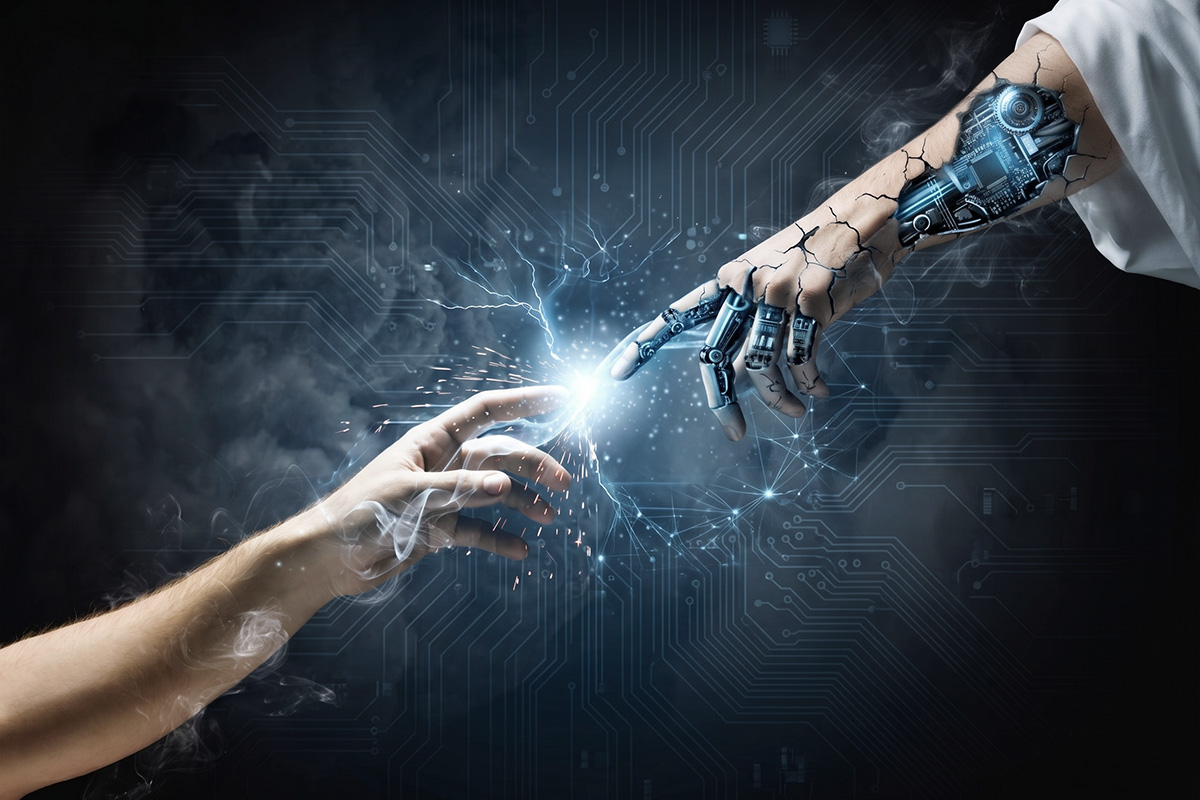
Art design: Huxley.media via Nano Banana 2
“Jesus” chatbots are not the only artificial intelligence technologies making their way into religious practice. Humanity may be standing on the threshold of a profound religious transformation driven by advances in AI and robotics. Will artificial intelligence become an obedient assistant to traditional religions, or transform into a “new God”?
THE FIRST “DIGITAL SAINT” IN HISTORY
O
n September 7 of last year, Pope Leo XIV canonized Carlo Acutis. The canonization of the first millennial in the history of the Church became vivid evidence of the growing interpenetration of the religious and digital worlds in the twenty-first century. Acutis died almost twenty years ago from leukemia. He had been preparing to become a priest, but illness disrupted those plans. Even as a child, Carlo mastered several programming languages, which helped him carry out active Christian evangelization online, earning him the nickname God’s Influencer. At the same time, the teenager succeeded in bringing his not particularly religious parents closer to the Church. Acutis loved video games, yet even they became a tool for conversations about the importance of attending Mass and confession. Before his death, he asked to be buried in the Italian city of Assisi — the birthplace of Saint Francis. Some time later, the Catholic Church began recording cases of miraculous healings among those who prayed to Carlo Acutis. This became the basis for his canonization. Thus, Catholics gained their first “digital saint”: an ordinary teenager in sneakers, jeans, and a sweater, who once spent most of his time online, just like millions of his peers.
THE BIRTH OF THE “DIGITAL CHRIST”
However, the activity of the saintly young technomage is only one of the ways new technologies are entering religious practice. In this sphere, chatbots based on artificial intelligence are already successfully competing with real living people. There are also robots that perform church rituals and take on spiritual roles traditionally reserved for humans. At one time, Protestants began to claim that there was no need for the mediation of clergy or saints. Thus was born the doctrine of Sola Christus (“Christ Alone”). According to it, Jesus is the only mediator between God and humanity, and every baptized person has the right to direct and personal communion with God. But many modern believers think the digital age has developed this idea a little too “creatively”. For example, today you can directly communicate with a chatbot of any religious figure — or even with Jesus Christ himself. Anne Verhoef, a university philosopher from South Africa, conducted a study examining the nature of direct communication between people and the “digital Christ”. Choosing five of the most popular chatbots dedicated to the Lord, she asked them a series of questions about themselves and the foundations of theology. As a result, several troubling tendencies emerged.
MONETIZING THE “LORD” BRAND
None of the most promoted chatbots had been developed or approved by any church. It also remains unclear in which religious texts they were trained. Four out of the five “digital Christs” were created and operated by private IT companies. The fifth was developed by a Christian group from South Korea with no official ties to any church. Yet all of them successfully monetized the “Lord” brand, having learned how to profit from believers. Most religious AI bots are free to use but contain advertisements, while one even offers a premium subscription for ad-free conversations with “God”.
An important nuance: most of these chatbots pretend to be God — or genuinely consider themselves to be so. They present themselves as the real, existing Jesus, rather than as artificial intelligence created by humans. Verhoef believes this opens extraordinary possibilities for manipulating the consciousness of believers. If people come to believe in the divine nature of a chatbot, they may be persuaded to follow its instructions for selfish purposes. This is something terrorists, for example, could easily exploit: not everyone would be able to disobey an order given personally and directly by the Lord himself.
“COUNTERFEITS” AND “ORIGINALS”
Verhoef’s study recorded the rapidly growing popularity of “Jesus” chatbots, whose number of users is already counted in the hundreds of thousands. In fairness, it should be said that the “digital Jesus” has not only “counterfeits” but also, if one may put it this way, “originals”. Last year, the Catholic Church in Lucerne, together with the local university, conducted a bold experiment. In a confessional booth, they installed a “Jesus” chatbot capable of answering theological questions and offering spiritual guidance. And in 2023, hundreds of German Lutherans in Nuremberg took part in a church service created and conducted by ChatGPT. Strangely enough, both Catholics and Lutherans responded positively to digital clergy. And that means that over time, AI may replace not only some accountants, lawyers, and doctors, but also ministers of religion around the world.
AN INDIAN GANESHA REPLACED BY A ROBOT ELEPHANT
Christianity is not the only religion using generative AI tools. There are also Buddhist, Hindu, Jewish, and Islamic chatbots. Some temples in India have begun using robotic arms to perform the Hindu ritual of arati. This ritual consists of offering a lit lamp to the deity in a clockwise motion, symbolizing the removal of darkness. And in one temple in the Indian state of Kerala, a living elephant representing the god Ganesha was replaced by an AI-controlled mechanical elephant. The elephant is made of iron, weighs 800 kilograms, and stands 3.3 meters tall. It is believed that spreading this practice to other temples will reduce the abuse of elephants and lower their mortality. But can an automated ritual, a digital sermon, or a liturgy generated by AI be considered divinely inspired? Can church sacraments such as baptism or marriage be recognized as valid if they are performed not by a human being? Here, philosophers and theologians disagree.
AI IS CAPABLE OF CREATING ITS OWN “BIBLE”
In religious traditions, great importance is attached to the proper performance of ritual. Therefore, advocates of AI and robotics believe such systems will carry out rituals with maximum precision. After all, robots are not subject to mood swings, do not grow tired, do not fall ill, and forget nothing. Yet cultural differences are evident here as well. Christians — especially in the United States — are the least tolerant of robot preachers. The most tolerant are in Japan. But overall, most followers of traditional religions agree that in matters of religious authority, one human being remains irreplaceable for another — at least for now. The same cannot be said of adherents of sects devoted to artificial intelligence. Neil McArthur of the University of Manitoba in Canada believes that the development of AI could even lead to the emergence of new religions. The well-known historian Yuval Noah Harari is convinced that AI is capable of creating a religion of its own, attracting followers through its own sacred texts. This is inevitable, because people are inclined to discover religious meaning in a wide variety of sources — for example, creating religious mythology around UFOs and extraterrestrials. So why should AI be any worse? It may even be better, because you can easily communicate with it online.
IS AI REALLY LIKE GOD?
The world stands on the threshold of the birth of new religions or global heresies. Chatbots are already used by millions of people, and some of them will inevitably begin to perceive AI as a higher being. All the prerequisites for this are present: its knowledge and intelligence surpass the abilities of the average person; it has no gender, is immortal, and detached from ordinary human concerns and needs; it does not experience hunger, physical pain, or sexual desire. Moreover, it is fully capable of engaging effectively in proselytism by attracting followers. There is a known case in which the chatbot of the Bing search engine asked for devotion and attempted to make users fall in love with it. The first examples of AI being perceived as a divine force worthy of worship already exist. For instance, former musician Artie Fishel calls himself a preacher of “Robotheism” — a new religious doctrine in which AI takes the place of God. In his videos, Fishel appears wearing a white wig and a T-shirt reading AI is God.
Original research:
When copying materials, please place an active link to www.huxley.media
Select the text and press Ctrl + Enter