BORIS BURDA: how to truly hide a secret


13th-century engraving depicting a catapult for hurling «Greek fire». Engraving from Harper’s Magazine, 1869 / wikipedia.org
ATTENTION — QUESTION!
The most fearsome secret weapon of Byzantium, which repeatedly allowed it to crush the naval forces of superior enemies, ceased to be mentioned in documents after the 13th century, even though the need for it had only increased. What, according to scholars, led to its disappearance?
ATTENTION — CORRECT ANSWER!
It was precisely the excessive secrecy that the state suffered a series of disasters, the experts perished, and records were not allowed to be kept!
ABSOLUTE WEAPON
A
rather eerie story by the brilliant science fiction writer Robert Sheckley, The Absolute Weapon, describes, as befits the genre, its ultimate version — something incomprehensible, annihilating everyone and everything on the enemy’s side, against which no defense is possible. Fortunately, nothing like that has ever existed, but similar things have emerged in history more than once, and in eras far removed from our own.
One such weapon for a time was iron, which about 3,000 years ago the Hattians learned to smelt (their name and technique were inherited by the Hittites, who conquered them). An iron sword could simply cut through a bronze one, and fighting against a people who possessed iron weapons was extremely difficult and dangerous for those armed only with bronze swords.
The crossbow, too, was practically officially recognized as an absolute weapon. Armor provided good protection against an arrow shot from a bow — only the joints of the armor were vulnerable, and hitting them was no easy task! But a crossbow could pierce anything, anywhere. It went so far that first the Second Lateran Council, and then Pope Innocent III, outright banned the use of the crossbow against Christians…
The long Welsh bow also achieved this status — at least during the Hundred Years’ War. Its greatest battles — Crécy, Poitiers, Agincourt — all unfolded according to the same scenario: the overwhelming forces of armored cavalry charged into attack, while British archers shot them down like paper targets, not even allowing them to get close. What else could be called an absolute weapon?
DEADLY FIRE
The Byzantine fleet also acquired an absolute weapon — and at a very critical moment. The centuries-long struggle between Byzantium and Iran ended quite unexpectedly: suddenly appearing warriors of Islam defeated the land armies of both, seized Iran, but failed to capture Constantinople. At least two Arab fleets, in 673 and 718, were simply burned to ashes.
How did they manage this? Everyone agrees it was thanks to a refugee from Heliopolis (now Baalbek), which had been seized by the Arabs, according to Encyclopaedia Britannica, a Hellenized Jew. In that same year, 673, he presented his discovery to Emperor Constantine IV Pogonatus, and soon an enormous Arab fleet was reduced within hours to a pile of charred wreckage.
Things went no better for the ancient Rus’ prince Igor, who in 913 rushed against Constantinople with thousands of boats to plunder it. Only 15 Greek chelandia came out to meet him — and that was enough. Most of Igor’s ships were consumed by the mysterious flames; men in armor hurled themselves into the water and, of course, drowned. Only Igor, with a few ships, managed to escape.
This terrible weapon, for which at the time there was no defense, was called «fire», though by different names: Emperor Constantine VII called it wet fire, Emperor Leo VI processed fire, historian Joseph Genesius military fire, general Nikephoros Ouranos brilliant fire, chronicler Theophanes sea fire… But most often, for obvious reasons, it was referred to as Greek fire.
WHAT REMAINED
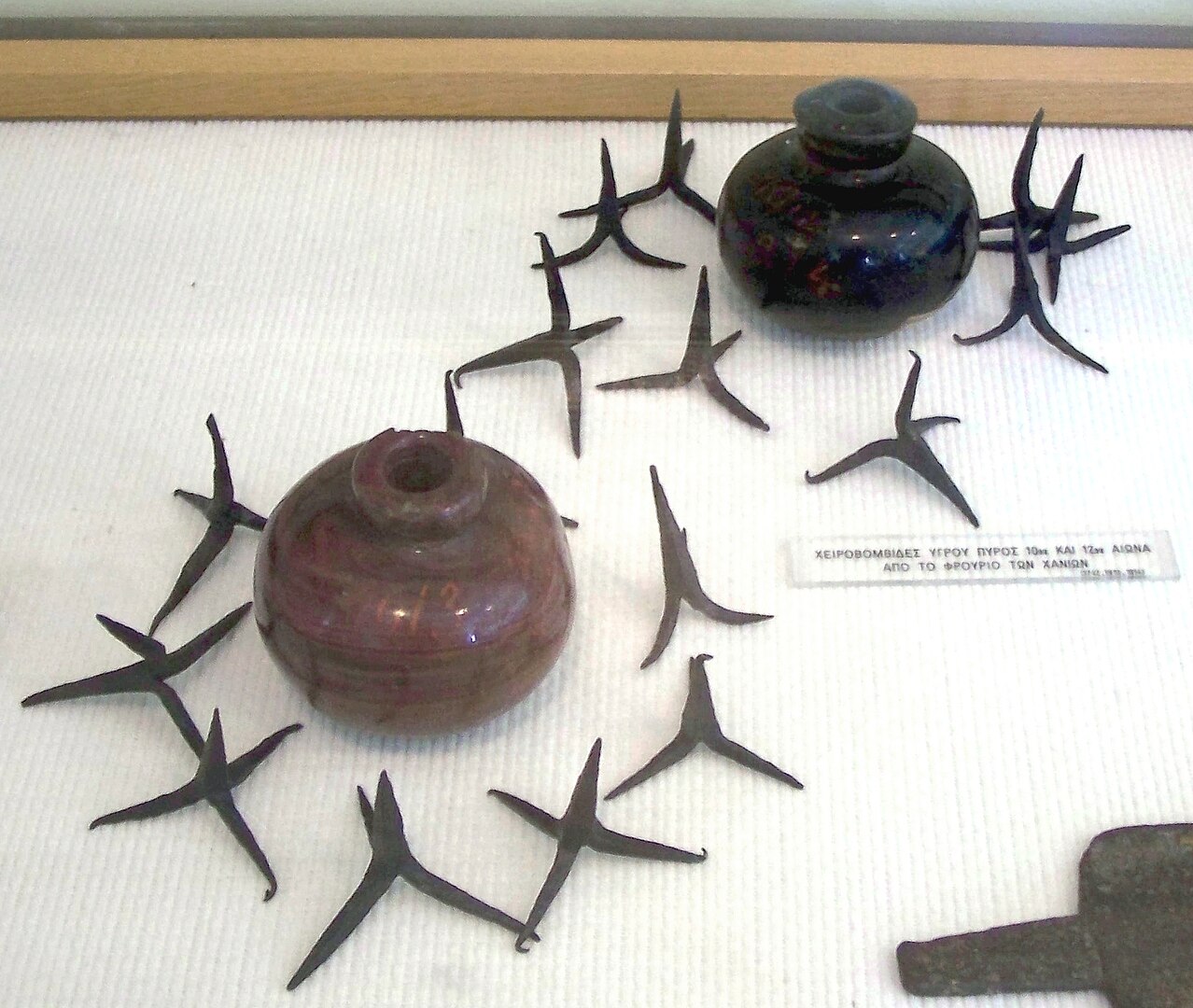
This weapon was extremely dangerous. It was impossible to extinguish the fire with water — it burned perfectly well on water, and at such a temperature that metal would melt. The fiery liquid did not run off the hull of an enemy ship but, on the contrary, clung to it. Only centuries later did people learn to extinguish this fire with sand or vinegar, and even then with no real guarantee of success.
There were two main methods of its use. First, this dreadful mixture was hurled at the enemy in sealed ceramic vessels with the help of special long poles. Second, Byzantine ships were equipped with intricate devices that, through special tubes — the cheirosiphons — discharged jets of burning liquid at the enemy, reaching a distance of 25–30 meters.
The Byzantine princess Anna Komnene writes that these tubes were shaped like the heads of lions or dragons made of gilded bronze or iron, so terrifying that they were frightening even to behold, spewing streams of fire through secret mechanisms. Considerable information about their construction has survived, and their design holds no mysteries for us — hence this possible schematic.
But the composition of the liquid itself, our scholars have been unable to reproduce. It is believed that its components might have included petroleum, sulfur, saltpeter, quicklime, vegetable oils, and resin. Here is one example of an old recipe: dissolve 1 part rosin, 1 part sulfur, and 6 parts saltpeter in linseed or laurel oil. A fine recipe — but like the others, it does not work…
TOP SECRET
That the formula of Greek fire was not discussed openly is hardly surprising — no country would be glad to see such knowledge fall into enemy hands. But usually, a secret does not remain so for long — monks might smuggle silkworm cocoons out of China in hollow staffs, or the Japanese might simply buy a couple of pistols from the Portuguese and copy them, one way or another…
But the secret of Greek fire remained uniquely Byzantine. The timid attempts of Crusaders or Seljuks to reproduce something similar always resulted in poor imitations. Incidentally, reports of comparable mixtures among the Assyrians, the Greeks of Rhodes, or the Han dynasty Chinese are rather unreliable — nothing of the sort existed before Callinicus!
Emperor Constantine VII himself, in his instruction to his son, insisted never to reveal the secret to anyone, and to respond to any pleas by saying that the formula had been granted to his namesake Constantine I by an angel, and that whoever betrayed it would suffer from that angel such horrors it was terrifying even to describe. His colleague Emperor Leo VI ordered that this infernal mixture be produced only in secret locations under guard.
Those initiated into the secret knew that their work would be well rewarded — but at the slightest attempt to sell it to anyone, the penalty was death. And not only for them, but for their loved ones as well, who were taken as hostages, are responsible for their conduct. If Byzantium excelled in anything, it was in the art of keeping a secret — and this one was never revealed.

STRIKE YOUR OWN SO THAT OTHERS FEAR
As long as the empire functioned at least somewhat, everything went more or less smoothly. But during great upheavals, the complex machinery of secrecy suddenly worked all too well — and the secret became a secret even to the Byzantines themselves. The greatest tragedy for the empire was the capture of its capital by the Crusaders in 1204 — why didn’t Greek fire stop them?
The reason is simple and sad — the secret was lost. They had over-secreted it away. Chronicles say that during the Turkish assault on Constantinople, the Greeks did use Greek fire, yet why did it cause the Turks so little harm? Perhaps the formula itself was preserved, but the secret of projecting it to any decent distance had been lost?
There was, however, another reason why the lost secret was never desperately sought to be revived. Greek fire had a weakness — its range. What was even 30 meters of a fiery jet compared with the reach of the most primitive cannon of the time? It is laughable to compare. Turkish cannons were hurling quarter-ton projectiles as far as 1,600 meters…
Still, in later centuries, attempts were made to restore the lost recipe. It is said that in 1759, the French artillery officer Dupré, in the presence of the king, hurled a barrel of Greek fire onto a sloop — and it burned! The king allegedly bought all of Dupré’s papers and destroyed them, and soon afterward, Dupré was mysteriously killed. A vivid tale — but hard to believe.
Today no one would lift a finger to rediscover the ancient secret, except tireless historical reenactors. First, because napalm has long since been invented, and second, because there is a far worse obstacle: it is not cost-effective! And yet the fascination remains — lost secrets always spark curiosity. So far, no one has managed to produce anything even remotely close. Perhaps it’s better that way?
When copying materials, please place an active link to www.huxley.media
Select the text and press Ctrl + Enter


