REVELATIONS IN SCIENCE: The Spontaneous Generation of Mice from Dirty Laundry

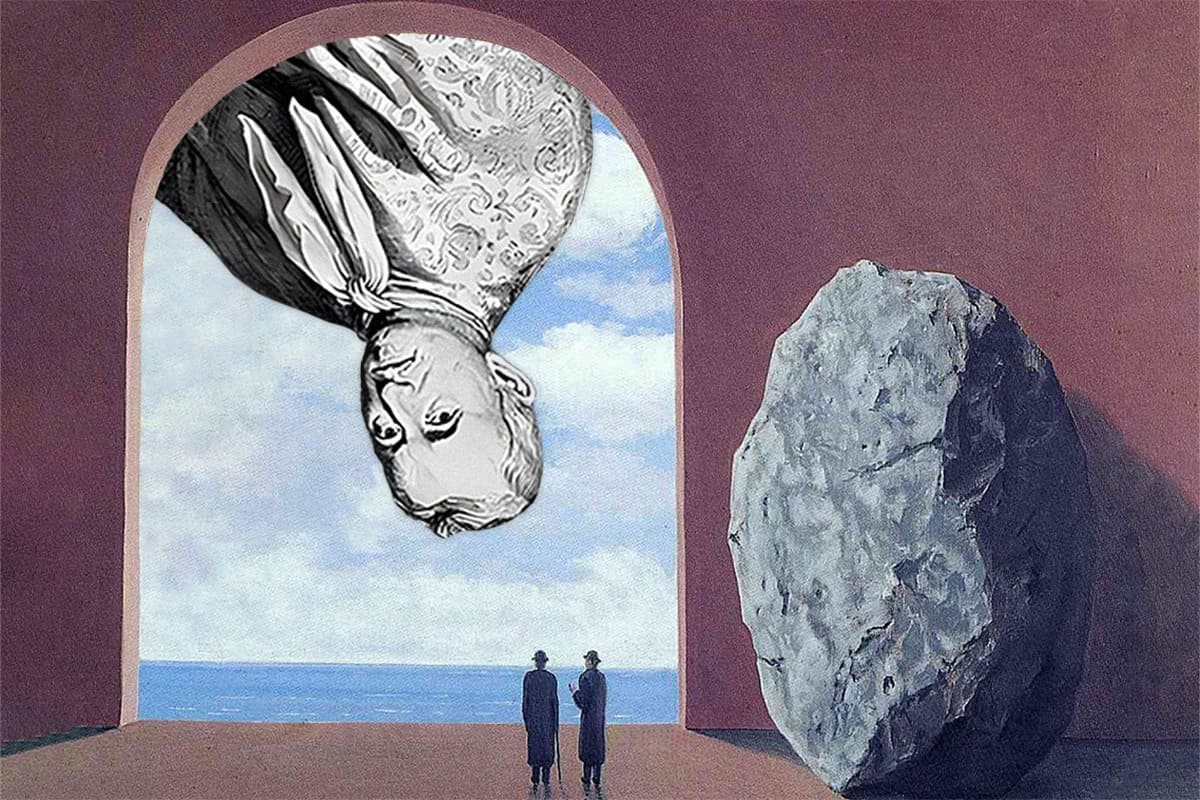
Art design: huxley.media via Photoshop inspired by René Magritte’s painting Portrait of Stephy Langui, 1961
WHERE DOES EVERYTHING COME FROM?
W
here did you personally come from? From your mother and father? Most likely, no one would argue with that. And what about other animals? That is also more or less clear. Fish are already a little more complicated, and insects require even more thought… You can no longer say with certainty that every tiny creature has a mother and father — in bees and ants, things are not quite so simple, and this has been known for a very long time… As for bacteria, I will not even mention them — just a little over three hundred years ago, no one even suspected they existed, and how exactly they reproduce was discovered only comparatively recently. And when it comes to viruses… everything becomes even more complicated — you would hardly find three people on an ordinary bus who know much about them, unless that bus happens to be heading to the Academy of Sciences…
But the less people know, the bolder their assumptions become. Wherever there was no direct answer, imagination stepped in. For example, the ancient Egyptians believed that not only frogs, toads, and snakes, but even such a large creature as the crocodile did not come from other crocodiles at all, but simply arose spontaneously from Nile mud. For a certain period, the ancient Greek philosopher Empedocles (485–425 BCE) agreed with them, claiming that the first creatures born from silt gradually became more complex, and that the most successful among them are the ones we still observe today. Plato (428–347 BCE) and Aristotle (384–322 BCE) believed that animal and plant matter becomes alive only when spiritual substance joins it. So does spontaneous generation exist? If not, where does everything come from? If it does, when and why? And what does science think about all this today?
A VERY LONG TIME AGO…
Generally speaking, there is no way around posing an extremely difficult question here — one for which it is not even clear how an answer could be given. At this very moment, life undoubtedly exists because someone is asking questions. But if life exists, that means there was once a time when it did not exist, and therefore at some point it spontaneously arose… If you dislike this idea, then accept the notion that life was never born at all but has simply existed eternally, and confront the alternatives — among which religion is not even the most terrifying option. The best solution would be to conduct some kind of experiment on the spontaneous generation of life. And please do not smile condescendingly — explain what exactly must be done for something nonliving suddenly to become alive. History has not concealed from us the scientific (yes, scientific!) works of such people — judge for yourself.
Let us not take too seriously, for example, the conviction of the ancient Chinese that if bamboo shoots were left sufficiently undisturbed, aphids would spontaneously arise from them, or the knowledge of the ancient Babylonians that worms — quite living ones — would sooner or later emerge spontaneously from mud accumulated in canals. We, too, when we were children, believed that monsters lived in the closet, and then we became wiser… No, let us instead consider a fairly major scholar whose death occurred less than four hundred years ago — the Fleming Jan Baptist van Helmont, the inventor of the word “gas”, which entered all the world’s major languages. For van Helmont himself, the question of the spontaneous generation of life — and rather substantial life at that (we will leave viruses and prions aside for now, as that is far too long a discussion) — for example, mice, was completely clear.
As it turns out, one simply had to take a large jar and stuff it with plenty of dirty laundry, then throw in as much wheat as one could spare, and keep it indoors for about three weeks, perhaps a little longer… During that time, the life force contained within the laundry solely because of its dirtiness would penetrate through the wheat husks, and a mouse would spontaneously arise! I suspect that van Helmont personally carried out the experiment he described and, moreover, obtained precisely the result mentioned above; otherwise, he would hardly have published it… But for some reason, I find it harder to believe that he excluded all the other possible ways that this very mouse might have appeared. Others, however, were not so skeptical: van Helmont was respected, and this argument was quite frequently cited as proof of the theory of spontaneous generation.

FRANCESCO REDI
It would have been far too simple to claim that spontaneous generation was possible only in dirty laundry. It soon became apparent that life also arose in rotting meat, in the form of noticeable white worms resembling fly larvae. Before long, it was proven that these actually were fly larvae. So that was how it worked: first came the rotting meat, then worms spontaneously generated within it, and only afterward did flies emerge from those worms! It seemed impossible not to believe such a thing, because every stage of this grand process was very easy to verify. Leave rotten meat exposed to the open air for some time, and there you have it — fairly large and clearly visible white worms appearing in the flesh of an animal that had long been dead. If this is not spontaneous generation, then what kind of spontaneous generation, excuse me, would satisfy you?
A remarkably convincing answer to these questions was provided by Francesco Redi (1627–1697), a man not only highly educated but also quite distinguished — the chief pharmacist of Tuscany and personal physician to the Medici duke. Like all truly convincing answers, his was extraordinarily simple. Let us take several jars filled with pieces of rotten meat. If they are left alone, the triumph of spontaneous generation seems inevitable — before long, every such jar will contain a hellish multitude of worms. But what if only half of the jars are left open, while the other half are covered with ordinary white gauze? The result is perfectly straightforward: common flies will continue to swarm around the uncovered jars, and soon white worms will indeed spontaneously appear there, from which ordinary flies will later spontaneously emerge. But in the jars covered with gauze, nothing at all will spontaneously arise.
From the results of his experiment, Redi drew a very serious conclusion, formulated, as was customary at the time, in a short Latin phrase: Omne vivum ex vivo — “All life comes from life”. This conclusion, like many others of its kind, broadened the applicability of Redi’s experiment (what if flies do not arise spontaneously, but earthworms do?), yet it quite firmly settled the question of the spontaneous generation of worms in rotten meat. Still, other possibilities remained, and those possibilities had to be investigated as well…
JOHN NEEDHAM
Supporters of spontaneous generation surrendered the territory their opponents had captured, but stubbornly continued to resist in positions that were easier to defend. Of course, it quickly became awkward in respectable society to speak of the spontaneous generation of creatures clearly visible to the naked eye. But already in the seventeenth century, lens grinders had polished optical glass to such perfection that it was discovered — and proven — that every drop of water and countless other liquids were inhabited by thousands of tiny yet obviously living creatures. Could they not also arise spontaneously? Naturally, such a hypothesis had to be tested. This task was undertaken by the Englishman John Turberville Needham (1713–1781), a perfectly serious scholar who had already gained recognition through his studies of pollination — and by no means a Jesuit, as Voltaire hastily imagined (yes, even a just cause is sometimes defended by unjust means, and nothing good ever comes of it).
For his experiments, Needham used ordinary mutton gravy. He poured it, still steaming hot straight from the fire, into flasks. Then he heated it once more — purely for the sake of experimental rigor. He sealed each flask with a cork and left them to cool. Once they had cooled completely, he sealed them again and examined the contents under a microscope. It turned out that every single flask was teeming with microscopic little creatures! They had not died; in fact, they had multiplied — even though, it would seem, there was no possible way for them to have gotten inside! There you have spontaneous generation — anyone who wishes may verify it, for mutton is plentiful everywhere! Soon after this experiment (1747), Needham was admitted to the Royal Society of London, and for a time, he became the most frequently cited author in his scientific field. So, was the matter finally settled? Not at all!
LAZZARO SPALLANZANI
Curiously enough, it was a Catholic priest who refuted Needham’s experiments! His name was Lazzaro Spallanzani, a remarkably brilliant and versatile man — a physicist, entomologist, and botanist. He proposed a very simple idea: perhaps Needham had not boiled his gravy long enough, or had left the cooling flasks unsealed for too long? Deciding to test the experiment himself, Spallanzani sealed his flasks not with corks but with molten glass, simply fusing them shut — air can seep through a cork, but not through glass. He boiled the flasks for varying lengths of time, from several minutes to several hours. Afterward, he allowed them to cool, sealing some of them again while closing others merely with corks, as Needham had done, so that every possible variation was represented.
And what did he discover? If the gravy (or vegetable broth) had been boiled only briefly, then after cooling, the flasks teemed with countless amusing little microscopic creatures, regardless of whether the containers had afterward been sealed with corks or fused shut. But if the broth had been boiled for a very long time — several hours — everything depended on how the flasks were resealed. If closed with corks, there were as many creatures as one could wish for; if sealed again with glass, not a single one spontaneously arose! Which meant that the others had simply not boiled their broths long enough or had left them cooling too long while sealed only with corks — together with the air, the tiny creatures had returned to the flasks!
BUFFON
Needham believed in his scenario of spontaneous generation, but, like any serious scientist, he was willing to admit that he might have been mistaken in the details. He began collaborating with Georges-Louis Leclerc, Comte de Buffon (1707–1788) — I suspect many of you recognize this name, for he truly was a major scholar. The result was an ingenious explanation for why spontaneous generation did not occur in flasks that had been heated intensely and for a long time. As it turned out, strong heating destroyed the “vital force” — a special substance without which spontaneous generation was impossible. That, apparently, was all there was to it. But even Buffon’s authority could not withstand Spallanzani’s simple modifications of his experiments. The cunning abbé did not merely heat his flasks — he continued until the contents were scorched into blackened charcoal. Nevertheless, if such a flask was allowed to cool for a long time while sealed only with a cork, the same luxuriant zoo of microscopic creatures appeared within it as in a flask that had not been burned black. Thus Spallanzani triumphed once again, and defenders of spontaneous generation found themselves under urgent pressure to invent yet another explanation.

LOUIS PASTEUR
Supporters of spontaneous generation claimed that the very “vital force” responsible for spontaneous generation perished when heated. Thus, no matter how much Lazzaro Spallanzani refined his heating procedures in order to destroy life already present in the experimental medium, all the “vital force” within that volume had also abruptly died. In truth, they had already defeated themselves with this argument. After all, what difference does it make what exactly perishes under heat — life itself or the “vital force”? This “vital force” supposedly entered the flask simply through fresh air, which would inevitably penetrate it once the seal was broken.
Nevertheless, even this detail was addressed by Louis Pasteur (1822–1895), an exceptionally serious scientist. His approach was well tested: prove that if no foreign material entered an open flask, then no spontaneous generation would occur within it. The solution turned out to be rather simple — to bend the open neck of the flask into the shape of the Latin letter S. If, after sealing and heating such a flask, one breaks off only the very tip of the neck, the air inside will, of course, mix with the surrounding atmosphere — yet for some reason no spontaneous generation of life occurs within the flask! Dust particles and bacterial spores contained in the air settle along the curves of the neck and never reach the nutrient medium. But if the flask is tilted so that the liquid washes over the bend, then everything suddenly “spontaneously” appears quite successfully — not exactly spontaneously, of course, but at least through reproduction.
Notice that the question of spontaneous generation was not truly resolved; it merely retreated to another level. Wikipedia elegantly states that “Pasteur put an end to the centuries-long debate over the spontaneous generation of CERTAIN forms of life UNDER PRESENT CONDITIONS, experimentally proving its impossibility”. One may now say that a complete solution to this question is extremely difficult, and it is not even clear whether it is possible at all. But the fact that the issue is not nearly as simple as many advocates of spontaneous generation once claimed — that much is certain. Well, almost certain…
LITERATURE
- Microbe Hunters — Paul de Kruif. St. Petersburg, “Amphora”, 2006, 359 p.
- Metazoa — Peter Godfrey-Smith. Moscow, “Alpina Non-Fiction”, 2023, 419 p.
When copying materials, please place an active link to www.huxley.media
Select the text and press Ctrl + Enter