THE CLONE REVOLUTION: Asexual Seeds Will Change Our World

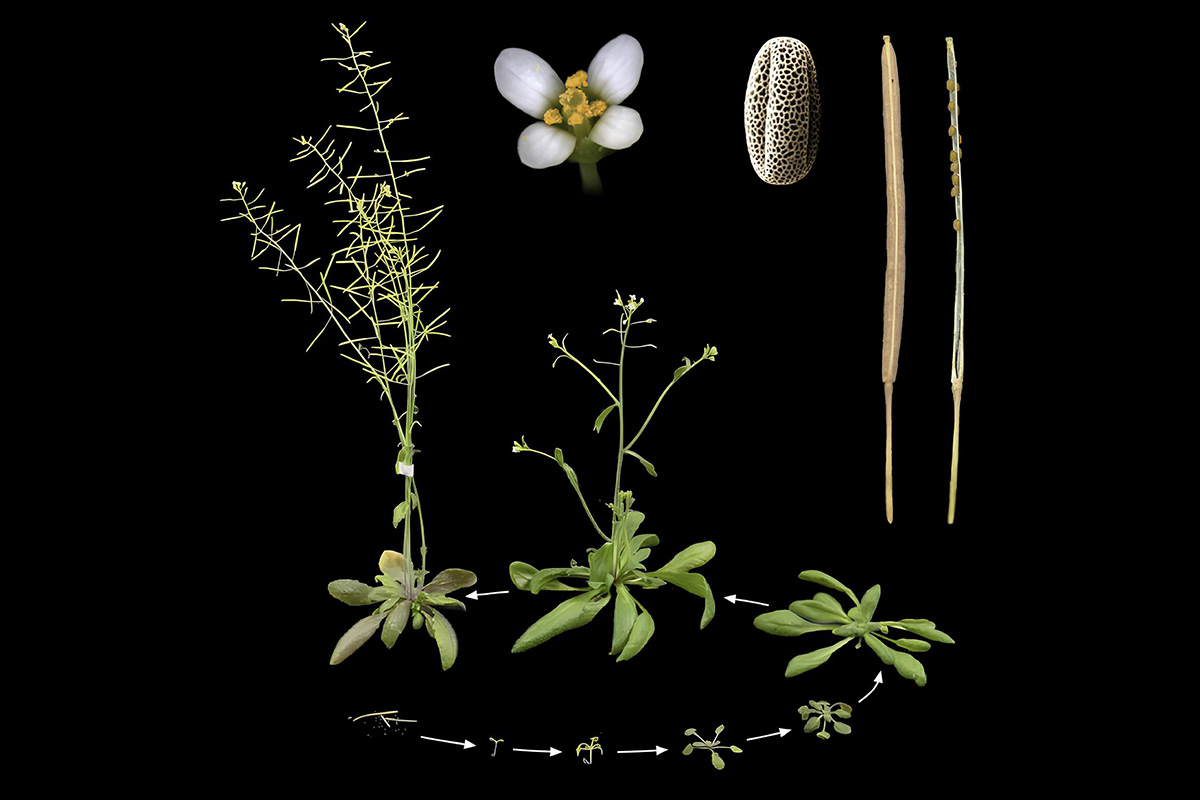
Arabidopsis thaliana at different stages of the life cycle (after Krämer, 2015) / researchgate.net
These plants may appear ordinary at first glance, but in fact their genes represent something revolutionary. They are capable of producing their own clones. Scientists expect that experiments with asexual seeds will open a new era in food production.
IMITATING NATURE
I
n eastern Australia, preparations are already underway for the first harvest of the frost-resistant Hy-Gain sorghum. This variety has been developed over the past decade from “asexual seeds” by scientists at the University of Queensland in Brisbane. The researchers borrowed this technology from nature. Apomixis is the name of a form of vegetative reproduction in plants in which seeds are formed without the participation of male sex cells. Science knows of more than 300 plant species that clone their seeds through apomixis. These are mostly flowering plants, and none of them are major cereal crops important for agriculture. That is why Australian scientists set themselves the task of introducing apomixis into crops such as sorghum, rice, and maize. They believe that new varieties could radically transform agriculture. Self-cloning varieties will be especially valuable for regions where there are problems with food production.
HYBRID VIGOR — UNLEASHED!
It is expected that the shift to asexual seeds will primarily transform the production of hybrid seeds, which have already become standard for several generations of farmers. Hybrid offspring, obtained by crossing two parent varieties through sexual reproduction, usually outperform their parents in their characteristics. This phenomenon is known as “hybrid vigor”. Thanks to it, from the 1930s to the mid-1990s, maize yields in the United States increased sevenfold. However, creating hybrids is a labor-intensive, costly, and time-consuming process — especially for crops such as wheat and soybean. Hybrid seeds must be produced and purchased anew each year. This is because if hybrids are left to self-pollinate, they produce a mixed yield — various combinations of unpredictable quality. Apomixis, however, stabilizes this “hybrid vigor”, since the hybrid clones itself. Thus, breeders and farmers gain access to an unlimited supply of high-quality, identical plants — elite varieties will preserve their traits from generation to generation.
AN “ALTERNATIVE” SEXUAL PATH
Technologies for the self-cloning of agricultural crops have a fairly long history. The genetic basis of apomixis became apparent to biologists around the 1940s. However, it was only in the 1990s that they began to understand that this trait does not eliminate sexual reproduction. Rather, it represents an “alternative sexual pathway”, for which two essential conditions must be met. The first is to disrupt cell division during the formation of egg cells and sperm cells. The second is to form an embryo independently of fertilization. In 2009, observations of artificially induced plant mutations finally yielded results. Researchers learned to successfully interrupt the process of sexual cell division and to artificially mimic the natural processes characteristic of apomictic plants.

HOW TO INCREASE THE FERTILITY OF CLONES
The “workhorse” of the experiment was a mutated relative of common cabbage — Arabidopsis thaliana. The authors of the experiment named this technology MiMe, hinting that the mutant was created through a simpler form of cell division — mitosis, rather than the more complex meiosis. The MiMe technology opened up vast prospects for engineering apomixis in plants. In 2016, MiMe rice was obtained, and in 2024 — tomato. However, one frustrating limitation emerged: although the plants were able to clone themselves, fertility steadily declined with each generation. Scientists solved this new puzzle with the help of maize. Screening 60,000 mutants of this crop made it possible to identify a single gene whose disruption leads to the formation of about one-third of egg cells through mitosis rather than meiosis. It was named nrf4, or “non-reductive female gene 4”.
MALE CELLS? UNNECESSARY!
Parthenogenesis is another key term for understanding how self-cloning works. It is a form of reproduction of female sex cells in which an embryo develops directly from an unfertilized egg cell — no male is required. Parthenogenesis is observed not only in plants. For example, it occurs in bees, aphids, daphnia, lizards, and fish. The main advantage of parthenogenesis is the ability to rapidly increase a population without the involvement of males. In 2006, another team of scientists turned their attention to Cenchrus squamulatus — a scaly sandbur. This apomict possessed a gene capable of triggering a true baby boom by inducing plant tissue to spontaneously form embryos. This technology was accordingly named BABY BOOM. In 2016, two teams of scientists — MiMe and BABY BOOM — combined their efforts and technologies. The result was apomictic rice capable of reproducing by cloning itself. In 2024, its fertility reached the level of a hybrid.
A BOOM OF “HYBRID” CLONES AWAITS US
Researchers believe that apomixis has a promising future. The new technology is compared to the invention of Gutenberg’s mechanized printing press in the 15th century, when diversity began to grow explosively from just one or two books. In the same way, the number and diversity of available hybrids adapted to local climatic conditions may grow exponentially. This could fundamentally transform our civilization, making food even cheaper and more accessible for millions of people. For example, in the near future, smallholder farmers in sub-Saharan Africa are likely to gain access to inexpensive, high-yield varieties of cowpea and sorghum. They will be able to save cloned seeds for sowing over several years, further reducing costs.
“CLONING FEVER”
Apomictic plants are of great interest to corporations operating in the global seed market. Apomixis significantly reduces the time and cost required to create new varieties. From a commercial perspective, the most promising direction appears to be the self-cloning of rice — a cereal crop that feeds more than half of the world’s population. In recent years, various companies have filed dozens of applications for apomictic crops. Unfortunately, in their efforts to outcompete one another, corporations are somewhat getting ahead of themselves — the technologies of self-cloning have not yet been fully refined by scientists. For example, cloned seeds of vegetable, fruit, and oilseed crops have not been particularly successful. However, scientists remain optimistic: there are clearly many unknown apomictic genes in nature that have yet to be discovered.
Original research:
When copying materials, please place an active link to www.huxley.media
Select the text and press Ctrl + Enter


