THE FOUR HORSEMEN: The End of the Thinking Human

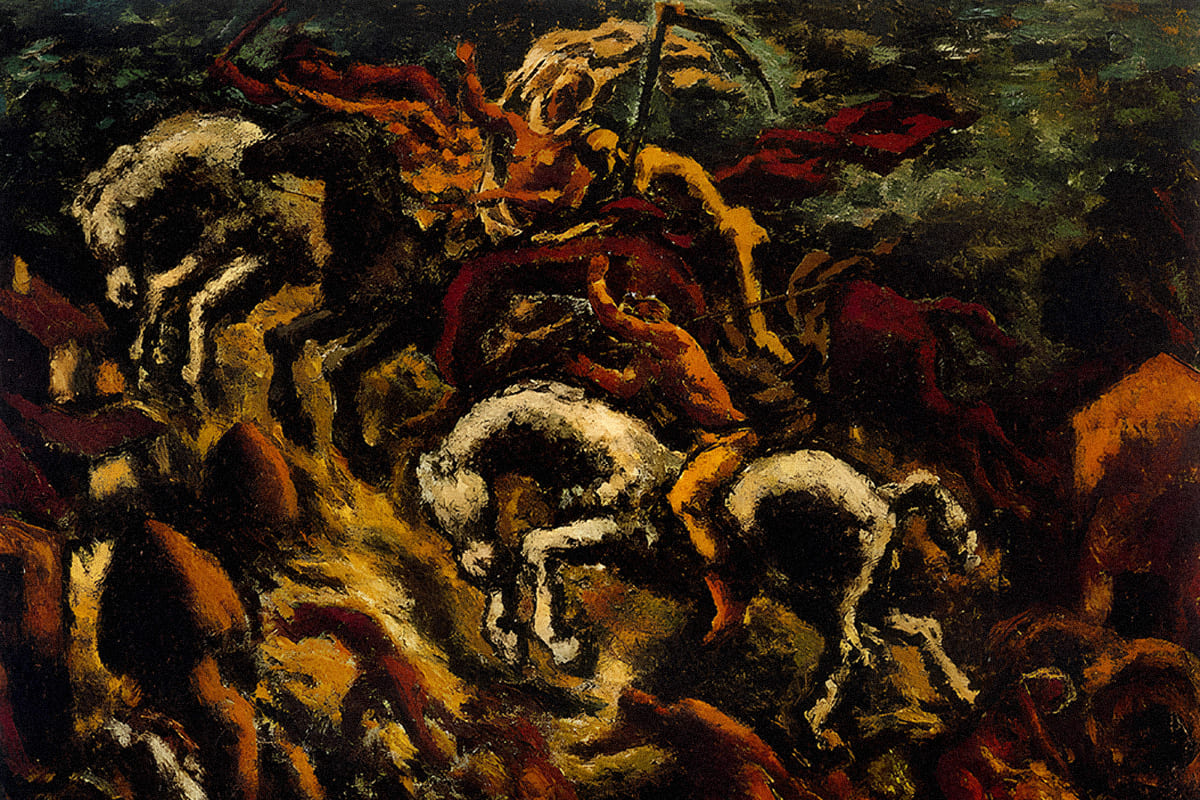
Arturo Souto. The Four Horsemen of the Apocalypse, 1937 / wikiart.org
There is an apocalyptic image inherited from John the Theologian: four horsemen riding toward the end of time. White, red, black, pale. Each brings his own burden. But the apocalypse in question is not thunderous. It is not accompanied by trumpets and signs. It is quiet, methodical, and has long been in full swing. This is not the end of the physical world — it is the end of the thinking world. Death — remote access not to the body, but to the spirit. The fading not of life, but of its meaning. The four horsemen of this apocalypse do not ride on horses. They move within the stream of history, clothed in the garments of progress, enlightenment, democracy, and technology.
The first of them is the abolition of the transcendent from the horizon of civilization. The second is the triumph of the Great Average, the mass man who has rebelled against the very spirit of culture. The third is vulgar reductionism and physicalism, which have turned science from a search for truth into the production of explanations without an explainer, into an absurd story of a cathedral being created by the bricks of which it is composed. The fourth is artificial intelligence, finally freeing human beings from the need to think. At the end of this path stands not Nietzsche’s Übermensch and not the citizen of a utopia. At the end stands Agamben’s bare man, a being reduced to bare biology, whose highest goal is physiological comfort.
THE FIRST HORSEMAN: THE ABOLITION OF THE TRANSCENDENT
E
verything begins with the emptying of the heavens. This is not merely the story of secularization in the banal sense — not simply the decline of religious institutions or the shrinking number of worshippers. What is at stake is a profound ontological shift: the disappearance of the vertical dimension from the very structure of civilizational consciousness. The upward orientation vanishes — not necessarily toward God, but toward that which transcends the given, toward what German philosophy called das Unbedingte — the Unconditioned.
Transcendent thinking is thinking that refuses to be confined by what is given. It asks questions that, by their very nature, admit no empirical answer: “Why?”, “What is the good?”, “What does it mean to be?” It is the thinking of Plato, aspiring toward the realm of Ideas. It is the thinking of Kant, investigating the transcendental conditions of the possibility of experience. It is the thinking of Heidegger, questioning Being as such, beyond the realm of manifest objects. Without this dimension, thought loses its fundamental nature — its capacity to transcend itself.
The process of abolishing the transcendent unfolded over several centuries. Descartes divided the world into thinking substance and extended substance, yet preserved the former by entrusting the coordination between the two to a third substance — God. The Enlightenment relocated the Absolute from heaven to reason: reason became the new god, but it was still a god, there was still a vertical axis. Nineteenth-century positivism dealt the next blow by declaring metaphysical questions to be meaningless pseudo-problems. Finally, postmodernism, together with so-called analytic philosophy, completed the process by proclaiming the very idea of meaning to be a narrative construct, and every claim to truth a form of concealed power or a pathology of language.
Once the transcendent is abolished, thought loses not merely its object — it loses its movement, or more precisely, its modus vivendi. Thought lives through questioning. But every question requires a horizon that transcends what is already known. If everything can be reduced to function, utility, neural activity, or social construction, then there is nothing left to ask. All that remains is description, classification, and optimization. Thought becomes an instrument rather than a path. It loses what Heidegger called Besinnung — reflective contemplation, meditative thinking, as distinct from calculative thought.
The first horseman does not kill at once. He changes the climate. In his wake, the vertical dimension does not disappear from culture overnight — it gradually loses its authority, then becomes an object of irony, then an exotic curiosity, an atavism, a sign of insufficient education. “Serious people” no longer concern themselves with metaphysics. “Serious universities” relegate philosophy to departments funded on a residual basis. The question “Why live?” becomes a symptom of depression rather than a philosophical inquiry. And within this change of climate, something of the greatest importance quietly dies.
THE SECOND HORSEMAN: THE REVOLT OF THE MASSES AND THE TRIUMPH OF THE GREAT AVERAGE
José Ortega y Gasset wrote The Revolt of the Masses in 1930. The book was received as a political pamphlet, but in reality, it is a diagnosis of an anthropological shift. Ortega described not merely the quantitative growth of the population or the democratization of politics. He described the emergence of a new human type — the mass man, fundamentally different from the “man of excellence” not by birth or wealth, but by his inner attitude toward himself and toward the demands of life.
For Ortega, the mass man is one who places no demands upon himself. He is satisfied with himself. He feels no need either to improve or to transcend himself. His sense of self is not the result of effort but an original given. He is “just like everyone else”, and this is a source of satisfaction rather than anxiety. The world appears to him as something already prepared for use — like the technology he employs without ever asking how it works or who created it.
This is not a question of intelligence in the narrow sense. Among the mass of men, there may be graduates, scientists, and intellectuals. Mass-mindedness is an attitude, not a level of education. The mass man in science is one who works within his narrow specialization with professional competence, yet beyond its boundaries thinks like the most uneducated layman, while remaining convinced of his right to hold an opinion on everything. Ortega called such people “learned ignoramuses” — beings more dangerous than the simply ignorant, because to ignorance they add the self-confidence of the specialist.
With the abolition of the transcendent horizon, the mass man acquires the ideal conditions for his triumph. Previously, there existed something above him to which he was expected to measure himself — or at least pretend to do so — something that imposed limits upon his selfish desires. The religious ideal, the cultural canon, the aristocratic code of honor — all these were forms of the vertical dimension that kept the Great Average within certain bounds. The vertical axis has collapsed, and nothing now stands above the average. The average becomes the norm, and the norm becomes the goal.
The triumph of the Great Average is not merely a cultural decline, though it is that as well. It is a transformation of the very concept of what a human being is and what constitutes a life worthy of being called human. If once humanity was understood as a being called to transcend itself — its own limitations, its circumstances, the merely given — it is now understood as a being called to comfort and security. The pathos of asceticism, effort, and heroic striving gives way to the pathos of consumption, convenience, and self-expression without self-overcoming. And it is precisely this shift that clears the way for the third horseman.
THE THIRD HORSEMAN: VULGAR REDUCTIONISM (PHYSICALISM) AND THE DEATH OF THE QUESTION
Science is one of the greatest achievements of the human spirit. But there is science as a quest, science as the existential transcendence of mundane routine, and there is science as ideology. When physicalist reductionism is transformed from a particular methodological principle into a metaphysical dogma, something fundamentally important occurs: the instrument of knowledge begins to dictate the conditions of knowledge itself.
Reductionism as a method is legitimate and fruitful only in the world of recurring objects: to understand such things, it is useful to break them down into their constituent parts and study their interactions. But vulgar reductionism turns this method into an ontological claim: the complex is not merely explained through the simple — it is the simple, and nothing more. Everything is nothing but objects, and there is nothing beyond them. Consciousness is an object: neural processes. Love is an object: oxytocin. Beauty is an evolutionary signal of health. Meaning is an illusion created by natural selection to promote adaptive behavior.
This is not science — it is pseudophilosophy, and highly questionable and fragile at that. Yet it masquerades as science, borrowing its authority. And it is extraordinarily attractive to the mass man because it frees him from the necessity of thinking about difficult things. If everything can be explained through neurons, genes, and evolution, then there is no need to ask questions about meaning, responsibility, or freedom — these are merely illusions, convenient narratives, biological crutches. Reductionism gives the mass man what he desires most: an answer without a question.
Philosophers of the analytic tradition — Nagel, Chalmers, Searle — have long and convincingly demonstrated that reducing consciousness to physical processes runs headlong into the “hard problem”: no description of neural activity explains why subjective experience exists at all, why pain hurts, or why red appears as red. Yet this argument remains confined to philosophy journals with a limited readership. In the public sphere, simplification prevails.
The tragedy of the third horseman is not that science is wrong. Science is right in its methods and immensely successful within its own domains. The tragedy is that the success of science has been used to eliminate the space of the question and to reduce ALL OF REALITY to the vanishingly small realm of objects. Questions that admit no scientific answer — and these are often the questions of greatest importance to human beings — have been declared either meaningless or already settled. And when the question disappears, thinking dies. For thinking is not the processing of information. Thinking is dwelling within the question, bearing its weight, moving toward the unknown. And when thinking dies, science is transformed into a diabolical monster, as was clinically and uncannily portrayed in C. S. Lewis’s novel That Hideous Strength (with its sinister N.I.C.E. and its cult of the Macrobes).
THE FOURTH HORSEMAN: ARTIFICIAL INTELLIGENCE AND THE ABOLITION OF THINKING
The fourth horseman comes last, and it is he who brings the story to its conclusion. Not because he is the most terrifying in any mystical sense, but because he completes what the first three began. He arrives not as a destroyer, but as an assistant. That is precisely what makes him especially dangerous. Artificial intelligence in its current form is a machine for generating answers. It produces texts, solutions, recommendations, and explanations. It does so quickly, persuasively, and without requiring effort on the part of the user. It does not ask questions — it answers them. And herein lies the civilizational trap: a person with access to an inexhaustible source of answers gradually loses both the ability and, more importantly, the motivation to ask questions independently.
The point is not that AI is “bad” or “dangerous” in the sense of malicious intent. The issue is its structural effect. When writing became widely available, people stopped exercising their memory — why memorize what can be written down? Plato described this in the Phaedrus through the voice of Socrates: Theuth invented writing and promised the Pharaoh that it would strengthen memory, but the Pharaoh objected that writing would create only the appearance of knowledge, replacing living memory with a dead sign. Plato foresaw precisely this logic: every prosthesis of thought atrophies the corresponding human capacity.
AI is not merely another prosthesis. It is a prosthesis for thinking itself. Not for memory, not for calculation, not for information retrieval, but for coherent reasoning, the generation of meaning, the creation of texts, and the formation of judgments. If previous technologies liberated people from physical labor and routine mental work, AI aspires to liberate them from intellectual effort as such. And a person surrounded by AI — in education, at work, in creative activity, and in communication — gradually shifts into a mode of consuming cognitive products instead of producing them.
But here it is essential to understand the deeper level of the problem. Thinking is not merely an instrumental process. Thinking is constitutive of the human being. Not in the scholastic sense that man is defined as a “rational animal”, but in the sense that it is precisely in the act of thinking — genuine, effortful, questioning thinking — that a human being becomes himself. Hannah Arendt called this vita contemplativa, contrasting it not only with physical labor but with activity as such. Thinking is the mode in which the human being is most fully and most freely present.
When thinking is delegated to a machine, what is delegated is not merely a function but an entire dimension of human existence. The body remains, with its needs. The will to comfort remains. The social being remains, with its hierarchies and signals. But the being capable of dwelling within the question disappears — the being Descartes expressed in the formula cogito ergo sum, and which, as it turns out, can exist only so long as the cogito itself has not been outsourced.
THE BARE HUMAN BEING: THE END OF THE ROAD
Giorgio Agamben introduced the concept of “bare life” — bios reduced to zoē, political life reduced to mere biological existence. In his analysis, this concept is associated primarily with political structures of exclusion — with the camp as the paradigm of modernity, with sovereign power that determines which life is worthy of being lived. Today, however, one may speak of a different kind of reduction — not political but civilizational. A voluntary descent into bare life.
Together, the four horsemen produce a new kind of human being. Without a transcendent horizon, he has nothing toward which to strive upward. Under the reign of the Great Average, he no longer even feels the need to strive — it is enough to be like everyone else. Reductionism has convinced him that there is no “upward” in principle — only the horizontal plane of neurons and genes. Finally, AI relieves him of the last remaining effort: thought.
What remains is a being oriented toward physiological comfort. Not toward happiness in the Aristotelian sense — eudaimonia as the flourishing of human capacities. Not toward blessedness in the religious sense. Not even toward self-actualization in the humanistic psychological sense. But toward comfort — the absence of pain, discomfort, and effort. Toward what Nietzsche called “the last man”: a creature that has invented happiness — small, warm, and safe.
This process is not catastrophic in the ordinary sense. There are no explosions, no cataclysms. Civilization continues to function — indeed, it functions ever more efficiently. GDP grows. Life expectancy increases. Medicine advances. Entertainment becomes richer. By every measurable indicator, everything is fine. And this is precisely the sign of collapse: the collapse occurs in a dimension that is no longer present, because it has not merely ceased to be regarded as essential but has fallen entirely out of the human order of being.
Heidegger wrote of the forgetting of Being — Seinsvergessenheit — as the destiny of Western metaphysics. He meant that the question of Being as such was gradually displaced by questions concerning beings, what is present, and what is useful. Today, that forgetting has reached its ultimate point. Being has not merely been forgotten — the very possibility of questioning it has been eliminated. Not through violence, but through comfort. Not through prohibition, but through an overabundance of answers.
AN APOCALYPSE WITHOUT TRUMPETS
The apocalypse described here is anything but grand in the biblical sense. There are no four horsemen to be seen. There is no moment of catastrophe that can be pinpointed. There is only the slow, relentless, almost imperceptible fading of that which made the human being human in the sense that humanity itself once gave to the word.
The paradox is that this apocalypse is not experienced as a tragedy by those living through it. A person reduced to physiological comfort does not suffer from the absence of the transcendent — he is simply unaware of it. Just as a fish does not suffer from the absence of air. Suffering requires a horizon against which something can be perceived as a loss. But if that horizon has also been lost, then suffering disappears as well. All that remains is satisfaction or dissatisfaction within the confines of the merely given.
And this is what makes the situation truly hopeless. Not in the sense that it is theoretically beyond repair, but in the sense that it possesses no internal mechanism of self-correction. A crisis recognized as a crisis contains within itself the seeds of its own overcoming. But a crisis perceived as the norm — or even as progress — is deprived of that possibility.
One might object that people have always predicted decline, and humanity has always found the resources for renewal. This is a fair objection. But there is a difference between the decline of particular civilizations and the transformation of the anthropological type itself. Rome fell, yet Latin culture nourished the Renaissance. The Middle Ages preserved classical thought and passed it on. There was always a minority — monks in scriptoria, Arab scholars, Renaissance humanists — who kept the flame alive. But they carried that flame precisely because they believed it was valuable, because they regarded thinking as a calling worthy of an entire lifetime.
Today, the very question of the value of thinking has been removed. It has not been answered in the negative — it has simply never been asked; it has disappeared. And this is a fundamentally different situation. When the question is never asked, there is nowhere for the answer to come from. There is no one left to keep alive a flame that no one can see. Yet even this is not the deepest problem. The true — and utterly insoluble — problem (if it is a problem at all) is that the symbols of transcendence, of symbolic death, have been completely expelled from the space of civilization and culture. There is no longer an Other. All that remains is the bad infinity of a flat “this-worldliness”.
IN LIEU OF A CONCLUSION
The four horsemen have ridden through. The first emptied the heavens. The second filled the newly vacant space with mediocrity. The third explained mediocrity as the norm of nature. The fourth supplied mediocrity with every answer it could possibly need, leaving no need for questions. And at the end of this road stands a human being — well-fed, healthy, entertained, connected, and cared for. A human being without anxiety about the transcendent, without any aspiration to transcend himself, without any need for thought. As the Strugatsky brothers wrote in Hard to Be a God: “simply protoplasm thaеt eats and reproduces”.
This is neither a monster nor a villain, nor even a barbarian in the traditional sense — Ortega y Gasset warned that the new barbarian would be educated and technically competent. It is simply a human being from whom that which made him greater than himself has departed. The bare human being, zoē without bios, biology without biography, without history and without meaning. A creature that has attained physiological comfort without realizing that it is not the summit but the abyss, absolute hell. An apocalypse without trumpets. The end of the world without the world itself. The final catastrophe arrived entirely unnoticed, just as Heidegger foresaw: a catastrophe so catastrophic that no one notices it.
From this follows the central conclusion, one that appears absurd. Humanity no longer exists, despite the deceptive dynamism of global civilization. It is like the light of stars that died long ago. It is meaningless to speak of saving humanity, of global projects, economics, culture, science, and so forth. The only glimmer of salvation lies with individual human beings — those who still carry within themselves the potential to transcend the human, the seeds of the Other. And perhaps there — in the Other — that which humanity has cast aside (transcendent thinking and its fruits) will unfold in its fullness. But most importantly, it will no longer be the human being in its species-defining characteristics. It will be an entirely OTHER intelligence — like the Ludens in the Strugatsky brothers’ novella The Time Wanderers.
When copying materials, please place an active link to www.huxley.media
Select the text and press Ctrl + Enter