10 LAWS OF TYRANNY: Jean-Bédel Bokassa of Central Africa

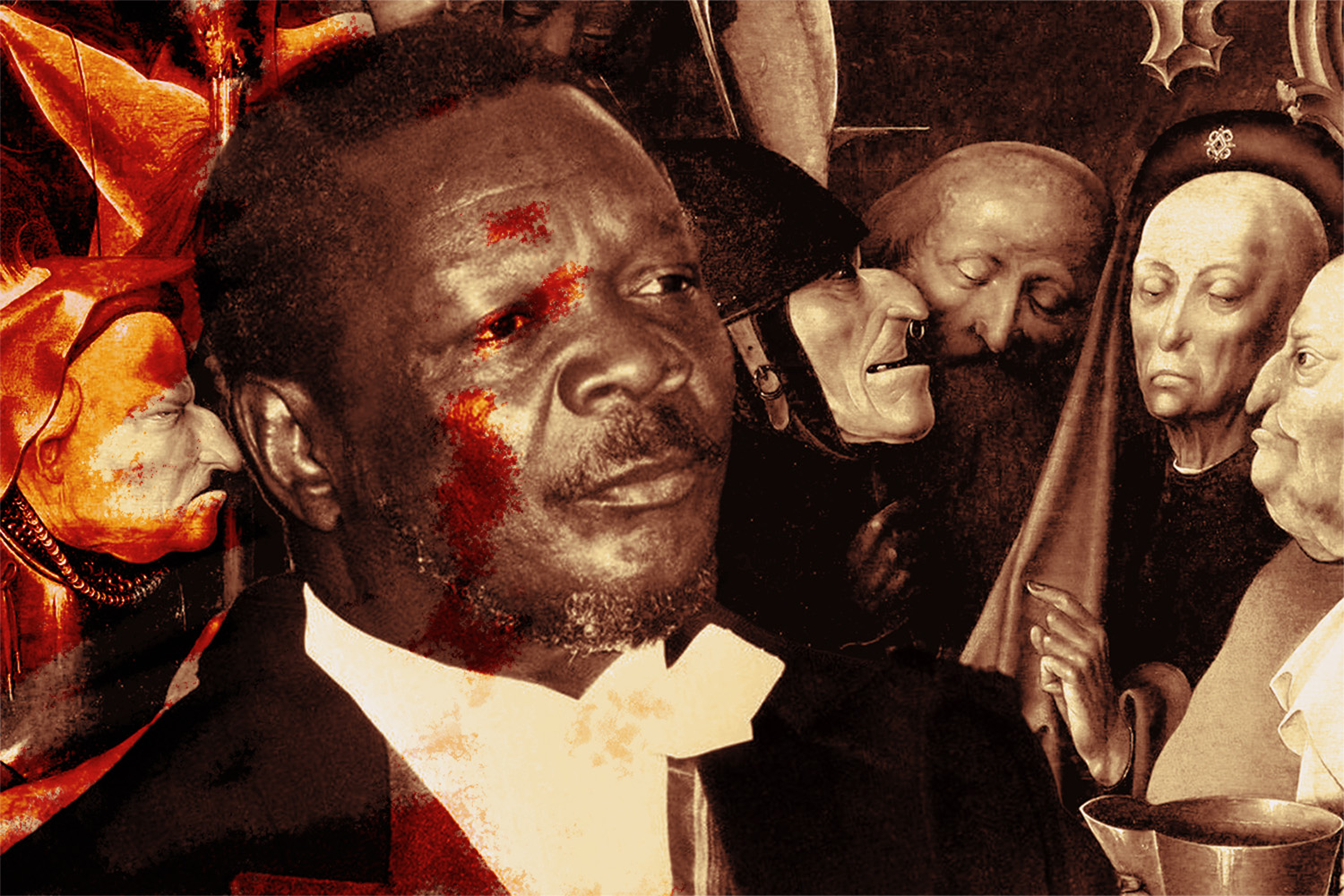
Hieronymus Bosch. Christ Before Pilate, 1516 / Art design: Olena Burdeina (FA_Photo) via Photoshop
ABOUT THE CANNIBAL FROM CENTRAL AFRICA
Jean-Bédel Bokassa earned his place among the top five tyrants who ruled at the end of the 20th century. Cruel, eccentric, a cannibal… His regime carried out mass killings, torture, looting, and more.
After declaring himself president, he abolished the country’s first constitution, calling it «a dead body that no longer represents the people». Then he renamed his state the Empire and crowned himself Emperor of Central Africa.
10 RULES OF JEAN-BÉDEL BOKASSA’S REGIME
RULE 1. BECOME A «REAL COLONEL»!
J
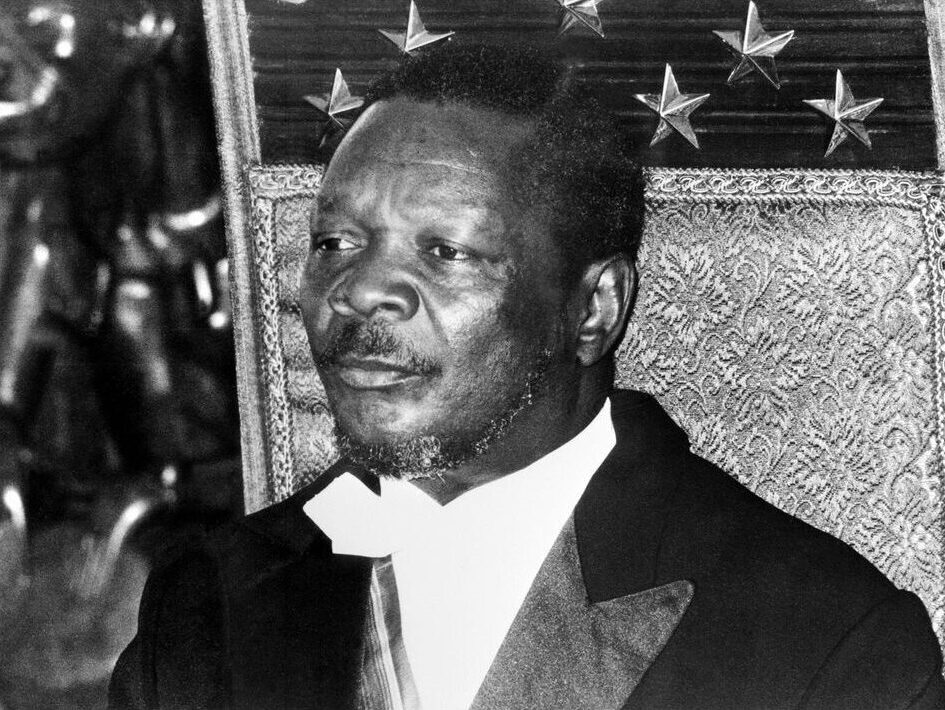
ean-Bédel Bokassa (1921–1996) was born into the family of a village chief in what was then part of French Equatorial Africa. Orphaned at the age of six, he received a French education at a Christian missionary school in Mbaïki.
Later, he studied at a school in the capital, Bangui, where he was expected to become a priest. But Bokassa likely had other plans. Following his grandfather’s advice, he seriously considered a military career as a means to climb to the top of the power ladder.
At 18, at the onset of World War II, Bokassa joined the French army. In 1944, he took part in the Allied landings in Provence. He later fought in Indochina and Algeria. He was awarded the Croix de Guerre and the Legion of Honour — France’s highest military distinction, established by Napoleon. He even received French citizenship.
In August 1960, on the ruins of the French colonial Empire, the Central African Republic (CAR) gained independence. It was one of the poorest countries in the world: fewer than 10% of the population could read and write, and over a quarter of all children died from disease and malnutrition.
It was in this country that Bokassa became the «real colonel» of the CAR army. He craved recognition and never missed a government event — always showing up adorned with every medal he had.
RULE 2. STAY CLOSE TO POWERFUL FAMILY MEMBERS!
Bokassa always made sure to stay close to the then-president of the CAR, emphasizing his personal ties to the head of state. Conveniently, this was easy to do: David Dacko was not only the president but also Bokassa’s cousin. Dacko had no remarkable achievements in state-building. Quite the opposite. Under his leadership, the country continued to spiral into economic ruin, and corruption thrived.
In need of external support, Dacko established diplomatic ties with Communist China and its leader, Mao Zedong, in 1964. Bokassa, by then the army’s chief of staff, was deeply displeased. He viewed this as a threat to the local elite’s power — and his own. The solution was simple: take control of the Central African government.

RULE 3. ERASE THE LINE BETWEEN YOUR OWN POCKET AND THE STATE BUDGET!
On New Year’s Eve, December 31, 1965, Bokassa gave his country one more «gift» — a military coup. He overthrew Dacko and, on January 1, 1966, declared himself President of the Republic. Over the next 14 years, Bokassa ruled the country single-handedly.
France, seeking to regain influence in its former colonies through «soft power», provided the dictator with military and economic aid. Early in his rule, Bokassa abolished the constitution and dissolved the National Assembly. By 1972, he had declared himself president for life.
The national economy, now solely focused on sustaining the dictator’s extravagant lifestyle, eventually collapsed. Bokassa actively exploited the country’s uranium and diamond resources, but all the profits went straight into his personal pocket.
He enjoyed attending public executions, deriving pleasure from them. Political opponents and aides suspected of disloyalty were executed in gruesome, brutal ways — some were fed to lions or crocodiles. Entire families were wiped out so that no one could seek revenge for the dead.
RULE 4. BE CREATIVE IN FINDING ENEMIES AND MONEY!
Bokassa’s rule plunged the country into a dark medieval era. His secret police eliminated anyone who failed to support the regime. In foreign policy, Bokassa became known for the inconsistency of his actions. Early in his rule, he severed diplomatic ties with China and expelled all «communist agents» from the country.
But just a few years later, he began cultivating friendly relations with socialist bloc countries — the Soviet Union, Yugoslavia, North Korea, Romania — convinced that France was not giving him enough money.
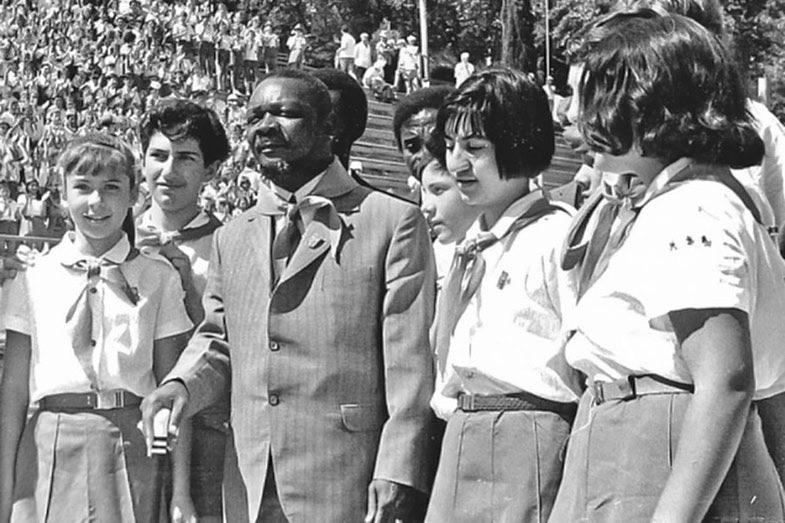
In June 1970, Bokassa visited the USSR for the first time on an official trip. He was particularly fond of the ritual of fraternal kisses with Leonid Brezhnev. Upon returning to the CAR, he adopted the habit of kissing his ministers — a ritual that became a kind of loyalty test… Anyone who kissed the dictator «without feeling» was deemed untrustworthy and swiftly sent to the afterlife.
In 1973, Bokassa visited the Soviet Union for the second time. In the Ukrainian Crimea, at the Artek children’s camp, he was ceremonially accepted into the Young Pioneers. However, while the USSR tried to steer the African dictator toward socialism, it was reluctant to part with its money. Still, after each friendly kiss with the communists, the size of financial aid from French capitalists predictably increased.
RULE 5. FOLLOW NAPOLEON’S EXAMPLE — BECOME AN EMPEROR!
Jean-Bédel Bokassa was obsessed with all things European — to such an extent that he decided to crown himself emperor, following in the footsteps of his idol, Napoleon Bonaparte. But to replicate Napoleon’s coronation down to the smallest detail, Bokassa needed money — a lot of it. Without any shame, he asked the then-president of France, Valéry Giscard d’Estaing, for funding. And d’Estaing agreed.
Why? Because the CAR supplied France with diamonds and uranium, both vital for the French nuclear industry. For the coronation ceremony, the entire staff — designers, craftsmen, and stage workers — was brought in from France. Bokassa turned to none other than a French company with a 200-year history that had once made garments for Napoleon’s coronation.
The cost of the «props» — the imperial crown, scepter, sword, and other regalia — was estimated at $5 million. The coronation as a whole cost $25 million. It took place on December 4, 1977.
From then on, Bokassa officially styled himself as the Emperor of Central Africa, and his country became the Central African Empire. Punishments took on an imperial scale as well: for theft, offenders had their ears cut off; for repeat offenses, their hands were chopped off.
RULE 6. BE GENEROUS TO THOSE WHO PAY YOU!
Bokassa established a personal monopoly over the extraction of diamonds and ivory, as well as coffee collection in Central Africa. He treated the state treasury as his private piggy bank. When the generous Chinese communists allocated funds for the construction of a university in the CAR, the Emperor of Central Africa used the money to buy a château in France.
In fact, he owned three more such châteaux. His friendship with French President d’Estaing was long-standing and strong.
In 1975, d’Estaing accepted Bokassa’s invitation to hunt in his private reserve. They spent a delightful time together in a game park covering most of the eastern half of the country. It was said that Bokassa enjoyed gifting his guests handfuls of diamonds.
A truly imperial gesture! Neither the giver nor the receiver seemed to consider that the proceeds from selling just one of those diamonds could have gone toward feeding a nation that lived beyond the edge of poverty.

RULE 7. IF YOU LOVE — KILL AND EAT!
«Sweet pork» — that’s what Bokassa called human flesh. On every trip, he made sure to bring along cans of this very «pork». He even treated his ministers to it. On one occasion, the «delicacy» served at a cabinet meeting turned out to be one of their own colleagues — someone who had recently shared the table with them.
Apparently, Bokassa had taken offense at something the minister had said. The cabinet members had no idea what — or rather, who — they were eating. Only at the end of the banquet did Bokassa reveal what they had just tasted and where the missing minister had gone.
His love of «sweet pork» reportedly began with a love affair — the dictator’s first culinary victim was his own beloved. It’s a common cliché: a man, overwhelmed by affection, says to his sweetheart, «You’re so sweet — I could just eat you up!» Bokassa took that literally.
First, he personally strangled the woman. Then he ordered her to be prepared as «sweet pork» — a dish he thoroughly enjoyed. And from that point on, he acquired a taste for it.

RULE 8. STRIVE TO LOVE ALL THE WOMEN IN THE WORLD!
Bokassa often declared his deep love for women — and he backed up his words with actions. He had 19 official wives. One of them, named Catherine, he made Empress and referred to as Wife Number One.
As a lover, he was insatiable. The names of his countless concubines — likely numbering in the hundreds, if not thousands — were impossible for him to remember. Since he collected them from all over the world, he simply called them by their nationality: the German, the Belgian, the Cameroonian, the Chinese, the Gabonese, the Tunisian, the Ivorian…
There was even one Romanian — an agent of the Securitate secret police. She began an affair with Bokassa on the orders of Ceaușescu, who, like Valéry Giscard d’Estaing, had a keen interest in Bokassa’s diamonds.
RULE 9. DON’T SHY AWAY FROM MASSACRING CHILDREN!
Within two years of his extravagant coronation, Bokassa had become highly toxic for Paris. Associating with him became a disgrace. Discontent with his regime was mounting. To make matters worse, Bokassa decided to turn his capital into a showcase of French provincial fashion.
He ordered the students of Bangui’s only secondary school to wear expensive school uniforms — even though their parents couldn’t afford basic school supplies. Notably, the only textile factory producing these uniforms belonged to Bokassa.

This abuse of students and their families brought thousands of protesters into the streets. Two hundred schoolchildren were arrested by the «Imperial Guard» for refusing to comply with the order. Bokassa gathered them in the courtyard of Bangui prison and, waving a cane with a golden handle, threatened them with execution. The killings of children continued for several weeks.
One by one, they were taken from their cells for «uniform inspections» and then beaten to death. According to reports, Bokassa personally crushed the skulls of at least five children with his cane. These mass killings could no longer be ignored by officials at the French embassy in Bangui… It became clear that Bokassa’s regime was living on borrowed time.
RULE 10. LOSING POWER IS NOT THE END OF LIFE
When Bokassa traveled to Libya to meet with his new «friend» Muammar Gaddafi, Valéry Giscard d’Estaing ordered French paratroopers to bring his regime to an end.
On September 20, 1979, they carried out a bloodless coup in the CAR. The operation was called «Barracuda». Bokassa’s troops offered no resistance. As a result, after 14 years, Bokassa’s cousin David Dacko regained the presidency, and the country returned to its former name — the Central African Republic.
The French confiscated all of Bokassa’s assets, and Dacko nationalized his businesses. Yet the cannibal emperor, one might say, got lucky: he first fled to Côte d’Ivoire and later moved to France — to one of his châteaux near Paris…
There were rumors that Bokassa had compromising material on the French president and tried to blackmail him. Perhaps that’s why the French left him alone — but made sure he didn’t wander too far.

TRIAL AND POSTHUMOUS REHABILITATION
In 1980, Bokassa was tried in absentia and sentenced to death with confiscation of property. He was charged with 13 serious crimes, including murder, cannibalism, rape, and embezzlement of state funds…
After seven years in exile, Bokassa returned to the CAR and stood trial in Bangui. The charges of cannibalism were dropped, but he was found guilty of the mass murder of children and other crimes… In 1993, the dictator was unexpectedly pardoned. Upon his release from prison, he declared himself the thirteenth apostle of Christ.
Bokassa died in 1996 in Bangui of a heart attack at the age of 75. In 2010, the country’s leadership issued a statement declaring his posthumous «full rehabilitation». And so, yet another dictator, cannibal, and murderer lived a long life without ever facing true justice for his horrific crimes.
10 LAWS OF TYRANNY: Nicolae Ceaușescu of Romania
When copying materials, please place an active link to www.huxley.media
Select the text and press Ctrl + Enter


