CHERNIVTSI UNIVERSITY — THE EMBODIMENT OF BEAUTY AND QUALITY

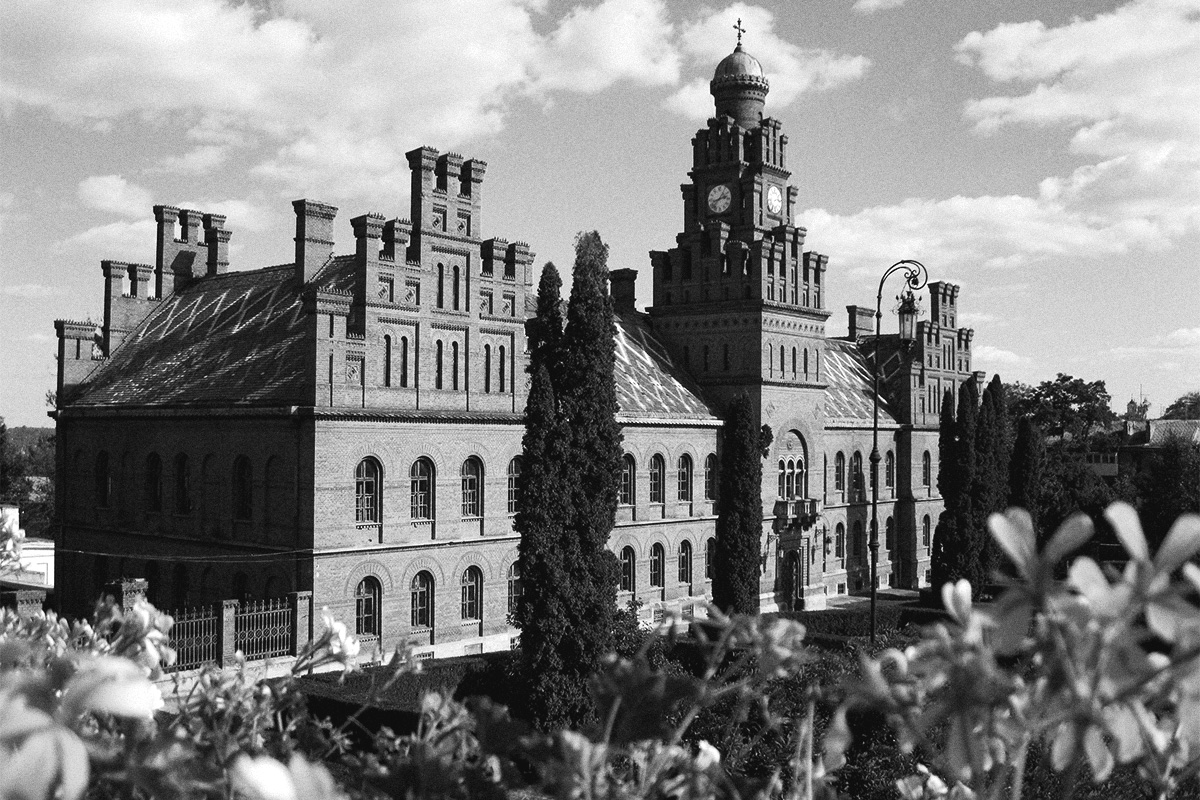
Yuriy Fedkovych Chernivtsi National University / Photo from a personal archive
When speaking about the most magnificent places in Chernivtsi — those that quite literally take your breath away — one inevitably thinks first of Yuriy Fedkovych Chernivtsi National University. It is one of the oldest and most beautiful universities in Ukraine, and moreover, the only university in the country included on the UNESCO World Heritage List (since June 2011). In the 1860s and 1870s, several cities of Austria-Hungary competed for the honor of being named a university city: Salzburg, Trieste, Brno, Ljubljana, and Olomouc. But, as they say, the strongest prevailed — our Chernivtsi, then the unofficial capital of Europe.
PROFESSOR TOMASHCHUK’S PROPOSAL
A native of Bukovina, deputy of the Bukovinian Regional Diet and the Austrian Parliament, Doctor of Law, and Professor Kostiantyn Tomashchuk, at the session of November 28, 1872, put forward and substantiated a proposal to establish a university in Chernivtsi. Such a step, he argued, would raise the authority of Austria-Hungary in this region. Tomashchuk’s opinion was heard, and the Bukovinian Diet appealed to the government with a request, in the interests of the state, to support the creation of a university in the city. This became the first step toward success. And on March 31, 1875, Emperor Franz Joseph I of Austria signed a decree establishing a university in Chernivtsi with a Greek Orthodox Faculty of Theology — the only Orthodox faculty in Austria-Hungary. And finally came the landmark date: October 4, 1875 — the ceremonial opening of the university, which received the name “The Franz Joseph Imperial and Royal University of Chernivtsi”. The occasion was timed to mark the 100th anniversary of Bukovina joining Austria-Hungary.
THE FIRST FACULTIES, THE FIRST STUDENTS
At first, three faculties were opened: Theology, Philosophy, and Law. The first rector became the above-mentioned Professor Kostiantyn Tomashchuk. By law, German was designated as the language of instruction for all disciplines. At the same time, however, theology students studied the poetry of Ivan Kotliarevsky and Old Church Slavonic grammar, while the Department of Eastern European History taught the history of Ukraine. The course of study lasted four years and required tuition fees; moreover, students also had to pay for taking and retaking examinations. Interestingly, obtaining a diploma was not free either. In 1875, there were 41 Ukrainians among the 208 students. By 1914, out of 1,198 students, 303 were Ukrainians, and approximately the same number were Romanians. The largest groups were Jews and Germans. Only in 1899 were women granted the right to enroll at Yuriy Fedkovych Chernivtsi National University. At first, there were only four female students, but ten years later, in 1909, their number had already reached 75.
NOTHING BUT BEAUTY!
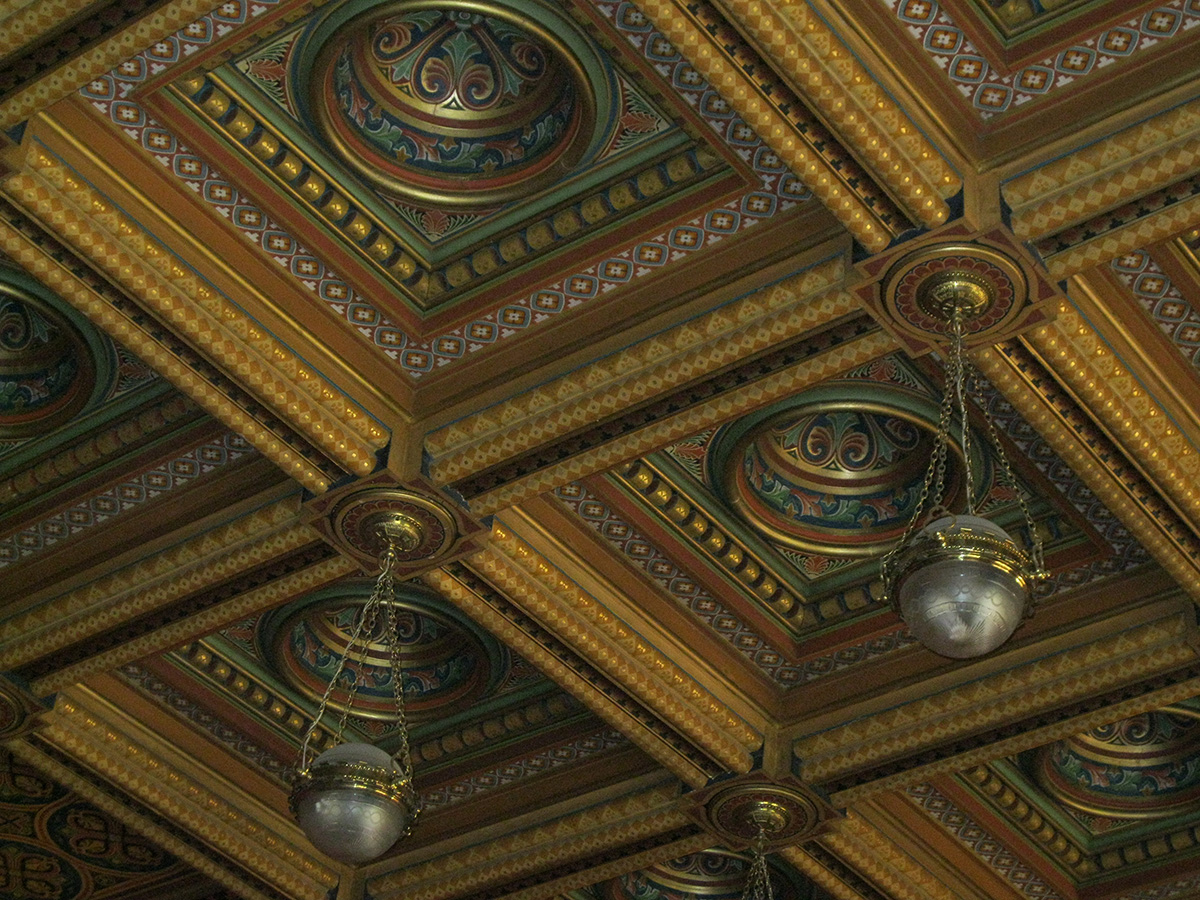
The university was housed in the former Residence of the Metropolitans of Bukovina and Dalmatia, built on Habsburg Hill. And this is not merely a pearl of architecture — it is truly a masterpiece. Architectural experts will confirm that there are very few architectural ensembles of such perfection within our country. Naturally, this did not go unnoticed by UNESCO. The terracotta complex, with its towers and stone carvings, was built over nearly twenty years (1864–1882). It combines various architectural styles — Byzantine elements and Romanesque solidity, Gothic features, and Moorish ornamentation. The ornamental patterns of the colorful glazed roof tiles are already closer to the traditions of national art. Likewise, the interior decoration of the complex unites Bukovinian motifs with the pomp of Chinese silk, Venetian mirrors, and multicolored marble. Yuriy Fedkovych Chernivtsi National University is at once an alma mater and an extraordinarily popular tourist attraction. And understandably so — such beauty cannot be hidden!
THE INITIATOR OF THE COMPLEX’S CONSTRUCTION
The initiator behind the creation of this majestic complex was the then Bishop of Bukovina, Yevhenii Hakman. He devotedly promoted the spread of the Orthodox faith in the region and also made significant efforts toward the establishment of the Bukovinian Metropolis. Thanks to his petitions, Emperor Franz Joseph I of Austria approved the construction of the residence in 1863. Hakman also had the honor of laying the foundation stone of the Chapel of Saint John the New of Suceava — the first building of the future ensemble. The total cost of construction amounted to approximately 2 million gold florins. Most of the funding was provided by the Bukovinian Orthodox Religious Fund, while the Austrian government and other religious communities of the city also contributed. In particular, as a gesture of gratitude for the contribution of the Jewish community, the tower of one of the ensemble’s buildings was decorated with a crown of Stars of David.
ARCHITECT JOSEF HLÁVKA
The project was carried out by the renowned Czech architect, philanthropist, and first president of the Czech Academy of Sciences and Arts, Josef Hlávka (the author of the design for the Vienna State Opera building). He set himself the goal of using exclusively local materials for the construction of the complex. During the works, he conducted extensive surveys of local natural resources, established ceramic and brick factories, and organized large-scale training for local stonemasons. And the quality control was beyond anything one could imagine! Every single brick was tested for quality by being dropped from a height of twenty meters. To ensure the durability of the brickwork, Hlávka invited thirty of the best masons from the western regions of Austria, but they were forbidden to lay more than one hundred bricks per shift. The mortar was prepared according to an old recipe, with the addition of chicken eggs and specific decomposition products of domestic animals.
Overall, the complex is clearly planned and laconic in style, resembling a medieval castle in its structure. Its courtyard is enclosed on three sides by buildings forming a ceremonial cour d’honneur. At the same time as the residence, a unique dendrological park was designed, filled with a variety of botanical wonders and decorative elements. The interior decoration of the complex’s buildings was created by renowned Bukovinian, Austrian, and Czech artists. Yuriy Fedkovych Chernivtsi National University became one of the finest examples of Habsburg-era architecture — perhaps the very best on the territory of Bukovina.
A FEW MORE INTERESTING DETAILS
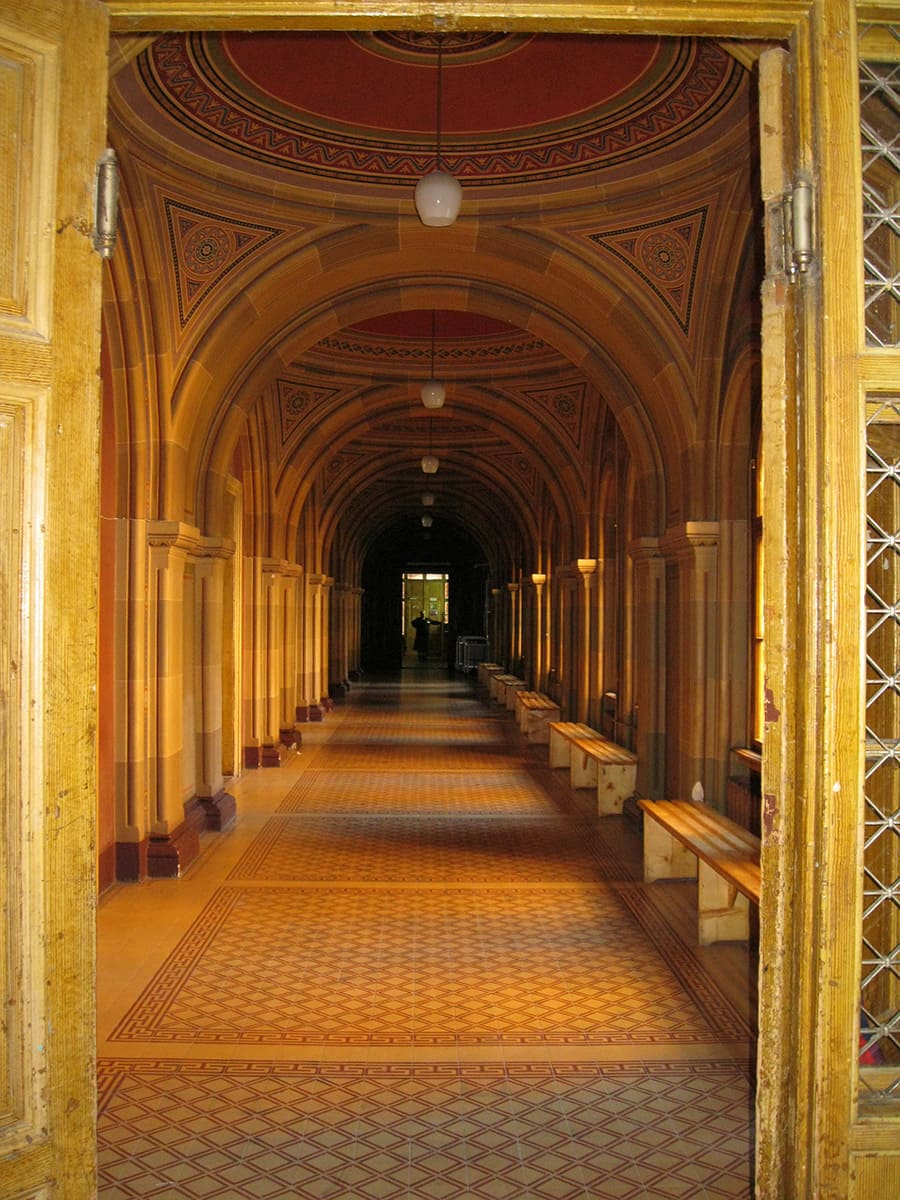
According to legend, the cross on the spire rising above the center of the residence points west for Catholics and east for the Orthodox. The most famous halls of the main building are the Marble Hall, the Red Hall, the Green Hall, and the Blue Hall. The most remarkable hall of the former Residence of the Metropolitans of Bukovina and Dalmatia is the Red Hall: its walls are adorned with Chinese silk, the ceiling is decorated with exquisite ornaments, and the floor is covered with parquet made of red beech, oak, and linden wood.
THE END OF THE EMPIRE AND OUR TIME
After the collapse of the Austria-Hungary in 1918 and the annexation of Northern Bukovina by the Kingdom of Romania, the university was considered a Romanian institution of higher education until 1940. In 1989, the university was named after the outstanding Bukovinian writer Yuriy Fedkovych. Eleven years later, on September 11, 2000, by decree of the President of Ukraine Leonid Kuchma, Yuriy Fedkovych Chernivtsi National University was granted national status. Among the university’s students at various times were writers Ivan Franko (in 1890–1891) and Denys Lukiyanovych, as well as linguists Oleksandr Kolessa and Yulian Kobyliansky, the brother of writer Olha Kobylianska. Lesya Ukrainka, Mykhailo Drahomanov, and Volodymyr Vynnychenko also visited the university in Chernivtsi. Times and political systems changed, empires fragmented, and new states emerged. Yet Yuriy Fedkovych Chernivtsi National University has preserved its status through every regime and under every ruler.
When copying materials, please place an active link to www.huxley.media
Select the text and press Ctrl + Enter