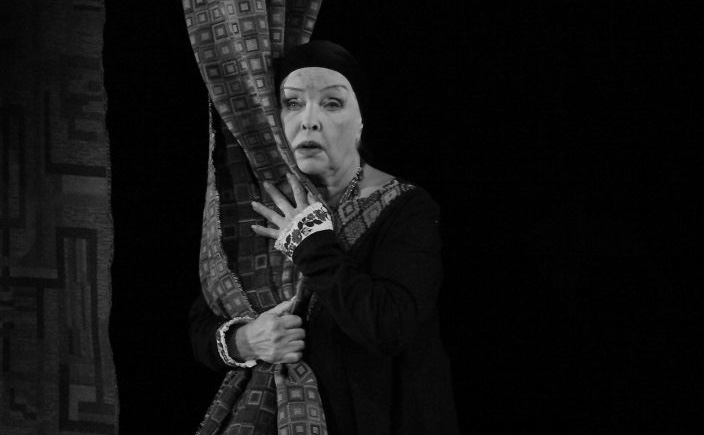
CONDUCTOR HALYNA SHPAK: the choir as a mirror of time


Halyna Shpak / Photo from personal archive
SHORT PROFILE
Name: Halyna Shpak
Date of Birth: June 16, 1964
Place of Birth: Odesa, Ukraine
Profession: choir conductor, lecturer in theoretical disciplines
Choral singing has always been something more than art: it became a model of society, a way to teach people to hear one another and to create harmony even out of diverse voices. Where words are not enough to contain feelings, polyphony begins, dissolving the personal «I» and giving birth to a new «we». In the Soviet era, the choir had a special mission. It was a symbol of the collective spirit, where the individual dissolved into the whole, submitting to the rhythm of the country’s single voice.
Today, the reality is different. The choir is no longer an instrument of ideology, but it has preserved its essence: to be a space where people and meanings meet. About the choir’s journey from past to present, its significance for education and culture, and about today’s students, spoke Halyna Shpak, conductor and head of the choir of the Odesa National Music Academy named after O. V. Nezhdanova.
CHOIR AND SOCIETY: PAST, PRESENT, FUTURE
Svitlana Pavlyanchyna: Why does choral art in Ukraine, and especially in Odesa, face difficulties with popularization? Are the roots of this problem in the legacy of the past, in the absence of a new cultural policy, or in the audience itself?
Halyna Shpak: This is indeed largely the legacy of the Soviet era. Back then, the choir was primarily an instrument of ideology: we sang about the Party, about Lenin, about the «bright future.» And, of course, for many people, this left a taste of formality. After 1991, unfortunately, we did not manage to redirect the public’s attention in time; we did not create a new image of the choir as an art of freedom and spiritual experience. In Europe, the situation is completely different: there, the choir is art number one, choral festivals gather full halls, and the audience is brought up on the tradition of collective singing. Here, the culture of the listener is only just beginning to form.
S. P.: The choir today is…
H. Sh.: The choir is certainly no longer the voice of the system. Today it is changing. It is becoming alive, free, and closer to true art. Chamber choirs of up to 20 people mean intimacy and subtlety, while large choirs of 50 or more embody power and scale. In school ensembles, sometimes dozens of children sing — and this too is priceless: every child learns to be part of harmony. This is the essence of the choir: no matter how many people stand on stage, it is always an experience of shaping personality and nurturing harmony.
S. P.: Choral art has always relied on people’s enthusiasm. Today, without systemic support, it seems to go against the current. How do you see its future?
H. Sh.: Believing in the future is not easy. The choir is not only a matter of funding or administrative support. The choir lives in people. As long as children’s voices sound in schools, as long as students sing and conduct, as long as there are teachers who devote themselves to this work, the tradition will continue. Of course, systemic support is very important: scholarships, international projects, exchanges — all of this could help retain talent and open new horizons. But even without it, the choir has always found its way: through enthusiasm, through love of music, through the inner need of people to be together.
After all, the choir for us is the DNA of the nation. Anyone can sing in a choir: amateurs who gather in their free time, children in schools, students in universities. This has always been the case, and I am sure it always will be. I remember how school principals used to insist: «There must be a choir in the school». Even if it was just one or two voices, the most important thing was singing together. A song performed together binds people more strongly than any words.
Today, unfortunately, young conductors lack practice more than ever. In many schools, preference is given to solo or pop singing. But the choir has a completely different value. It nurtures a sense of community, the ability to listen to one another, and the capacity to be part of a whole. This is not only about music — it is about humanity. I have seen how even those children who struggle to hit the notes, who «draw» with their voices instead of singing correctly, eventually open up and find their melody. They became so attached to the choir, to the teacher, to their friends in the ensemble that it created a warm and profound bond. The choir often becomes the heart of the school.
The voice of the Ukrainian choir, of course, will not disappear. Because music is not only for musicians, it is for everyone. It gives inspiration, sometimes even the meaning of life. And anyone who has ever sung in a choir knows: this thread between people will never be broken.

CHOIR AS ART: REPERTOIRE, VOICES, EXPERIMENTS
S. P.: What is the life of a student choir like today? How do you choose the repertoire, and what is closer to the students themselves — classics or contemporary experiments?
H. Sh.: The life of a student choir is always dynamic: every year, some leave, others join, and the ensemble renews itself like a living organism that is constantly changing. Our repertoire is primarily classical: Mozart, Bach, Brahms. But classics do not reveal themselves to young people immediately — one has to grow into them.
Students also enjoy trying contemporary music and cross-genre experiments. Sometimes we add movement, light, candles, elements of theatricality — and the choir becomes even closer to the audience. But the foundation remains the same: the academic school, tested by time.
You know, musical preferences reflect the path of the students’ inner maturation. At first, they are drawn to simpler forms — light, bright ones. And then comes the realization: the simpler the music, the harder it is to perform. That is when they begin to truly appreciate the classics.
S. P.: Can we say that voices sound different in various regions of Ukraine? Do singers have a special vocal coloring that depends on the environment in which they grew up?
H. Sh.: There are indeed particularities, that’s true. Southern voices are broad, deep, with a powerful range. Western ones are bright and delicate, especially the sopranos. This reflects nature itself: the steppe, the sea, or the mountains shape the timbre. But of course, it also depends on the environment in which a child grows up.
S. P.: Which voices are in short supply now? The ones that sound especially vivid and unique, but are becoming increasingly rare?
H. Sh.: Very fine high sopranos and true low altos. There are a few of them, which makes them especially valuable.
S. P.: How does choral conducting differ from symphonic conducting?
H. Sh.: Choral conductors work with a choir, symphonic conductors — with an orchestra. But many of our students continue their studies and master both directions. This gives them a broad grasp of musical material.

CHOIR AND THE PERSON: EDUCATION, PERSONAL STORIES, THE POWER OF POLYPHONY
S. P.: What is most important for you in choral singing? What strength does it give to children and young musicians in their upbringing, development, and human experience?
H. Sh.: The choir is a model of an ideal society. Everyone is equal, yet everyone matters. It is a collective effort that nurtures humanity and compassion. Even children without a sense of pitch gradually get involved, develop, and become deeply devoted to music. And leadership here is organic: a person learns to work in a team, while also showing personal initiative.
S. P.: How does the choir influence children?
H. Sh.: The choir has a tremendous impact. Choral singing shapes values, nurtures harmony, and kindness. A child who sings in a choir grows up to be a more sensitive person, able to hear both themselves and others. That is why it is so important to preserve the system of choral education not only in music schools but also in regular general education schools. When a school has a choir, children learn not only music — they learn responsibility and mutual understanding. It is a unique school of life. And I would very much like this tradition, which once existed, to return: it gives children much more than it may seem at first glance.
People who went through choir in childhood are more likely to remain connected to it. It supports them throughout life. For example, my acquaintance Pasha, a surgeon from our 20th clinic in Tairova. When he was a boy, he studied at the first choral school in Ukraine named after Stefan Klymentiyovych Kryzhanovsky. He graduated, but chose not music, but rather medicine. He became a surgeon. And yet the love for choral singing stayed with him. To this day, he sings in church, in the choir.
Recently, Pasha told me: «Imagine, I come home from work completely exhausted — patients all day, surgeries, fatigue. But as soon as I stand in the choir and begin to sing — a second wind opens up. It feels as if I come alive again». This is the power of the choir: even if music did not become a profession, the choir remains with a person, gives them strength, inspiration, and brings them back to life.

CHOIR AND ODESA: THE CITY’S CULTURAL SCENE
S. P.: Halyna, do you think your student choir is an educational ensemble or a full-fledged participant in the city’s cultural life? What is the choir’s place in Odesa today?
H. Sh.: In fact, our student choir fulfills the functions of a professional ensemble. We regularly perform in the Philharmonic Hall, in the Literary Museum, and in the city’s churches. We have annual Christmas and Easter concerts, conducted both by teachers and by students. This gives them the chance to show themselves not only as singers but also as future conductors. However, unfortunately, we organize all the concerts ourselves — and this reflects the reality of choral art today.
The choir gives people what they especially lack — a sense of hope. Sadly, nowadays almost everyone lives under the weight of their own anxieties, and choral singing becomes a kind of support. People come to the student choir’s concerts precisely for this feeling of living energy: the youth, sincerity, and openness of our students create an atmosphere that cannot be imitated. This is the special quality of a student choir — it resonates in the souls of listeners.
S. P.: Could a choir be born in Odesa that would represent the city?
H. Sh.: Theoretically, yes. Odesa has all the prerequisites for the emergence of a choir that could represent the city at a high level. After all, a major event is already held here — the All-Ukrainian Festival-Competition of Choir Ensembles in memory of K. K. Pigrov. This competition brings together dozens of ensembles from all over the country, creating a vibrant atmosphere of competition and exchange of experience.

CHOIR AND THE ACADEMY: THE EDUCATION SYSTEM AND STUDENTS
S. P.: Today, you lead the choir yourself. How is the department organized, and who are your students?
H. Sh.: I teach at the Department of Choral Conducting, where every student is required to sing in the choir and master the profession of conductor. Right now, we have 55 students: four years of the bachelor’s program and one and a half years of the master’s program. On average, about ten students per year. We have international students from China, and we’ve also had students from Argentina and Venezuela. Usually, they come to study with a specific teacher. Some are drawn by Odesa itself — the sea, the atmosphere, the warmth of the people.
S. P.: How has the entrance competition changed over the years, and how strict is the selection today?
H. Sh.: In the 1980s, the competition was 3–4 applicants per place. Now it is smaller, but the state-funded places are filled. For example, there are 11 students for 8 state-funded places — some pay for their studies.
S. P.: And is there competition between conservatories in Ukraine today?
H. Sh.: We have five main centers: Kyiv, Lviv, Odesa, Dnipro, and Kharkiv. Kyiv is a magnet — students come there from all over the country. But Odesa also carries weight: our graduates work in music colleges across Ukraine and often send their students to us.
S. P.: How important are international contacts? Do you invite teachers and masters from other countries?
H. Sh.: They are of enormous value. Guest masters inspire students and bring new knowledge. Now, during the war, many are afraid to come here. Of course, we would be delighted to welcome colleagues from Lithuania, Latvia, and Moldova — it all depends on their personal attitude and readiness to work in difficult conditions. But there are also worthy conductors here in Ukraine.
S. P.: A choir is not only voices, but also destinies. Does it ever happen that someone seems formally suitable, but later it turns out they are just a passing guest in the profession?
H. Sh.: Yes, sometimes it seems a student fits, we accept them, and later it becomes clear that they do not. A choir is like a living organism: one voice can give strength to its breath, another can disrupt its balance. In the past, exams were very strict — they included solfeggio and harmony. These subjects were removed, and I believe that was a mistake. They provided a solid foundation: they shaped the ear, developed musical thinking, taught one to think in sounds, not just repeat them. If I had the opportunity, I would gladly bring these disciplines back, because everything else is built on this base. But for now, it is not feasible.
S. P.: How do you determine the potential of students? Who among them is capable of becoming a leader?
H. Sh.: Ambitious students are noticeable right away. Sometimes this even comes across as aggression — not malicious, but defensive. Our task is to channel it into creation. There are students who are «gifted from above»: they come with a cultural background, upbringing, and experience. Such students are easy to distinguish — they strive for leadership gently, with intelligence.
S. P.: Do students fear that in the choir their individuality will dissolve and their voice will be lost among the others?
H. Sh.: On the contrary, it becomes stronger. Many students are initially afraid that their voice will «dissolve», but gradually they realize that it becomes part of the harmony, and this gives it strength.
S. P.: How do students learn to hear themselves in the choir?
H. Sh.: Beginners often sing «from the throat», exaggeratedly, trying to push through the choir. But we explain: in a choir, it is important not to stand out, but to blend in. Four parts must sound as one voice. Individuality is revealed in solo parts, and that requires hard work in vocal lessons.

CHOIR AND THE CONDUCTOR: HALYNA SHPAK’S PERSONAL JOURNEY
S. P.: Halyna, you yourself joined the choir at a very young age — what was it like? What did it mean for you to sing together with senior students when the college and conservatory were merged?
H. Sh.: Yes, I entered college in 1979, I was only 15, and in 1984, I was already in the conservatory. It was an incredible experience: we, teenagers, sang in one choir with conservatory students who were already 22–24 years old. The age difference was palpable, but it was precisely what made the atmosphere so special. It felt like a great school of life: like younger pupils and seniors in one family. The older students explained and showed us how music is born, how to work with text, and how to breathe. For me, it was a divine feeling of belonging to something greater.
S. P.: Are your children also connected to music?
H. Sh.: Both of my sons graduated from music school in violin. They chose other professions — one became a sailor, the other an IT specialist. But music is always with them: the younger one plays guitar, the older one listens to classical music. I am sure that musical education is never in vain.
S. P.: What is a happy concert for you?
H. Sh.: For me, a happy concert is when the choir and the audience unite in a single breath, when they sing «with one heart». In such moments, music becomes a state of absolute harmony. That was the case at the last concert with Liudmyla Monastyrska and Vitalii Bilyi: the hall and the choir seemed to dissolve into each other, and it was a true miracle.
P.S. After speaking with Halyna Shpak, I caught myself thinking: a choir is not just a musical ensemble. It is the breath of the city, its memory, and perhaps its future. Odesa has always known how to give birth to talent, and a choir can become its living symbol — unifying, inspiring, giving strength and hope. In such moments, you realize: the city needs its own choir, one that will sound like the city itself — free, polyphonic, unique.
When copying materials, please place an active link to www.huxley.media
Select the text and press Ctrl + Enter