IS IT A PALACE OR A FORTRESS: The Estate of Count Ksido in Khmilnyk


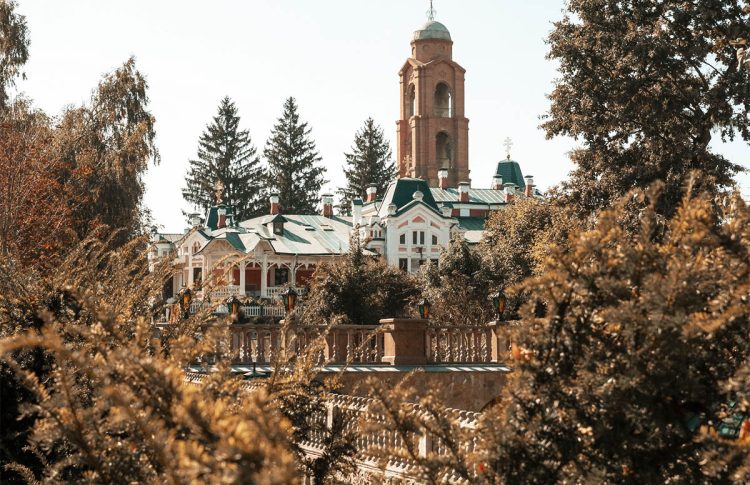
Count Ksido’s Palace, view from the tower side / wikipedia.org
Where to find Count Ksido’s castle?.. In Khmilnyk — a small town nestled in the picturesque valley of the Southern Bug, one of the oldest cities in Ukraine, located 60 kilometers northwest of Vinnytsia. It’s also a resort town known for its radon waters…
The first written mention of Khmilnyk dates back to 1362. That was when Lithuanian Prince Olgerd captured the town after a fierce battle with the Tatars, referred to in one chronicle as the «ancestors and inheritors of the land of Podillia».
According to local legend, the people who lived on the island — the site of the old town — frequently repelled Tatar hordes and other invaders. The island was densely covered with wild hops, providing a perfect natural shelter for the locals, a kind of natural fortress.
In the mid-15th century, Khmilnyk came under the rule of Lithuanian princes and later became part of Poland. In 1534, Hetman Jan Amor Tarnowski (best known as the founder of Ternopil in 1540) grew tired of the constant visits from uninvited guests and surrounded the entire town with a stone wall and towers.
TEMPORARY VICTORIES OF THE COSSACKS
I
n the Wild Fields of that time, the Ukrainian Cossack movement was gaining strength: in 1594, Khmilnyk was seized by the troops of Severyn Nalyvaiko, and 43 years later, Pavlo But, nicknamed Pavliuk, stormed into the town. “Both scythes and sickles were forged into weapons, and the earth trembled for a reason — the Cossacks shook the Poles,” reads a passage from the Khmilnyk Chronicle dated 1637.
But the same chronicle goes on to describe the brutal punishment the Polish authorities were preparing for the Cossacks. The Cossacks regained control of the town again in 1659 when it became the residence of Hetman Ivan Vyhovskyi. It was during the Cossack era that an archaeological discovery was made in Khmilnyk in August 2003, when municipal workers unearthed underground aqueducts built between the 15th and 17th centuries. The ingenuity of the ancient builders deeply impressed archaeologists.
TURKISH TIMES IN KHMILNYK
In 1672, Khmilnyk fell under Turkish control. Podillia became another province of the Sublime Porte (a metaphorical name for the Ottoman Empire) for a full 27 years. The Janissaries immediately began reinforcing the castle and constructing a mosque. This is how the city came to have an octagonal structure with walls one and a half meters thick, equipped with loopholes.
It is said that underground passages were dug between the castle and the mosque, as well as between the guard posts… After the Turks, the Poles returned, and a century later, the town became part of the Russian Empire. Even the emergence of industry (a potash plant, saltpeter, and glass factories) couldn’t save it. The town barely survived.
As for the castle… Having lost its strategic importance, it gradually fell into ruin. But the old Turkish mosque has survived to this day. In 1976, a historical museum was opened in the tower that had served as a minaret during the Turkish period.

IS IT A PALACE OR A FORTRESS?
Towering gloomily above the island on a high rocky bank stands the castle of Count Ksido, who was an aide-de-camp to General Anatoly Stessel (best known for surrendering Port Arthur during the Russo-Japanese War of 1904–1905). The hill, known as Castle Hill, was manually built up by peasants in the 14th century as a defensive fortress against Tatar raids.
The prototype for the future structure was a Lithuanian defensive castle. The estate of Count Ksido is one of the most original buildings in Khmilnyk. It was constructed between 1911 and 1915 according to the design of architect Ivan Fomin. The castle blends architectural styles from various eras. When viewed from different angles, it’s hard to believe it’s a single building.
From the river side, it appears to be a Renaissance-style castle with corner towers (essentially a fortress), while the main façade with its colonnade above the entrance reflects classicism — the style of a noble manor with white columns and balconies. Two facades in completely different styles and no rear side at all — this is what sets the Ksido castle apart from all other structures in the Vinnytsia region. Neo-Renaissance and Neoclassicism combined in one building — there is nothing else like it in Ukraine.

THE HANDSOME LADIES’ MAN, COUNT KSIDO
And who exactly was Count Kostyantyn Ivanovych Ksido? What do we actually know about him? A handsome and intelligent man, Greek by origin, a Russian nobleman and officer, Kostyantyn Ksido arrived in Khmilnyk at the end of the 19th century to serve in the battalion of the Kazan Infantry Regiment, tasked with suppressing the rebellion led by Ustym Karmelyuk.
In addition to his military duties, Ksido also published books on geography and was a regular presence at society balls, where he spun more than one young lady’s head with his charm and fashionable hats. Women adored him, though rumors swirled: he was said to be a true gigolo. He might have remained a mere army officer if not for a stroke of luck. It was a tip from writer Ivan Bunin (who at the time was serving nearby, in Letychiv) that helped him put his popularity with society beauties behind him — he suggested Ksido pay attention to a wealthy woman.
So Ksido proposed to the already middle-aged Countess Kateryna Volodymyrivna Levashova. She was, as people said, “terribly unattractive” and, to make matters worse, deaf and mute. But her father, Count Levashov, was considered the wealthiest landowner in Khmilnyk at the time.
Naturally, the countess had a lavish dowry — 28 nearby villages, not counting properties in Khmilnyk itself, a sugar factory in the Podillia province, and significant financial assets. Ksido, of course, was delighted with such gifts, including the noble title, and repaid her with marital loyalty. The couple had no children…

THE LATER FATE OF THE COUNT AND HIS CASTLE
With the money he acquired, he began building a family castle in 1911. But in 1915, construction was halted due to World War I. As for the final design — it remains a mystery to this day. It must be said that Count Ksido wasn’t particularly invested in the construction; the Khmilnyk residence was merely a summer retreat for him.
He lived mainly in St. Petersburg, and after the revolution, he emigrated to the West… Rumor has it that he returned to Khmilnyk only once — in 1943. He supposedly came from Czechoslovakia. He wandered through his old castle and met with his former servant, Dmytro… Over the years of Soviet rule, his ancestral home housed all sorts of things: agricultural courses, an electrotechnical school, warehouses, a mill, and even the NKVD headquarters. Since 1964, Count Ksido’s palace has functioned as a city hotel.
KHMILNYK IS A RENOWNED RESORT
Khmilnyk is also the most famous balneological resort of the Ukrainian lowlands. A turning point in its history came in 1934 when a hydrogeological expedition was invited to search for drinking water — and unexpectedly, at a depth of 65 meters, they discovered not potable water but healing radon water.
Khmilnyk’s water contains a complex chemical mix: radium, radon, potassium, nitrogen, magnesium, iron, manganese, iodine, sodium, chlorine, bromine, and cobalt — along with carbon dioxide and bicarbonate. It holds 5.3 grams of mineral salts per liter! There are no other deposits like it in Ukraine, so in 1936, scientists from the Ukrainian Research Institute of Balneology and Physiotherapy developed the first treatment indications for radon therapy — primarily for musculoskeletal disorders.
The high radon content also allows for the treatment of nervous system conditions, cardiovascular diseases, rheumatism, and other ailments. Today, Khmilnyk is a resort, and the Ksido Castle is one of the highlights of its cultural offerings.
When copying materials, please place an active link to www.huxley.media
Select the text and press Ctrl + Enter