MONOPOLY ON KNOWLEDGE: How Plunder Became the Engine of Science

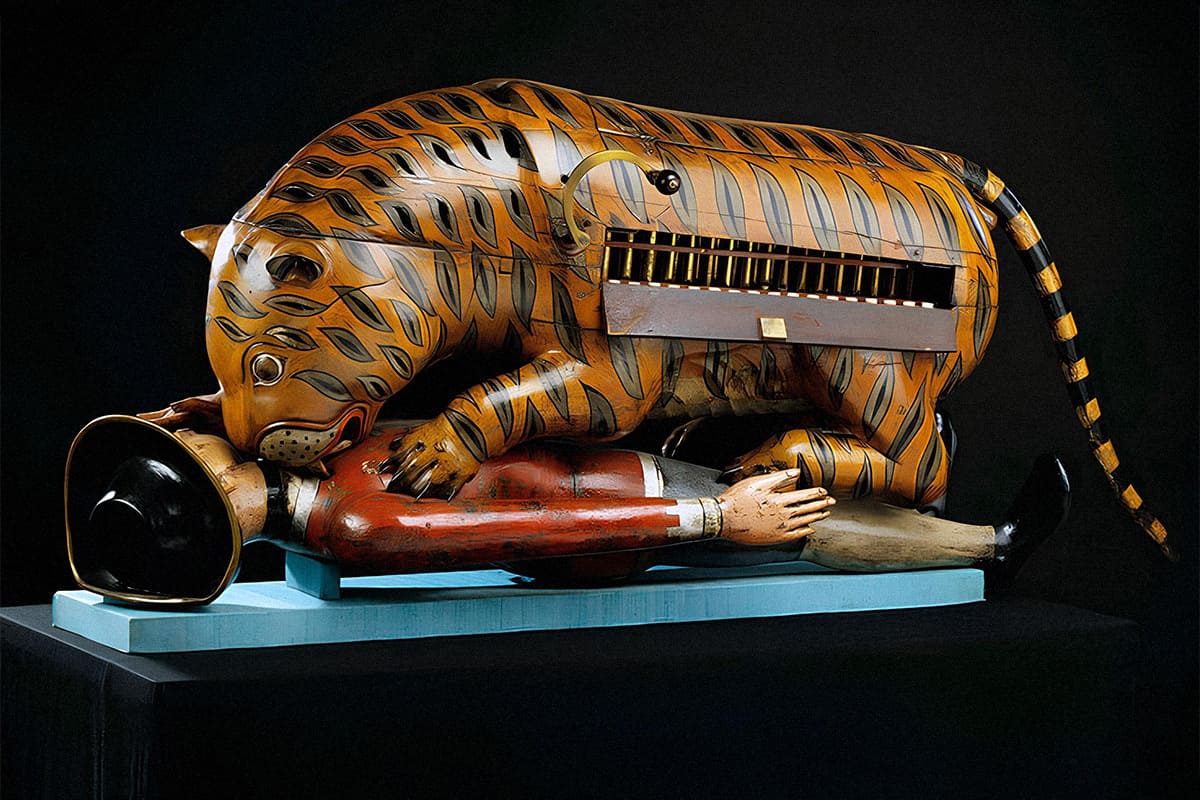
The mechanical tiger from the palace of Tipu Sultan in Mysore (India) was once displayed at the London headquarters of the East India Company / nature.com
Visiting museums in Europe, we admire with fascination the vast collections of ancient artifacts. Thanks to the work of outstanding scholars, we are able to better understand Eastern culture and become acquainted with the great history and traditions of Asian countries. But do we reflect on the price at which this knowledge was acquired? Do we recognize the true nature of power, which is impossible without control over knowledge? Let us explore this together with the journal Nature, which has reported on one of the latest scientific studies on this topic.
«CIVILIZED» PLUNDER
T
he founder of the Asiatic Society of Bengal, William Jones, can confidently be described as an exceptional figure. Fluent in 13 languages, he was one of the first to serve as a guide for Europeans into the world of Indian culture. Jones identified the Indo-European language family and made a significant contribution to the development of comparative mythology by drawing parallels between stories of gods in Ancient Greece, Ancient Rome, and India. He was genuinely fascinated by Indian culture, which did not prevent him, as a judge of the Supreme Court in colonial Bengal, from being part of a brutal system of oppression. In 1790, speaking before the Asiatic Society, Jones declared: «We will transfer to Europe all the sciences, arts, and literature of Asia». In other words, the British had no intention of limiting themselves to the plunder of material resources alone. Of course, former empires today are not particularly fond of recalling these far from admirable actions.
For some time, the idea was popular that the colonization of India was not especially profitable for Britain from an economic standpoint. However, the myth of imperial «benevolence» was окончательно dispelled by the research of the well-known economist Utsa Patnaik, who convincingly demonstrated that between 1765 and 1938, Britain extracted a total of about $45 trillion from India. For comparison, this figure is 17 times greater than the current annual GDP of the United Kingdom. Patnaik argues that this estimate is very «conservative», since it is impossible to calculate the exact scale of this staggering plunder. Over 200 years of British rule in India, there was almost no growth in income per capita. In the second half of the 19th century, incomes in India fell by half, average life expectancy decreased by one-fifth, and tens of millions died from famine caused by colonial policy.
LESS KNOWLEDGE — LIGHTER THE WEIGHT OF CHAINS
The East India Company collected taxes in India, after which about a third of this revenue was put back into circulation — the money taken from Indians was used to purchase goods produced by Indians themselves. Part of these goods went to meet British needs, while another part was re-exported to Europe, where the proceeds were used to buy strategic commodities: iron, tar, and timber. Without the enormous profits extracted from this exploitative scheme, the Industrial Revolution in England would have been impossible. In 1858, when the state replaced the East India Company, this system was refined so that all the gold and silver that should have gone to Indians in exchange for exports accumulated in London. Britain used Indian revenues for military expansion into other regions of the world and for settling Europeans in Canada, Australia, and other territories.
However, not only control over money, but also control over knowledge lay at the core of colonial policy. Warren Hastings, the first Governor-General of India from 1773 to 1785, argued that the accumulation of knowledge by the British «reduces the weight of the chain that keeps the natives in subjection». The East India Company did not initially directly finance the collection and transfer of knowledge about science and nature in the parts of Asia under its control. However, many of its employees were engaged in collecting ancient manuscripts, maps, catalogues, botanical drawings, artifacts, and samples of flora and fauna — all of which accumulated in the repositories of colonial India. Much of this material ended up there as a result of organized plunder and was later sent to Europe.
SCIENCE AS AN INSTRUMENT OF COLONIALISM
This little-known aspect of colonial capitalism is explored in the new book Monopolizing Knowledge: The East India Company and the Second Scientific Revolution in Britain (2025) by historian of science and technology Jessica Ratcliff. She shows how complex and contradictory the intertwining of the history of science and the history of empires can be. And these entanglements had profound consequences for the development of scientific knowledge and practices in Britain and around the world. The East India Company used «corporate science» not only to extract natural resources. It also provided cultural resources necessary for the exercise of colonial power. The Company funded the construction of a network of astronomical observatories to determine longitude, keep time, and monitor weather conditions essential for increasing agricultural production.
It was forced to take this step because the consequences of famine caused by unbearable taxation were becoming increasingly severe. Even the army turned into a «form of institutionalized knowledge». For example, geodesy and astronomy were critically important for coordinated, expansionist military campaigns. Botanical gardens were not created by chance either — they contributed to the development of botanical knowledge and practices that played a key role in the production of highly profitable commodities such as tea, hemp, flax, rubber, and indigo. And it was precisely for the analysis and systematization of accumulated knowledge that research institutions such as the Asiatic Society of Bengal were established.
MUSEUMS — MONUMENTS TO CHAUVINISM?
The dissolution of the East India Company did not put an end to its scientific activities. Its legacy continued in the cultural sphere. By placing private collection items in numerous museums, the Company made them widely accessible, thereby transforming its assets into «public science». Partly in response to the demolition of East India House in 1861, an ambitious project emerged — the «Thames Mahal», a vast Museum of India on the banks of the Thames. It was intended to bring together the Company’s scattered scientific collections and to establish an Indian Institute on its basis, including a library, museum, research center, and an educational institution for civil servants. However, these grand plans were never realized due to a lack of funding. The specimens and manuscripts looted by the East India Company remain dispersed across various institutions — the British Museum, the Victoria and Albert Museum, the Royal Botanic Gardens, Kew, the Natural History Museum, and others.
Today, the public rarely reflects on the role of science in the history of the East India Company or on the role of colonial capitalism in shaping British scientific institutions. The private monopolization of Asia’s resources fueled the «second scientific revolution» in Britain — the first, as we recall, took place in the 17th century. It contributed to the further professionalization and specialization of scholars, as well as to the division of sciences into natural and social disciplines. Vast collections removed from the colonies became indispensable sources for research. At the same time, the establishment of «orientalist» public museums reinforced British cultural and religious chauvinism and the racist theories that flourished during that period. In recounting the past, Ratcliff’s book is strikingly relevant. It not only helps us understand the complex interplay of private and public interests in the era of colonial empires, but also reveals the connection between «state» and «corporate» science in the modern world.
Original research:
When copying materials, please place an active link to www.huxley.media
Select the text and press Ctrl + Enter