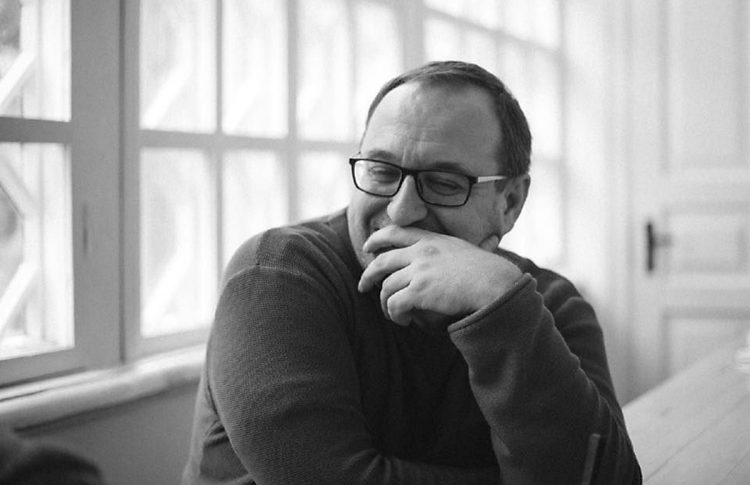
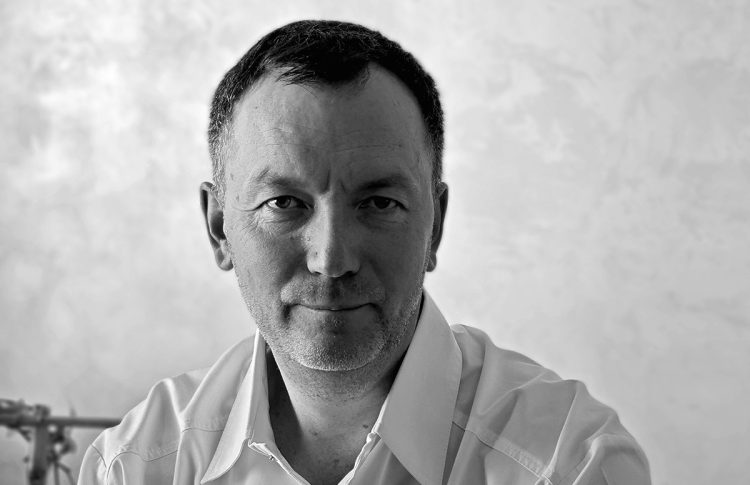
PAVEL LUKASHEVSKY: «Music — Prayer and Life»


Paweł Łukaszewski / lukaszewski.org.uk
SHORT PROFILE
Name: Paweł Łukaszewski
Date of Birth: September 19, 1968
Place of Birth: Częstochowa, Poland
Profession: composer, conductor, educator, musical figure
Critics hail Paweł Łukaszewski as a true master of a cappella choral writing — his works fuse the sacred traditions of liturgical chant with a distinctly modern sound. His music has resonated in the hallowed halls of the Vatican and at the leading festivals of Europe and the Americas, earning him numerous honors, including the prestigious Orphée d’Or – Prix Hector Berlioz and several Fryderyk Awards.
He is often spoken of as the spiritual heir to composers such as John Tavener, Arvo Pärt, and Krzysztof Penderecki. In an interview for Huxley.media, the operatic tenor Narad and his protégé Leonid Shokh sit down with Paweł Łukaszewski to discuss the inner essence of music and the role of spirituality in compositional art.
Narad: My book The Descent of a New Music has recently been published, in which I’ve gathered portraits of the most extraordinary contemporary composers — those who have revealed themselves to me over seventy years of studying and reflecting on their music. I included some of your works as exemplars of music that reaches far beyond reason and touches the Spirit. Brahms said that he could ascend to a special plane of existence and, from there, take any note or melody he wished and bring it down to earth. Tell me, how do you create your music?
Paweł Łukaszewski: That’s probably a question I find hard to answer. But I believe the most important thing is to be sincere. For me, composing sacred music isn’t just a craft — it’s my calling.
Narad: Do you keep in touch with fellow composers who also go beyond the ordinary and possess the ability to create beauty not yet known to the world?
Paweł Łukaszewski: Yes. I have a good relationship with Ēriks Ešenvalds from Riga — a remarkable composer. Also with Paul Mealor from Scotland, who wrote music for Prince William and Kate’s wedding. You’re surely familiar with Henryk Mikołaj Górecki, one of Poland’s most significant composers; he passed away fifteen years ago.
I recommend listening to his Symphony of Sorrowful Songs and his choral works. But, to my mind, Arvo Pärt is unquestionably inimitable — truly divine in his genius. I would also mention Valentyn Silvestrov from Ukraine — a vital figure in spiritual music.
When we speak of spiritual music, we talk about what lies between the sounds. To me, it’s something that isn’t on the page — it’s what exists between the notes. That’s why time is such a crucial category in our work. As composers of sacred music, we work with time itself. We strive to stretch out time, because in today’s world everything moves too fast. We need another kind of time — a spiritual, eternal time.
Narad: Could we say that this is a striving for the timeless?
Paweł Łukaszewski: Yes. It’s also tied to the Greek concepts of Chronos and Kairos. For me, working with time is absolutely essential — after all, God is Time. In Greek thought, Chronos is linear, sequential time, while Kairos is the sacred moment in which true fullness emerges. In sacred music, I aim precisely for that moment when sound becomes presence. Music is a means of entering into another dimension of time. To me, God is Time.
Narad: Your music seems to hold tremendous potential for the future. It transcends conventional chordal harmony — a leap forward that paves the way for new generations of composers who are ready to break through to a higher level of perception and consciousness.
Paweł Łukaszewski: I work within conventional musical «orthography» — notes, dynamics, agogics (the subtle flexing of tempo and rhythm) — and I don’t use graphic elements or «art objects» in my scores. I simply don’t need them. I believe you can create something genuinely new by using time-tested tools. I write with ordinary chords; my task is to discover a new path to them.
Narad: Might that be why the twelve-tone system has lost its relevance and atonality no longer plays an important role?
Paweł Łukaszewski: Yes. Atonality no longer matters. It was significant sixty years ago — as an experiment and a discovery. Today, it’s history. Students may find it interesting to learn how things were, but you can’t really listen to that music in a car — it’s cut off from human perception. In my view, that kind of avant-garde music belongs in museums; it’s become outdated. What we need now is music that speaks to the spirit, to what lies within us.
Narad: You’re talking about very important things. But how does one allow music to touch a person’s soul?
Paweł Łukaszewski: I believe the most crucial element today is time — and there’s catastrophically little of it. Most people can’t even spare an hour to simply listen to music. They can manage three or four minutes — one song.
Narad: May I ask a difficult question? How do you discover those sounds and notes, and what do you rely on first — mind or soul?
Paweł Łukaszewski: I think it’s all of it together. Of course, the mind is involved in the process, but I’m not a mathematical composer like Iannis Xenakis. That’s fascinating, but for me both feeling and intellect matter. I feel fortunate — like I’ve been given a gift from God — to be a composer.
Narad: Once I heard the music of the spheres — just for a few seconds. But I said to myself, «This beauty must come down to earth».
Paweł Łukaszewski: Exactly. The question then becomes: what is the difference between spiritual music and religious music? To me, spiritual music can be as simple as a single bar. Sometimes one chord is already sacrum — something sacred, palpably filled with presence. Composers like Arvo Pärt, Henryk Górecki, and John Tavener write truly spiritual music.
Others compose masses, requiems, motets — but that can be merely religious music. Sacrum represents a higher point, because it draws us closer to God. My goal is to create something that serves as a bridge to the Divine. Perhaps it is my calling to help people draw nearer to Him.
Narad: Many compose beautiful music, but does it have inner meaning? Where is the dimension that elevates a person beyond themselves?
Paweł Łukaszewski: Truly spiritual music can touch even those who do not believe, giving them a chance. Perhaps in their final moments they will say, «I believe», and music will guide them there. Henryk Mikołaj Górecki once told me, «This world needs beauty. If there is no beauty — in music, in art, in churches, in museums — we face a dark end».
I believe beauty can be expressed through music. That is why I do not write music for myself — I write it for God. When I sit before a blank page, I don’t tell myself, «Now I will create a spiritual piece», for who can judge whether it is truly spiritual?
Narad: I think one can say it only when the soul is completely open.
Leonid: Some of my favorite works of yours are the two motets and the Nunc Dimittis, the ancient Biblical hymn «Now you dismiss your servant.» Which of your compositions do you consider the most personal and most significant?
Paweł Łukaszewski: Probably my Third Symphony, which I’ve titled Symphony of Angels. You can find it on Spotify. The theme of angels has always been very important to me. When I compose, I reread a great many sacred texts — one passage in the Book of Enoch about angels struck me profoundly and inspired this symphony. It holds a special place in my heart.
As for the Nunc Dimittis you mentioned, I wrote it in just three hours. One of Britain’s leading conductors, Stephen Layton, called me the day before I was due to fly to London for a CD recording and said, «I have half a session free — could you write something and we’ll record it tomorrow?» I agreed, and in three hours the Nunc Dimittis was born. It has since become one of my most popular pieces.
Leonid: Estonian composer Arvo Pärt once said, «Music is my friend, ever understanding. It’s the handkerchief for drying tears of sorrow and the source of tears of joy. But also a painful thorn in my flesh and soul». What is music to you?
Paweł Łukaszewski: Arvo Pärt isn’t often very wordy — perhaps that quote was one of his rare revelations. For me, music is prayer. It’s my way of speaking with God. Two words suffice to define it: prayer and life.
When copying materials, please place an active link to www.huxley.media
Select the text and press Ctrl + Enter