EDWARD AMCHISLAVSKY: on how Leonid Utyosov “composed” his life

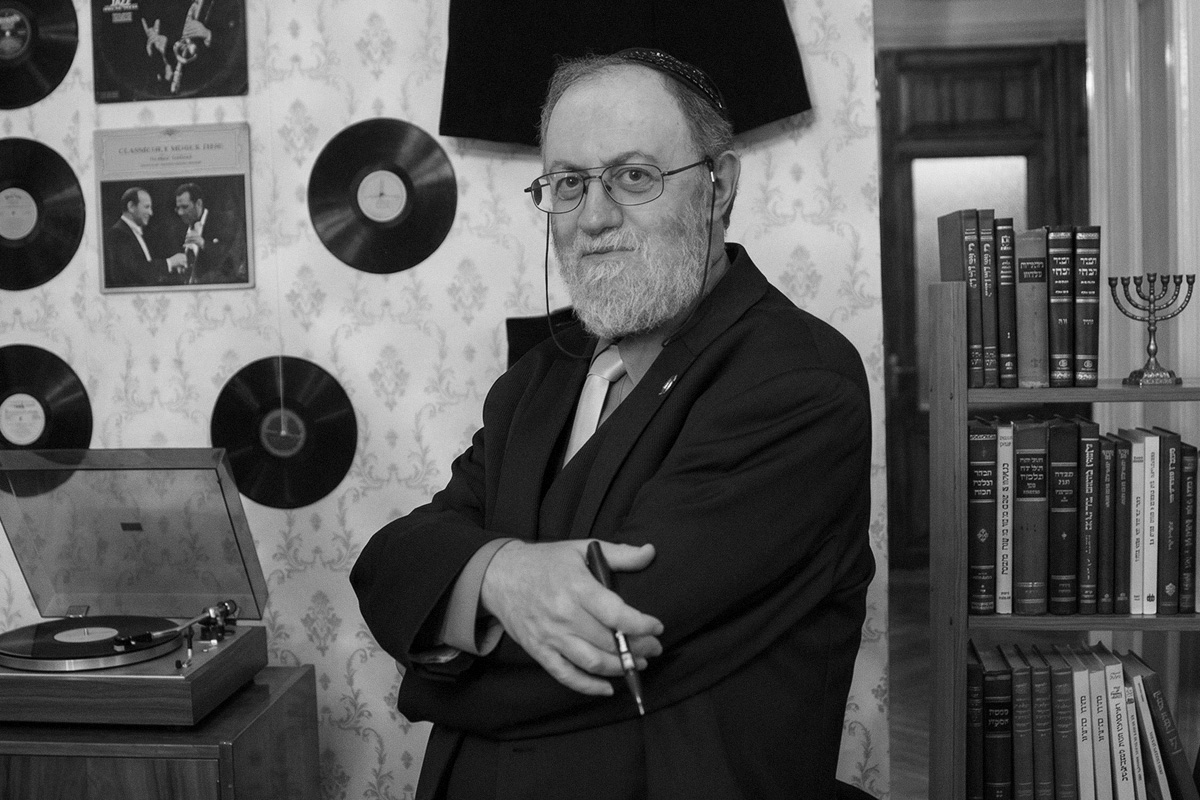
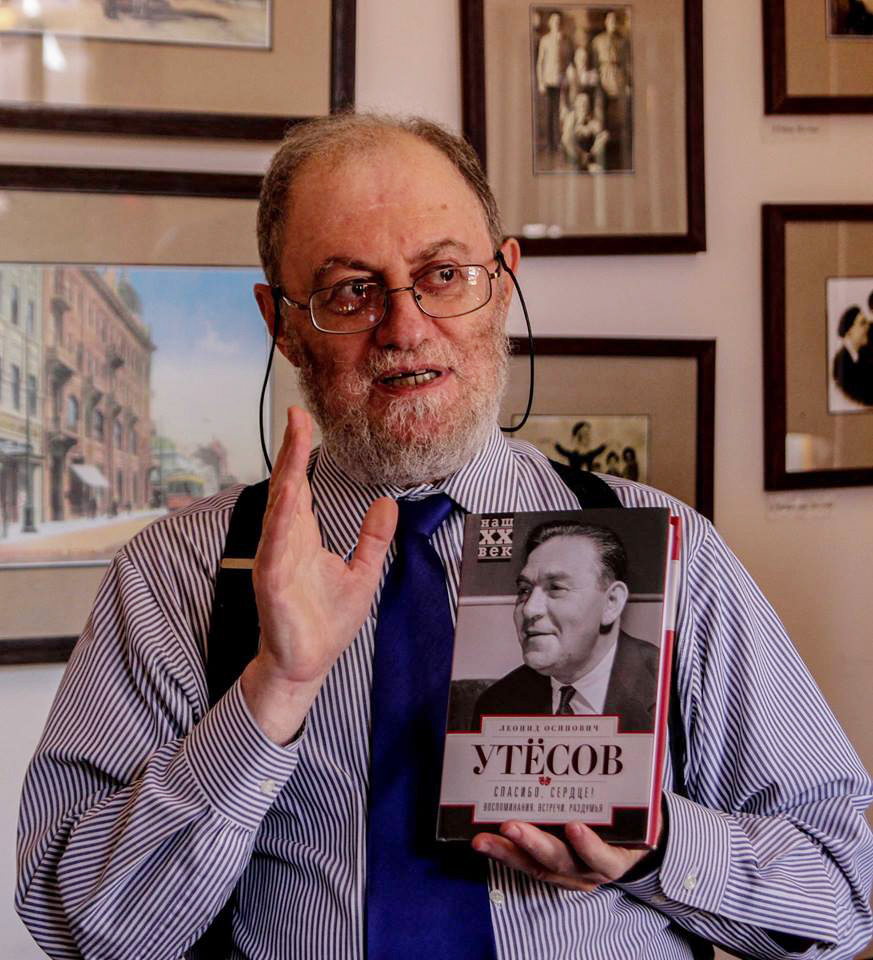
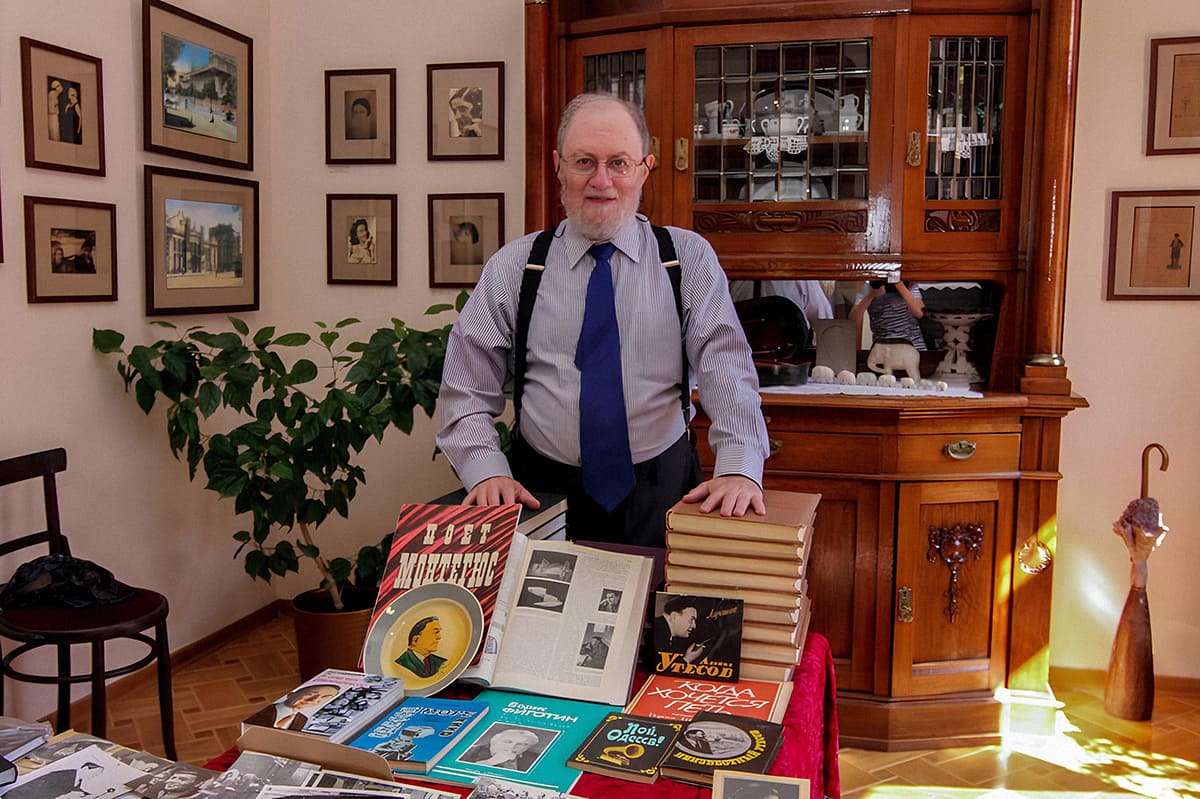
Edward Amchislavsky at the Odessa Jewish Museum. Photo by Oleg Vladimirskiy, 2015 / From a private archive
SHORT PROFILE
Name: Edward Amchislavsky
Date of Birth: May 26, 1958
Place of Birth: Odesa, Ukraine
Profession: telecommunications engineer, bibliophile, journalist, writer, publisher, Doctor of Arts, professor
There is such a notion as a “great Odesite”. Without a doubt, Leonid Utyosov is one. He was not only an outstanding variety artist, but also a master “author of his own life”. Reality and mystification intertwined so closely in his life and work that at times it becomes impossible to separate them. Yet Edward Amchislavsky, the author of the “Utyosov Encyclopedia” and dozens of books about Utyosov, does not abandon his attempts to make sense of it. For nearly half a century, he has been exploring the “Utyosov myth” that the great artist left us as his legacy.
THE “UTYOSOVOVEDOV” DYNASTY
M
y passion for the biography and work of Leonid Utyosov was passed down to me from my father, Boris Amchislavsky. The “Utyosov Encyclopedia” is the last work we began together with my father. To date, three volumes have already been published. Unfortunately, I will now have to continue my work in “Utyosov studies” without him — my father passed away at the end of March 2024. I remember that very last day when I came to see him. He came out to meet me from his small study and said: “That’s it! I’ve finished the letter ‘Z’!” In other words, he managed to complete this monumental work and only then departed. I always understood that working on the encyclopedia gave him the strength to live. He left behind a fully prepared, typeset text sufficient for the publication of approximately six more volumes. Thus, the complete encyclopedia will consist of nine books. My task now is to edit the text, select photographs, and publish it. But, of course, beyond the encyclopedia, I also have many other materials on my computer. Some of them we have already published, others not. As of now, our body of work includes 22 published books about Leonid Utyosov.
THE MEETING OF TWO ODESITES
For the first time, Leonid Utyosov appeared in our family’s life in October 1978, when my father set off from Odesa on another business trip. At that time, we were active members of the Book Section of the Odesa House of Scientists, and there they helped us get in touch with the great Odesite — Utyosov. We were given Leonid Osipovich’s Moscow address and phone number, and also asked to pass along several books by Odesa writers as a gift for him. My father and Utyosov spoke on the phone, and Leonid Osipovich scheduled a meeting for the next day: “Come at twelve, we’ll talk. We’ll have about fifteen or twenty minutes…” But the meeting immediately went off script — in Utyosov’s living room they talked for nearly five hours! There were several reasons for this.
First, Utyosov met a fellow Odesite — a kindred spirit. The subject of Odesa was always special and inexhaustible for him. He could speak about this city for hours! Second, Utyosov was an incredibly sociable person. He needed communication with an audience or a listener as much as air. It was important for him to have someone nearby to whom he could address his storyteller’s talent. Unfortunately, by that time, there were almost no such people left around him. His daughter lived in the neighboring apartment, but she was seriously ill and physically unable to be a full-fledged conversational partner. And my father turned out to be not only a grateful listener, but also a grateful reader of Utyosov.
THE BIRTH OF THE “UTYOSOV COLLECTION”
In 1976, the last book by Leonid Utyosov was published — Thank You, Heart!. It immediately became a bibliographic rarity. On the Odesa book market, with an official price of 2 rubles 12 kopecks, it was sold for at least 100–120 rubles. For comparison, the first edition of Mikhail Bulgakov’s The Master and Margarita at the time cost 75–80 rubles. Utyosov asked my father, “Do you have this book?” “What are you talking about?” my father replied. “It’s impossible to get it in Odesa!” Then Utyosov took his business card and, between the lines “Leonid Osipovich Utyosov, People’s Artist of the USSR”, wrote by hand: “Please, if possible, one book for the bearer. L. O. Utyosov”. And added: “Give this card to the director of the bookstore. I left a crate of my books there — they will give you one of them”. At the same time, Utyosov asked my father to purchase a couple of albums by Boris Fabisovich, a well-known theater photographer.
In addition to photographs of famous actors, the album included a celebrated image of Utyosov — with a cigarette, half-turned. The bookstore director turned out to be a woman. She held the business card in her hands for a long time, as if deciding what mattered more to her — to keep Utyosov’s autograph or to give away the book… In the end, my father did return to Leonid Osipovich with the book Thank You, Heart! and the albums of theatrical portraits. Utyosov signed both editions for him. Thus, another of Utyosov’s books appeared in our home, in addition to the already owned With a Song Through Life, as well as numerous records and articles from newspapers and magazines. This was how the Utyosov collection was born, and it continued to grow over many years. And then something truly incredible happened…
HOW I MARRIED… INTO UTYOSOV’S APARTMENT
Leonid Utyosov died on March 9, 1982. And in November of that same year, I got married for the first time. We had just set off on our honeymoon when news came that Leonid Brezhnev had passed away. Upon our return, I learned that my wife had long arranged an intra-family apartment exchange. So by the time we came back, her grandmother had moved in with my wife’s parents, and we settled into apartment No. 7 at No. 11 Triangular Lane, which in May 1982 had already been renamed Utyosov Street. In March 1983, at a meeting of the Book Section dedicated to the anniversary of Leonid Osipovich’s death, I gave a short talk — “Leonid Utyosov on My Bookshelf”. And suddenly, someone from the audience shouted: “What’s so surprising? He lives in Utyosov’s apartment!” After the meeting, the well-known Odesa journalist Yevgeny Golubovsky approached my father and me and asked, “Is that true?” I replied: “Apparently it is, if that’s what people are saying”. “If that’s the case, you are obliged to create a Utyosov museum”, Golubovsky declared.
Since then, some malicious tongues have claimed that I deliberately married in order to end up in this apartment. But I swear, it happened in a completely mystical way — I knew nothing about the history of this place. Moreover, I still had to prove that Utyosov had indeed lived there. After all, several apartments in that building claimed the proud title of being “Utyosov’s”. The situation resembled the dispute among seven Greek cities over which one was truly the birthplace of Homer. In Utyosov’s books, there is mention of this house on Triangular Lane, and there was one more detail: an apartment with a balcony on the second floor. But as many as seven apartments fit that description, and Leonid Osipovich himself never mentioned the number of his apartment.
“THE ANCESTRAL CASTLE” ON TRIANGULAR LANE
We turned to the bureau of technical inventory, retrieved the building’s archival plans, and made copies — as the data became more precise, the competitors were eliminated one by one. When the staff of the Odesa theatrical library learned about our investigation, they suggested searching for the necessary information in old theater journals. And in Soviet Variety and Circus, No. 3 for 1975, which published materials dedicated to the 80th anniversary of Leonid Utyosov, we discovered the memoirs of Fyodor Lipskerov — an old friend of Leonid Osipovich, a playwright and compere who often hosted his concerts. Lipskerov’s grandmother was a very well-known midwife in the city — a traditional birth attendant, as they used to say. One night, as Fyodor recalled, a maid came running to her with an urgent request to go to the address Triangular Lane, building 11, apartment 7 — “The mistress is about to give birth any moment!”
Thus, with the assistance of Lipskerov’s grandmother, twins were born into the family of Iosif and Malka Weisbein — first a girl, Perl (Polina), followed by a boy, Lazar. The boy would later become the legendary artist Leonid Utyosov. He used to say about this event that from birth he had grown accustomed to letting women go first. But the final, decisive detail was that Utyosov himself was a member of the journal’s editorial board. That is, the text indicating the apartment number was approved by him personally. Later, Natasha Weisbein — the daughter of Utyosov’s elder brother Mikhail — gave us a photograph from the family archive, taken in the late 1950s to early 1960s. It shows the courtyard of building No. 11 on Triangular Lane, the back staircase, and an inscription by Mikhail: “This is the castle of your ancestors”. As you may have guessed, it once again referred to apartment No. 7.
CONFUSION WITH BIRTHDAYS
Working with materials about Leonid Utyosov is an activity akin to that of a detective. Utyosov wrote extensively about himself — books, articles, interviews, television films… But the facts contained in them are sometimes difficult to distinguish from legends. Take, for example, his date of birth. All encyclopedias — both the musical and the Great Soviet one — list March 21. Although Utyosov himself always celebrated his birthday on the 22nd. The same date appears in his military ID, dated 1950. Leonid Osipovich treated this discrepancy philosophically: “I was born on March 22, but if encyclopedias say it was the 21st, then they must know better”. This phrase comes from a letter Utyosov wrote to his friend Vladimir Alexandrov, which we first published back in 1990.
After that, the phrase spread without reference to its source, but the original letter, given to us by Vladimir Alexandrov, is still preserved in our archive. And yet, since Utyosov often preferred a beautiful phrase to strict facts, we decided to verify this information. In 2013, Liliya Belousova, deputy head of the Odesa Regional Archive, found a record in the rabbinical registry of Utyosov’s birth — March 10 in the old style, that is, indeed March 22 in the new calendar. Leonid Utyosov’s life and work are largely legendary, since he himself constantly created a myth about his own persona. One of the most famous stories is the attempted “escape abroad”, because of which Utyosov for a long time had neither titles nor official recognition.
HOW UTYOSOV “FLED ABROAD”
According to one version, he and his orchestra intended to cross the Turkish border; according to another — the Finnish one. How this legend was born was first told to us by Iosif Prut, a well-known playwright and close friend of Leonid Utyosov, and later confirmed by the composer Nikita Bogoslovsky. It happened in 1934, about two months before the premiere of the film Jolly Fellows. Iosif, Nikita, Leonid, and several other members of the orchestra were riding a Leningrad tram after a rehearsal. Leonid Utyosov proposed a wager: “Let me start a rumor right now, and we’ll see how it spreads!” After that, he loudly announced to the entire tram: “Have you heard that Lenka Utyosov, with his orchestra, has crossed the border — from Vladikavkaz to Nakhichevan?” Anyone even slightly familiar with geography understands that there was no border between those two cities — it was all territory of the Soviet Union. But unexpectedly, the joke took on a life of its own and began to acquire far from harmless “details”.
It should be taken into account that all this was happening against the backdrop of the assassination of Sergei Kirov, which followed soon after and even caused a slight delay in the premiere of Jolly Fellows. Prut recalled that at the time two reviews of the film appeared in Pravda and Izvestia, listing the names of Alexandrov, Orlova, and other actors — everyone except Utyosov. When the outraged Prut approached the newspaper editors, they explained: “Well, you understand… Utyosov fled abroad! We cannot publish the name of such a person in newspapers”. And this tram joke echoed throughout Utyosov’s career until the late 1950s. His friends even had to prove that it was a fabrication to the then Minister of Culture, Nikolai Mikhailov. Under his tenure, attitudes toward this story began to be reconsidered.
“JOLLY FELLOWS”: ANOTHER MYSTIFICATION
But I was able to put the final point in the story about newspapers allegedly removing mentions of Leonid Utyosov from reviews of the film only in 2019, when I was trying to find the graves of his parents and clarify the dates of their birth and death. The only thing I knew was that they were buried in the Jewish section of the Vostryakovskoye Cemetery. However, I was refused any information on the grounds that I was not a relative. Still, I managed to locate the overgrown gravestones with the dates inscribed on them. These searches went on in parallel with my work in the archives of old newspapers and magazines. I went through all the publications of that time and realized that I was dealing with yet another mystification: not a single review of the film Jolly Fellows had been published then! Neither mentioning Utyosov’s name nor omitting it. In fact, almost nothing was written about Jolly Fellows at the time. The reason was that, simultaneously with this comedy, the film Chapaev was released, and all the press attention was focused on this “ideologically important” picture. However, I did discover another remarkable phenomenon — thanks to Vera Inber, the weekly all-Union newspaper Kino, where she ran the column “Writers on Cinema”, essentially turned into an Odesa literary almanac. In spirit, the newspaper became largely “Odesa-like”.
HOW UTYOSOV “TALKED THE CHEKISTS INTO CONFUSION”
One of my favorite anecdotes is the story of how, in early 1953, Academician Mints, accompanied by another “scholar in civilian clothes”, came to Leonid Utyosov with a letter that many prominent Jews were being asked to sign in connection with the so-called “Doctors’ Plot”. It is known that Utyosov was supported by Lazar Kaganovich, the People’s Commissar for Railways of the USSR, who was born in Ukraine, though not an Odesite. In the new ministerial building, Leonid Osipovich was allocated a large apartment, and for the orchestra’s tours — as many as two specially equipped railway carriages. At the required moment, they were simply attached to any train. One carriage was entirely for sleeping, for the musicians, while the other had two separate compartments for Utyosov and his daughter Dita, as well as a dining area that could be transformed into a rehearsal hall by folding the tables. This allowed the musicians to rehearse right on the road. It was precisely to this apartment, provided by Kaganovich, that Academician Mints and his companion came. Utyosov invited them into the dining room for tea. And then came the stories, the jokes… Utyosov “talked” his guests so completely that they only remembered the purpose of their visit once they were already out on the street. The situation was reported up the chain, all the way to Lavrentiy Beria, who listened and then called Joseph Stalin. Stalin’s response was: “Do not touch the artist”. Most likely, this is a legend. But it also has a kind of real historical background.
“STALIN HIMSELF IS ASKING YOU TO DO THIS!”
In the 1930s, a campaign began in the USSR against “accented couplets”. Roma, Armenian, Georgian, and Jewish songs fell under the ban. Among the prohibited pieces were Leonid Utyosov’s “From the Odesa Prison”, “Hop with a Flick”, “Limonchiki”, and others. One day, Leonid Utyosov happened to meet Platon Kerzhentsev, who headed the Committee for Arts and effectively controlled the variety repertoire. “I’ve heard, Leonid Osipovich, that at private gatherings you perform unrecommended material. If I hear of this again, measures will have to be taken”, Kerzhentsev said and walked away. If it’s forbidden, then it’s forbidden — nothing to be done. And then, at one of the concerts in the Kremlin, after Utyosov and his orchestra had performed the approved program, a man “in uniform” approached him and quietly but insistently asked him to sing “From the Odesa Prison”. But Leonid Utyosov categorically refused several times to perform banned material. The man left, but then returned with the words: “Stalin himself is asking you to do this! You wouldn’t refuse him, would you?” Utyosov brought the orchestra back on stage, and they performed “From the Odesa Prison”. When the song ended, a deathly silence hung in the hall for about a minute. One could hear a lone fly buzzing. After a pause, Joseph Stalin slowly took the pipe out of his mouth and gave a couple of casual claps. And that was it — the hall exploded with thunderous applause and enthusiastic cries of “Bravo!” Then Utyosov was asked to perform several encores…
THERE WAS NO DUET WITH THE LEADER
This episode did indeed take place. But the scene from a film in which Joseph Stalin sings “From the Odesa Prison” together with Leonid Utyosov is pure fiction. One simply has to understand how Soviet society was structured at the time. Stalin could make Nikita Khrushchev sing and dance the hopak at a party gathering, but he would never have allowed himself anything like that in public. However, the story with this song had a continuation. About a week later, Utyosov met Platon Kerzhentsev again. Leonid Osipovich remarked: “The other day I did perform ‘From the Odesa Prison’ at a concert. And even several times…” To which Kerzhentsev, almost shouting, replied: “I warned you! That’s it — you will no longer perform on stage”. “But you must understand, I couldn’t refuse!” Utyosov exclaimed. “Whom could you not refuse?” Kerzhentsev demanded. “Stalin”, Leonid Osipovich answered calmly and walked on. After going about a block, he looked back and saw that Kerzhentsev was still standing in the same place, frozen in the same pose as when he had left him. Of course, such a real incident had every chance of acquiring the most incredible details and turning into a legend.
UTYOSOV AND HIS “ILLEGITIMATE CHILDREN”
Leonid Utyosov left us with many riddles that we have been solving for nearly half a century, gathering materials piece by piece, buying them at auctions. At the same time, I often have to argue with auction houses when they list as “Utyosov-related” items that in fact have nothing to do with him. In other words, the stream of mystifications surrounding Utyosov has not dried up. For example, there was a man who declared himself his illegitimate son and even, while his parents were still alive, changed his surname to Utyosov and his patronymic to Leonidovich. He was, of course, invited to talk shows, where he claimed that his mother had become pregnant when she allegedly worked as a cleaner for Utyosov. But everything he said did not stand up to any criticism. Utyosov never had a housekeeper with that name, and the descriptions of the house and apartment did not match either.
A DNA test put an end to this sensation: the father of the “illegitimate son” turned out to be exactly the man who had been considered his father all along. Unfortunately, such wild cases occur from time to time. For instance, a few years ago, a certain “heir of Utyosov” sued a publishing house and won a large sum for the unauthorized reprinting of a book. But where could such an “heir” have come from? Utyosov’s only daughter, Dita, had no children. In her second marriage to film director Albert Gendelstein, she raised his children from a previous marriage — daughter Yulia and son Valery. Incidentally, Yulia was the wife of the writer Efraim Sevela — they moved to Paris and later separated. After Sevela returned to the Soviet Union, we often communicated, and the main subject of our conversations, naturally, was Utyosov.
“AND WAS THERE A BOY AT ALL?”
Apart from Dita, Leonid Utyosov had no other heirs. His second marriage to Antonina Sergeyevna Revels was childless. In 1987, we invited her to Odesa and arranged a tour of “Utyosov places” for her. She was accompanied by a woman and a small boy, whom she introduced as her niece and her son. Years later, that boy grew up and began to claim that his mother had, in fact, not been a niece, but the daughter of Antonina Sergeyevna. I reviewed all the materials, questioned all the witnesses, including the members of Utyosov’s orchestra who were still alive at the time — there was no daughter of Antonina Sergeyevna! And she simply could not have appeared, as was claimed, in 1961.
Let us look at the orchestra programs for that year — the schedule was extremely tight. And everywhere Antonina Sergeyevna’s performances were announced; she executed quite complex dance-acrobatic numbers requiring serious physical exertion. It is impossible to imagine her doing all this while pregnant! So where could a daughter have come from? I believe that it was indeed Antonina Sergeyevna’s niece — she effectively adopted the girl after her sister’s death. And although this “heir” had neither biological nor legal connection to Utyosov, he nevertheless attempted to sell the copyrights first to me, and then through auctions. Naturally, nothing came of this venture.
THE “ANTI-JUBILEE” THAT WAS SAVED
The last official public appearance of Leonid Utyosov took place on March 24, 1981, and was timed to his birthday. It was not a milestone date — he turned 86. But at that time, the Central House of Arts Workers had a tradition of celebrating so-called “anti-jubilees”. At Utyosov’s evening, hosted by Alexander Shirvindt, performers included Roman Kartsev, Viktor Ilchenko, Mikhail Zhvanetsky, Rostislav Plyatt, and others. The evening was considered informal, with jokes “on the edge”, so the press and television were not invited. But fortunately, a recording was still made technically in the radio booth. And one of the participants — Yuri Veksler — made a copy for himself the next day. Considering that part of the archives was soon lost in a fire, he did this just in time. This is how those recordings were preserved and partially restored. It is an example of how, piece by piece, we have to assemble Utyosov’s legacy.
Back in the days of our home museum in Odesa, people constantly came to us — to look at photographs, documents, or simply to talk. We even kept a special visitors’ book, where many outstanding figures left their notes: Mark Zakharov, Alexander Shirvindt, Mikhail Derzhavin, Boris Vasilyev, Anatoly Pristavkin, Sergei Yursky, Tikhon Khrennikov, and others. Unfortunately, the book itself was later lost somewhere in Odesa. But we had photographed part of the entries in advance and later published them in the book Forever Utyosov He Remained!. The book turned out to be substantial — 368 pages — and structurally multilayered: from direct testimonies to indirect ones, from poems and personal autographs to cultural context. It should be noted that this is not even a record: the first book we published in America contained 864 pages. This created difficulties with printing houses — no one wanted to deal with such a volume.
A DETECTIVE STORY WITH A MARSHAL
I always have to insist: I am not a writer — I am a researcher. A bit of Sherlock Holmes, if you like. And I often have to involve specialists from very different fields, because attribution or fact-checking sometimes requires completely unexpected knowledge. For example, in Utyosov’s archive we came across a photograph in which Leonid Utyosov is standing next to two marshals. On the back, there was an inscription with the names of these military men: Marshal Rotmistrov and Marshal Voronov. We never questioned this information until we began work on the “Utyosov Encyclopedia”. When we examined materials on Voronov, we realized that it was definitely not him in the photograph!
My third wife, who has an absolutely phenomenal memory for faces, helped us identify who it was. We went through the list of all the Marshals of the Soviet Union — no match. But besides them, there were also marshals of individual branches of the armed forces. We began to study them — and found a match down to the smallest detail! The third person in the photograph turned out to be Marshal of Armored Troops Bogdanov. A great many photographs of Utyosov have survived. And as a rule, he is always at the center of the group — you can see it in his gestures, in his facial expressions, in the way people listen to him attentively or laugh. There are, for example, photographs where Arkady Raikin is literally overwhelmed with laughter next to Utyosov. Although making Raikin laugh was not easy — in real life, he was far more restrained emotionally than he appeared on stage.
“FROM TRAGEDY TO THE TRAPEZE”
Even before the revolution, it was Leonid Utyosov who became the founder of the topical couplet genre, based on the principle “in the morning — in the newspaper, in the evening — in the couplet”. In the morning, Leonid Utyosov would read newspapers, select relevant topics, and by evening, Odesa authors who worked with him would produce poetic texts on them. He created for himself the image of a “news vendor”: he would run onto the stage with a bag, pull out a newspaper, and, as if reading from it, perform a couplet “of the day”. But his talents did not end there. While still very young, he began performing in the circus, and this left a distinct mark on his work. On February 2, 1923, at the Palace Theatre in Petrograd, a demonstrative synthetic evening performance was staged: From Tragedy to the Trapeze, Utyosov Shows Everything… That evening, Utyosov played Raskolnikov in an excerpt from Crime and Punishment, Menelaus from The Beautiful Helen, sang couplets, read stories, played the violin in a classical musical trio, performed romances accompanying himself on the guitar, danced, conducted the “Comic Choir”, acted as a clown, juggler, acrobat, and finally concluded everything with a trapeze act. And all of this — in a single evening.
“WHAT KIND OF AFFAIR? JUST A PAMPHLET…”
Leonid Utyosov was a very special person. He created around himself a space of half-tones and hints. Even his so-called “Don Juan list”, which people often like to discuss, was to a large extent part of the game. For example, he would be asked: “Leonid Osipovich, is it true that you had an affair with Maria Vladimirovna Mironova? Could you have been the father of Andrei Mironov?!” To which he would instantly reply: “An affair? What are you saying! What kind of affair? Just a pamphlet…” He knew how to turn any everyday episode into a joke, into a legend. For instance, he himself told the following story. In the 1920s, he left Elena Osipovna for an actress. That winter was unbelievably cold. And his wife sent a cartload of firewood to the mistress along with a note: “Keep the stove going properly so Lyodya doesn’t catch a cold”. Utyosov accidentally read the note, after which he packed his suitcase and returned home. Elena Osipovna was a wise woman and understood that she had two options: either to divorce or to learn to manage the situation. She chose the latter. In the orchestra, she had people who kept her constantly informed about everything. For example, she was perfectly aware of Utyosov’s closeness with Antonina Sergeyevna, who would later become his second wife. But for Elena Osipovna, far more important than jealousy was the fact that Antonina Sergeyevna looked after her husband’s diet and health.
THE UTYOSOV UNIVERSE
There were probably times when Elena Osipovna acted more decisively. For instance, she could take the first plane to one of her husband’s tours and appear unannounced at the door of his hotel room. However, it should be remembered that these “true” stories from life were told by Leonid Utyosov himself. Still, there was one woman he almost left for — the operetta actress Kazimira Nevyarovskaya. A tragic accident prevented it: in the 1920s, Kazimira Nevyarovskaya died in a terrible fire that broke out in a train carriage carrying her to a tour. Utyosov kept her photograph with an autograph, along with a newspaper clipping reporting her death, in the top drawer of his desk until the end of his life… Leonid Osipovich behaved in life exactly as he did on stage or in films. He always wanted to perform. Whenever he told a story, he became carried away and would unconsciously begin to interpret facts in a way that made them as engaging as possible for the listener. Then word of mouth spread these unusual stories around the world as if they were entirely real. Leonid Utyosov is an entire universe — vivid, unusual, full of paradoxes, both cheerful and tragic at once. That is why I find it incredibly fascinating to study the facts of his biography, comparing them with the myths he himself created about his own life.
When copying materials, please place an active link to www.huxley.media
Select the text and press Ctrl + Enter