ROMAN PUCHKO: How Circular Design Will Transform Ukrainian Cities

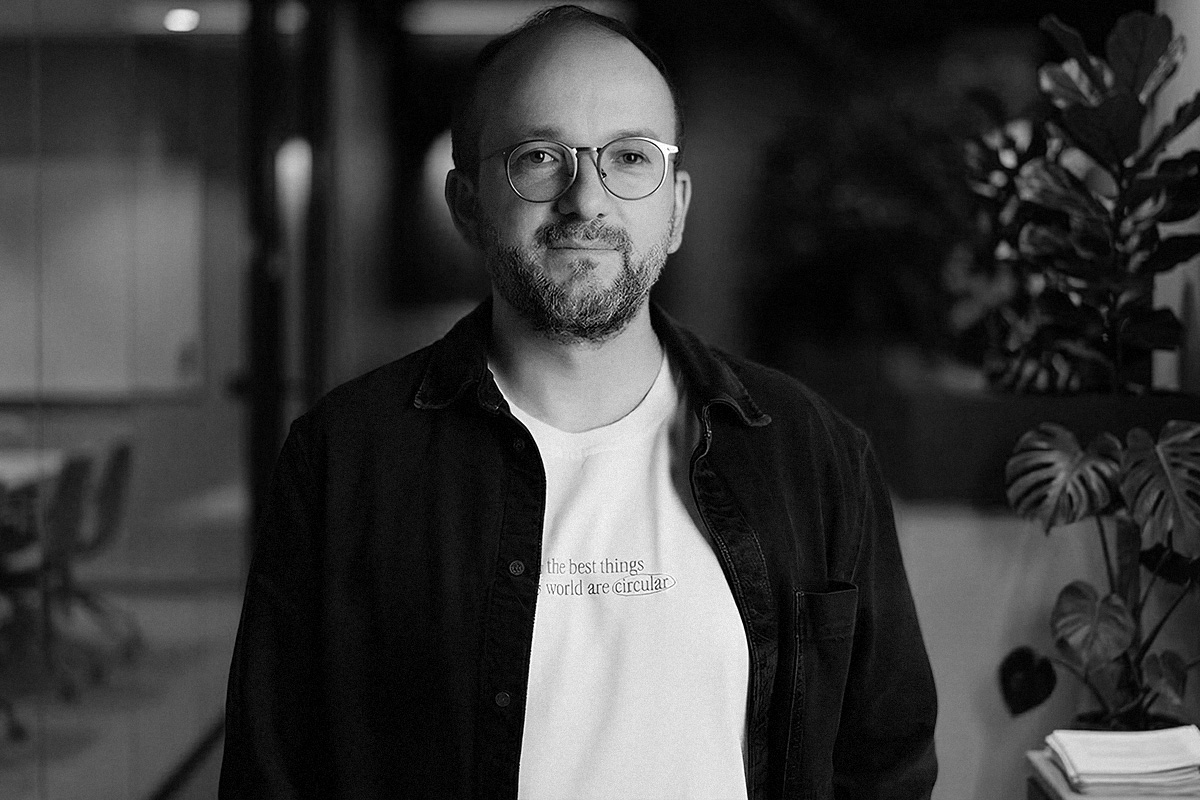
Roman Puchko / Photo from personal archive
SHORT PROFILE
Name: Roman Puchko
Date of Birth: August 30, 1988
Place of Birth: Rozhniv village, Ukraine
Profession: Expert in supply chain management and international trade
ReThink founder Roman Puchko speaks about his intellectual journey — from universities in the Netherlands to creating an expert organization in Ukraine. He is convinced that the circular economy can fundamentally transform the practices of Ukrainian urban development and state-building. All it takes is to consider the experience of European cities, our own potential, the concept of the New European Bauhaus, and the principles of circular design. In the interview, he explains why these will become the key to Ukraine’s effective post-war reconstruction.
CIRCULAR ECONOMY AS A PHILOSOPHY OF RESOURCE MANAGEMENT
T
he circular economy I work in is not so much about industry as it is about philosophy. It is about a specific systemic approach to any sector of the economy of any country. It is about design, vision, and the creation of value. You look at any activity as a cyclical process from the perspective of using particular resources. Therefore, those who limit the circular economy exclusively to the issues of the green transition or climate neutrality are mistaken. Research shows that 55% of these challenges indeed lie in the field of energy, while the remaining 45% are problems of the economic model. These concern which materials are used, how production and supply chains function, and so on. My team focuses precisely on these 45%.
In other words, we are not actually engaged in energy, we do not install solar panels, and we do not lobby for anyone’s corporate interests. We want to change people’s worldview, their perception of managerial and economic processes. At present, Ukraine faces many challenges related to secondary materials and their economic attractiveness. To move this forward systematically, we need to implement at least three things. First, to significantly increase the cost of waste disposal in landfills. Second, to substantially increase the value (not to be confused with price!) of fossil resources. And third, to fully implement a CO₂ market. If we do all this and properly establish a circular model, many industries will become profitable and competitive.
THE NETHERLANDS’ EXPERIENCE AND THE INEVITABILITY OF UKRAINE’S TRANSITION TO A CIRCULAR MODEL
The circular economy can deliver a significant innovation effect. This is not some kind of fantasy, as we are not the first on this path. Let us look at our partners in the Netherlands — for them, recycling concrete is 10–15% more profitable than using new materials. Therefore, they do not need to lobby anyone or prove anything. When the use of secondary resources is specified as a priority in municipal and state tenders, the circular economy works like clockwork. Ukraine will inevitably move toward this paradigm, especially after the war, which has caused extensive destruction. It is only a matter of time.
On the path toward the EU, its regulations will have to be implemented exactly as they are written. For example, to introduce digital audits and digital accounting of buildings, which turn them into a kind of «materials bank». We recently had an interesting conversation with representatives of Platform — an integrator of marketplaces for secondary construction materials in the Netherlands. They told us that they plan in advance what they will be able to obtain from each building. There is a demolition plan for buildings calculated for decades, and everything they consist of is digitized for future reuse.
UKRAINE’S RECONSTRUCTION AND THE VAST MARKET FOR SECONDARY RESOURCES
We are currently engaging with the government and Western partners to launch a joint pilot together with construction companies and building materials manufacturers. Because it is one thing to adopt a law, and quite another to implement it. The government expresses interest in the circular economy, but it is resource-constrained, as almost no one in Ukraine fully understands how to do this. Moreover, let us be honest: right now, Ukraine’s number one priority is to preserve itself as a state and to provide the Armed Forces and the front with everything necessary.
However, after the end of the war, the ideas of the circular economy in relation to rebuilding the country will inevitably come to the forefront. Buildings that have withstood and can be revitalized will become a representation not only of embodied carbon, but also of embodied memory. The debris of destruction will turn into a resource for urban design. Innovators from all over the world will want to offer their solutions in ecological modular adaptive construction and natural materials. Potentially, this is a colossal market, because we are a large country, we have many municipalities and diverse needs, but also a great deal of waste and a large scale of destruction. According to RDNA5, reconstruction needs over the next 10 years amount to 588 billion dollars. The housing sector alone requires approximately 67 billion. There is so much work ahead that clear markers of our progress toward the goal may appear in 5 to 8 years.
There are three indicators that we are moving in the right direction: the emergence of a national strategy for the transition to a circular economy, the creation of a market for environmentally sustainable resource use and environmentally sustainable construction, and the replacement of landfills with waste processing plants. Perhaps then people will stop looking at me as if I were a visitor from another world who, for some reason, is trying to «save the Earth».
HOW ONE BECOMES A PROVIDER OF THE CIRCULAR ECONOMY
I truly consider myself a romantic, but one who follows a pragmatic approach. The seeds of the evolution of my current thinking were planted about 15 years ago, when I was pursuing my Master’s degree at Wageningen University. I was interested in circular design, what an ecosystem is, how the physical and economic worlds relate to each other, and how the finiteness of resources affects them. Then there were my studies in the «Circular Cities» program at the University of Amsterdam. I even wanted to go on to a PhD to research all this. But I was talked out of it (and rightly so!).
When I returned to Ukraine, I went to work in agribusiness — a field close to my interest in ecosystems. And then it so happened that, while helping a business school develop a program, I suggested an event on the topic of the circular economy as an experiment. I did not even expect it to attract so many participants. Because at that time, many people’s understanding of the circular economy was at the level of «let’s sort waste». Mentally, it really resembled a combination of two worlds. In Ukraine, I am sometimes called an unofficial Dutch ambassador. In the Netherlands, on the contrary, I promote everything Ukrainian.
I see great value in combining two ways of thinking, two approaches to life. When it comes to the efficiency of resource use, it is hard to find anyone better than the Dutch. And although in the Dutch setting any changes are perceived with caution, it must be acknowledged that not everything can be planned, and some spontaneity even embellishes our lives. Ukrainians bring their own distinctive style — thoughtful, adaptive, and flexible.
HOW RETHINK PROMOTES THE CIRCULAR ECONOMY
Since 2017, the expert organization ReThink, which I lead, has been engaged in translating the best global experience of building a circular economy for Ukrainians. ReThink is a non-profit public organization that strives to change the consumption behavior of Ukrainians and draw their attention to new technologies and materials. We have promoted the ideas of circular design and sought to develop green innovations by organizing hackathons for Ukrainian chemists and physicists, for universities, and for business startups. During the COVID pandemic, we created a series of online webinars featuring «stars» of circular design. Among them were the Deputy Mayor of Amsterdam, Marijke van Doorninck, economist-anthropologist Jason Hickel, author of the Sustainable Development Index methodology, honorary president of the Club of Rome Anders Wijkman, and others.
We are also engaged in advocating for the circular economy, the results of which include legislative restrictions on the use of single-use plastic. Since 2019, we have focused on developing circular concepts for Ukrainian cities — there is enormous room for improvement there. At present, the only city approaching this concept is Lviv, where there are examples of participation, a new quality of architecture, and the use of experimental materials. This includes the project of a unique surgical building created free of charge by the Japanese «disaster architect» Shigeru Ban, a prosthetics workshop made of CLT, environmentally sustainable social housing projects supported by the EIB, and a completely new approach to urban planning in new districts, as exemplified by Northern Lviv.
NEW EUROPEAN BAUHAUS AND A NEW PHILOSOPHY OF URBAN DEVELOPMENT
For ReThink, the first pilot project of an urban circular concept was the UNIT.City innovation park in Kyiv. For the first time in Ukraine, commissioned by the park’s founder, we conducted an assessment of all material flows within a single area. In addition, we became the first official partners of Ursula von der Leyen’s New European Bauhaus (NEB) initiative, whose goal is to combine architecture, design, sustainability, participation, and technology in order to create a resilient and beautiful urban environment.
How did this initiative come about in general? For many of those living outside the «ideal» EU, this may seem surprising, but by 2020, the European Commission had come to realize that cities were developing suboptimally, with various socio-economic and environmental imbalances emerging. In addition to issues with migrants, wastewater, construction, and food waste, they identified another problem: when the pattern of development becomes excessively commercial, it departs from an organic aesthetic trajectory, destroys the landscape, and damages historical heritage.
NEB proposed an approach that combines inclusivity and participation, sustainability, and circular design. At the philosophical core of this strategy is the idea of the «beauty of life». What is beautiful cannot be bad. By improving the aesthetics of cities, this strategy positively affects the quality of development projects and reduces the level of social tension. It encourages people to take responsibility for their cities.
The European Commission is expanding the circle of stakeholders as much as possible, involving architects and urban planners, civil society, and business in the initiative. For me, NEB is an example of how, by uniting, it is possible to systematically overcome problems that have accumulated over the years. At the New European Bauhaus Festival in June, we will present innovations in circular reconstruction that are being implemented in Ukraine. Our country is increasingly integrating into this new mental space.
GREEN ENERGY, CHINA, AND THE LOGIC OF OPPORTUNITY COST
Since the beginning of the full-scale invasion, we have been working together with the government and communities on the design of Ukraine’s ecological and resilient reconstruction. We are developing legislative and economic incentives for the reuse of materials. Ukrainian companies need to be provided with an economic model that would be beneficial for them to implement. As for green energy, on the one hand, for an exhausted country, this is not an easy task. But on the other hand, if generation is built from scratch, green energy is the cheapest solution. Clean technologies do not contradict competitiveness.
We have the example of China, which balances between its domestic «traditional» market and European demand for products of the green transition. Critics argue that China, while extracting rare earth metals, still pollutes the environment. But here I would recall the concept of opportunity cost. The philosophy of this concept in financial managerial accounting is as follows: «Perhaps things are not ideal now, but how much would you have lost if they had turned out differently?»
We see that China produces quite competitive products — batteries, industrial storage systems, and electric vehicles. How could it have been otherwise? For example, if the Germans had done this, the production chain would have been more ethical and environmentally friendly, but also much more expensive. And the pace of development would have been slower. Meanwhile, the Chinese would still have done the same, because the global economic system, in which success is measured by GDP, does not incentivize them to act differently. It forces people to neglect truly important things in pursuit of profit.
AGRIBUSINESS, ECOSYSTEMS, AND THE TRUE VALUE OF LAND
The demand for finding a similar balance also arises in Ukrainian agribusiness, which is, in fact, not much less ecological than European or, especially, American agriculture. Our traded commodities — corn, soybeans, wheat, rapeseed — are in no way inferior. But we understand that we can extract much more from one hectare. Our trade with the EU has gradually shifted toward supplying finished products. Although, frankly speaking, European countries are not starving, so we supply more grain to the countries of the Middle East, North Africa, and even China.
There is no tragedy in this: processing and selling raw materials are completely different businesses, different product niches. Recently, we had a discussion with DG AGRI — the department of the European Commission that shapes agricultural policy and at times controls up to 30–40% of the EU budget. It is difficult for us to reach agreements with Europeans, not because the products of our agricultural companies are somehow inferior, but because they are very strong and competitive.
European farmers, whose protests recently disrupted agreements between the EU and Mercosur, react sharply to any threats. Yes, it will never be easy for Ukrainian companies in this market. But for the ecosystem, for the issues of the circular economy, this is not of decisive importance, because according to the philosophy of opportunity cost, in another scenario, you would have lost more. As soon as our agricultural companies truly feel ownership of the land, care for soils, biodiversity, water quality, and irrigation will become standard practice for us. At ReThink, we are inspired by the fact that we are at the forefront of the trend toward efficient resource use and systemic thinking, working on very practical and important things for the future.
When copying materials, please place an active link to www.huxley.media
Select the text and press Ctrl + Enter


