UKRAINIAN VERSAILLES: The Radziwill Palace Awaiting Revival


Napoleon Orda. Olyka Castle. 19th-century engraving / wikipedia.org
The palace complex in Olyka is often referred to as the Ukrainian Versailles. It’s nearly half the size of the French residence, but at the time of its construction, work on the palace near Paris hadn’t even begun. So today, let’s visit the castle in the eastern part of Volyn Oblast.
The small settlement of Olyka came into the possession of the ancient Lithuanian Radziwill family a long time ago. Jan Radziwiłł, «the Bearded», passed it down to his son, Mikołaj Radziwiłł, «the Black».
In 1547, Mikołaj Radziwiłł — Marshal and Grand Chancellor of Lithuania — received the title of Prince from Charles V, Emperor of the Holy Roman Empire (as well as King of Spain, Germany, and Italy). And Mikołaj felt that the time had come to establish a hereditary principality.
365 ROOMS OF THE RADZIWILL CASTLE
T
he Radziwills were a fabulously wealthy family, and knew how to live in style. And they had plenty to show for it: countless settlements and castles, vast estates. They also held high offices in both Poland and Lithuania. One need only read about their princely hunts to imagine their opulence. One striking example: Karol Stanisław II Radziwiłł went hunting not alone, but accompanied by some two thousand infantrymen, several hundred noblemen (plus 200 hounds), and a supply convoy loaded with food, drink, and of course, hunting gear…
In May 1564, thanks to the efforts of Mikołaj «the Black» Radziwiłł, the town of Olyka was granted Magdeburg rights. Around the same time, the construction of the Radziwill residence in Olyka was completed. The total area of the castle exceeded two hectares! There was nothing of comparable grandeur anywhere in Europe — once again, a testament to the Radziwills’ immense fortune.
The building reportedly had 365 rooms. It was said the owner slept in a different chamber every night. The castle’s interiors were the stuff of legend — grand halls richly decorated, adorned with paintings in gilded frames and elaborate wall frescoes. The Grand Hall featured a portrait gallery of the Radziwill family.
A FORTRESS — AND SIMPLY A THING OF BEAUTY
The first written description of Olyka Castle dates back to 1686; the second appeared half a century later, in 1737. The latter was accompanied not only by a detailed layout but also by illustrations. The Radziwill residence in Olyka was a bastion-style castle — one of the first square bastions on the territory of present-day Ukraine. At each of the four corners stood bastions with casemates. The walls reached a thickness of 1.5 meters in some places. They were protected by an earthen rampart and a moat, which was filled with water from local rivers via an artificial cascade. The castle lost its military significance in the 18th century.
ALBRECHT RADZIWIŁŁ’S QUIET HAVEN
Albrecht Radziwiłł (1592–1656) described Olyka in a beautifully precise way: a «quiet haven». The castle complex included a residential palace, two wells, stables, and an arsenal stocked with muskets, hook guns (a type of early firearm), and cannons adorned with coats of arms and mottos. On the ground floor of the ensemble were service areas — kitchens, bakeries, a confectionery, and an armory. One of the towers housed a furnace used to melt metal for casting cannons…
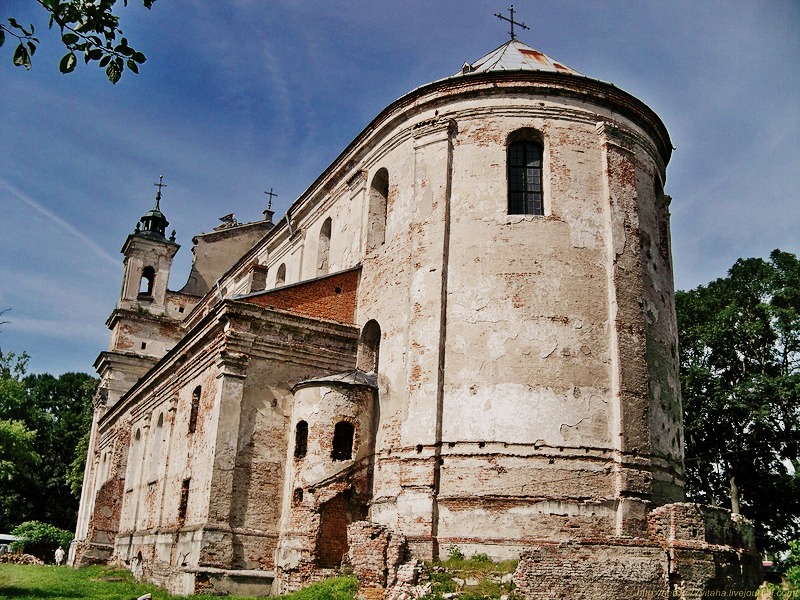
It was in Olyka that Albrecht Radziwiłł, Grand Chancellor of Lithuania, would come to rest. Here, the prince read and hunted. A devout man, Albrecht decided to make a meaningful contribution to the town’s spiritual life. At his own expense, he commissioned the construction of the largest collegiate church in Volyn — the Collegiate Church of the Holy Trinity (built between 1635 and 1640).
In the early 1990s, the church returned to the Roman Catholic faithful. The prince also supported the Olyka Hospital of the Holy Christ, which treated not only Catholics. Another Radziwiłł, Ferdynand, introduced free medical care in the early 20th century and additionally provided housing and pensions for his workers.
400 YEARS OF OWNING OLYKA
The Radziwiłłs owned the estate for nearly four centuries. Olyka Castle was one of several dozen residences of this distinguished family. Researchers dubbed it the Ukrainian Versailles due to its resemblance to the royal residence of the French kings. Over the centuries, the fortress withstood a Cossack siege, a Swedish invasion, and raids by Peter I’s troops.
The palace hosted Polish nobility as well as literary icons — the French writer Marcel Proust and the British author Somerset Maugham, who both mentioned the castle in their works, admiring its beauty. Olyka suffered major fires in 1803 and 1823. During the War of 1812, the palace was converted into a military hospital, which remained in operation until 1837. Between 1840 and 1882, the castle remained empty. Then, in 1870, misfortune struck again when the town hall burned down, along with the priceless municipal archive.
Only in 1883 did Radziwiłł’s descendant, Ferdynand Fryderyk, begin restoration work in Olyka. Construction lasted nearly 30 years under the supervision of architect Zygmunt Gorgolewski, the designer of the modern Lviv Opera House.
The palace housed an art collection that included English engravings, paintings, and portraits. For the castle, Ferdynand Radziwiłł (1834–1926) also acquired a unique library of rare editions, numbering six thousand books.
Originally conceived as a fortress enclosed by walls, Olyka Castle had no surrounding park. Ferdynand ordered the moats and marshy grounds to be drained and planted with fruit trees. The elderly gardener, Mr. Milewski, adorned the central courtyard, outer grounds, and walls with flower beds.
THE LAST HEIR
During World War I, the castle was damaged. After the war, the last heir to Olyka, Janusz Radziwiłł, modernized the palace’s interior by installing electricity, heating, and plumbing. Janusz was a highly respected figure — chair of the Foreign Affairs Committee in the Polish Senate and a three-time candidate for Minister of Foreign Affairs. As a result, the castle frequently hosted politicians, diplomats, and influential Catholics.
The Radziwiłłs retained the castle as their residence until September 1939, when Janusz was arrested. Unsurprisingly, it was at that moment that much of the castle’s unique furniture, tapestries, artworks, and historical documents were taken to Russia.
OLYKA — CAPITAL OF POLAND
At the beginning of World War II, Polish President Ignacy Mościcki relocated from Warsaw, where German forces were advancing, to Olyka Castle. For seven days, the small town in Volyn effectively served as the capital of Poland, with crucial state meetings held in the palace.
During the same war, the castle suffered yet another devastating fire. The palace and surrounding buildings were severely damaged — only the walls and vaults above the ground floor survived intact.
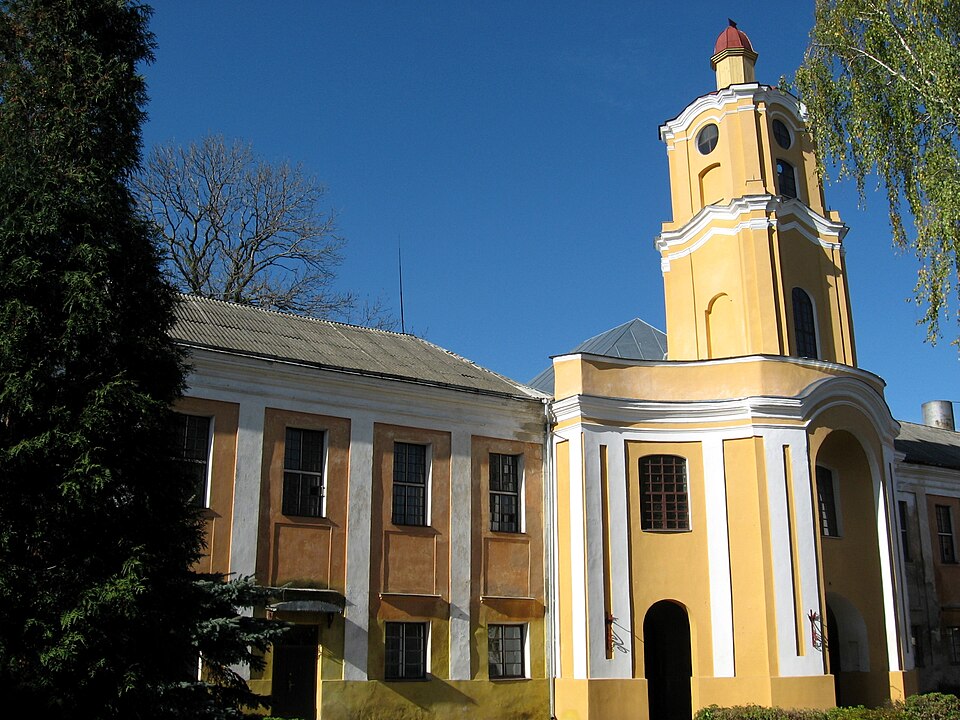
In the postwar years, the Soviet authorities nationalized the Olyka Castle. In 1957, in what had once been the ancestral seat of European aristocrats, the Volyn Regional Psychiatric Hospital was established. At that time, the interior of the castle was in dire condition. The current yellow color of the facade is also a legacy of the Soviet period. Much of the castle’s defensive architecture was significantly destroyed.
POSITIVE DEVELOPMENTS IN RECENT YEARS
However, since 2021, the castle has been managed by the Volyn Regional Museum of Local History. One can only hope that this time it will be fortunate — and that someday it will regain its former strength and allure. In its heyday, Olyka was remarkably grand, not much smaller than Lutsk. The Olyka Castle itself once featured a system of 15 underground chambers arranged in a circle, with exits leading to the neighboring church and the bastions. There is still much to be restored.
When the Ukrainian SSR annexed Western Ukraine, Soviet authorities downgraded Olyka’s status, turning it from a city into an urban-type settlement. But on April 17, 2025, the Verkhovna Rada of Ukraine voted to restore Olyka’s city status. That’s a hopeful sign. Still, we sorely miss the Radziwiłłs — with their 400 years of successful stewardship over this estate.
When copying materials, please place an active link to www.huxley.media
Select the text and press Ctrl + Enter