BORIS BARSKY: «Laughter is when the soul is still breathing»

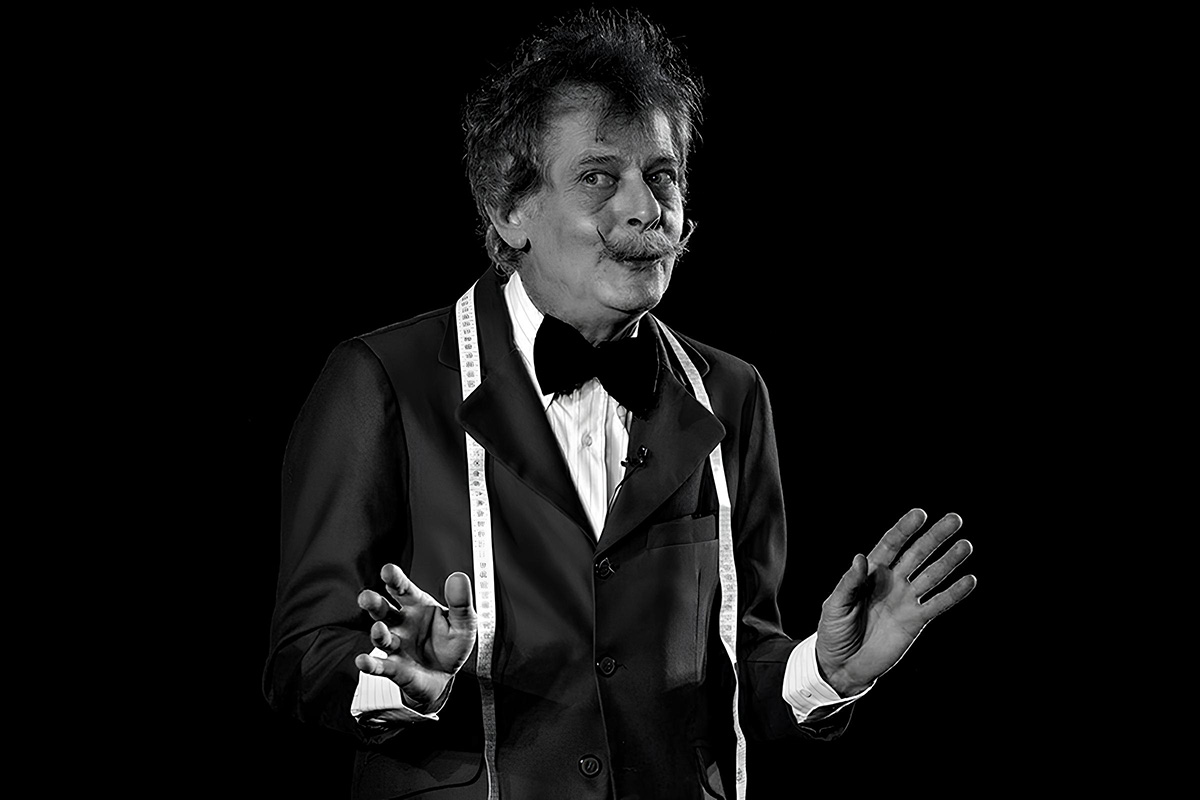
Boris Barsky. Photo by Dmitry Skvortsov
SHORT PROFILE
Name: Boris Barsky
Date of Birth: September 22, 1959
Place of Birth: Odesa, Ukraine
Profession: People’s Artist of Ukraine, director, poet, engineer-physicist
Boris Barsky is a People’s Artist of Ukraine — an actor, director, poet, and the director of the legendary Odesa theatre House of Clowns. He is one of the founders and the iconic face of the cult TV project Masks-Show, which became a symbol of Odesa humor and theatrical absurdity in the 1990s. After graduating from the Odesa Polytechnic Institute and later from GITIS with a degree in directing variety and mass performances, Barsky devoted his life to the stage. He is the author of several collections of poetry and prose, where irony, lyricism, and a subtle philosophy of the smile intertwine. Today, Boris Barsky continues to lead the theatre, perform on stage, and remain true to his belief in laughter as a force that helps us live and preserve our humanity.
As soon as you open the door, you’re already in another dimension. My gaze glides across the walls, where everything is alive — photographs, autographs, posters, jokes — and in an instant, you find yourself in a special world. A world of humor, masks, and a world of Boris Barsky. Everything around is genuine, slightly ironic, yet endlessly kind. And it doesn’t matter whether we call it the «House of Clowns» or the «Masks Theatre» — it’s immediately clear that we’ve entered a place where laughter sounds so natural, as if this is what life truly is.
Boris Barsky greets you in his office with his wide signature smile — and, of course, with a compliment. He finishes his conversation with the previous guest and then, softly and effortlessly, weaves you into the dialogue.
BETWEEN A LINE AND A PAUSE
Svitlana Pavlianchyna: When you enter your theatre, you feel a space of warmth, kindness, a bit of chaos, and memories. This sense of home — is it the result of intention or simply the nature of the theatre?
Boris Barsky: This is our air. Everything here matters: the walls, the autographs, the photographs, the objects. Every signature is a story, every item is a memory. Everything is charged with the energy of the people who have passed through this house.
S. P.: Boris, what is the most precious thing here, in this office?
B. B.: Probably these patches and letters of gratitude. There are many of them, from different military units. Some are special. One is from Valerii Zaluzhnyi — he sent it personally. And another one is from Oleksandr Usyk, with his autograph. You know, I’ve been saying from the very beginning: «We will definitely win — that’s not even up for discussion! And after the victory, our entire theatre will dance the hopak». Usyk always dances the hopak when he wins. So I thought: «Why don’t we all dance? Not just the theatre — Odesa. And then all of Ukraine!» Can you imagine: a million people, one hopak. That’s something for the Guinness World Records. And Usyk somehow heard about this dream of mine and sent a message through mutual friends: «Greetings to Barsky!» A simple story — but one that gives you goosebumps.
S. P.: There are many phrases and short expressions on the walls. «The one who plows and forges is the one who forges and plows. And the one who dances and sings is the one who sings and dances». «You cannot possess art — you can only surrender to it». What are they?
B. B.: These are my motivators. When I became a director — and I’m an artist, not a director — I didn’t have a commercial streak or a habit of «paper life». Everything developed the way a sense of humor develops — gradually. At some point, officials started coming with inspections — electrical safety, fire safety. One of them asked me what one must do in case of a nuclear explosion, and I told him: «Nothing at all. Just stand sideways against the wall — so that at least your profile remains!»
I started noticing that they all stick out their little side pocket in exactly the same way. So I came up with this: let them sit down while I «step out for three minutes». They wait — and begin reading these phrases on the walls. I come back, and I see different people in front of me — a bit kinder, calmer. And then you can talk. Humor, patience, and a few inscriptions help me run the theatre. Sometimes friends brought in phrases, sometimes colleagues: «Don’t be smarter than you are kind», «Exhale first, then think», «A hedgehog is a proud bird — it won’t fly until you kick it».
S. P.: Is there a phrase you don’t like?
B. B.: There is. «Don’t shake the green apple tree — when the apple is ripe, it will fall on its own». I can’t stand it. But it works! If you want something fast — it won’t happen. Everything ripens when the time comes.
S. P.: Being a director without losing the artist within — is that even possible?
B. B.: When I became a director, at first I didn’t realize that it meant working from morning till night. Everything here is your responsibility. One day the roof leaks, another day a tile cracks, another day the toilet is dripping. I think an artist can play anyone — even a plumber. The main thing is not to lose inspiration…
S. P.: And how many years have you been devoted to the theatre? When did you first feel you had truly given yourself to it?
B. B.: Probably when I became an actor. Although my first degree is in engineering — I graduated in ’81 and worked for three years at the Southern Center for Standardization and Metrology. And then, for New Year’s, we were invited to the Philharmonic. I was already performing on stage, and during the day I was going to my bosses, begging them to let me go. They said: «The state spent money on your education, you must work it off». And I replied: «I will work — just on another front, the artistic one».
S. P.: And you went to theatre school later?
B. B.: .: Later. That was my second education. At seventeen I had no idea where to go. A teacher at school even said I should be sent to a boarding school for the mentally disabled (laughs). But I forgave her long ago. Back then the main thing was to have a higher education and a military department — so they wouldn’t draft you into the army. And, of course, there was love. While preparing for the exams, I liked a girl — she was applying to the Energy Faculty. I decided to follow her. Didn’t guess right. She went into thermal energy, and I ended up in nuclear — the passing score was lower there. So I had to warm myself with the light of the stage instead.
WHEN THE AUDIENCE BECOMES A CO-AUTHOR
S. P.: It seems that the «House of Clowns» Theatre has become a living symbol of Odesa — not a monument, but a real, functioning joy.
B. B.: That’s pleasant to hear. I think so too. My wings immediately grow when I see the audience smiling, when they enjoy it. Odesa has always known how to laugh. Even when it shouldn’t. It’s a special trait of the city. Our humor is a separate phenomenon. It’s a way of thinking. It’s not about jokes — it’s the ability to laugh through tears. It’s Babel, Zhvanetsky, Holubenko. It’s the skill of telling the truth without hurting. Kindness wrapped in irony.
Now in our hall we have people from Odesa, Kherson, Mykolaiv. And everyone laughs. Humor unites better than any slogans. Here, everything is alive and warm. Especially before the performance — someone chats, someone hugs, someone jokes. Even our cat-painting exhibition «The Cat Gallery» is unique: Olečka Yarova creates them from old work books, newspapers, tickets.
S. P.: In every city audiences laugh differently. Somewhere quietly, somewhere to tears. In Odesa laughter lives like a native language. Do you feel this difference?
B. B.: Of course. The Odesa audience is instant. A southern temperament. They catch a joke immediately, can outshout the actor, can give a prompt. But when the war began, Odesa welcomed people who left their cities, their homes, their businesses. Now new viewers come to us — they are different. They laugh, but more quietly. As if they’re afraid to disturb others. You see that something is funny to them, but they hold back. Then they stand up, applaud — and that gratitude is special. Deep.

S. P.: Today it feels like laughing has become harder. What has changed in your sense of humor over the past few years?
B. B.: My attitude toward humor has changed. There are topics you could joke about before, but now — no. I avoid even hints of dark or bloody humor. Why? Today it’s more important to speak about what heals. We live in a binary world: there is good and evil, light and darkness, laughter and pain. But when everything merges into one continuous negativity — someone has to bring the smile back.
When the war began, the theatre closed. All theatres closed in 2022, and I would come here, to the empty hall, just to sit. Silence, darkness, no sound, no children’s laughter. I felt like I was in a morgue. Then I realized: I can’t wait. The theatre is private — which means I can open it myself. I didn’t advertise anything, just wrote a post on social media. Three solo performances. And suddenly — a full house. People came, and I hadn’t even started joking yet, and they were already laughing. They were thirsty for laughter. That’s when I understood: humor is not an ornament to life, it is breath.
There was one performance during that time with a truly unique atmosphere. When the power was cut, and we performed The Ginger City by candlelight and flashlights, the audience didn’t want to leave. Probably because home is not walls and not electricity, but people who stay together even in the dark. And that is the truth about inner light.
S. P.: If theatre is a mirror of its era, then what does today’s time feel like on stage? Has it become louder, subtler, or maybe more absurd?
B. B.: Probably all at once. Louder, quieter, deeper. My own worldview is changing — just like everyone’s. We’re becoming more philosophical. We begin to perceive life as something very fragile: yesterday is already gone, tomorrow may not come. Only one thing remains — to enjoy every moment. To live it fully, with a smile. Because there is nothing worse than when your life is stolen from you — your time, your feeling, your joy.
S. P.: You used to hold children’s festivals, comedy festivals — the theatre was literally boiling with life. Everything was buzzing. What has remained from that time? Does that atmosphere still live within you?
B. B.: Of course it does. Back then everything was breathing — the walls, the people, the children. There were many festivals, especially children’s ones. Sometimes I’d come in at eleven, and they had been here since eight in the morning. Security, administrators, staff — all exhausted, and the kids are running around, laughing, chirping. I walk in, listen, and think: «How wonderful! What an atmosphere!» And they reply: «Yes… since eight in the morning!» (smiles) It was alive. Real.
We held Comediada — international festivals, world-class. Participants came from thirty countries. On the jury was Charlie Chaplin’s son, Eugene, who gave us a photo of his father. Producers from Cirque du Soleil selected clowns here and signed contracts. There was so much humor per square centimeter that the air rang. People arrived even before the performance started and said: «I just feel like smiling».
And now, even when nothing like that is happening, I still feel that energy — from the audience, from people. I communicate a lot: from France, Georgia, Israel, the Netherlands — they call, ask how we are living. I say: «Everything will be fine, thoughts materialize. We think about victory — we will dance the hopak». And every time I say thank you: for the help, for the fact that we stand together. Even in a store, when someone comes up: «Let’s take a photo, we’re volunteers, we weave camouflage nets…» — and you understand: it’s all the same energy. The energy of life.
S. P.: For your theatre, kindness has long become a natural state. Helping, sharing, supporting — as if it were part of your nature. What is the most important thing in this for you?
B. B.: We came up with an idea — to bring people together. Not everyone can come to the theatre and buy a ticket, even in Odesa. And there are those who live far away, abroad, but love us and write: «We grew up on your shows». So we suggested this: if someone wants to help, let them simply buy a ticket. And we will give these tickets to those who truly want to come but cannot. Once we went to Horodsad to hand out tickets. I stepped out of the theatre early and saw a couple — husband and wife. They said: «So this is the ‘Masks’ Theatre! We didn’t even know». And I said: «Well, come — tomorrow is a performance».
«We would love to», they replied, «but we’re from Kherson, and right now we simply don’t have that possibility». I said: «Now you do. Let’s go — I’ll ‘accidentally’ meet you at the event and give you the tickets». And that’s exactly what we did. The next day they came, watched the performance, then found me and said: «Thank you! We had forgotten what it feels like to smile». And they gave me a little Kherson flag — the most precious thing they had. I didn’t want to take it, said: «Let it stay with you». But they insisted: «No, now it must be with you». Moments like that — that’s what it’s all for.
S. P.: Can we make people happier?
B. B.: It’s become harder. But still possible. You can’t make someone happy by force. You can only remind them that happiness is not circumstances — it’s a state of being. And you can’t offend a happy person; you can only make them laugh! When someone comes to the theatre, they’re searching not just for laughter. They’re searching for confirmation that life continues. If after the performance someone stops being afraid even for a second, smiles again — then the theatre is alive, and we’ve done our job.
S. P.: Boris, what makes you smile? What made you laugh most recently?
B. B.: A lot of things — especially improvisation before going on stage. I’m a naturally cheerful person, simply positive: I wake up — and I’m happy I woke up. For me it’s a philosophy — enjoy every moment. I surround myself with positive people and keep away from negativity. I try to live so that around me are those you want to learn from, those you want to hug.
S. P.: Oh, this phrase seems to belong to Slava Polunin?
B. B.: Yes, exactly! He spent his whole life surrounding himself with people you just want to hug. And that’s probably why that warmth always radiated from him. Slava and I have been friends for many years, we worked together. He has this gift of attracting bright, kind, genuine people. For him it’s not a pose — it’s a life principle. We keep in touch — though we don’t see each other often. I know that he and his team are with us, with Ukraine, they support us, worry about us. Even from afar you can feel it — like the light of a person who knows how to share joy.
S. P.: Do you tour? What does the stage outside Odesa give you today?
B. B.: Touring is a separate chapter. For example, Israel. We’re planning a trip in February. It’s warm, bright, and there are many of our fans. We’ll go there with the play Romeo and Juliet — right for Valentine’s Day. Our friends there — the producers from the company Class-Club Entertainment, wonderful people — invited us. The first time I went alone, without a sound engineer, without anyone. They said: «You’ll manage». I made a program like a stand-up show, everything went great. Then they said: «Now come with the whole troupe». I explained that it’s going to be «more expensive», but they insisted: «Now let’s do it properly».
THE ERA UNDER THE «MASK», OR THE LAUGHTER OF THE VHS AGE
S. P.: Boris, I’ve long wanted to ask: your unmistakable «Masks-Show» logo — these characters with multicolored hair, almost clowns, almost punks — where did it come from?
B. B.: It was Zhorik’s idea — Heorhii Deliev’s. It was the mid-80s. We were working at the Philharmonic back then. Zhorik had graduated from the Construction Institute, the architecture faculty — he drew wonderfully and, in general, did everything in a non-standard way. I remember on Komsomol Day he went to the barber shop, got himself a mohawk, dyed it orange — in 1986! Our director saw him and started stuttering: «Are you out of your mind?!» And he calmly replied: «I like it. My wife likes it. Everyone likes it. Only you — don’t». After that, of course, he was fired from the Philharmonic, but the image remained. Later the three of us — Zhorik, me, and Olya Mezentseva — took a photo together. Three clownish profiles (like Marx, Engels, and Lenin). And that’s when Zhorik came up with the idea for the logo — the profiles of «Masks-Show». That’s how this symbol stayed with us — cheerful, bold. Our sign of freedom and self-irony.
S. P.: Is there a moment in the history of «Masks-Show» or the early theatre that you would call a starting point?
B. B.: We had several such points. You know, when we got into GITIS, we had already spent six or seven years working on stage, and we had experience up to the ceiling. Everything we later read in textbooks — we had already broken through with our own foreheads in practice. I remember reading somewhere that any normal troupe lives three to five years — fulfills its mission and falls apart. With us it didn’t happen. We clung to everything: pantomime programs, «Clown Attack», touring, our «pranks» — experimental shows, films.
After performances, we would go out into the hotel lobby and perform mini-shows for ourselves, for the maids, for anyone nearby. Then we collected the best numbers and showed them to friends in the rehearsal room — watched what lived, what didn’t. Everyone had the freedom to experiment and express themselves: someone wrote poems, someone held exhibitions, someone played punk rock. Probably that freedom was our real starting point. We simply never set boundaries for ourselves.
S. P.: Do you think the audience was ready for «Masks-Show» when you came to television?
B. B.: Oh no! When «Masks-Show» first came out, the audience wasn’t ready at all. Newspapers wrote all kinds of nonsense, they criticized us. But then time passed — and everything flipped. People started to understand. We were always experimenting. For example, the performance Night Symphony is a psychedelic performance. The first time we played it, 80% of the audience left. The second time — a few years later — half stayed. And then people started writing that it was better than any drug. It was Heorhii Deliev’s idea — he directed it, didn’t like explaining much: he just said, «Do it like this». And I did. Then, when I watched the recording, I understood: there’s no need to search for meaning at all. It’s like a kaleidoscope — you turn it, and the picture keeps changing. At the core was pantomime — alive, absurd, almost hypnotic.
S. P.: You once said that «Masks-Show» was a very expensive project and that recreating it today would be impossible. Why?
B. B.: Because we did everything for real. We crashed cars, blew things up, destroyed sets, and performed a huge number of stunts. Each episode meant hundreds of scenes. It was living madness — but real.
S. P.: When you watch your old «Masks-Show» episodes — for example, The Wedding — you’re amazed: so many details, every movement, every glance is a joke. Was it all scripted, or did it happen on set?
B. B.: Back then we could spend two or three months just coming up with themes. We’d sit and throw ideas around: «Let’s do something about a hospital». — «No, about the traffic police». — «Or maybe about firefighters?» And so on, in circles. Then we’d start shooting, and it would turn out that something funny on paper didn’t work at all on set. And that’s when the real magic began — improvisation. Someone would suggest: «Let’s do it completely differently!» And that’s how the real show was born.
Take Ihor Malakhov — Hosha, who played «The Mafioso» — he was the most «fall-prone» person in the world: he could jump off a second floor just for a shot. And Deliev had iron discipline: he sat, wrote everything down, controlled every detail. One episode needed at least a hundred funny situations. A hundred! And still, the funniest ones were always born on set. Improvisation — that’s where all the juice is. When laughter comes not from the script, but straight from life.

S. P.: And who works with pantomime today — is the genre still alive, or has it faded away?
B. B.: The genre is alive. There are guys who do it powerfully — for example, the pantomime quartet DEKRU in Kyiv (amazing young people), the physical comedy theatre Mimirichi — «silent» actors with screaming facial expressions, successfully performing in Europe. But to point to one single leader is difficult now: it’s not one big stage, but many small centers — young groups, experiments. In short, pantomime hasn’t died — it has simply transformed and lives on in those who aren’t afraid to play with their bodies and invent new things.
S. P.: Is there a place for young performers in your theatre?
B. B.: Of course. A theatre must breathe, must live. I always dreamed that the best would gather here. That the stage would be open to anyone who carries light. We have young actors performing, stand-up comedians, and guys from other theatres.
S. P.: Boris, you often say that laughter is a universal language. What do people find funny today? What still brings them together?
B. B.: You know, many people write on social media now: «We rewatched your shows — they’re still funny». And they’re funny because we were having fun when we made them. If you enjoy yourself, the audience will enjoy it. For example, we have a play called Wild Forever — or, as we call it, What Men Don’t Talk About. I chased this play for seven years. It was written by the American family psychoanalyst Rob Becker. Families come to this performance — real, loving, lively couples.
This play is performed in forty countries around the world; it’s even listed in the Guinness World Records as the longest-running Broadway one-man show. And what’s amazing — in every country the audience laughs at the same things, because people everywhere are the same. The producer gave me the rights and the freedom to adapt the text to our humor, because here everything is different: not American, not European laughter, but Odesa laughter. He allowed me to add some poetry. He allowed one poem, and I read two. But that’s the truth — the performance only became better because of it.
S. P.: You often say that everything you do is infused with love. Is this your creative principle?
B. B.: That comes from my father. He used to say: «Everything beautiful is made with love». He would pause — and then add: «Just look at yourself in the mirror». I later inserted this phrase into a performance. And I think it’s very accurate. Because without love — no joke, no scene, no life will work.
LIFE IN THE INTERMISSION
S. P.: Of course, I can’t help asking about your poems — ironic, subtle, with that signature humor of yours. Your lines often appear online, in short videos and reels. How is it now? Do you still feel like writing?
B. B.: These days, I simply don’t have time for poems. Although the story behind them is funny. Most of my poems I wrote during tours — usually out of melancholy, out of that aftertaste the stage leaves behind. You’ve just performed, everyone loves you, applauds you — and ten minutes later, that’s it, the hall is empty and you’re alone. And you start fantasizing so you don’t get bored. A muse arrives and dictates. That’s how the poem «You Were Lying in a Hammock» appeared. We were filming Masks on a Picnic in Savran, Natasha Buzko was lying in a hammock, I took out a pen and paper — and wrote:
You were lying in a hammock
With a cigarette between your fingers,
And unwittingly you twisted
Something somewhere in your spine.
You were lying by the river,
Neither close nor far,
And with your lips you blew
Droplets like little bubbles.
I wanted to be a breeze,
I wanted to be that hammock,
To scratch your chest with tiny paws
Like a light-winged butterfly.
I wanted to be the river,
To caress you with my hand,
To stroke your hair and body —
How tender I could be.
I wanted to be a breeze,
I wanted to be a butterfly,
But to hell with it —
Why would I need someone
With a twisted vertebra?
I read it to Natasha — she smiled and said: «Thank you, you are kind. I love you too». My wife is always my first listener. Once I wrote a poem about love — she asked: «About me?» I said: «No». She exhaled: «Thank God».
S. P.: Your poems have that original «Barsky style», and they’re also a way to prolong a good mood… The collection Lyrisms clears the mind, and Black Kittens is a touring detective story.
B. B.: Exactly. There’s also Pretend — I wrote it for my grandchildren, but adults laugh even louder. There’s Hopscotch — plays that preserve the best theatrical traditions. All the books are alive, light, without tediousness. Like the theatre, they’re about joy, kindness, and a bit of madness. If someone wants to touch my «lyrical madness», as I call it, they can write to my assistant Alena (asmila.ok@gmail.com). She knows where the books are hidden and will send them anywhere in the world — our mail service, like our theatre, works with inspiration.
S. P.: What inspires you the most today — the sea, the city, people, or memories?
B. B.: I also have a wonderful dacha — my wife’s parents’ house. I go there and can just sit for a couple of hours, and it feels as if I’ve been on vacation. Fresh air, birds singing, crickets chirping, frogs croaking. Harmony. And I love meditating too — I turn on some music, sit, think. Listen to the silence. And I feel good there.
S. P.: And now, a true joy — small, but sincere — what is it for you?
B. B.: In 2022, on April 5, I got a little joy — my granddaughter was born. Finally it happened! She’s growing now, and she is… In Ukrainian it’s «kumедna» — funny, amusing. When she «slепит» (in Odesa dialect — says something) — it’s something special! But in general, my joy is that my friends are alive and healthy, that the people I love are happy. If they’re doing well — I’m twice as happy.
S. P.: Is there a phrase or a line that supports you right now?
B. B.: Probably our slogans. «We know how to make people happy», «Our humor heals and prolongs life». But sometimes it happens that you’ve poured yourself out on stage, made everyone laugh — and then three or four days pass without performances, and you think: «Does anyone even need this? Maybe no one needs it? Maybe you aren’t needed either?» But then you stop yourself: the sky is always there — it’s just that sometimes clouds cover it. They will pass, and it will be clear again. The main thing is to go outside, breathe the air, see the sun. Especially in Odesa — here the sun heals better than any medicine.
And while Boris Barsky says this — calmly, simply, as if in passing — it becomes clear: his philosophy truly works. He lives the way he performs: with self-irony, but without cynicism; with tenderness, but without pity. In a world that grows darker day by day, he remains a man of light — someone who knows how to carry joy.
When copying materials, please place an active link to www.huxley.media
Select the text and press Ctrl + Enter