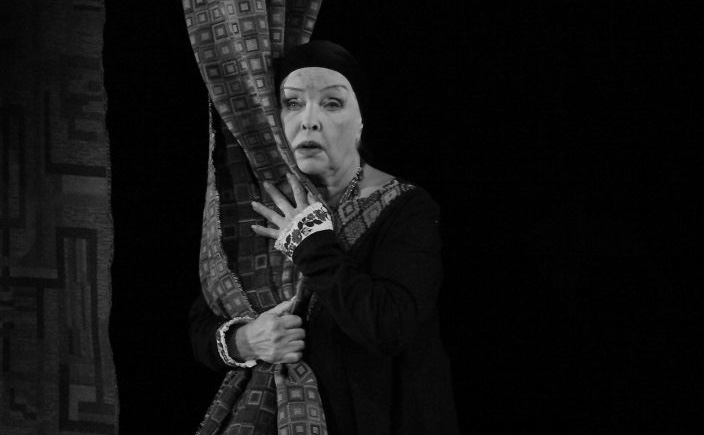
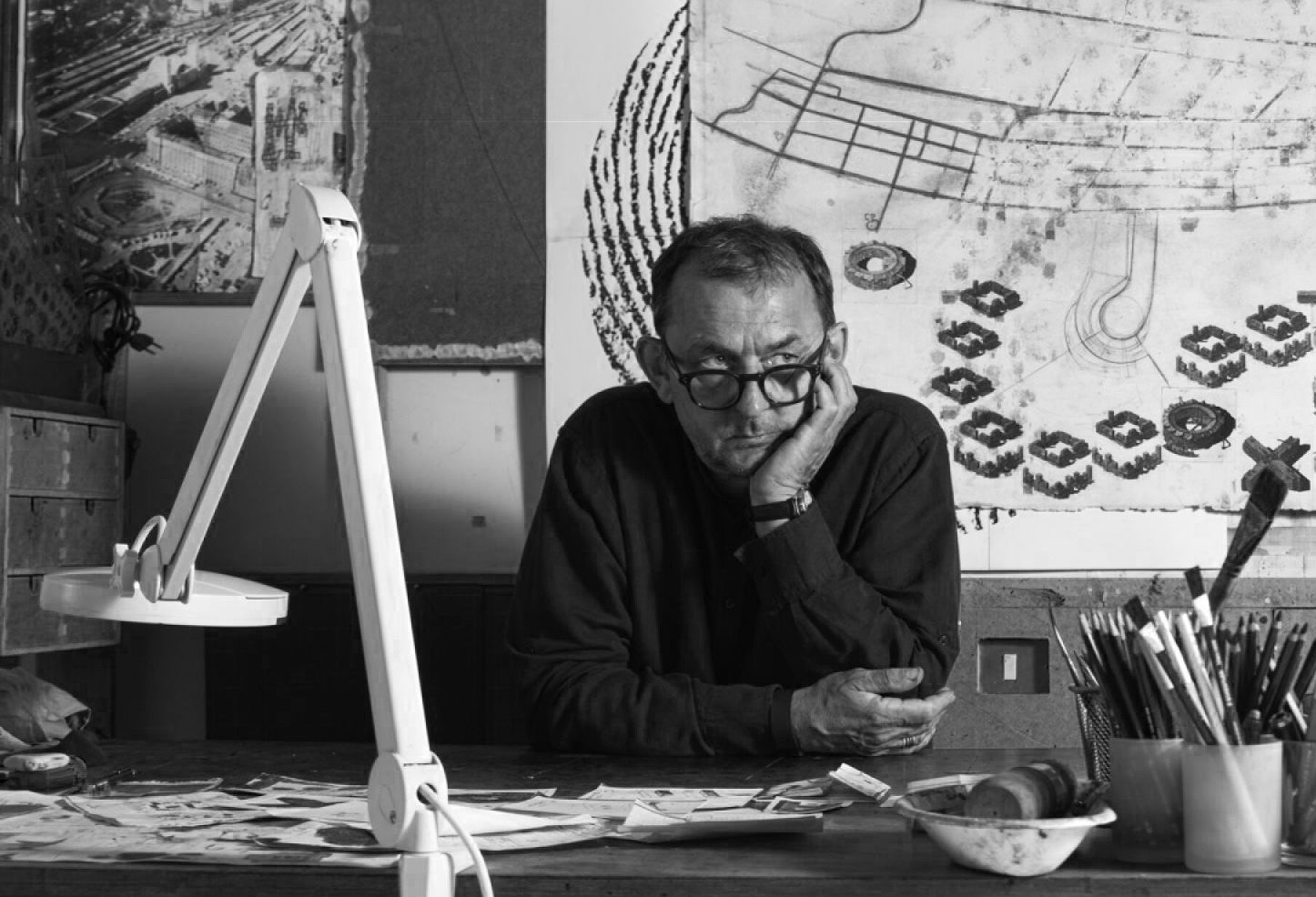
CONVERSATION WITH PAVLO MAKOV, the author of the installation «Mezha» featured on the cover of the third issue of Huxley

Pavlo Makov, Mezha, 2020. Installation. Part of the private collection of Oleh Sehin.
Pavlo Makov is a Ukrainian artist, a member of the Royal Society of Painter-Printmakers (UK) and the National Union of Artists of Ukraine, as well as a corresponding member of the National Academy of Arts of Ukraine.
He is one of the few Ukrainian artists whose works have been sold at Sotheby’s. Makov has held over a hundred international exhibitions, and his artworks are part of museum collections around the world. He is the creator of several graphic series, including Place, The Book of Days, Targets, Gardens, among others. In 2018, he was awarded the Taras Shevchenko National Prize of Ukraine.
We met the artist in his studio to talk about cultural policy in Ukraine, the technological future of the world, and why citizenship matters more than ethnicity. Pavlo Makov was born in Saint Petersburg, lived in Rivne, Kyiv, and Simferopol, and has been living in Kharkiv for nearly 40 years.
UKRAINE IN THE REALM OF SHADOWS
O
ur country has yet to emerge from the realm of shadows. Ukraine has been an independent state for 29 years. Before that, it spent centuries striving for independence — but never quite succeeded.
Where should we begin counting history? With Kyivan Rus? But is Kyivan Rus Ukraine or the beginning of imperial Russia? This question can be turned in any direction.
The fact remains: we were a province of various empires — Austro-Hungarian, Polish-Lithuanian, Russian. We can beat our chests and shout that we stand on our own, but that’s not true. Even Shevchenko lived and created within an empire. He loved Ukraine, wanted freedom for it — but in reality, it didn’t exist at the time.

Now parts of former empires have found themselves within one independent state — and that’s no easy task. We all suffer from a denial of the obvious: that Ukraine is still in the process of formation — not only institutionally and politically, but also creatively and intellectually.
We beat our chests, yet we smuggle sacks of amber across the border. A friend of mine from Lviv put it well: «Look, they’re all Ukrainians, but every third one has either a Hungarian passport, or a Polish passport, or a Polish Card, or even a Romanian passport. Just in case. So they’re already ready to leave, if anything happens.»
When you look westward from the East, you long to be there. But when you look westward from Lviv, all you see is the Polish border — you no longer see what’s to the East.
When the war began, people didn’t say it out loud, but deep down they were thinking: «To hell with it, that whole Left Bank Ukraine! If only we could ‘become a little Polish’ over here on the side.»
And our people in the East, conversely, longed to «become a little Voronezh,» «a little Kursk,» or even «a little Moscow.»
A PLACE THAT DOESN’T EXIST
Unfortunately, Ukraine does not exist on the cultural map of the world. In 2001, I received the «Golden Book» award in Tallinn at an international artist’s book exhibition. At the reception, a Japanese woman asked me, «Ukraine — where is that?»
I replied, «Europe,» and started teasing her, saying something like, «It’s near Tallinn, just 1000 kilometers to the south.»
And that’s when I had the thought: Ukraine is a utopia. Not in the sense of «a perfectly ordered state,» but in the literal meaning of the word: utopia — a place that doesn’t exist.
What has Ukraine done in the realm of culture over the past 29 years? We still don’t have a national museum of contemporary Ukrainian art. If you want to see what artists are creating, you have to visit their studios. The cultural attaché of Ukraine in France doesn’t even know who Serhiy Zhadan is.
Maybe she’s well-versed in French literature, but she has no idea that there’s a Ukrainian writer translated into 29 languages.
The cultural sociologist Hélène says there are three pillars: politics, economy, and culture. Without the third, the other two don’t function. Even the problem of corruption is linked to the absence of culture.
Civilization exists only where philosophy lies at the heart of high culture. The moment this core is removed, everything begins to fall apart.
And here, they’re removing a plaque from the house where Demian Shevelov lived — a world-renowned philologist and linguist. Many 20th-century philosophers started out as philologists. The entire structuralist movement began there. And yet, paradoxically, local officials say: «Why do we need Shevelov?»
Today, every country is fighting for its cultural heritage. In Vilnius, I heard locals say that Mickiewicz was a Lithuanian poet. Yes, he lived in Vilnius, but he wrote in Polish. And what about us?
All our culture belongs to various ethnic groups who lived on the territory of former empires. We should be putting up memorial plaques noting that Malevich lived and taught in Kyiv — but at the same time acknowledge that he was part of the Russian Empire, and that much of what he created was shaped by it.
Mamardashvili once said that Russia is «a country of eternal repetitions.» Ukraine isn’t much better. There is no shift. Because that’s the mentality. But even the mentality of Russian-speaking Ukrainians is different from that in Russia. The Russian mentality says, «We’re fine with this.» The Ukrainian one says, «We’re not fine with anything.»
I deeply want Ukraine to emerge from its utopia, and I’m doing everything I can to make it happen. But in 29 years of independence, the people have not elected a single politician who has seriously considered how to lead this land out of the realm of shadows.
ON ONE’S PLACE
Since 1993, I’ve been working with the concept of place. When the Soviet Union collapsed, I made a conscious decision to stay in Kharkiv. To put it mildly, I didn’t enjoy living in the USSR, and I realized that in Ukraine I had a much greater chance of living the way I wanted to.
Ethnic origin was the last thing on my mind. At that time, all I cared about was my citizenship.
I realized I had to stay here and «tread out» my own place. At the time, I was inspired by an exhibition of Morandi’s etchings in Glasgow. I saw how a person could create masterpieces from just two simple things: still lifes in a studio and the view from a window.
I’m not from Kharkiv. I don’t have sentimental childhood memories tied to it. I understood that Kharkiv was an average industrial city. In the 1920s, when Theodore Dreiser traveled through Russia, he said, «This is your Soviet Chicago.»
And I was trying to understand how to live in the Ukrainian Chicago.
CRIMEA AND DONBAS
Maybe I’m wrong from a geopolitical point of view, but Crimea is not Ukrainian territory. I lived there for 10 years. I’ll share an unpopular opinion: Ukraine actually benefited when Crimea was taken. Culturally and mentally, Crimea was never truly Ukrainian. There are 2.5 million people living there with a different mindset.

Forcing us to stay together is like pouring water into gasoline: gasoline is good, water is good, but the car won’t run.
As for Donbas, the commission should include not only those who still live there — though I’m sure there are true patriots of Ukraine among them — but also those who left. They’re from Donbas too. Those who left are our people, even if they don’t speak Ukrainian.
Trying to reclaim these territories is an absurd decision. From a territorial standpoint, annexation is a violation of every possible rule since World War II — but from a mental standpoint, it’s not. Of course, this is the result of failures by those who had been dealing with Ukraine for years before the conflict.
The focus should have been less on Lviv and more on Crimea and Donbas. And now, maємо те, що маємо — we have what we have.
IF I HAD A MAGIC WAND
I’m an artist, and in that sense, an individualist. I understand that it’s not so much about material resources as it is about mindset. If you have the will, you can do with ten hryvnias what someone else couldn’t do with ten million.
Education is the first and most important thing — in the broadest sense of the word.
Because it determines what the country will be in ten, fifteen, twenty years. You can’t be stingy when it comes to education; it should be accessible to the smartest, most dedicated people.
Today, experience on its own holds little value: you can find information with a single click. But without the individual, information is nothing.
Sources give us dry facts. It’s the person who shares knowledge that turns it into your experience. My father used to say: «When I give lectures, I don’t talk about what’s in the textbook. I talk about my personal experience — what isn’t written in books.»
ACADEMIC SCHOOL AND CRAFT
In Ukraine, we have three serious art universities: in Lviv, Kharkiv, and Kyiv. Since Soviet times, there’s been a trend: Kharkiv is especially strong in training graphic designers; Lviv offers excellent education for applied arts, particularly for glassblowers, and it also has a printing institute that teaches book design; and Kyiv has a bit of everything. Kyiv acts like a magnet, attracting many talented people.
Many great artists never relied on academic training. In the Picasso Museum in Barcelona, you can see drawings he made at the age of 14–15. At that age, he had already completed his academic education, and afterward, he simply did whatever he wanted.
No one can accuse Picasso of not knowing how to draw — his early works are fantastic. He was incredibly gifted, which is why he finished academic schooling so early. Van Gogh, on the other hand, was self-taught. He made many copies, and his talent enabled him to become a brilliant draftsman.
Craft is one of the ten components of success.
A talented person needs to learn it — and then forget it. Less talented people, unfortunately, are unable to do that. It’s hard to predict who needs art school and who doesn’t. I can’t say that someone won’t become an artist without academic training, just as I can’t claim that academic training will turn a talented person into an artist.
ON MENTALITY
I don’t know why this kind of mentality developed in Ukraine. I’m part of it too, whether I want to be or not. I think its roots lie in a slave-like perception of the world, in an unwillingness to take responsibility.
People here are gripped by a fatal thirst for stability — a stability that, in truth, doesn’t exist anywhere in the world.
Stability exists only as long as you keep pedaling — stop pedaling, and you start to fall.
People around the world have now settled into a horizontal position. Since World War II, we’ve been living in a relatively peaceful environment — and that’s created the illusion that it will always be this way. But that’s impossible, because geopolitical issues are laughable compared to what awaits us due to climate and environmental change.
Even the most fervent activists fighting for the planet are, in a sense, hypocrites — because they’re not really thinking about the Earth itself, but about how we can continue living on it. The Earth will be just fine without us.

A vivid example of this is Chornobyl. Wolves roam there, carp swim, trees grow. I have a project called Fountain of Exhaustion, which I created back in 1995. Unfortunately, it hasn’t lost its relevance. I made it based on a feeling — and even then, exhaustion permeated the entire society. Now it’s even more visible, and this applies not only to Ukraine.
«YOU CAN’T BE A FAMOUS ARTIST FROM AN UNKNOWN COUNTRY»
I’m an artist, and an artist only feels. I don’t draw conclusions, I don’t analyze — I sense. What sets an artist apart from most people isn’t the ability to draw or compose music. It’s the ability to feel more subtly — and to express it.
Artists, writers, poets, musicians — they’re all just instruments.
My work is a tool for conveying certain thoughts to others. The real result of my activity is not what’s drawn, but what happens to a person when they see it.
The role of the state is to gather all these instruments, take them out into the world, and show them to others. It was only three years ago that we finally got an institution responsible for representing Ukrainian culture abroad.
People have often asked me: «Ukraine? What do you have besides yourself?»
So I set myself the goal of creating my own website — at least to say something about Ukraine, because as a whole — we simply don’t exist.
It’s hard for me to answer the question: «How did recognition come to you?»
In 1986, my free life and free work began. That’s when I realized that if I wanted to do what I loved, I had to figure out how to finance it.
If the artist Makov was going to sit in the studio, I had to buy him materials and support his family. What helped me enormously was my knowledge of English — something very rare at the time. I’d find addresses for exhibitions in books, write letters, send in my work, win awards.
But you can’t be a famous artist from an unknown country. It’s like singing on a stage in total darkness: no backdrop, no beautiful set.
What is this voice, where is it coming from, and what else is there besides that voice?
Everything that’s been done abroad has either been my personal initiative or the initiative of those who invited me — it has never come from the state.
Over the course of my entire career, there was only one occasion — back in 1998 — when a cultural attaché attended my joint exhibition with David Rhys Davies in the UK.
To make Ukrainian art interesting abroad would require titanic effort from the state. But we have neither a civil society, nor government programs, nor any understanding of cultural policy. Ukraine’s cultural image is utterly nonexistent.
Look at how Russia, after the collapse of the empire, wrapped itself in all that cultural background. It pursues a very aggressive cultural policy — in a good sense.
They rent out the Guggenheim Museum in New York and exhibit everything from Rublev’s icons to contemporary Russian art, along with world-class collections assembled by Russian industrialists and works by outstanding artists.
They understand that without culture, nothing else — economy included — can thrive.
Art and culture are the bonds that unite not only hearts and souls, but entire societies and nations.
And here — we have nothing.
CITIZENSHIP AND ETHNICITY
To me, citizenship is far more important than ethnic origin. A nation is also a civic concept — it’s made up of different ethnic groups, so the formation of a nation must take individual identity into account.
I don’t like it when people say, «This is Ukrainian art, and this is not Ukrainian art.» Because everything created by people in Ukraine — regardless of their background, and especially their ethnicity — is Ukrainian art.
I believe that if Ukraine has a future, it lies in civil society, not in ethnic identity. We started building a nation very late. While others are already thinking about how to live as separate cities, we are still trying to figure out how to become a country.

ON HOW THE WORLD IS CHANGING
There’s a well-known Italian writer, Baricco. Not everyone in Italy is particularly fond of him, but I would recommend reading two of his books: The Barbarians: An Essay on the Mutation of Culture — a collection of his newspaper columns — and The Game.
These aren’t works of fiction. The first was written a year before the iPhone appeared, and the second in 2018, when the world was already completely permeated by the Web. While the first book describes how the world begins to change, The Game explores what has happened over the last 30 years.
I recommend starting with The Barbarians, because there he gives a few simple examples: how, instead of French, Italian, or Spanish wines, suddenly wines from Australia, California, and New Zealand appeared — and why, on average, they became quite good.
Or why the best football players suddenly started being benched. Because no one needs the best players anymore!
The point is not whether you can skillfully dribble past three defenders like Pelé did — the point is whether you can make the pass that lets someone completely unknown score the goal.
Baricco himself says his books are becoming outdated — that artificial intelligence is what’s coming next. Everyone’s afraid of chips, but they don’t realize they put their chips in their pocket every morning. My iPhone can tell you absolutely everything about me.
There’s no need to fear the loss of privacy — it’s already gone.
ART AS SHOW
The fact that art has turned into a show is undeniable. A new contemporary art museum recently opened in one of Ukraine’s cities. I followed them on Instagram not long ago. They had invited me several times to do an exhibition, but I declined.
It’s a complicated process: you have to gather the works, borrow them from private collectors, transport them. And then recently I got a notification on Instagram. They posted a story saying they urgently needed an installation on a specific topic — within a week.
What do they mean, «urgently need an installation,» and they’re announcing it like that? As if someone’s just going to quickly sketch something out on their knee and call it an installation!
We’re suspended between two paradigms. On the one hand, we use iPhones. On the other, I’m deeply connected to my craft. Because my etchings and drawings — despite dealing with contemporary issues — are, at their core, a very medieval craft.
Back in 1993, I saw a notice in London about a massive international computer graphics exhibition. At the time, that was something truly incredible, so I decided to check it out. When I walked into the first hall, my jaw dropped — I realized that this was something you simply couldn’t create by hand.
I looked through a few more works with admiration. By the fourth one, I was bored. Different minds, different hands — but the essence was the same.
A pencil line drawn by a human hand is absolutely unpredictable. But all of them were working with the same set of computer algorithm phrases.
ON VALUES
People today don’t want to pay for brains. Not just artists, but scientists too — for anyone, really. The only reason they pay IT specialists is that those brains make games. And for games — they’re willing to pay.
Unfortunately, we live in a society where your value is determined by whether you have an iPhone and an expensive car. That’s seen as proof that you’ve got something in your head — since you managed to earn it.
But I’ve always said: the true quality of life lies in your circle of communication. Not the shirt you wear, not the car you drive, not what you eat or drink. You can earn millions and still exist in a toxic, nasty environment. For any decent person, it’s always more pleasant to give than to receive — because in giving, you find joy.
Interview by Zhanna Kryuchkova and Oles Maniuk.
To understand my attitude toward the world, I want to share a quote from Italo Calvino’s novel Invisible Cities:
— Everything is in vain if, one way or another, we are headed for the infernal city, which pulls us in ever more tightly, like a whirlpool.
— For those who live today, hell is not something that lies ahead — if it exists, it is already here, it is what we live in every day, it is what we create together.
There are two ways not to suffer from it.
The first is easy for many: to accept hell and become part of it, to the point that you no longer notice it.
The second is risky and demands constant vigilance and reflection: to recognize in hell who and what is not hell — and to help them endure, give them space, and make them last as long as possible
When copying materials, please place an active link to www.huxley.media
Select the text and press Ctrl + Enter