BORIS BURDA: How to Quickly Repair a Lunar Rover’s Wing


Apollo 17 mission, December 12, 1972. Mission Commander, astronaut Eugene Cernan, performs a brief inspection of the Lunar Roving Vehicle (LRV) during the first extravehicular activity (EVA-1) / wikipedia.org
ATTENTION — QUESTION!
During the Apollo 17 mission, Commander Eugene Cernan accidentally struck the fender of the Lunar Roving Vehicle (LRV) with the geological hammer attached to his belt, breaking it off. But the rover was successfully repaired using an item that somehow found its way into the astronauts’ equipment — no one had planned to bring it. After that, however, it became standard equipment on subsequent missions. What was it?
ATTENTION — THE CORRECT ANSWER!
Ordinary Scotch tape — adhesive tape.
OUTSIDE THEIR FIELD OF EXPERTISE
I
t is now well known that major discoveries are often made not by specialists who have devoted their lives to studying a particular problem, but by people from entirely different fields, sometimes ones far removed from the subject at hand. Perhaps such amateurs simply do not know that what they are attempting is supposedly impossible, whereas professionals do. There is no shortage of examples. The painter Samuel Morse invented the practical code for long-distance communication, the dentist Antonio Meucci devised the telephone, the physician John Gorrie gave humanity the refrigerator, and the printer Benjamin Franklin protected us from lightning with the lightning rod. The list goes on. Likewise, the company 3M, within whose walls this remarkably useful invention was created, was originally focused on entirely different goals.
Not so long ago, in 1902, five businessmen from the American state of Minnesota joined forces to manufacture a rather straightforward product — sandpaper. A business like any other. That is how they came to be known as 3M, an abbreviation of their full name, Minnesota Mining & Manufacturing. There was nothing surprising about that: the Mesabi Iron Range, located in the state, produces more than half of all the iron ore mined in the United States. The company began by manufacturing abrasives, purchasing a corundum mine for that purpose. The mine proved unprofitable, so they decided to produce abrasives from Spanish garnet, another sufficiently hard material. But the garnet-coated sandpaper performed poorly — the garnet simply flaked off, and they could not solve the problem. Something had to be done…
THE COLLEGE DROPOUT
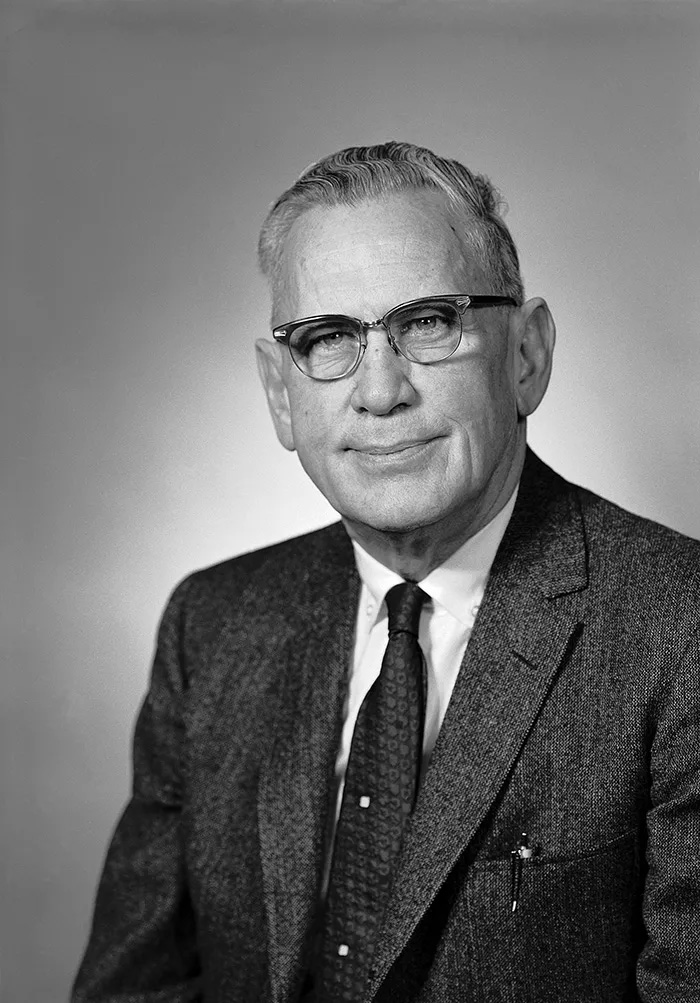
Richard Drew began his career far from the path of technical innovation, earning a respectable income playing the banjo in youth orchestras. After saving enough money to pay for his education, he enrolled at the University of Minnesota, where he managed to study for a year and a half before dropping out — he found it boring. But even bored young men need to earn a living. When Drew came across a newspaper advertisement announcing a job opening at 3M, he applied. He honestly admitted that he had never worked for an employer before, but was eager to start and willing to accept any salary. He added that he was physically strong and knew how to drive a tractor. He got the job. To begin with, the inexperienced newcomer was assigned the lowest-level task — investigating complaints about the quality of abrasive paper. One of its principal customers was auto body shops.
There, Drew encountered a new fashion: two-tone automobiles. How could painters keep one painted section from being stained by the second color? It turned out to be far from simple. To create a clean boundary between the two colors, the already painted area was masked off — sometimes with ordinary newspaper, sometimes with parchment paper, but most often with heavy-duty surgical adhesive tape. Newspaper came off easily but left uneven edges; surgical tape was extremely difficult to remove, and when it did come off, it rarely produced a straight line. In either case, the result looked sloppy. It was then that Drew began thinking not about his immediate duty — selling sandpaper to smooth out those uneven edges — but about a more ambitious solution: creating an adhesive tape that would stick firmly yet peel away cleanly without spoiling the paintwork. After all, the company had already accumulated considerable experience in manufacturing adhesive tape.
NAMED AFTER MISERS
The strength of the tape used to mask already painted surfaces tended toward extremes: it was either far too weak or, in the case of surgical tape, unnecessarily strong. Drew therefore set out to find a golden mean, especially since the company already had impressive experience in manufacturing various kinds of adhesive tape. At the same time, he saw an opportunity to cut costs. What is the most expensive part of adhesive tape? Presumably the adhesive itself. And how much of it is actually needed to keep the tape in place? Very little. So why not apply the adhesive only along the edges of the tape? That would require much less of it. Then, once the painting was finished, the tape could simply be pulled off in a single motion. The savings were indeed enormous — almost folkloric in scale. And who, according to folklore, is famous for being exceptionally thrifty (not to say stingy)? In Slavic folklore, that distinction belongs to the inhabitants of the Bulgarian town of Gabrovo. But we are talking about the English-speaking world. There, the archetypal miser is the Scot. Locally, that meant Scotch. And so the new tape acquired its new name, which quickly caught on and was eventually applied even to adhesive tapes with glue covering the entire width of the backing. Admittedly, because of the shared name, adhesive tape was often confused with Scotch whisky, giving rise to the saying: “Send a fool to buy Scotch, and he’ll come back with adhesive tape”.
NEW IDEAS DO NOT WIN OVERNIGHT
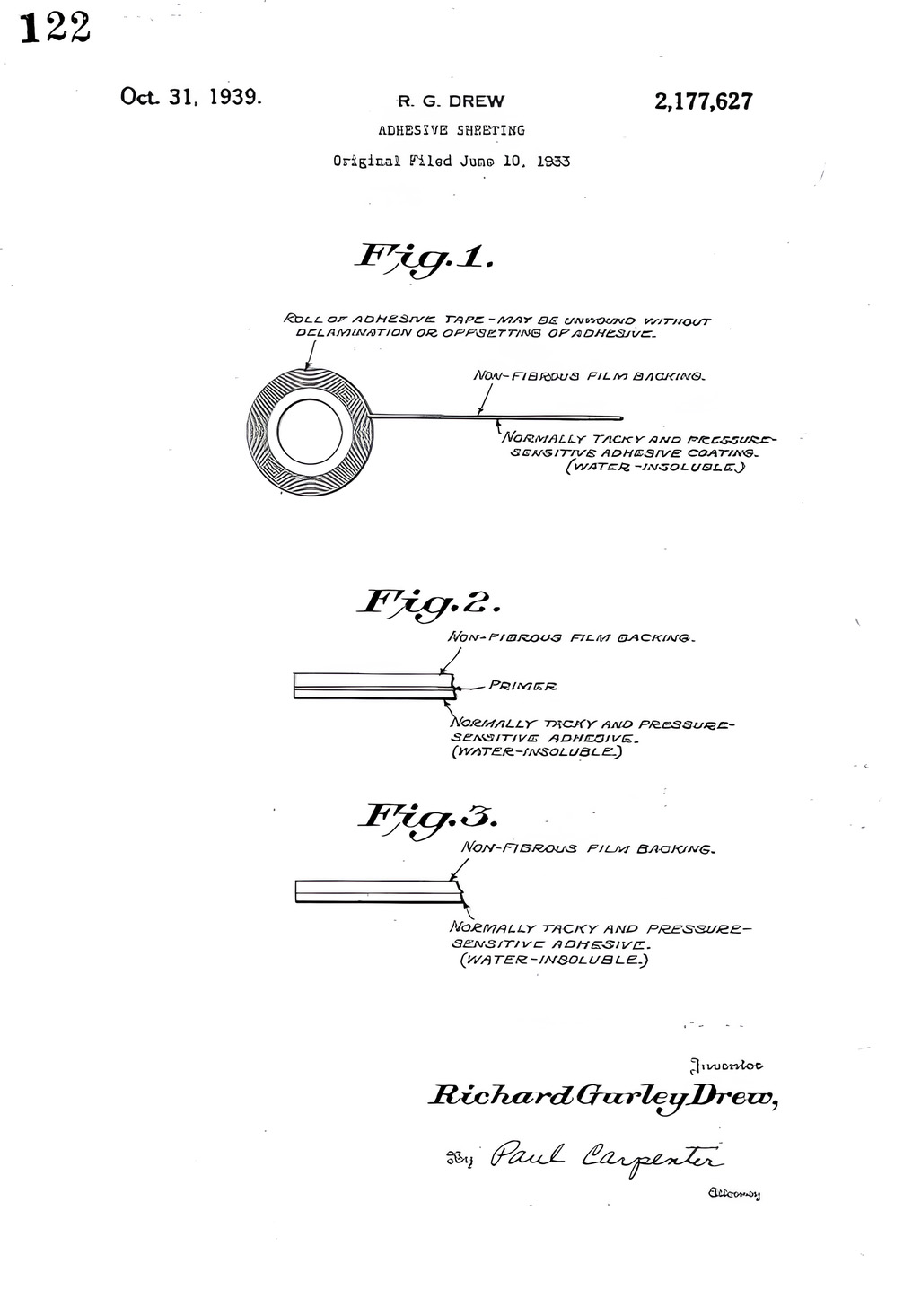
As is often the case, Richard Drew’s success brought him new problems. After all, no one had asked him to invent a new tape to improve automotive painting. And who, then, was supposed to sell sandpaper to body shops? His supervisor even forbade him from purchasing the machinery needed to manufacture the new tape — company policy prohibited buying anything costing more than $100. Drew found a clever workaround. If new equipment could only be purchased for less than $100, then why not buy it in several separate pieces? No problem. They made multiple purchases, assembled the machine from the individual components, and before long the quality of automobile painting had improved dramatically, while Drew’s reputation continued to grow. But he did not rest on his laurels. Soon he took another step forward. Around the same time, 3M’s competitor, DuPont, invented cellophane. Drew realized it could serve as the perfect backing for a new kind of tape. The idea did not succeed immediately, but it eventually worked. In 1930, the new Scotch Transparent Tape was introduced to the market. Who would need such a product during an economic downturn? As it turned out, many people. Instead of buying new things, they repaired old ones. Scotch tape was used to mend worn books, curtains, windows, and even holes in clothing. Secretaries repaired broken fingernails, bankers patched torn banknotes. Farmers sealed cracks in eggs, housewives fastened bait to mousetraps, made covers for milk containers, and removed lint from clothing — and it all worked.
THE IMPORTANT THING IS TO START!
During the war, Drew became head of a special production laboratory that, among other responsibilities, worked on projects for the military. His colleagues at 3M nicknamed it the “Funny Farm” and regarded it with little respect, believing it produced very little of value. Yet during the war alone, the laboratory developed more than one hundred types of adhesives, tapes, and abrasives for military use. Drew also introduced a new concept that would later be adopted by many companies, including Google: employees were allowed to devote up to 15 percent of their working time to developing their own ideas. It turned out that this was not a loss for the company but a direct source of profit. Incidentally, no one cared about formal education when recruiting people into Drew’s laboratory. One of his colleagues later recalled: “He created greenhouse conditions for us — a kind of autonomous creative laboratory where we could do whatever we wanted and conduct any experiments we pleased. He knew that if you put a group of eccentrics into an atmosphere of complete freedom, interesting things could come out of it”. It always works that way. Go back to the beginning of this article, and you will remember that Scotch tape proved useful even in space. Even today, the giant corporation 3M derives roughly 20 percent of its revenue from manufacturing the vast array of Scotch tape products. And it all began because one talented young man was never forced to toe the line.
When copying materials, please place an active link to www.huxley.media
Select the text and press Ctrl + Enter