BORIS BURDA: How to remove a foreign player from the field

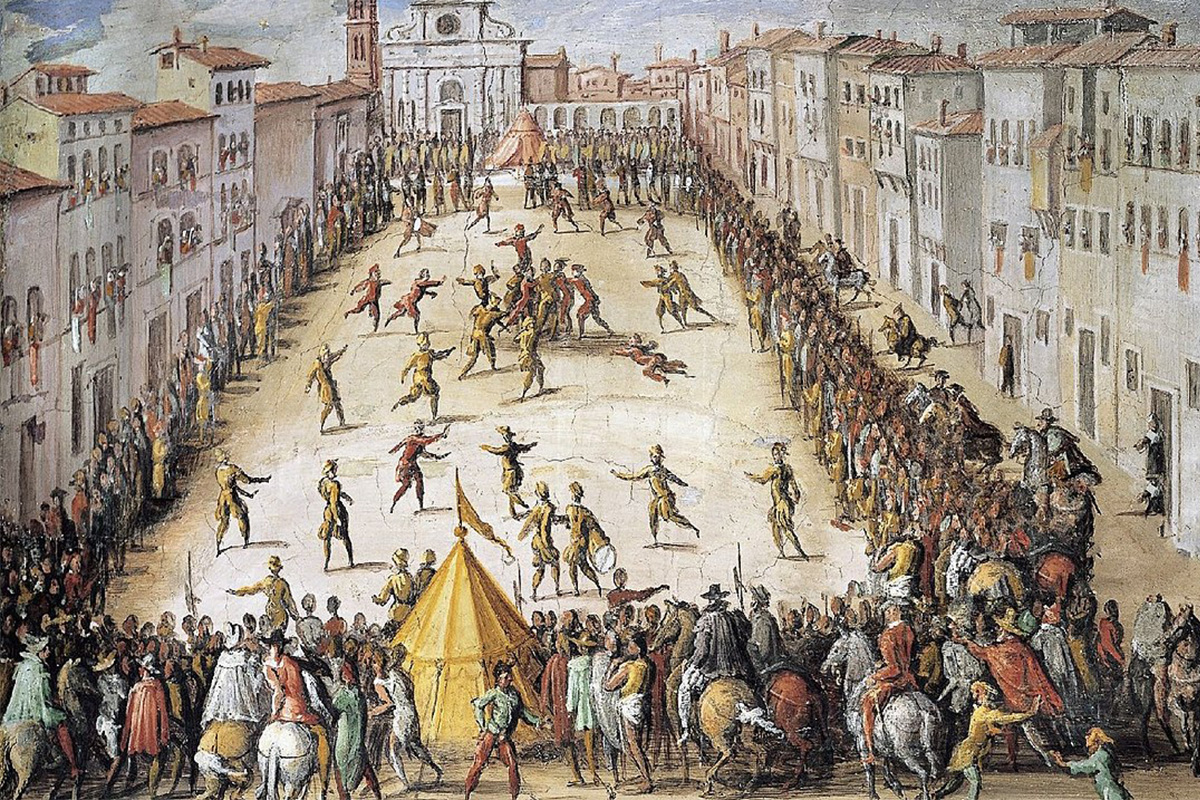
Giorgio Vasari. «Football» match on Piazza Santa Maria Novella in Florence, between 1561 and 1562 / wikipedia.org
ATTENTION — QUESTION!
In English football, it is sometimes called an early bath. What exactly?
ATTENTION — CORRECT ANSWER!
A red card — take it and head for the shower earlier than everyone else…
FIRST REFEREES
G
ames resembling football appeared in the ancient world and in Ancient China long before our era (cuju, episkyros, harpastum), and in England, people played a game — a prototype of football — at least since the times of the Norman conquest. But the first mention of the need for a referee on the field dates back to as early as 1581.
Its author was the priest, lexicographer, and head of elite schools Richard Mulcaster, who is even said to have coined the very word football. He was the first to write about a «judge over the sides» who would be able, in the most natural way, to eliminate possible inconveniences arising during the game.
When modern football was being formed, referees appeared almost immediately — already in 1842, a referee was mentioned in the description of a match in the town of Rochdale. Some believed that referees were unnecessary in football — gentlemen would settle any doubts among themselves. But experience showed that relying on this was too costly.
Referees developed their own system of signals for players — at first, to attract attention, they carried a small bell; then, an amateur referee, who worked as a policeman, brought a whistle to a match, and this turned out to be very convenient. Later, universally recognized gestures appeared, allowing referees to convey their decisions to the players.
Now players know that if the referee points to the corner flag — there will be a corner kick; if he blows the whistle and raises his arm — it’s an indirect free kick; if after the whistle he points towards a team’s goal — a direct free kick is awarded against them; and if he whistles and points to the penalty spot — it’s a penalty. And there are other signals as well…

A TENSE SITUATION
The system of universally recognized gestures developed historically and far from immediately, and some situations — the most problematic ones, in fact — remained outside of it. For example, the toughest refereeing action, sending a player off for a serious foul, was usually expressed verbally by the referee. Just so that no one could pretend not to understand what was happening…
That would be fine — if the offender got stubborn, one could simply throw them out by force, and there would always be people ready to help at any match. But already in 1872 the first international match England vs. Scotland took place, and in 1901 the England national team defeated Uruguay in Montevideo, winning the first international match outside the British Isles — and off it went…
Very soon, referees from a third country started being invited to officiate international matches — an extra safeguard of impartiality. At the same time, a referee was not at all required to speak the languages of the competing teams. In such cases, universally recognized gestures were what saved the day — footballers all over the world knew them. But what to do about situations that had no gesture at all?
It is surprising that such an incident was recorded only in 1966 during an England vs. Argentina match. The Argentine player Rattin committed a rough foul, and the German referee Kreitlein sent him off — in his native German, of course. But Rattin refused to understand German, and it took a whole ten minutes to get him off the field — even with the help of the police…
LIKE A TRAFFIC LIGHT
The problem worried many — after all, you couldn’t possibly bring two interpreters onto the field along with a foreign referee just for international matches! It concerned the British international referee Ken Aston as well. At the time, he headed the FIFA Referees’ Committee, was present at that very match, and understood how real the problem was.
They say the solution came to Ken Aston while he was driving his car. Whether he wanted to or not, he had to pay attention to traffic lights. Green means go, yellow warns, red forbids… remarkably similar to what needs to be communicated to players — and without any translation!
The referee’s wife, Hilda Aston, took a practical part in solving the problem by creating what was meant to send the right signal to players — yellow and red cards made of thick paper. Hilda Aston selected the size of the cards so that they would fit comfortably into the breast pocket of her husband’s referee shirt.
Yellow and red cards were sometimes confused, which led to problematic situations. A simple and effective solution was eventually found: keep the yellow cards in the shirt’s breast pocket, and place the red cards in the back pocket of the shorts. As a result, the Germans began to call the red card Arschkarte (Arsch — meaning, pardon, «butt»).
PRACTICAL APPLICATION
The first yellow card in history was shown during the opening match of the 1970 World Cup to the Soviet footballer Kakhi Asatiani. Red cards are a bit more complicated: at World Cups, the first one was shown to Chilean player Carlos Caszely in 1974 during a match against West Germany. Clearly, at lower-tier tournaments others had received them earlier, but it is unclear who exactly…
Reactions to red cards were sometimes extremely emotional. José María López Silva, a player for Real Madrid’s farm club, reacted so violently after receiving one that the commentator suggested he should switch to boxing and meet Mike Tyson. Yes, exactly what you think happened — he bit the referee, and quite painfully.
A similar but much more altruistic reaction came from Fernando d’Ercoli, a player for the Italian club Pianta. He snatched the red card from the referee and mercilessly ate it. He did, of course, have to leave the field, but no further dismissals were recorded in that match — the referee simply had nothing left to show.
Red cards are used rarely: their lifespan is over 10 years, significantly longer than that of yellow ones. But sometimes they still get some work — in 2011 in Argentina, during a match between Claypole and Victoriano Arenas, the referee sent off all players, both starting and substitutes, as well as the coaches: 36 dismissals in one match, an unbeatable record!
By the way, not only referees can show such cards. The famously scandal-prone footballer Paul Gascoigne found a yellow card lost by the referee and, of course, showed it to him — «don’t lose it!» The referee reclaimed his lost property and immediately showed Gascoigne a yellow card — «don’t get cheeky!»
And it’s not only players who can receive a red card. In 2005, during a match between Peterborough North End and Royal Mail, the Peterborough goalkeeper tried to explain to the referee that the goal had been scored against him with a rule violation. Referee Andrew Waine responded with terrible profanity — but then came to his senses, pulled out the red card, and showed it… to himself!

DEVELOPMENT OF THE IDEA
The red card has become not only an instrument, but also a souvenir. During a reception with President Kirchner, Argentine referee Elizondo presented him with a valuable gift — the very red card he had shown to Zidane in the 2006 World Cup final, when Zidane head-butted the Italian Materazzi who had insulted him, was sent off, and France lost.
Some people find the two standard cards — red and yellow — insufficient. Former UEFA president Michel Platini proposed introducing an additional card, white (or orange), for situations where a warning is not enough but sending a player off is still too much. A player receiving such a card would leave the field for 10 minutes — as in hockey.
If the number of cards is to be expanded, the first idea that comes to mind is a green one — this color is also on traffic lights but has not been used yet. It is suggested for cases when a player does something good rather than bad — for instance, voluntarily points out their own foul. The first such matches have already been played, though this practice has not become popular yet.
In general, people have become so used to cards that they sometimes substitute them with whatever is at hand — and everyone understands the meaning. One amateur referee in Dagestan, for example, used his Communist Party membership card instead of a red card. Clearly, someone wanted at least on the football field to put this document to punitive use… But I hope this habit will not take root either.
When copying materials, please place an active link to www.huxley.media
Select the text and press Ctrl + Enter


