COMPOSER JAMES MACMILLAN: we are here on earth to glorify God

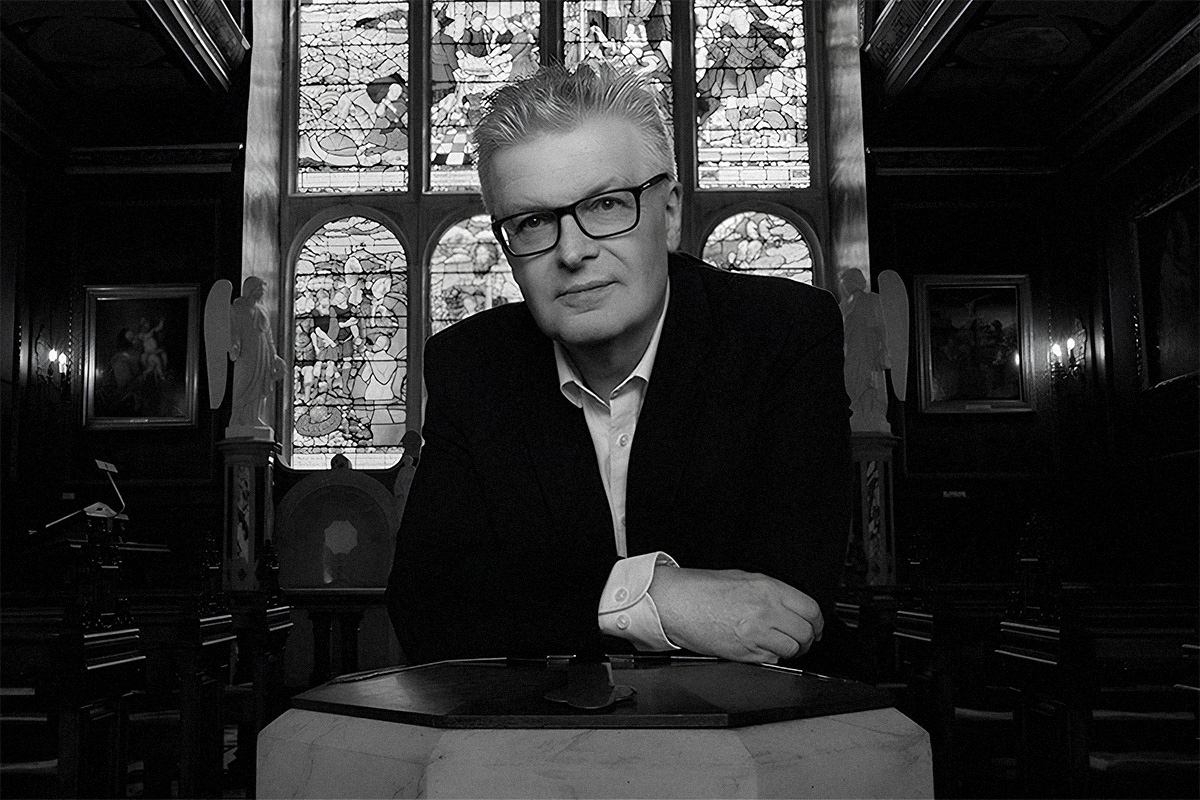
James MacMillan © Photo by James Bellorini / Photo from personal archive
Sir James MacMillan is widely regarded as one of the greatest composers of his generation. Born in 1959 into a working-class family in Ayrshire, Scotland, he felt from a very young age that music was his true vocation, beginning to compose at just nine years old. In 2019, The Guardian ranked MacMillan’s Stabat Mater among the 25 greatest works of classical music of the 21st century. He was appointed Commander of the Order of the British Empire in 2004 and Knight Bachelor in 2015. In 2022, he composed Who shall separate us?, the anthem written for Queen Elizabeth II’s state funeral on 19 September. In this fascinating interview for Huxley, Sir James MacMillan reflects on the power of silence, music as revelation, and the meaning of life — exploring how sound, spirit, and purpose intertwine in his art.
Leonid: Good afternoon, Sir James! My name is Leonid Shokh, and I am a journalist working for Huxley. I would like to introduce Narad, my singing mentor. Narad, Richard Eggenberger, an opera singer by training, has been living in India for the past 60 years, where he originally met an extraordinary woman called Mirra Alfassa (The Mother). That meeting proved to be life-changing: she helped him realize his spiritual mission — to dedicate his life to a new music, music of profound inner strength and inspiration, born from higher planes of consciousness. A few years ago, Narad published a book titled The Descent of a New Music, in which he highlighted a number of contemporary composers whose works, in his view, bear the mark of a new art — music infused with spiritual inspiration and born from higher spheres of consciousness.
Narad: My first question to you is one I’ve asked many other composers, including your friend Frank La Rocca. It is, of course, a challenging question: Does music come to you as revelation?
James: As a believer, I’m very aware of the umbilical link between music and silence, and of the ongoing search for the sacred — perhaps even more so now than ever — among modern composers who are reaching for something that has preoccupied artists throughout history. And there is a sense, even among those who are not conventionally religious, that music points beyond ourselves toward something greater. Maybe music is the product of something more than simply the sum of our parts. But ultimately, yes — I do believe there is an umbilical connection between what I do as a composer and a sense of the divine. Perhaps music is one of the artistic forms that opens a window onto the nature of the divine.
Narad: I’ve listened to many of your compositions, and in several of them I sense a distinctly mystical quality. Could you reflect a bit on that — on the mysticism that seems to enter into your music?
James: Throughout musical history, there has always been a link between music and mystery. Music itself, by its very nature, is mysterious — perhaps especially to our modern culture, which often finds music baffling because it speaks a language all its own, one that lies beyond words or images. In a world increasingly dominated by the visual and the verbal, music can seem strange, elusive, otherworldly. And yet, I think that is precisely its role: music fills that gap, that vacuum, with its sense of mystery — its intuitive connection to something divine. In some ways, music may be one of the last remaining avenues by which the divine enters the public square, the shared space of human experience.
Narad: Then I must ask: does music arise from the depths of your soul? Or what role does the mind play in composition — if it plays a role at all?
James: I certainly believe it does. The mind must be fully engaged if the deeper emotions are to find their most effective and truthful expression. Music is, to me, an emotional force — and also a religious and spiritual art form. But if this spiritual or emotional impulse is not shaped, disciplined, and guided by the mind, it can fail to communicate its full depth and beauty. There is an artisan’s craft involved: the ability to take emotion and the inner spiritual experience and form them into something that speaks clearly, powerfully. A composer must keep his wits about him — must have a firm intellectual grasp of how music works, how structure works, how the basic parameters of musical language can be shaped to create greater power and deeper resonance.
Narad: I have had the great blessing of knowing someone of extraordinary inner stature — a woman from France, known in India, where I live, simply as The Mother. She spoke of a plane of music where one can access any melody, harmony, or form — a realm where true harmony exists. Do you ever feel that music comes to you from such an ethereal plane?
James: Yes. And I don’t really know where that plane is — whether it lies within me, around me, outside me, over there or up there. But I do sense that the musical artist is always reaching toward something on an ethereal plane. Even though I emphasize the importance of intellect in the craft of composition, that emphasis does not negate the reality that music is connected with another plane — perhaps with several planes — beyond the merely human or the merely physical. These are states that composers must find their way to, each of us in our own manner.
And what strikes me is that even when I speak to people who don’t share my worldview — and I meet all sorts of people who love classical music and contemporary music through my work as composer and conductor — even the most skeptical, the most secular-minded listener will acknowledge that there is something deeply spiritual about this art form. That acknowledgment, that small concession that music is somehow greater than the sum of its parts — that it touches something deep within us, or something deep beyond us — is profoundly important.
It means that many music lovers, believers and non-believers alike, are traveling parallel paths toward the same destination: an understanding that music is a spiritual art form, and that through its own musical language it searches for the sacred.
Narad: Speak to me a little about the sacred — about religiosity, spirituality, the mystical. This must be a major dimension of your work.
James: It is. And it’s interesting — people in the arts world, journalists and cultural commentators, often ask whether I feel isolated as a religious composer. My answer is always: I don’t. I meet many deeply religious composers of many different kinds. The implication behind the question, I suppose, is that we live in a modern world where religion is meant to be «over», where we are expected to have left behind these supposedly old-fashioned ideas about belief.
And certainly, many aspects of modern culture have moved away from any search for the sacred or the spiritual. But music never really could. There is something innate in the very nature of music that is spiritual — something that seeks the sacred, whether consciously or not. To make this point, I often turn to modernity itself — to the history of Western music over the last century or more. What we find is a procession of major composers who were profoundly religious men and women. Take Stravinsky, for example: he set the Mass, the Psalms, little prayers. He was, in his own way, a deeply religious man. And then at the other extreme of early modernism you have Schoenberg, who reconverted to practicing Judaism after leaving Germany in the 1930s. His later works are infused with Jewish culture, Jewish spirit, Jewish theology.
Move forward into the post-war period and you encounter Olivier Messiaen — profoundly Catholic, and every piece he wrote is saturated with his particular, and sometimes eccentric, spirituality. And then consider the composers who emerged from behind the Iron Curtain after Shostakovich — composers like Alfred Schnittke, Sofia Gubaidulina, Galina Ustvolskaya, Arvo Pärt, Giya Kancheli. All of them were profoundly religious figures, each in their own way. So when people suggest that modernity has done away with the sacred, I simply point to the music. The sacred has been there all along.

Narad: What about your sacred compositions for the common man? And I don’t mean music for amateurs specifically — I mean music written for the ordinary person.
James: I’ve always loved writing choral music. But when I was younger, the invitations came from some of the greatest choirs in the world. When the BBC Singers or the choirs of Westminster Abbey or Westminster Cathedral ask you for a piece, you naturally write to their strengths. So my early work tended to be quite complex — music that required real virtuosity to perform.
But then I became aware of something important: there was a growing interest in my music among ordinary church choirs and community choirs, amateur groups who found some of that repertoire too difficult simply because it was written for elite ensembles. So I made a conscious decision. I needed to build a body of work that was practical — music written so that good amateur choirs could actually sing it. And ever since then, I’ve made that a priority in my choral writing.
My Strathclyde Motets, for instance, were composed for a very ordinary — though very good — college choir. Through that experience, I learned a great deal about writing for the «ordinary man and woman» who simply love singing. It’s essential, I think, for composers to remain connected to their roots and to the wider musical ecosystem — and that ecosystem relies enormously on non-specialist singers and instrumentalists, volunteers and amateurs who sustain musical life in local communities. Composers — as Benjamin Britten and many other British composers have said — ought to be useful to their community. And I hope, in some measure, that this is true in my case as well.
Narad: I have one last question. Arthur Schnabel once said, «The notes I handle no better than many pianists. But the pauses between the notes—ah, that is where the art resides!» Could you speak about silence?
James: There is — yet again — that umbilical link between music and silence. Every composer knows that the music they create, the music they search for, begins in that silent place. It wasn’t only John Cage who understood this. It is in the silence of one’s own heart and soul that composers, paradoxically, discover sound — sound they then shape into their work. So silence, both metaphorical and literal, matters enormously. I especially feel this now because I live in a very quiet place — far away from the city, deep in the Scottish countryside. It’s profoundly conducive to work. And I know that the silence around me, as well as the silence within me, has a great deal to do with the music I write.
Leonid: I fell in love with your Miserere — listening to it was a deeply moving experience for me. Could you share the story behind it? How did it come to you?
James: It actually came about as a companion piece . It was a commission from The Sixteen — a wonderful British choir with whom I have a very warm relationship. They wanted a modern companion to Allegri’s Miserere, and writing companion pieces can be a double-edged sword. Usually the work you’re asked to stand beside is enormously famous and deeply beloved within musical circles — and of course Allegri’s Miserere is exactly that.
Everyone knows the mythology surrounding it — Mozart in the Sistine Chapel, hearing it once and writing it out from memory — and everyone knows its enchanting quality, the way the chant is interwoven with the polyphony. So I remember thinking: I need to write something that acknowledges the original, yet allows the music to move in my own direction. You can certainly hear echoes of Gregorian chant in my Miserere, but there are other elements as well — the harmonic language of the modern world, and even, I would say, something of my Scottish accent. There’s a subtle Celtic atmosphere to the piece, something of that landscape and sensibility.
Leonid: Especially the ending — it’s incredibly powerful. I also wanted to ask you a larger question, perhaps even a grand one, about the future of humanity and life on Earth. What is your perspective on where humanity is headed? Do you feel there is a kind of spiritual evolution happening today — or are we moving backward? What, in your view, is really taking place in the world?
James: Well, I don’t have a crystal ball — I can’t see the future. But I remain hopeful that even in these difficult times the Holy Spirit, if I may use my Catholic language, is still at work. In fact, it is often in the deepest abysses of human experience that the Holy Spirit, that God Himself, is most profoundly at work. People have asked, Where was God in Auschwitz? And in the immediate aftermath of that horror, Adorno famously said that poetry was no longer possible. One can understand the nihilism and despair that produced such reactions.
And yet — it is sometimes precisely in the abyss that the seeds of renewal appear. The twentieth century gave us terrible abysses: the Holocaust, the Third Reich, the brutalities of communist and fascist regimes. Human beings descended to appalling, bestial levels. And yet, through all of it, mankind still created music. The evil men of the world could not silence that impulse — that desire to sing, to compose, to make meaning through sound.
And that simple, stubborn desire to make music reveals something essential: a longing for humanity to continue, to have a future, to leave a legacy. So even when things seem very dark — and they do seem dark at times — I hold on to hope. And as a Ukrainian, you understand this deeply. Look at what is happening in your country and your community — and still people are making music, and still they look toward the day when peace will return, and humanity can once again turn the tide toward something good.
Leonid: And what is the meaning of life to you? How do you understand your own purpose — or the purpose of human life more generally?
James: I believe we’re here on earth to praise God. I know there’s a great deal of skepticism about that, and to many people it sounds like a rather useless or outdated aim. But in truth, that is what music is ultimately about. There is something profoundly impractical about music and the arts. The great technicians and technocrats of the world often look at them with bewilderment: they see no obvious utility, no measurable function. But it is precisely that lack of practicality that reveals something essential — it points to our spiritual nature, our spiritual essence. And if music exists to serve God, then perhaps our life on earth shares that same purpose: to continually seek a reconnection with our divine source, our divine maker.
When copying materials, please place an active link to www.huxley.media
Select the text and press Ctrl + Enter