MAN-MADE EVOLUTION: Why Cats and Dogs Are Becoming Alike

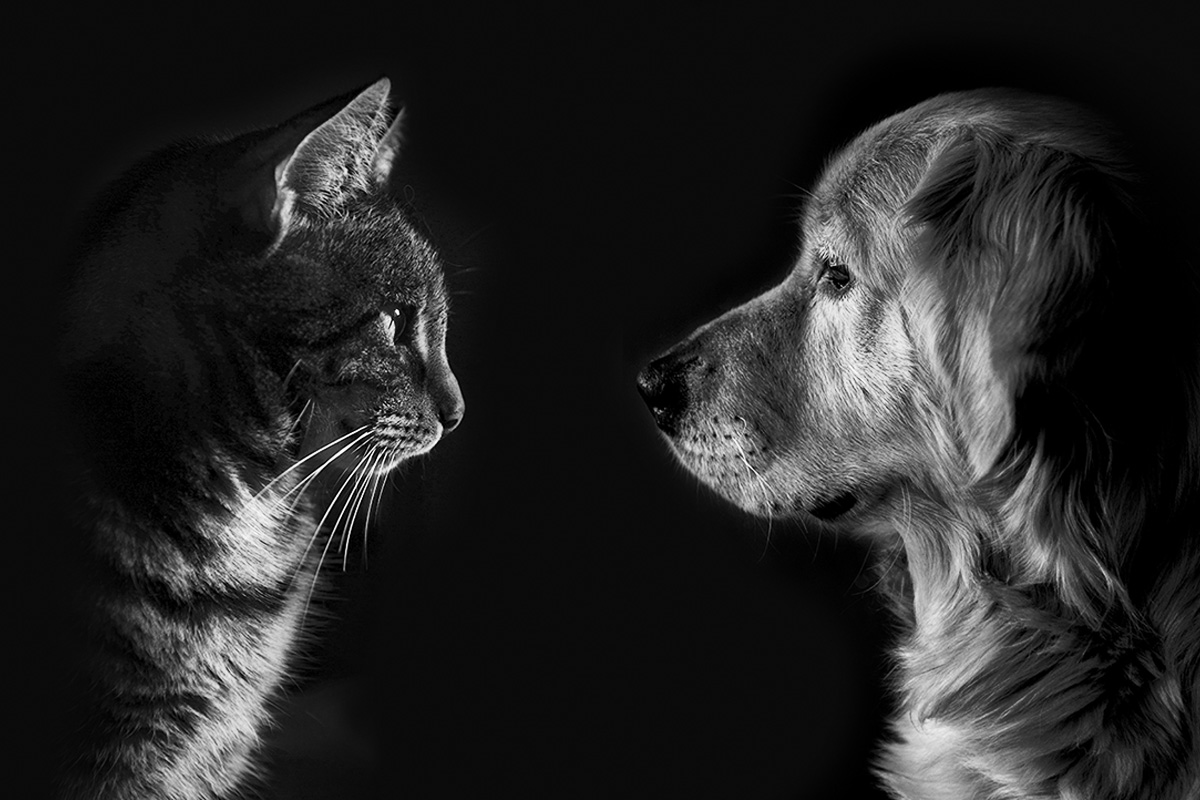
Photo source: stoltzgroup.com
«They live like cats and dogs». This proverb is becoming obsolete right before our eyes. It is being replaced by another one: «They are like cats and dogs». Scientists have discovered that domestication has brought additional diversity to these species, but at the same time has surprisingly provoked external similarities. The shapes of dog and cat skulls are becoming increasingly similar to each other.
«THEY FIGHT LIKE CATS AND DOGS»
T
his is how people who strongly dislike each other are commonly described. Folk mythology portrays cats and dogs as well-known antagonists. Although this is not entirely fair. Cats do indeed secrete a specific enzyme that can cause irritation in dogs. However, not every dog will react to it aggressively. In many families, disproving common myths, dogs and cats coexist peacefully in the same space, which does not prevent people from dividing into two large camps — committed «cat people» and committed «dog people». Therefore, the silly question «who is smarter — a dog or a cat?» remains, for many, still unresolved.
Apparently, it was precisely this question that evolutionary biologist Abby Grace Drake from Cornell University in New York sought to answer. To do so, together with her American and British colleagues, she decided to delve into the brains of these animals. Fortunately, these are humane times, and technological progress does not stand still, so they did this not with a scalpel, but through MRI scanning. The scientists examined 1,810 cat and dog skulls, comparing domestic pets with their wild relatives. Unexpectedly, the skulls of two different biological species, separated from a common ancestor by 50 million years of evolution, demonstrated striking similarity. But why did the skull shapes of a Persian cat and a Pug turn out to be so alike?
HUMANS «SHIFTED» EVOLUTION ASIDE
In studying evolution, scientists identify two processes moving in opposite directions — divergence and convergence. In the first case, two species sharing a common ancestor gradually begin to differ greatly from one another. This is entirely logical, since animal populations spread across the world and their developmental paths diverge. Adapting to new habitats, they develop new traits. In the second case, everything happens the other way around: living in the same environment, even unrelated species become increasingly similar to each other. In the case of domesticated dogs and cats, the primary factor of evolutionary selection has been humans. Both unintentionally and deliberately conducting selective breeding, people have triggered a process of convergence. As a result, similar traits began to form in two different biological species. Thus, for example, Persian cats and Pugs have ultimately become owners not only of flat faces, but also of similar skull structures.
THE STRUCTURE OF SKULLS IS CHANGING DRAMATICALLY
You might say that in the case of the Persian cat and the Pug, this resemblance could have been accidental. After all, other breeds of dogs and cats do not seem particularly similar to one another. But Drake is a serious and respected scientist. Therefore, she naturally analyzed not only flat-faced breeds of dogs and cats. Dozens of old specimens, which had been stored for years in museums, veterinary schools, and digital archives, underwent 3D scanning. These datasets were compared with data from popular domestic cat breeds such as Maine Coons, Siamese, and Persians, as well as representatives of more than 100 dog breeds. Among the latter were dogs with muzzles of very different lengths: from short-faced Pugs to long-faced Collies. The results of the study showed that domestication has significantly altered the skull structure of both dogs and cats. First, it increased the diversity of their skull shapes compared to wild animals. And second, it led to certain cat and dog breeds becoming similar to one another — converging either toward elongated or toward flattened faces.
WHY TURN A CAT INTO AN XL DOG?
An elongated skull is a characteristic feature of wild canids. This group includes dogs, wolves, foxes, and jackals. Their skulls generally tend toward similarity. Among felines, however, the situation is different. Wild cats — lions, tigers, and jaguars — have been endowed by evolution with a far greater diversity of natural variations. Yet domestic breeds of dogs and cats now span a more extreme range at both ends of the scale. Take, for example, the American dog breed XL Bully. As of December 31, 2023, it was banned in England and Wales. The government stated that dogs of this breed were more often than others responsible for attacks on people, resulting in fatalities.
However, while XL Bully dogs were prohibited, the law said nothing about cats. In defiance of the British government, a breed of cats resembling XL Bully dogs was subsequently developed. But along with similar traits, human intervention can bring similar suffering to both dogs and cats. By bending nature to their will, humans compress millions of years of evolutionary selection into just a few decades. Selective breeding often pushes a breed beyond what an animal’s body can naturally sustain. For example, there are meat chicken breeds in which 30% of body weight is concentrated in the breast muscles. As a result, the birds suffer from constant heart and lung problems.
THE «RED SPOT» OF EVOLUTION
However, in the case of short-faced dog and cat breeds, humans are only partly to blame. They themselves are programmed by evolution to be charmed by infantile faces — rounded cheeks, small noses, and large, low-set eyes. Thus, unconsciously, people prefer to show parental care toward pets whose features mimic the appearance of human babies. In this sense, humans are powerless, since, like all living beings on the planet, they are governed by instinct. They are no different, for example, from the herring gull, whose chicks instinctively peck at the red spot on the parent’s beak, prompting the adult bird to regurgitate food.
In fairness, it must be acknowledged that there are certain objective grounds for treating a pet like a child. The mental age of an average dog is roughly equivalent to that of a 2–2.5-year-old child. A dog can understand more than 165 words and signals and can «count» up to three. Cats, meanwhile, are able to associate words with images even better than children. At the same time, the social intelligence of dogs and cats is approximately at the same level. Determining which of them is «smarter» is not easy, if only because cats, unlike dogs, for some reason are studied by scientists far less frequently.
THE RISKS OF ARTIFICIAL SELECTION
Evolution created the red spot on the beaks of gulls as a social trigger mechanism that ensures the survival of the species by satisfying the hungry chick’s need for food. Domesticated animals have also developed such a «red spot» — they have embedded themselves into the mechanisms of care that evolution shaped in humans to preserve their offspring. Unfortunately, the extreme physical traits that stimulate human caregiving have proven to come at a rather high price. Flat faces and unnatural skull shapes cause breathing difficulties, neurological disorders, birth complications, and other health problems in domestic animals. Drake’s research helps us understand that, having learned to control species convergence, humans have placed in their hands a tool that may pose a threat to life on the planet no less serious than, for example, nuclear technologies.
Original research:
- How dogs and cats are evolving to look alike and why it’s humans’ fault – new research
- Copy-cat evolution: Divergence and convergence within and between cat and dog breeds
When copying materials, please place an active link to www.huxley.media
Select the text and press Ctrl + Enter


