NOLAN, HOMER, AND “GOD’S MISTAKE”: Why Culture Always Lies About the Past — and Why That’s Okay

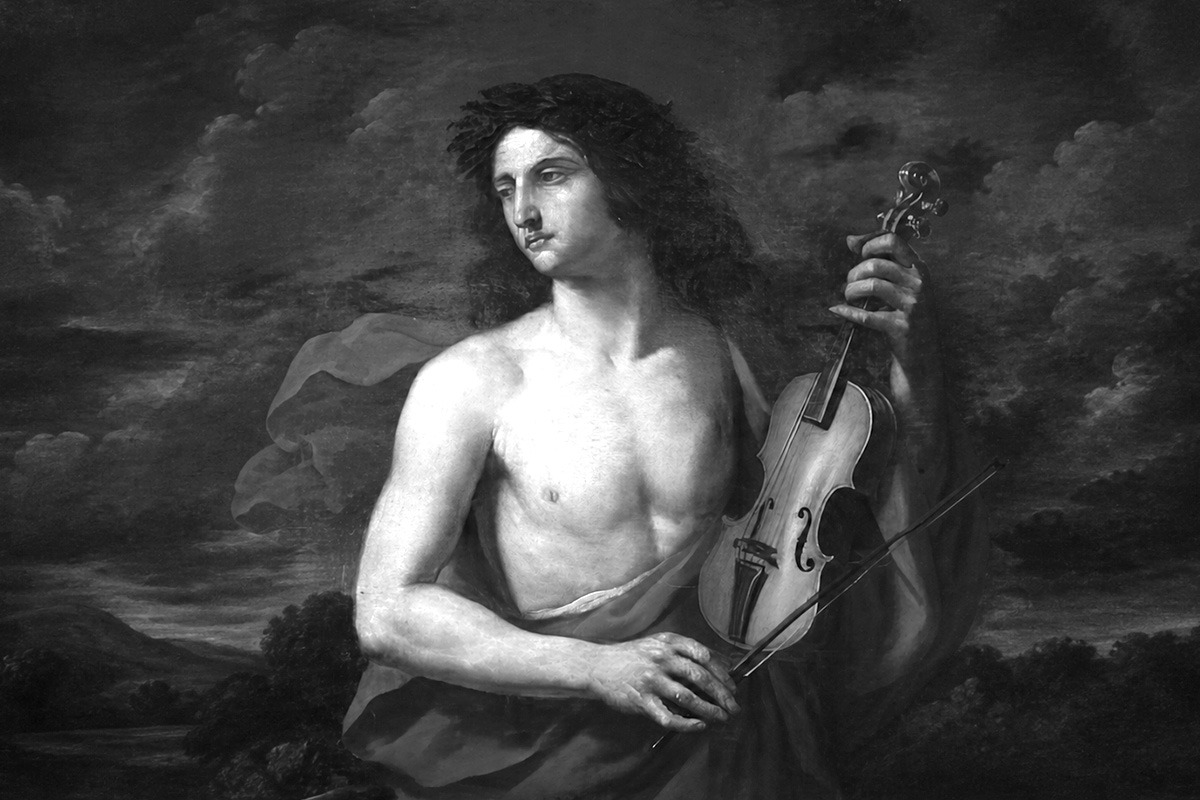
Cesare Gennari. Orpheus Playing the Violin, 17th century / Art design: huxley.media via Photoshop
Those who accuse Christopher Nolan and his film The Odyssey of “making things up” and distorting its ancient origins miss the main point: Homer himself never had any single “correct” version of the Bronze Age. Every era rewrites the Great Text according to its own fears, hopes, and values. But does that mean that the entire history of world literature is nothing more than a succession of brilliant “forgeries”? Let us explore how the mechanisms of cultural anachronism actually work.
THE POETICIZATION OF HISTORY — A CULTURAL LAW
G
reat cultural texts are always great myths, and they become so not because of ethnographic accuracy, psychological realism, or unquestionable moral authority. Within the realm of culture, these texts live according to special laws that have only an indirect relationship to what we might call truth. A work of art is always a delicate, almost invisible thread of Ariadne stretching from the author’s imagination to the imagination of the reader, viewer, or listener. The logic of this journey is nonlinear, and the way out is not always found in the same place as the way in. The poeticization of history inevitably causes the two to diverge.
But can such a divergence be considered a mistake? Or is it a fundamental law of culture to which everyone is subject — Mycenaean storytellers, Athenian initiates, and Hollywood directors alike? You may be surprised, but there has never been any “correct” understanding of Homer, just as Homer himself never possessed a “correct” understanding of the Bronze Age. What, then, did exist? The poeticization of history, something inherent in all world literature — from archaic times to the present day. One might call it a kind of “law of culture”. And the present almost inevitably intrudes upon this poeticization.
THE AUTHENTICITY OF FACT AND THE AUTHENTICITY OF MYTH
In Shakespeare’s Julius Caesar, Romans hear a mechanical clock strike, while Hamlet studies at an eleventh-century university that did not open until the sixteenth century. Writers and artists repeatedly sacrifice historical accuracy for artistic expressiveness and modernization. One might recall the novels of Walter Scott, or Renaissance painters whose Old Testament and classical figures parade around in sixteenth-century doublets, armor, and hats. And there is hardly any need to mention medieval chivalric romances or the bylina epics of the Kyiv cycle! The greatest works of world literature and art often contain “things that could not have existed”. In abstruse art-historical terminology, this is called “intentional anachronism”. But does that make Hamlet or The Song of the Nibelungs any worse? No.
An artistic masterpiece possesses a different kind of “authenticity” — the archetypal authenticity of a cultural myth rather than the historical authenticity of fact. In Homer’s eighth-century “Dark Age”, what mattered above all was whether the listener empathized with Achilles and Penelope. What mattered was striking a certain anthropological pattern. In fact, this remained important for the Greeks of the Classical period as well. Thus, without burdening themselves with the accuracy of details, they depicted Homeric heroes with all the everyday attributes characteristic of the fifth century. Achilles looks like a typical, instantly recognizable hoplite? No matter! That is not the point. What matters is the plot, the visual imagery, the emotions, the character…
HOMER’S HEROES LIVED IN A DIFFERENT WORLD
Classical Greek culture adapted Homeric archaism to itself. But Homer had previously done exactly the same thing with the realities of the Bronze Age. His poems, for example, are full of references to iron, which the Mycenaean world did not yet know. Or to gods such as Aphrodite, who had never existed among the Achaeans. Poseidon was no longer the supreme god in Homer, while the son of Zeus and Hera somehow disappeared — in the Mycenaean period, it was precisely such a “trinity” that was worshipped, rather than a divine married couple. Under no circumstances would Patroclus, Hector, or Achilles have been cremated on funeral pyres in those days, as Homer describes — leaders at the time were buried exclusively in tumulus tombs. Homer filled the lives and daily existence of Mycenaean kings not only with details from his own era, but also with psychology and a social structure alien to them. He already had little understanding of what a war chariot actually was — in the Homeric text it functions as a “taxi”, not a “tank”. And that is only the beginning.
The wanakes — Bronze Age rulers such as Agamemnon and Odysseus — behave in Homer like typical tribal chiefs of the Dark Ages. Yet judging by the decipherment of Linear B, they were more akin to Eastern-style despots than to “first among equals”, the leaders of military democracies. Their power and authority rested on entirely different foundations. In Homer, heroes feast, argue with kings, and own land privately. First, all of this is highly vivid and poetic and serves as the engine of an enthralling plot. But there is also a second point: no such democracy or freedom of thought existed, or could have existed, among the Mycenaeans. The wanax was an absolute monarch who ruled an extraordinarily rigid bureaucratic hierarchy. You could hardly get away with much under a ruler like that.
WHY THE GREEKS WERE SOMEWHAT WARY OF THEIR OWN “BIBLE”
The demand to recreate the Bronze Age “according to Homer” seems absurd. Homer undoubtedly conveyed certain authentic details, ancient names, geography, and individual relics of the past with considerable accuracy. But the key word here is certain. By then, he understood very little not only about everyday life, but also about the distinctive psychology, religion, political organization, and social structure of that historical period. After all, roughly 400 years separated the creator of the great poems from the events of the Trojan War! So, to save time and space, we will not delve into an analysis of all Homer’s “bugs”. Female characters, for example, whose authenticity also raises many questions… Let us simply acknowledge the total “poetic distortion” of the Bronze Age world, its people, and its events in the Homeric poems, once again emphasizing how poorly they corresponded to the values, psychology, and intellectual demands of the Classical era. This sounds paradoxical, considering that by the fifth century BC the Homeric texts had finally become established in a single “correct” version. In effect, it had turned into something like a “school textbook” or even the “Bible” of the Greeks. Yet readers and listeners faced enormous moral and ethical difficulties. Homer described a world governed by an entirely different morality — one that differed greatly from that of the Classical era.
HOMER’S “WRONG” KIND OF PATRIOTISM
The main problem lay in the posthumous fate of Homer’s characters: the great righteous man and the sinner, the hero and the contemptible coward all became equally meaningless shades after death. To “save” the universally revered Homer from accusations of amorality and impiety, the Classical era fully engaged its mechanisms of reinterpretation. Odysseus’s journey to Hades, for example, came to be read allegorically — as the symbolic path of a sage, leading him through the knowledge of death toward spiritual purification and truth. Plato even proposed forbidding children from reading Homeric passages dealing with death. For such an anti-state understanding of the afterlife completely undermined a citizen’s motivation to give his life for his native polis.
The state, however, critically needs its citizens to give their lives for it at the first call and without hesitation. More than that, they must regard doing so as a great honor and a blessing. Otherwise, what kind of state would it be? From this perspective, Homer can be imagined as a dangerous pacifist, an anti-war and even anti-totalitarian writer. At this point, one might send greetings from Karl Popper to Plato, whom Popper regarded as a key source in the history of the ideology of the “closed society”. You will agree that from here it is not such a long way to Nolan’s war-weary Odysseus, who appears to exhibit something resembling PTSD… But Plato’s contemporaries also looked askance at Homer for another, no less serious reason.
AN UNJUST PARADISE
The point is that Homer’s paradise, the Isles of the Blessed, is not a reward for virtue but a “VIP zone” for the chosen few. One can enter it regardless of earthly merit, but only through very powerful connections — namely, by being related to the gods by blood. The Greeks considered Homer great, but there was clearly something wrong with this profoundly undemocratic and unjust Homeric idea. What do you mean Zeus’s son-in-law is allowed in, but I am not? What do you mean a colonel’s son cannot become a general because the general has a son of his own? And the world of the Classical Greek poleis preferred a different arrangement. Let the moral tribunal of Minos, Rhadamanthus, and Aeacus decide a person’s fate after death. Behaved badly — the “holy trinity” sends you to Tartarus; behaved well — welcome to Elysium. Alas, this almost Christian concept of an otherworldly reality had nothing whatsoever to do with Homer himself. In his works, all mortals indiscriminately dragged out a miserable existence beyond earthly life.
Yet even these meaningless and powerless shades bore absolutely no resemblance to the vivid, active, and purposeful posthumous destiny of a Bronze Age hero. Unlike the traditions of the Dark Ages, Mycenaean culture placed great hopes and responsibilities upon the deceased hero. Having left this world, he became the protector of his kin. That is why he was buried in a magnificent tomb, in full military equipment, with gold ornaments, superb pottery, and delicious food — in other words, with everything necessary for the journey to the other world and to intercede on behalf of his entire lineage in the afterlife. The Achaeans did not cremate their dead, as people later did in Homer’s time in order to provide themselves with psychological protection from the world of the dead — the age of great heroes had no need of such protection. Overall, the eschatology of the Mycenaean era was far closer to that of ancient Egypt or Mesopotamia than to the pessimism of the Homeric Dark Ages or the polis-era belief in a just judgment after death.
HUMBLE PERFECTION
We have to admit that Homer’s texts were strikingly at odds with the values and with the psychological, cultural, technological, and everyday realities of both the Classical and the Bronze Age! Both past and future viewed the society, world, gods, and people described in Homer’s poems in ways that were anything but Homeric. Why, then, was Homer so beloved in antiquity and why is he still loved today, rather than having been thrown onto the rubbish heap of history 2,500 years ago? Because the emotions, characters, and destinies of Homer’s heroes are archetypal — people of any era can recognize themselves in them. Just as they can, for example, in biblical characters or in the Sumerian tales of Gilgamesh. These texts are mesmerizing because they possess the essential quality: they are works of artistic genius, if not perfection. Yet this “perfection” is of a special kind, one that comes with a particular right to make mistakes.
Yes, they are not free of factual and sometimes even logical errors. But when encountering them, one gets the feeling that someone from above was speaking through the mouth of a genius. This brings to mind a joke in which Einstein, having gone to heaven after his death, asks God to show him the ultimate, final, and most complete formula of the universe. God agrees. Einstein studies the formula carefully and says, “Lord, but there is a mistake here!” “I know!” God replies with a smile. Beyond the joke, the right to make an error may well have been a consciously embraced philosophy of creativity. Thus, architects in the Islamic tradition created perfect geometric patterns symbolizing the perfection of the Creator. Yet they would deliberately and humbly leave behind an almost imperceptible flaw — for they were merely “transmitters”, not the true authors of perfection.
PEOPLE HAVE ALWAYS TRIED TO CORRECT THE “MISTAKES” OF GENIUSES
The temptation to correct a genius’s “mistakes” has been powerful in every age. In the fifth century BC, an Athenian admired Homer for his poetic beauty. But when seeking not beauty, but “truth”, spiritual salvation, and the meaning of life, he turned not to Homer’s poems but to the Eleusinian and Orphic mysteries. And then something remarkable happened — people began to view Homeric texts through the prism of those mysteries! Nothing remotely resembling such interpretations followed from Homer’s poems, either explicitly or implicitly. Yet the initiates believed they had discovered their “secret code”. They thought Homer had deliberately concealed the truth about the immortality of the soul beneath the guise of myth, accessible only to the initiated. In fact, Charles Augustin Sainte-Beuve followed essentially the same path in the nineteenth century. The French critic liked to speculate about the author’s subjective hallucinations, arguing that the author himself was generally incapable of understanding what he had written.
Nevertheless, humanity has been extraordinarily fortunate — it has critics! People capable of explaining everything “correctly” both to the general public and to the author himself. But there is one problem: culture always offers not a single set of “rules”, but an entire range of them. Every subsequent era writes itself into a great text. Yet the great text, in turn, is equally eager to write itself into the present. This is how cultural mechanisms work, whether anyone likes it or not. So, as Comrade Stalin might have put it in such a case: “Culture has no other Nolans, Shakespeares, or Homers for you!” If, however, you are not a devotee of historical materialism, Goethe and the Schlegel brothers may be of greater help. Romanticism, as we know, likened a work of art to a plant. You would hardly judge a violet for being a violet, would you? And if you insist on evaluating it, it makes sense to do so exclusively according to “the laws of violets”. Or, in more contemporary terminology, according to the laws governing the birth and transformation of cultural myths.
When copying materials, please place an active link to www.huxley.media
Select the text and press Ctrl + Enter