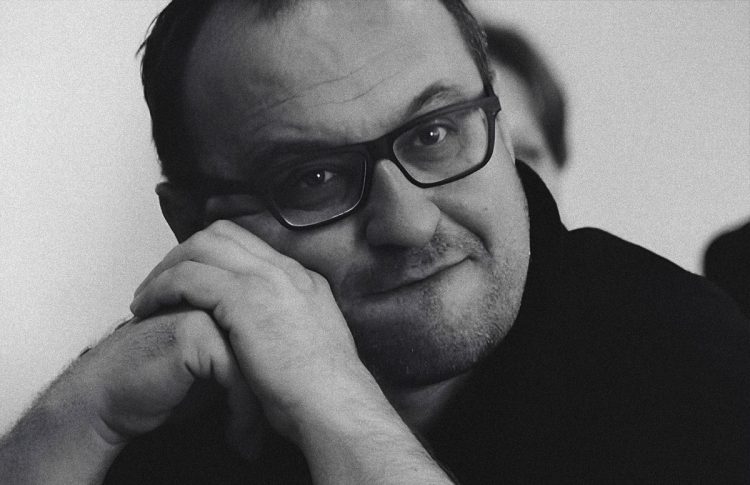
PAVLO HUDIMOV: «At the moment, I am a professional listener, not a musician»

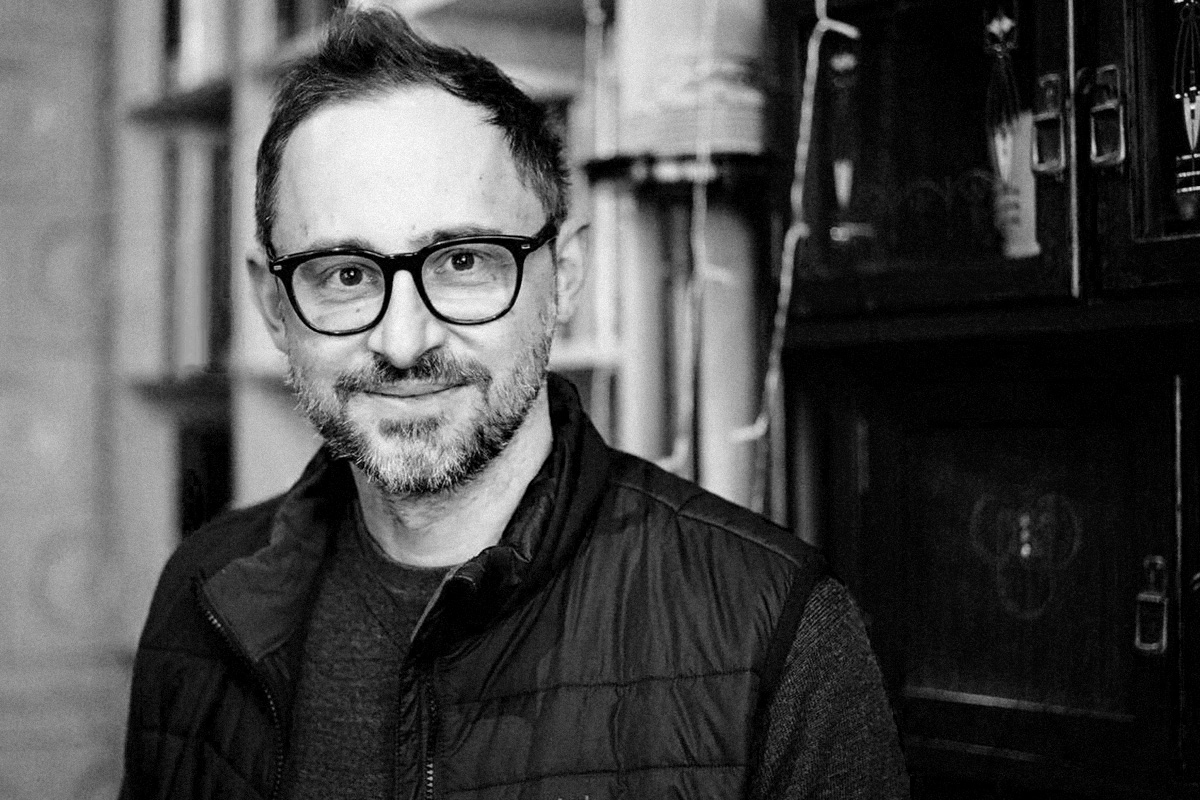
Pavlo Hudimov. Photo by Vasylina Vlublevska / Provided by the Ya Gallery Art Center
SHORT PROFILE
Name: Pavlo Hudimov
Date of Birth: October 12, 1973
Place of Birth: Lviv, Ukraine
Profession: landscape architect, art curator, gallerist, musician, producer, co-founder of the band Okean Elzy, founder of the band Hudimov
The documentary film Okean Elzy: Stormwatch is now showing on big screens across Ukraine — the first attempt to encompass the thirty-year history of the country’s number one Ukrainian band, which, of course, is different for everyone. How did Pavlo Hudimov — gallerist and guitarist, co-founder of Okean Elzy, and thus one of the main characters of this film, which entertains the viewer for two hours with unique chronicles and jokes, squeezes out a tear, yet explains almost nothing about the phenomenon of the nation’s most beloved band — perceive the film?
Pavlo Hudimov left the band in the summer of 2005, yet Okean Elzy has never left Hudimov: he appears from time to time at concerts, playing special sets. Or performs together with Sviatoslav Vakarchuk at small venues such as the Lviv House of Scientists. For Stormwatch, Pavlo provided what he had preserved all these years — his personal archives, which essentially became the foundation of part of the film. For better or worse? Pavlo has always been uncompromising in his assessments. And now, likewise, he does not mince words — including when speaking about the politics, omissions, and white spots of which the film contains more than a few.
Andrii Alforov: What did you feel when you first watched the film and saw a different version of yourself on screen?
Pavlo Hudimov: Well, first of all, I watched it several times. They sent me three different versions because they needed editing comments. I made corrections. And besides that, I worked on the archives. It turned out that those boxes of videotapes I had been keeping all these years came in handy. I had never gone through them — neither when I was still playing in Okean…, nor after I left the band. They had simply been lying there all this time. Even so, the film has many white spots, because two hours is far too little to fit in three decades. Even more, actually.
Because Okean Elzy grew out of the band Clan of Silence, and it’s impossible to tell its real story without those chapters. And when we began communicating with the directing team in one way or another, they reacted very positively to all these additions. They tried to highlight certain things, shoot additional material, and arrange the accents. Because at first everything somehow got blurred: in the first part the story was about the band, and in the second — already about Slavko , his views, political activity, personal life, musical tastes…
I believe this film should have been made in several parts and should have told much more about the formative period. The people who came to cinemas to watch it didn’t really know anything about us in the early years. They grew up with Okean… over the past decades. Therefore, when we talk about my impression of the film, it is this: the film does not give a comprehensive answer to what Okean Elzy actually is and where the band came from. I’m more than certain that the existing material would be enough for several episodes in which one could tell the collective’s detailed history, its phenomenon…
А. А.: You don’t seem like a sentimental person, yet you kept all those video archive tapes. What made you do that?
P.H.: It’s a researcher’s approach. I respect the years when I played in Okean Elzy, and the people with whom I created this band. And I feel responsible for the materials that ended up in my personal collection. I consider them valuable. So I couldn’t just throw them into the trash bin of history. That’s probably what a stereotypical rock-and-roll star would do — but not an exhibition curator and gallerist (laughs).
А. А.: By the way, how would you personally define the Okean Elzy phenomenon?
P.H.: First of all, it’s otherness. Ukrainian music had many different good bands, but not all of them had a vivid individuality. The second factor is personalities. It is the personalities that determine the uniqueness of a band. Okean Elzy from the very beginning consisted of strong individuals, each with a unique perspective. You could make a separate film about each of them — and it wouldn’t be boring. The third factor is the musical material itself, rooted in global music.
In other words, it wasn’t purely local material made in the tradition of Soviet or post-Soviet rock with its social protest. It was something of its own. To have a clearly defined phenomenon, it has to be studied. There should be a book written, for example. Written by someone who very precisely feels all these cultural factors. Written without white spots or censorship… A book that includes the difficult and unglamorous pages of the band’s history. But I’m more than certain that at this stage — when the band is still alive, active, touring — this is very hard to do. The distance is too small.
In Ukraine, the rules of the global show business are very distorted. Any conflict within a band is carefully concealed, silenced, considered bad publicity. Whereas in the West, the opposite is true: it boosts a band’s popularity. Here, everyone is afraid of saying something the wrong way, so they resort to taboos. As for the film Okean Elzy: Stormwatch, it contains a number of underexposed moments, or even omissions, which could have been useful — they would have made the film better, more expansive.
One such topic is Okean Elzy and Russia. Today it is absolutely relevant. When we have a war and strive to understand its causes, there exists a band that was once hugely successful in the country we are currently fighting. Okean Elzy filled stadiums there, performing major solo concerts and participating in top music festivals. Not a word about this appears in the film. I understand why. But when we speak about Russia and about how we were perceived there, it is worth noting that we were almost the first Ukrainian band that impressed audiences not with parody or irony, but with serious music.
What we were doing there back then is extremely important now. It needs to be highlighted, because it shows the influence the Ukrainian band — and therefore Ukrainian culture — had. While we are now standing in cultural defence and lamenting how Russia conducts «cultural» occupation, trying somehow to resist it, we should remember how Okean Elzy at that time successfully and gently carried out a Ukrainian cultural expansion in Russia.
А. А.: I had a conversation with a radio journalist about this. And when I pointed out the omission in the film of the topic related to Okean Elzy carrying out a «soft» Ukrainization in Russia… he told me this: «The filmmakers probably don’t mention it because they consider the band’s efforts unsuccessful. After all, Russia attacked us anyway, so attempts to ‘Ukrainize’ their society turned out to be ineffective».
P.H.: By that logic, you could blame absolutely everyone in Ukraine: we all «underperformed», since Russia attacked us; we failed to personally make Putin and the Kremlin elite fall in love with Ukrainian culture — therefore we messed up… Complete nonsense. When we talk about the situation in Russia, we need to understand the enormous gap between the political elites and the cultural elites, who respected and loved us, who attended our concerts. All these people are now sitting quietly, staying silent because they are afraid, or they have emigrated. But Okean Elzy, just like other Ukrainian bands, did a great deal to ensure that Ukrainian musical culture had a significant influence in the Russian musical and media space.
А. А.: History shows that musicians react most sharply to injustice in the world: The Beatles, Bob Dylan… They all resorted to some kind of manifestos concerning racial injustice, wars… Do you share that point of view?
P.H.: Well, this is inherent to any artist. Of course.
А. А.: The musicians of Okean Elzy participated in both Maidans, even though they almost never sang protest songs. In the film, Zhadan even says that the performance of Okean… on Maidan in 2014 marks the beginning of a new chapter in Ukraine’s history. Maidan is politics, and you have always viewed politics with bias. I remember how one of our mutual friends, in a wave of patriotic enthusiasm in 2004, announced her desire to work for Viktor Yushchenko’s campaign… And you asked her then: «What, you’re craving some dirt?» Has your attitude toward politics changed since then, or has it stayed the same?
P.H.: It hasn’t changed. It’s an extremely complicated and dirty business. Moreover, politics is also highly ineffective. I believe that artificial intelligence would handle many things better than our politicians, who — cynically hiding behind patriotic slogans — somehow always work in their own interest rather than for the Ukrainian people and the state. The cynicism of politicians (not only Ukrainian ones) has always astonished me.
Politics today merely imitates certain processes. It’s very shameful. And personally, thank God, I never actually went into politics. This is something worth discussing with Slavko ⓘ. He was there twice — and twice he left.
Perhaps he knows more, because he saw it all with his own eyes. It’s a pity that this is not reflected in the film either. It is only mentioned that Slavko founded the Holos party, was one of its leaders, and served in parliament after the first Maidan — but there is no explanation (and I myself don’t know) why he interrupted his parliamentary term and ended his political activity. This is a very interesting topic — Slavko and politics. It would have been worth analysing his political path, inviting professional political scientists as commentators. But this is absent. Instead, we hear only the views of the band’s supporters and fans, who give very emotional rather than analytical comments.
A.A.: Bob Dylan once said that the world is run (meaning politicians) by those who don’t listen to music. You’ve met many political figures along the way — not only Ukrainian ones. You stood with them on stage, they attended your concerts, commissioned architectural and design projects from you. Are these really people who don’t listen to music? Don’t listen in the sense that they don’t hear it, don’t respond to its humanistic messages?
P.H.: I met many of them, but they were never part of my circle of communication. Just acquaintances. We rarely talk about what they listen to or collect. My social environment is a bit different. Once, during the Orange Revolution, I almost punched a prominent politician in the face for publicly insulting the members of Okean Elzy. He treated us like… service staff, singling out only Slavko. And that infuriated me. Slavko didn’t react at all. So I limit my interactions with politicians as such.
A.A.: Unlike politicians, you yourself listen to a lot of music. Is protest still the central idea of rock’n’roll, or has it changed?
P.H.: It seems to me that rock music worldwide is currently in a certain crisis. What is rock music today? It’s the classics in their final chapter. Some of them age gracefully, others — not so much. There is no longer an idea as such. Everyone is waiting for a new musical culture that would respond to the challenges of our time. I don’t find in contemporary rock music what inspires me. But I do find many interesting things in contemporary classical music, modern jazz…
I not only listen to music, but also work on musical education. I teach even children to listen to music: I developed a series of educational programs taught in schools. There are lectures for adults as well. In my Lviv art center, we host vinyl music evenings where we break down iconic albums, analyse them, and try to link these phenomena to visual culture. But for me, this is now a hobby.
A.A.: Why a hobby?
P.H.: Because I no longer want to be involved in show business, and I only do what I like — music, aesthetics, and so on.

A.A.: At what point did art and gallery work push music into the realm of a hobby? Your first space called Ya Design in Kyiv was opened while you were still actively performing with Okean Elzy.
P.H.: Art has always been part of my «self». And when I opened the Ya Gallery art center in 2007, it became my main pursuit — curatorship, educational work. It now takes up 99% of my time. For me it is an extremely important mission, even the main one. I have a sense of priorities, and my artistic activity dominates. Unfortunately, I no longer find room in my life for writing songs and music. At the moment, I am a professional listener (laughs), not a musician as such. I can listen to one album for a month. Like now — the 1975 Commodores album , which I’m crazy about. It has such an insane groove. And when I hear it, I realise how average a musician I am. So I play as it comes. But I’m not always satisfied with the results.
A.A.: What feelings do Okean Elzy songs evoke in you now?
P.H.: Joy. A vinyl version of the album Model (2001) has just been released. And I’m very pleased that a certain revision of Okean Elzy’s musical past is taking place. People are rediscovering these songs. Slavko deserves credit for handling this creative legacy so responsibly. After we left the band, he did a lot of work to ensure that this heritage did not disappear. He manages everything and, of course, receives certain dividends.
А. А.: What memories do you keep from your time in Okean Elzy?
P.H.: First of all, memories of a feeling. There was a certain lightness at the beginning of our work. Now it feels almost unattainable. I think we all miss that lightness very much. We were incredibly happy because we were playing music — even if we were very average musicians back then. Maybe that’s because we were fulfilling our dream. You can see that in the film. And once the dream had been realised, the big show business began, with one tour after another… Routine. And we stopped being happy. The film contains nothing about the crises we went through. For example, when we recorded tons of material and nothing came of it… According to the film, we only had achievements and victories. But that is not true.
А. А.: What allowed the band to maintain a healthy internal environment for so long and to overcome crises?
P.H.: Balance. And Yurko Khustochka was responsible for that. He was the judge, the one committed to fairness, the one who could reconcile all of us. A unique quality. He was both gentle and very precise. Velvety on the outside and steel on the inside. None of us had such a talent. Slavko and I are hot-tempered, emotional people. We could bark at each other, constantly pulling the blanket to our own side. Denys Hlynin (the permanent drummer of Okean Elzy) kept his distance, whereas Khustochka was the cement that held everything together. And when he left — because he didn’t want to play in such an atmosphere — everything immediately fell apart. The most important thing disappeared: unity. Now I think that things could have been done differently: we could have taken a break for a while, rested from each other, rebooted, and then reunited. But we lacked wisdom. Even though we were already quite grown-up at that point . We should have been able to draw conclusions. We still had a chance then. After some time, we could have come back together and continued. Perhaps in a completely different way: playing more complex things instead of sticking to the mainstream.
А. А.: The last time you played together in the original lineup was on Maidan, in the winter of 2014?
P.H.: No. The film doesn’t mention this, but we played in that lineup twice in 2014. The last time was at the Olympic Stadium, at the anniversary concert marking Okean Elzy’s 20th anniversary. We played a whole set that we had prepared specifically for that event. I remember how happy Slavko was when we gathered for rehearsals. I even joked that he was probably the only fan of the golden lineup of Okean Elzy. It even seemed to me that he was the most nostalgic. After that, we never reunited again. Only Slavko and I played together — at the Lviv House of Scientists, for example, or several times in Kyiv at large Okean Elzy concerts. But whether it’s possible for us to reunite someday as a full group and do something together — I don’t know.
Everyone would have to want it — not only me, but also Yurko Khustochka, Slavko, Dima Shurov, and Denys Hlynin. We could come up with something interesting. But we must understand that there are other musicians in the band now, and such gestures shouldn’t diminish their contributions in any way. I like the current lineup, and I used to play a bit with Miloš Jelić and Denys Dudko . They consider me someone close.
I think something interesting could be done even now. We shouldn’t wait until we’re all 75 (laughs). I’ve suggested a few interesting ideas. For example, we could reunite in the original lineup and record our early songs — the ones that were never recorded. The songs that actually shaped Okean Elzy. Record them with contemporary arrangements. That’s great material, and personally, I’m struck by its naivety and lyricism. But again — everyone has to want it.
А. А.: For such a desire to arise, you at least need to voice this idea to the guys. Have you talked to anyone about it yet?
P.H.: Only with Slavko Vakarchuk. We were sitting in my gallery once, talking about various things, including the band’s creative legacy. And that’s when I suggested re-recording our early songs.
А. А.: How do you reconcile today’s Pavlo Hudimov — the curator and gallerist — with the guitarist, a former member of Okean Elzy?
P.H.: By creating a great exhibition about the band. Because a documentary film is not a sufficiently comprehensive format to convey the phenomenology of Okean Elzy. An exhibition would allow us to include far more information than two hours of screen time. Stormwatch is, of course, an interesting and informative film. But do I consider it artistically perfect? No, I do not.
А. А.: Exhibitions about musicians have been created in the West many times. There have been exhibitions dedicated to Elvis Presley, The Beatles, Pink Floyd, David Bowie… In Ukraine, nothing like that has ever been done. You and I once created a large exhibition dedicated to a single film — Shadows of Forgotten Ancestors. And how do you imagine an exhibition about Okean Elzy?
P.H.: It’s a great tradition — creating such exhibitions. Because the museification of rock culture is an extremely powerful phenomenon. I think one could create a very interesting exhibition about Okean Elzy, one that would include preserved materials, the band’s instruments, photographs, concert costumes, videos, personal items, projections, installations…
By the way, I have several pairs of concert shoes I bought when I moved to Kyiv. They could make great exhibition pieces. And such an exhibition should be held in a major museum, like Mystetskyi Arsenal. And if we think even bigger, I envision an exhibition about Ukrainian rock as a whole. That would be a fantastic format.
When copying materials, please place an active link to www.huxley.media
Select the text and press Ctrl + Enter