PHILOSOPHER INNA HOLUBOVYCH: Biography as a Form of Being

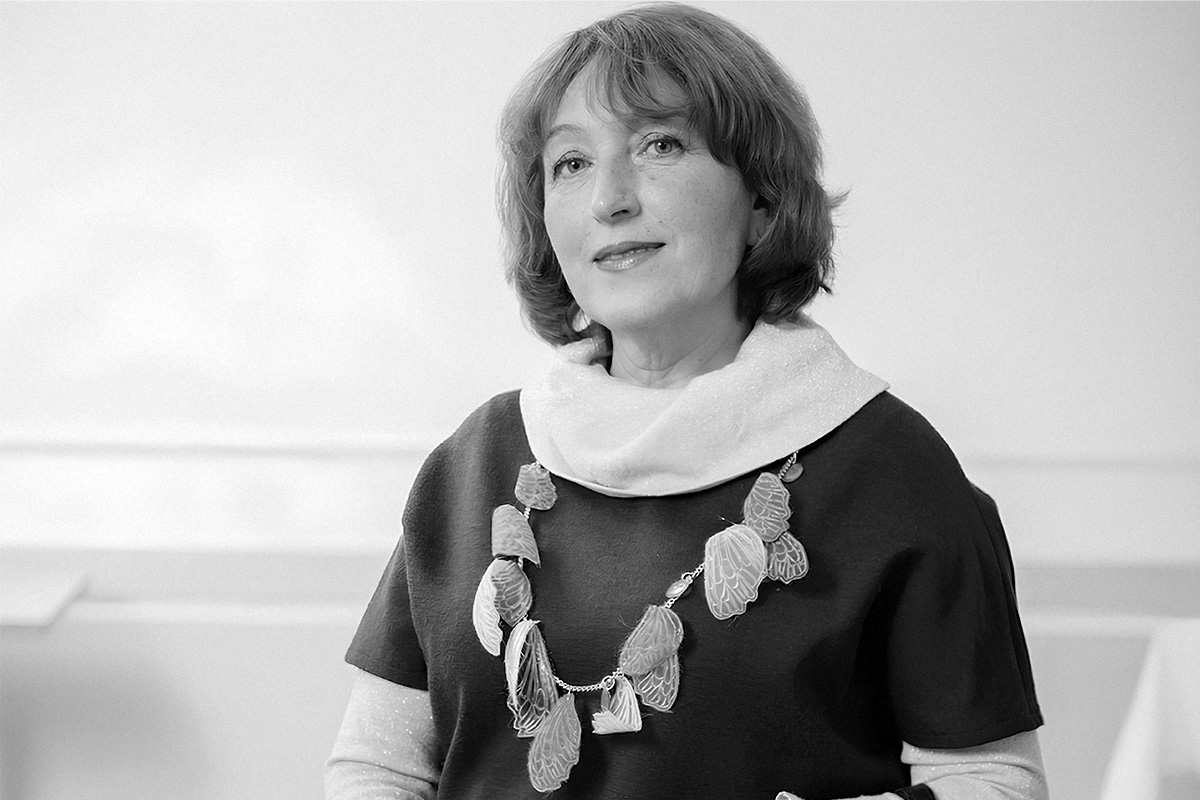
Inna Holubovych / Photo from personal archive
SHORT PROFILE
Name: Inna Holubovych
Date of Birth: September 10, 1966
Place of Birth: Shymkent, Kazakhstan
Profession: Doctor of Philosophy, Professor, Head of the Department of Philosophy
What makes a human life truly a life — what is lived, or what is narrated? This question inevitably arises whenever we turn to the genres of biography and autobiography. At first glance, they may seem to be merely forms of recording experience. But in reality, they are something far greater: a way through which a person not only describes themselves, but also comes to possess their own “self”. Philosopher Inna Holubovych believes that biography and autobiography are not simply texts about life. They are forms in which life becomes meaningful, coherent, and recognizable. And this is precisely where their existential significance lies.
BETWEEN THE “SELF” AND THE “OTHER”: TWO MODES OF UNDERSTANDING
“B
iography” and “autobiography” — these two words often merge into a single semantic stream. And not by accident. Whenever we speak about them, we are psychologically inclined to perceive a person and their life as some kind of “completed wholeness”. But if we look more closely, we will see that these are nevertheless two distinct modes. Autobiography is self-interpretation, while biography is the way another person understands you. Both perspectives on a human being are, in one way or another, sanctioned by culture. As early as the 1920s, Boris Tomashevsky formulated the methodological problem of the “right to biography”, which, in his view, a researcher of cultural texts must possess.
This was not about naïve biographism, in which a work is directly derived from the writer’s life, because a literary or philosophical text possesses its own structure and internal laws and cannot be reduced to biographical facts. At the same time, biography remains important and functionally connected to the work itself if certain aspects of it are incorporated into the poetics of the text or help clarify its internal structure. In other words, the “right to biography” requires proof through analysis. It is a right that, essentially, must be “earned” by demonstrating that an appeal to biography deepens the understanding of the work rather than replacing it.
THE RIGHT TO BIOGRAPHY
This line of thought was later developed by Yuri Lotman, the founder of the Tartu Semiotic School, for whom biography became no longer merely auxiliary material, but a special kind of cultural text — “life as text”, possessing its own structure, meaning, and laws of organization. Yuri Lotman wrote remarkable works in which biography effectively appears as a “living face”. For me, as both a scholar and a patriot of Odesa, Yuri Mikhailovich is an extraordinarily important figure. He lived and worked primarily in Tartu, but he maintained a close connection with our city, one of an intellectual and academic nature.
Odesa has traditionally been one of the significant centers of the humanities, and it was precisely within this environment that Yuri Lotman’s methodology found a living continuation. His ideas were actively discussed at Odesa universities, especially among philologists, cultural theorists, and researchers of textual studies. Many representatives of the Odesa humanities school regarded themselves as continuators of the Lotman tradition: through a shared language for describing culture, through an interest in sign systems, texts, and the mechanisms of cultural memory. My academic supervisor — philosopher and philologist Iryna Matkovska — was a close friend of YurMikh (as Yuri Mikhailovich was called by those close to him) and belonged to the orbit of the Lotman circle, where the “right to biography” within culture was affirmed.
THE BIRTH OF THE “SCIENCES OF THE SPIRIT”
The second line is connected with Wilhelm Dilthey, one of the founders of the “philosophy of life”. He placed autobiography at the center of historical discourse because, unlike biography, it requires no “justification”. In an autobiography, a person “lives through oneself” as part of a broader historical narrative. And this provides grounds for reconsidering the status of the humanities — the “sciences of the spirit”, which study not nature, but the human world: history, culture, language, religion, and art. Their key instrument is the “understanding” of the world through lived experience rather than “explanation”, as in the natural sciences.
That is why psychology, too, should rely on forms of self-understanding that already exist within culture: texts, letters, diaries, memoirs. For Wilhelm Dilthey, these are not merely collections of documents, but spaces in which the living fabric of human experience is preserved. They make it possible to reconstruct not only ideas, but also the very process of their formation. And Dilthey demonstrates this in practice by creating intellectual biographies of Georg Wilhelm Friedrich Hegel and Friedrich Schleiermacher. At the same time, he emphasizes that biography is always interpretive, dependent on cultural codes and research frameworks. Which means that the original form of historical knowledge is not cultural forms themselves, but directly lived experience.
BIOGRAPHY AS A FORM OF CULTURE
It should be noted that contemporary researchers nevertheless regard autobiography as a later phenomenon. Until the 17th–18th centuries, even the word itself did not exist in stable usage. Autobiography is clearly a more complex genre, one that requires greater cultural maturity and a more fully formed sense of self. A true revolution in the understanding of ancient and medieval biography was carried out by the outstanding cultural theorist Sergey Averintsev. The structuralist approaches contemporary to him distanced themselves from biographism, considering it something secondary or even an obstacle to textual analysis. Sergey Averintsev proposed viewing biography as a special form of culture, possessing its own logic and meaning.
For him, ancient biography was a distinctive way of thinking about the human being, in which the universal emerges through the individual. It is a form of cultural reflection that presents life as a “text” capable of being “read”. Thus, Plutarch does not merely record events, but essentially “reads” history and culture through a person’s fate. He creates the image of a personality who becomes the bearer of ethical and cultural meaning. This tradition would later continue in Christian literature. The lives of saints would likewise construct the image of a person as a bearer of meaning, as a figure through whom culture speaks about itself.
THE ILLUSION OF BIOGRAPHY
The French sociologist Pierre Bourdieu observed that from biography, we expect a narrative about the unique experience of a human life. But when we attempt to present a human life as a coherent, logically structured story, we create it according to a preexisting cultural template. We speak about ourselves in a language that already exists within culture, using ready-made patterns of success, vocation, crisis, and overcoming adversity. And this makes the claim of penetrating individuality through biography somewhat illusory. It seems to us that events unfold in a logical sequence, but this quality belongs not to real life itself, but to the narrative constructed about it.

Real life never unfolds like a predetermined plot. It contains ruptures, accidents, and the unevenness of experience. Biography inevitably conceals from us “true” individuality. After all, even an eyewitness to events recounts them through specific genre forms — novels, memoirs, blogs… Memory within biographical narratives is structured in such a way that a person distances themselves from “primary” experience and increasingly relies on the forms and templates offered by their era. This means that in biographies and autobiographies, people speak about themselves in the language of culture rather than in the language of immediate lived experience.
BIOGRAPHY AS REBELLION AND TRANSFORMATION
When individualization within a culture is weakened, biography easily becomes formulaic. Fortunately, if we recognize the individuality of every person as unique, then we must also acknowledge that the text of one’s destiny does not necessarily have to be entirely dictated by culture. Genuine biography emerges where there is a rupture with what has been prescribed. When life cannot be reduced to a template, it becomes a form of life-creation — a resistance to cultural scenarios. This may be described as an existential “rebellion” or as metanoia — a transformation of the mind. It is precisely the moment of resistance that creates a “high biography”, in which individuality reveals itself. Otherwise, life turns into a “meaningless infinity” of repeating the same patterns, into a pseudo-autobiography, a stream of “I”-statements lacking inner unity. In what way can the autobiographical attitude resist deindividualization? By capturing the nuances of events and experiences in a self-contemplative attempt to “slow down” and look closely at one’s own experience.
THE LIMITS OF AUTOBIOGRAPHY: FROM NARRATIVE TO SILENCE
Sometimes contemplative practice leads not to the affirmation of autobiography as something self-sufficient, but rather to the threshold where the distinction between biography and autobiography disappears. This limit becomes especially clear in Augustine of Hippo’s Confessions, where he speaks about himself in great detail while simultaneously refusing to include in his biography what he cannot remember — infancy, for example. Since the beginning and the end of life do not fully belong to a person, one must remain silent about them. “I have become a great mystery to myself,” says Augustine. That is why autobiography, for him, is not an end in itself but a path. It leads toward the moment when the story about oneself must give way to silence, in which an encounter with God awaits. In order to allow Him to speak, one must first “fall silent” oneself — renounce the narration of one’s own story.
Autobiography thus proves to be merely one of the steps in the ascent toward God, and here a paradox emerges: it becomes authentic precisely at the moment when it ceases to be self-sufficient, when it denies itself as a form of self-admiration and theatricalization of life. Only by renouncing all of this can the story of a life enter spiritual culture as an example rather than as the unique history of an individual personality. When Paul the Apostle speaks about himself in the third person, separating the “self” from the “hero”, a distance from oneself arises that is necessary for self-understanding. Thus, life unfolds simultaneously in several dimensions — as an event, as an accomplishment, and as a narrative. The latter becomes not merely a description, but a “construction” — the act of giving form to life.
BIOGRAPHY AS EXPERIENCE AND AS QUESTION
Once, through my own research experience, I became convinced of how difficult it can be to separate a real person from their biographical model. For an entire year, I worked at the Bakhmeteff Archive in New York City with materials connected to the life and work of Georges Florovsky. As is well known, his childhood was spent in Odesa, where he received a classical humanities education. Florovsky’s father was the rector of a theological seminary. The young Georges’ intellectual interests were formed in an atmosphere that combined a multilingual urban environment, university culture, and theological tradition. After the Revolution, Florovsky found himself in exile and became one of the key figures of 20th-century religious thought. His peculiar alter ego was Georgy Fedotov — a hagiographer and historian of Christian culture.
Florovsky and Fedotov were connected by a complex intellectual rivalry. In the archive of St. Vladimir’s Orthodox Theological Seminary near New York, I discovered an interesting document — Fedotov’s lecture course on hagiography. It was the first thing that truly made me reflect on the extent to which biography is capable of telling us about a real person at all. For example, in hagiographic texts themselves, biography ceases to be the description of a unique destiny and becomes a cultural universal that no longer belongs to any particular individual. The hero of a saint’s life is not so much an individuality as a bearer of a model according to which they structure their life.
CULTURE AS SELF-DESCRIPTION
Ultimately, biography is not merely a genre, but a mechanism of culture. Culture lives by describing itself through human destinies, through their stories — this is how it speaks about itself. Autobiography is culture’s self-description on the scale of a single human life, a kind of “molecule” within the “chemistry” of the historical and cultural process. When culture loses the ability to describe itself, there emerges an excess of “I”-statements without content. And then genuine autobiography disappears, while the vitality of cultural mechanisms themselves comes into question, because culture loses the ability to speak about itself and to see itself from the outside. Autobiographism is one of the forms and modes of being of culture. Broadly speaking, culture is characterized by a constant “I-ness” — the tendency toward “this is how I think” in its many manifestations: from talk shows to confessions. But an excess of pseudo-confessional “I-ness”, lacking the integrity of a lived form, is destructive for culture. “We” is a very dangerous phenomenon. And unfortunately, it testifies to the destruction of the stable mechanisms through which culture functions in the modern world.
When copying materials, please place an active link to www.huxley.media
Select the text and press Ctrl + Enter