REVELATIONS IN SCIENCE: The Baron did not reveal the secret of the game


Art design: huxley.media via Photoshop, inspired by René Magritte’s painting Portrait of Stephy Langui, 1961
GAME AS SCIENCE
G
ame theory as a mathematical discipline emerged in the 19th century, but interest in its problems began much earlier. As far back as 370 years ago, a certain Chevalier de Méré invented a new dice game: he threw the dice four times and lost if not a single six appeared. De Méré discussed his game with Pascal and Fermat, and they confirmed that it was a winning one. Soon, however, people stopped playing with the chevalier, and he proposed another variant: he would lose if, in 24 throws of two dice, double sixes never appeared even once. This time de Méré did not consult the scientists — and in vain: the game was a losing one, and he was ruined.
Thus, probability theory came into being, which later proved useful for game theory as well. Learning how to win a complex game with guaranteed success is a fascinating challenge. For such a subtle game as chess, it has not yet been solved even today. And the temptation of solving it, combined with possible material gains, led the highly competent engineer Wolfgang von Kempelen (1734–1804) to forget about his reputation and embark on a path of deception — one that was quite elegant, spectacular, and extremely well suited for media coverage.
A FLAWLESS START
A Slovak of Irish descent, he studied in Győr, Pressburg (now Bratislava), Rome, and Vienna, spoke seven languages, and by the age of twenty-five was already managing the salt mines of the entire Hungarian part of the empire. In 1770 von Kempelen was knighted, and in 1775 he became a baron. He built a water supply system for Bratislava Castle, constructed a pontoon bridge in Pressburg, and reconstructed the fortifications of Budapest — someone incompetent or lazy would simply not have managed such tasks. In addition, he invented and built another remarkable mechanism: a device that, using bellows, valves, pins, and the like, quite convincingly imitated the human speech of a three- to four-year-old child. The baron compiled a detailed description of it, entitled The Mechanism of Human Speech Together with a Description of the Speaking Machine, thanks to which it was repeatedly recreated.
It was last reproduced in 2007 by the German scientists Brackhahn and Bauer — and everything worked. Kempelen’s role in improving the water supply of the imperial residence of Schönbrunn is also beyond doubt. In 1772 Empress Maria Theresa set him this task, and soon he created a self-regulating water pump that pumped water into reservoirs and maintained the operation of many famous fountains, including the celebrated Neptune Fountain. And it was the same Maria Theresa who, most likely, subjected Kempelen’s reputation to an irresistible temptation by instructing him to uncover the secrets of a visiting illusionist. She had no idea how well the baron would succeed…
«THE GREAT TURK»
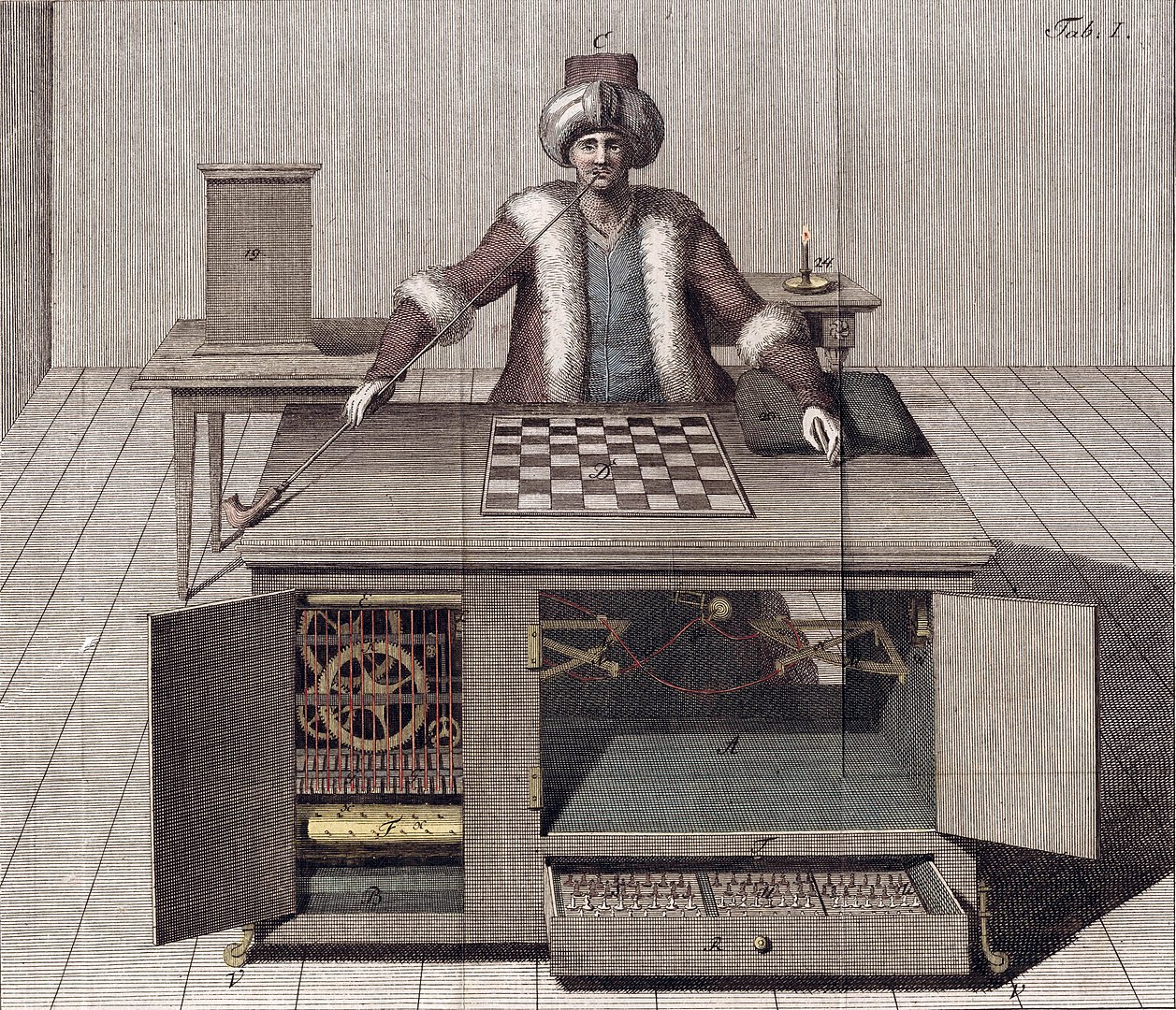
As early as 1769, at the height of his engineering achievements, Kempelen presented the empress and the court with a new wondrous automaton. It took the form of a richly dressed Turk seated at a table in front of a chessboard. The pieces were set out on the board, and Kempelen announced that this automaton was ready to play chess with anyone present — a most complex game in which the number of possible positions that can arise on the board exceeds 1062! Count Ludwig von Cobenzl sat down to play without the slightest fear — and suffered a hopeless defeat, lasting less than half an hour. The other volunteers fared no better.
As an encore, the magical «Turk» brilliantly solved the spectacular problem of how to move a knight across all 64 squares of the board, visiting each square only once. Many believed it was merely a clever trick. But no one was able to expose it. The burgomaster of Pressburg, Karl von Windisch, recalled: «The assumption that the automaton was controlled by a human arose in the very first minutes of the demonstration. Many spectators were so convinced of this that they did not hesitate to voice their opinion aloud. But we were all in for a shock when Mr. von Kempelen threw the doors of the cabinet wide open. He turned the automaton in all directions, illuminated its interior with a candle, lifted the Turk’s garments, and allowed us to peer into every crevice. When, despite all my efforts, I failed to discover a single suspicious object even the size of a hat, my self-esteem suffered a cruel blow. The rest of the spectators experienced the same feeling, which was eloquently reflected on their elongated faces».
It was obvious that the burgomaster had been deeply offended. Later, he said: «Subsequently, I examined the automaton more than once, tested it in every possible way, played chess with it, and must frankly admit that I understood nothing. I console myself with the thought that other people, far more knowledgeable in mechanics, found themselves in the same position: no one managed to uncover the secret… If this is a deception, then let it be so! In any case, it is a deception that does honor to the human genius, a deception astonishing and incomprehensible…»
And yet, despite such triumphant reviews of his invention, Kempelen set the automaton aside and did not touch it for quite a long time — the Empress Maria Theresa preferred that he devote himself to his work as an engineer. Perhaps she was right?
THE HEIR’S WHIM
But in 1781, the newly enthroned successor of Maria Theresa, Joseph II, while receiving in Vienna the heir to the Russian throne, Grand Duke Paul, decided to astonish him with the carefully preserved miraculous «Turk». Paul was delighted and persuaded Joseph to send the wonder automaton on a foreign tour. Indeed, how could one refuse such a petitioner? And what about Kempelen? He was clearly in no hurry: he postponed these highly prestigious гастроли by at least a year, taught the «Turk» to speak by showing it the letters placed on the table… The questions put to the «Turk» and its answers have survived: «How old are you?» — «192 months». «Are you married?» — «I have many wives». «How many possible variations does a game of chess contain?» — (the «Turk» shows a one followed by an enormous number of zeros — an answer that is deliberately inaccurate, but close to the correct one in meaning).
At last, he had to go — one does not readily argue with Paul. Some dispute this, but it seems that the automaton did reach St. Petersburg and that Catherine II played against it — and, of course, unsuccessfully. The proud empress insistently demanded that Kempelen sell her the automaton, but he managed to wriggle out of it by explaining that he had to be constantly present with the device.
Belles-lettres took a great liking to this plot, producing at least two novels and the feature film The Chess Player (1938). According to its story, a crippled Polish officer named Voronsky is hidden inside the automaton; he defeats Catherine, and when she deliberately makes an illegal move, he knocks a piece off the board. For this, the empress orders the automaton to be shot. Kempelen takes Voronsky’s place and is mortally wounded during the execution (Lord, why?). Well, that was the kind of cinema they made back then…
The performances in Paris were successful — both at court and at the famous chess café Café de la Régence. With one exception: a game against André-François Danican Philidor, clearly the finest chess player of the era, ended not in the automaton’s favor. True, Philidor acknowledged the strength of his opponent’s play, but still, it became clear that this mechanical «Turk» was not perfect and could lose to an ordinary human being…
Benjamin Franklin, on the other hand, lost to the automaton but treated it with great interest — in his library, a book about the wondrous «Turk», written by Philip Thicknesse, was later found. In London, the automaton played games for stakes of five shillings with anyone willing — clearly not at a loss to itself. And in Amsterdam, it faced the King of Prussia, Frederick the Great, and won again. The king’s curiosity knew no bounds — it is said that he even offered Kempelen a large sum of money for the secret of the «Turk», but received no consent.
DECLINE AND A NEW LIFE
Kempelen returned from the tour and resumed an ordinary life, seemingly forgetting about his automaton. Many tried to uncover its secret. Some claimed that the baron had a powerful magnet in his pocket with which he controlled everything, though no one understood how exactly he did it. Others believed that barely noticeable strings led to the automaton, yet anyone could walk around it and see no strings at all. Some even asserted that a living chess player was hidden inside the «Turk». But Kempelen opened the automaton’s doors to anyone interested, and everyone could see that there was nothing inside except gears, chains, and forks! Why stop promoting such a marvel?
In 1804 Kempelen died, and his heirs sold the «Turk» for 10,000 thalers to the Bavarian impresario Mälzel. A new, powerful phase of its fame began. In 1809 it crushed Napoleon himself — the greatest military commander, not unfamiliar with chess battles — in just 19 moves. Two years later, in Milan, it defeated the Viceroy of Italy, Napoleon’s stepson Eugène de Beauharnais, shone in Paris, and in London offered opponents a pawn and the first move as odds, yet still lost only 2 games and won 45! But it did lose after all, and it had been beaten by Philidor… So what was the secret?
Later, the «Turk» crossed the ocean and astonished Americans for a long time. It took part in the major New York exhibition of 1826, amazed Boston, Baltimore, and Philadelphia, checkmated Charles Carroll — who, like Franklin, had signed the Declaration of Independence — and this went on for decades.
However, in 1836 Edgar Poe himself published the essay Maelzel’s Chess Player, in which he posed a very strong question: «If this is an automaton, then it should always win, but it occasionally loses — why?» Interest in the technological marvel of the past century began to wane, while uncomfortable questions multiplied. Mälzel decided to transport the «Turk» back to Europe, but died aboard ship, and the automaton passed to the captain, without its secret, which only Mälzel knew. The new owner donated the automaton to the National Museum of Philadelphia, where it was exhibited solely as a remarkable immobile mechanism whose secret had been lost. In 1856, as a result of a fire, the famous «Turk» burned down. But it ceased to be a legend two years earlier.
JUST THAT — AND NOTHING MORE!
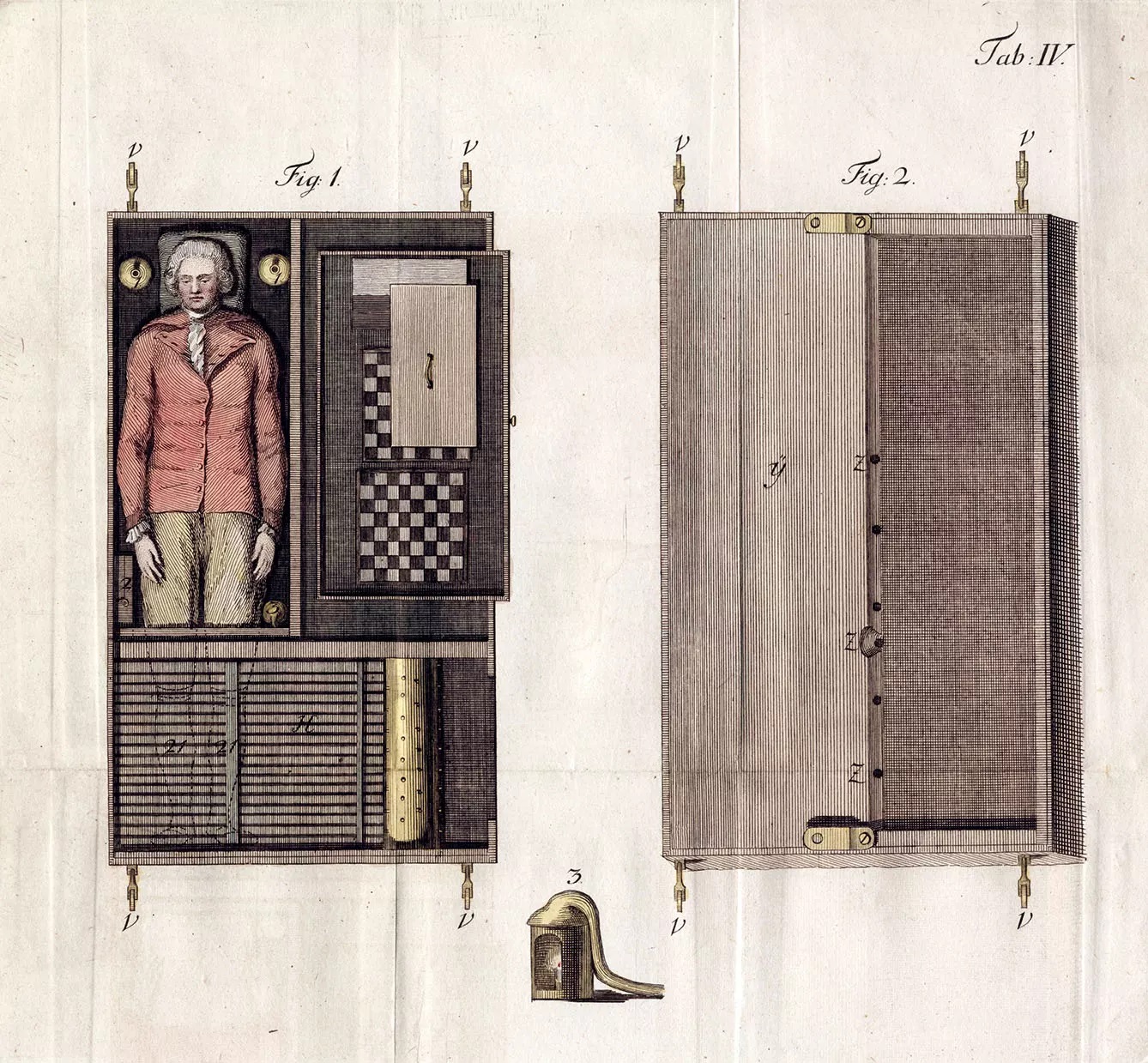
A devastating publication appears about the presence of a breathing tube inside the «Turk» — why would an automaton need one? An article surfaces in which two young men admit that they accidentally saw the famous chess player William Schlumberger climbing out of the machine after a game. Finally, it is explained in detail how, thanks to a system of partitions and mirrors inside the machine, it was possible to create cavities large enough to conceal a player from everyone’s view. Johann Allgaier, Henri Boncourt, Aaron Alexandre, William Lewis, Jacques Mouret, the same William Schlumberger (the chess stars of the time) — for each of them evidence is found that they sat in the stifling cabinet of the «Turk» for a substantial fee (remarkably, not one of them ever let it slip at the time!).
It becomes clear why von Kempelen was reluctant to return to his most sensational creation. And yet, for all that, Kempelen’s automaton does not cease to be a marvel of the technology of bygone times. The ingenious device takes into its mechanical fingers exactly the piece that the hidden player wishes to move. Where to place it, the player sees by the movement of a little ball beneath the chessboard — this is ensured by strong magnets. Every twelve moves, the game’s operator carefully winds the machine for a long time with a large key, giving the chess player time to think. More and more details surface — what is the point of hiding them anymore? Fraud. The most ordinary kind, albeit fairly inventive.
And here is another important lesson. Do not allow the inexplicable; do not let elements of a new device be turned into an astonishing secret and an insoluble mystery. If something is unclear, sort it out before the very last page of the patent application, simply so that everyone does not laugh at you afterward. If you are told that this is a secret that must not be disclosed — know firmly that you are being deceived. It is better to turn around and leave at once — at least you will not become a laughingstock. And show a little leniency toward Wolfgang von Kempelen, who did not cling to his sensation as his main breadwinner and bearer of fortune. He was a fine mechanic even without it, and therefore guilty — but deserving of indulgence.
LITERATURE
- Kempelen, W. Mechanismus der menschlichen Sprache nebst Beschreibung einer sprechenden Maschine. Vienna, 1791: with 27 engravings. Facsimile edition: G. Holzboog, 1970. 456 pp.
- Sergey Markov. Hunting Electric Sheep: The Big Book of Artificial Intelligence. Moscow: OOO Alatyr, 2024. — Vol. 1. — pp. 308–309.
When copying materials, please place an active link to www.huxley.media
Select the text and press Ctrl + Enter


