THE DA VINCI CODE: The Hidden Geometry of the «Vitruvian Man»

Art design: huxley.media via Nano Banana 2
«Mona Lisa» is the first thing that comes to mind when the conversation turns to Leonardo da Vinci. Perhaps it is the most famous painting in the world. That is why most of our contemporaries regard Leonardo first and foremost as a brilliant artist. However, he himself considered himself a great engineer. But do we really know everything about him and his works? Recent discoveries suggest that da Vinci came remarkably close to uncovering a mystery that modern science has yet to fully comprehend.
NOT EVERYTHING WORKS, BUT EVERYTHING IS GENIUS!
A
s an inventor, Leonardo was extraordinarily prolific. At least, that is how he «sold» himself to the kings and dukes of the late 15th and early 16th centuries. He is credited with the earliest technological concepts of gliders, helicopters, parachutes, diving suits, cranes, gear systems, cluster bombs, aerodynamically stabilized artillery shells, and other types of weapons. He was also the first hydrologist. His «Codex Leicester» contains 730 conclusions drawn from observations of water, including an accurate description of the hydrological cycle and the effect of flow velocity on pressure. And all of this — at the turn of the 15th–16th centuries, 400 years before such fantastical ideas became reality.
However, when modern engineers attempt to bring Leonardo’s ideas to life, quite a few questions arise about the genius. In particular, regarding his device for walking on water. There are also flaws in the famous «tank» depicted in his 1485 sketches. In reality, it would not have been able to maneuver due to its enormous weight and issues with gear ratios. But perhaps the most frustrating part is that da Vinci is constantly being stripped of his status as a «pioneer». For example, the Chinese claim that they invented the idea of the helicopter, as a toy capable of lifting into the air, which appeared in China 1,800 years earlier. As Ilf and Petrov once said, anyone can offend an artist…
THE GREAT MASTER OF ILLUSION
However, it is not so easy to topple Leonardo da Vinci from his pedestal. His imagination and intuition were far ahead of his time. And the «codes» he left behind are still being deciphered by the most inquisitive minds. Da Vinci was an unparalleled master of illusion. Engaged in physiognomy, he introduced the concept of moti mentali, which can be understood as the depiction of transient, dynamic states of the mind, thoughts, and emotions. Hence, the «ambiguous» facial expressions in his portraits. To convey inner states through subtle external changes of the face, he used the technique of sfumato — smooth, almost imperceptible transitions from light to shadow or from one color to another.
Applying up to 30 layers of glaze to achieve a delicate shadow around the mouth of the «Beautiful Princess» or the «Mona Lisa», he reached not only a fantastic level of detail but also created unparalleled illusions. What the eye sees does not correspond to what the brain interprets as reality — Leonardo accounted for this discrepancy in perception centuries before scientists understood the mechanisms behind it. From certain angles, these women appear content and cheerful; from others, they seem thoughtful or melancholic. This is moti mentali in action!
MATHEMATICS BECOMING ART
A considerable number of Leonardo da Vinci’s mysteries are connected with mathematics. He had an excellent command of mathematical tools. There is evidence that while working on the «Mona Lisa», Leonardo immersed himself deeply in geometry. «Let no one read me who is not a mathematician», he said. Perspective, symmetry, proportions, and geometry — he used all of these to create various kinds of illusions. In the «Annunciation», he uses perspective to emphasize the corner of the house, the enclosed garden, and the path. In «The Last Supper», the architecture of the building behind Jesus and the 12 apostles, together with the lines on the floor, creates a «vanishing point», ensuring a subconscious focus within the painting.
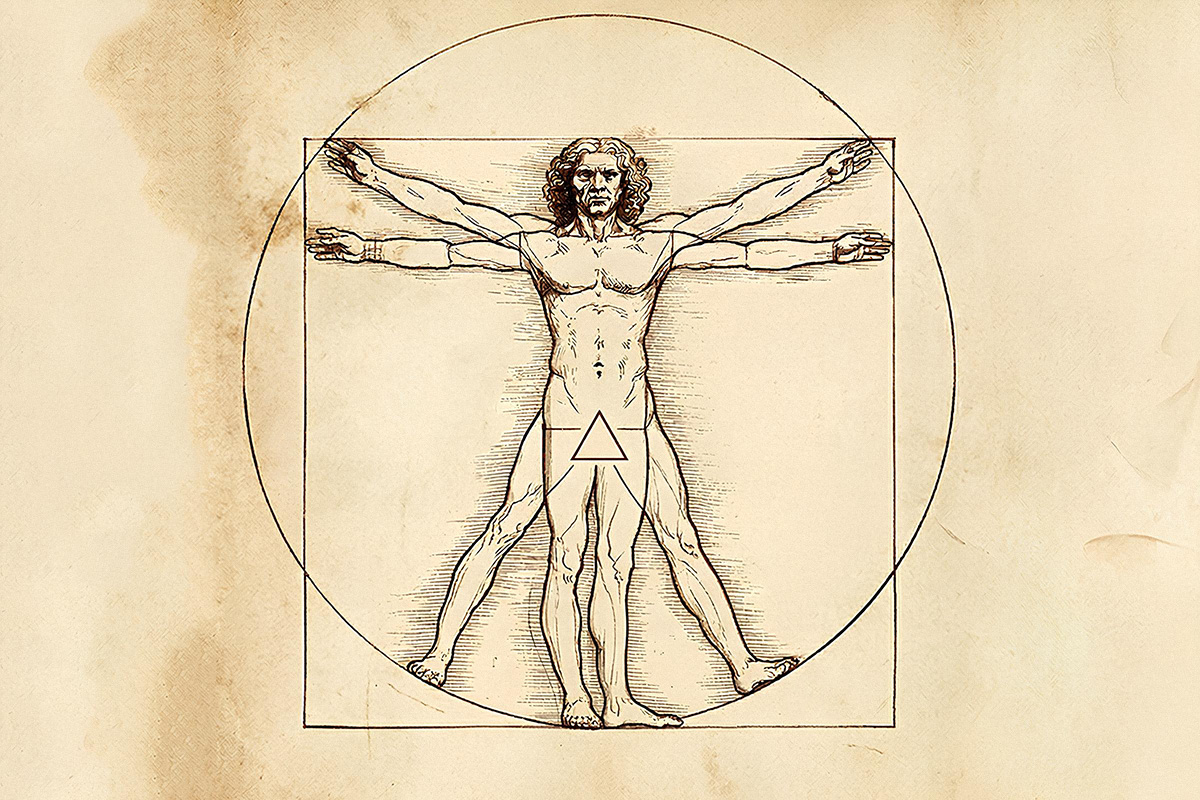
Leonardo’s geometric experiments were closely connected with his search for patterns in nature and art. This also explains his interest in the works of Marcus Vitruvius Pollio, an ancient Roman architect and engineer. Vitruvius was the first to suggest that arm span and height are related. A person with outstretched arms and legs fits perfectly within a square. And if the navel is taken as the center, a perfect circle can be drawn around the body. Thus emerged Leonardo’s famous sketch, the «Vitruvian Man» — an attempt to define the ideal proportions of the human body.
STRANGE PROPORTIONS OF THE IDEAL
However, the ideal always differs not only from reality but also from something even more perfect. That is precisely why the proportions of the «Vitruvian Man» are anatomically inaccurate. The truth is that Leonardo did not intend to create an anatomical guide. It is believed that he chose the proportions of the «Vitruvian Man» based on the theory of the golden ratio. The first to introduce it to the world in 1509 was the Franciscan monk and mathematician Luca Pacioli. He defined the golden ratio as a harmonious proportion in which one part relates to another as the whole relates to the first part.
Pacioli believed that by applying this divine principle, one could create aesthetically perfect images and compositions without error. Da Vinci adopted this principle to achieve the proportional harmony underlying the structure of the «Mona Lisa». It would seem logical to find it in the image of the «Vitruvian Man» as well. However, the golden ratio cannot fully explain its proportions — they do not quite align. It is clear that the extraordinarily detail-oriented da Vinci made them this way deliberately. Yet for more than 500 years, no one could understand why the artist chose such peculiar proportions for the arms and legs. Only in our time has this been resolved — and not by a renowned art historian, but by an ordinary Italian dentist.
THE SECRET HIDDEN «BETWEEN THE LEGS»
Before the dentist Rory McSweeney, millions of eyes had gazed at the «Vitruvian Man» for centuries — yet only he managed to notice this detail. And, as they say, it was in plain sight. In the groin area of the «Vitruvian Man», the dentist discovered an equilateral triangle. Interestingly, Leonardo himself pointed to it in his notes accompanying the sketch: «If you spread your legs… and raise your arms so that your extended fingers touch the line of the top of the head… the space between the legs will form an equilateral triangle». But it was only in the 21st century that dentist McSweeney took the great artist’s words literally. He carried out calculations for this triangle and found that the ratio between the distance across the man’s feet and the height of his navel is approximately 1.64 to 1.65.
This is very close to the tetrahedral ratio of 1.633 — a uniquely balanced geometric form. At the end of the 19th century, two scientists, Jacobus Henricus van ‘t Hoff and Joseph Achille Le Bel, independently discovered that the carbon atom in organic compounds has a tetrahedral structure. This became a key milestone in the development of ideas about the spatial structure of complex compounds. The tetrahedral ratio has found wide application in crystallography, optics, and materials science. In chemistry, the tetrahedral structure is characteristic of many molecules. In construction, it is used to create spatial load-bearing structures.
THE MATHEMATICAL «ORIGIN OF THE WORLD»
Most likely, McSweeney did not discover the tetrahedral ratio in the «Vitruvian Man» by chance. His profession helped him grasp the significance of this number. As early as 1864, dentistry introduced the term «Bonwill triangle». This is an imaginary position of the jaw which, at a ratio of 1.633, ensures its optimal functioning. Are there too many coincidences here? Why is it that, following minerals, crystals, molecules, and biological structures, the proportions of the human body also appear to be organized around specific geometric ratios?
The simple answer is that this is how nature maximizes mechanical efficiency. However, McSweeney himself sees the reason for this pattern in the fact that «human anatomy has evolved in accordance with geometric principles that govern the optimal spatial organization of the entire universe». It is possible that the triangle mentioned in da Vinci’s notes is not coincidentally located in the area of the reproductive organs of the «Vitruvian Man». It may be that Leonardo was hinting at a certain «origin of the world», a source that gives rise to the mathematical nature of reality.
Original research:
When copying materials, please place an active link to www.huxley.media
Select the text and press Ctrl + Enter