«THE SECOND BETHLEHEM»: How a cave city became the pride of Italy

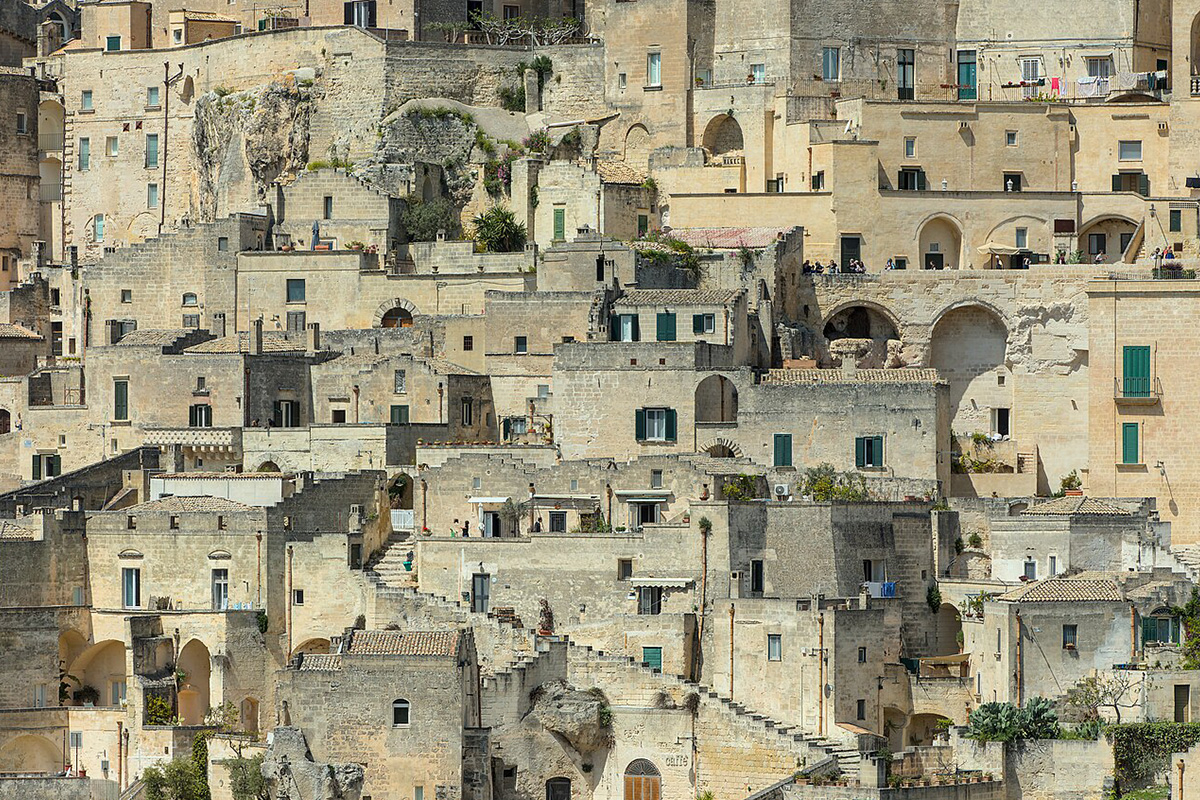
Matera (Basilicata, Italy) — view of the Sassi from the Murgia Timone viewpoint (on the opposite bank of the Gravina River): details of the old town built on several levels / wikipedia.org
In 1993, this city was added to the UNESCO World Heritage List as «the most outstanding, intact example of a troglodyte settlement in the Mediterranean region, perfectly adapted to its terrain and ecosystem». This was reported by the publication Italy Heaven. The city is called Matera. It is one of the most fascinating, oldest, and still inhabited cities not only in Italy but in the world, with evidence of human settlement dating back to the Paleolithic era, in natural caves carved into the rock. Matera is located in the southern region of Basilicata (historical name: Lucania), and its cave districts are known as the Sassi (from the word «stone»). Ravines, cliffs, caves… and within them churches, monasteries, hermitages, and houses have been built.
At times, it feels as though you are looking at a scene from the Old Testament. It is therefore hardly surprising that films such as The Passion of the Christ by Mel Gibson (2004), which depicts the Sassi and the gorge below, as well as The Gospel According to Matthew by Pier Paolo Pasolini (1964), were shot here. The city of Matera is known as the «Second Bethlehem» and is one of the most authentic places in Italy to visit. Tourists often bypass it, despite the fact that Matera is as beautiful a city as Rome or Florence — only without the crowds. Yet there were times when Matera was called Italy’s «national disgrace»…
THE FIRST MENTIONS OF MATERA
T
he history of Matera begins in prehistoric times. Evidence of this includes numerous pottery artifacts from the Early Neolithic period found in caves. The earliest ceramics in Matera are dated to approximately 7500 BCE. The city that emerged on the site of a prehistoric settlement likely has Greek origins. In Ancient Greek times, Matera was closely connected with colonies on the southern coast; during the Roman period, it became a major trade and transit route. After the fall of the Western Roman Empire (which occurred in 476, when its last emperor, Flavius Romulus Augustulus, abdicated the throne) and the reconquest by Byzantine emperors, the city of Matera remained under the control of the Lombards and Saracens for a long time, until the Norman invasion of Italy in 1042. During the Norman rule, the city entered a peaceful period, but later suffered from famine and earthquakes.
For a long time, Matera was a royal city, until it came under Aragonese rule and was granted to Count Giovanni Carlo Tramontano, who was later killed by local residents burdened by taxes. In the 8th century, Byzantine monks settled here in Matera. They arranged churches in the grottoes, very similar to those that can be seen in Cappadocia or in Syria. Local residents built their homes in the Sassi, also using natural grottoes. The streets of the cave city are narrow, with countless steps. Rock-hewn churches scattered throughout the city are decorated with frescoes and sculptural elements. Parallel to the historic Sassi center, from the 13th century onward, a new city of Matera developed, with districts built under the supervision of renowned Italian architects.
MATERA — THE CAPITAL OF THE BASILICATA REGION
1623–1806… During this nearly 200-year period, Matera was the capital of Basilicata until Napoleon Bonaparte moved the capital to Potenza. Local residents struggled with water shortages, so they devoted their energy not to building houses but to digging channels and trenches to collect water in the limestone and to creating systems of various cisterns. Gradually, the inhabitants turned Matera into a green city with hanging gardens. Matera can be difficult to navigate. The city center, its oldest part, is built on the edge of a plateau. A rocky mountain rises above the place where the valley descends into a deep river ravine. It is here that the city cathedral is located.
Over time, the rocky slopes of the valley beneath the city were used to create caves necessary for living, storage, and keeping livestock. The poorest local peasants lived in these cave districts. The settlements filled the narrow valley and stretched along the very edge of the gorge. The most refined of the cave districts is called Sasso Barisano, and the other is Sasso Caveoso. At first glance, the slopes appear to be rows of small, weathered stone buildings. However, behind the façades — which sometimes project outward like ordinary houses — the living spaces extend deep into the rock and usually include one large room with an anteroom for animals at the back.

THE POOREST CITY OF MATERA AND A NEW LAW
At the beginning of the 20th century, this southern Italian area became synonymous with absolute poverty. At that time, Matera was called Italy’s «national disgrace». Many families, as in ancient times, crowded into cave dwellings — under unsanitary conditions, without running water or electricity, living side by side with their animals. In 1952, the Italian government adopted a law under which about 17,000 residents of the cave city were resettled in other districts. «The state will bear the costs of reconstructing the Sasso Caveoso and Sasso Barisano districts in Matera and of building public housing specifically intended for farmers, workers, and artisans, to replace what currently exists in these districts and will be declared unfit for habitation and demolished».
Thus, the Sassi faced decline. By the 1980s, the abandoned caves of Matera had become a compelling reminder of the past. A few affluent residents returned and renovated the old cave houses. Then, in 1986, a decision was made to preserve and restore the cave complex, and in 1993 it was added to the UNESCO World Heritage List. Today, the city is a source of national pride. On January 19, 2019, Matera was granted the status of «European Capital of Culture — 2019», and it continues to attract thousands of visitors, despite being located outside the usual tourist routes.
CAVE FRESCOES
In Matera, as throughout this part of southern Italy, there are many churches carved into the rock on hillsides and in ravines. These rock-hewn churches — chiese rupestri — were mostly created by Basilian monks, whom we have already mentioned, who fled persecution in the Byzantine Empire during the 8th–9th centuries. In the caves, one can often see faded frescoes in the Byzantine style. However, one of the most beautiful churches in Matera is not a rock church. San Pietro Caveoso is built in a picturesque location above a ravine. It is a charming small building with a welcoming atmosphere and folk artistic decorations. Higher up in the rocks are two churches — Madonna dell’Idris and San Giovanni in Monterrone — connected by a tunnel. Here, a genuine cave atmosphere is felt, enhanced by several beautiful wall paintings in the Byzantine style.
«RECONSTRUCTED» CAVES — A LURE FOR TOURISTS
As tourism in Matera has become a business, enterprising locals have created so-called «reconstructions» of caves for visitors — cave dwellings filled with antique objects. Among them is Casa Grotta di Vico Solitario in the Sasso Caveoso district. You are escorted into the cave and then left alone… free to look around at your own pace while listening to an audio recording about the dwelling’s history in the language of your choice. In the Sasso Barisano district there is a similar cave — Casa Grotta del Barisano. Here you can see the typical layout of an inhabited cave as it was before being emptied in the 1950s. The furniture and design are standard — perhaps even overly so — and what is striking is how families adapted to such near-Spartan living conditions. It is shocking to realize that, quite recently, people lived like this: chickens were kept under the bed, a horse in a corner, and children slept wherever there was free space.
MATERA AS A FESTIVAL CITY
The largest festival in Matera is the Festa della Bruna, held every year on July 2. The city becomes beautiful, glittering, and magnificent during the historical reenactment of the feast of Madonna della Bruna. A medieval legend tells of a peasant who, while returning to Matera, gave a ride on his cart to an unknown young woman. Upon arriving in what is now the Piccianello district, the woman asked him to deliver her message to the bishop. Soon after, she disappeared from the peasant’s sight. Before long, the woman’s identity was revealed. It was the Madonna. In her message, she asked the bishop to remain in Matera.
«Thus, on an adorned cart, I wish to enter my city every year». The bishop and clergy immediately went to the place where the woman had alighted from the cart and found an image of the Virgin Mary there, which was solemnly brought to the cathedral and placed on a richly decorated cart. Some, however, believe that the custom of carrying the Madonna on a cart recalls the looting of the city by the Saracens who once besieged it. It was then that the icon of the Mother of God was taken away on a cart to save it. The beginning of the celebrations in honor of Madonna della Bruna dates back to 1389, when Pope Urban VI linked this event to the Feast of the Visitation of the Blessed Virgin Mary to Elizabeth, setting its date — July 2 — in the liturgical calendar.

HIGHLIGHTS OF THE CATHEDRAL
Matera Cathedral is one of those structures that fits perfectly into its surroundings. It features a rose window, four large columns with depictions of the Evangelists, and twelve columns honoring the Apostles. The cathedral’s façade has been preserved exactly as it was commissioned by Pope Innocent III at the beginning of the 13th century. The 16-rayed rose window is a true jewel of the Matera Cathedral. It is crowned with an image of the Archangel Michael driving away the dragon. Both elements are important to the symbolism of the church and to Christian spirituality. The rose-stained-glass window symbolizes divine light penetrating the church and illuminating the faithful within. Since its construction, the interior has undergone numerous changes and reconstructions, becoming today a triumph of Baroque style and splendor. Alongside the stucco work and gold of later centuries, the ancient fresco Madonna and Child Blessing is particularly striking. The fresco dates back to the time when this religious building was constructed.
WILL THERE BE MASS TOURISM
Paolo Verri, head of the Matera 2019 Foundation, who was responsible for the European Capital of Culture program in 2019, said that mass tourism in a small city would be avoided at all costs. For non-mass tourism, however, the paths are open. «We are not Venice and we do not hope to become it. But let’s be honest: if tourism had not created jobs, the situation today would look different. Tourism offers new opportunities. And it brings real money», Verri added.
And finally, a bit of statistics. Unlike Rome, with approximately 22.2 million tourists per year, and Pisa with 3 million, Matera receives fewer than one million visitors.
When copying materials, please place an active link to www.huxley.media
Select the text and press Ctrl + Enter