THREE ANDRIIS: An Open Letter to a Young Person About the Science of Living

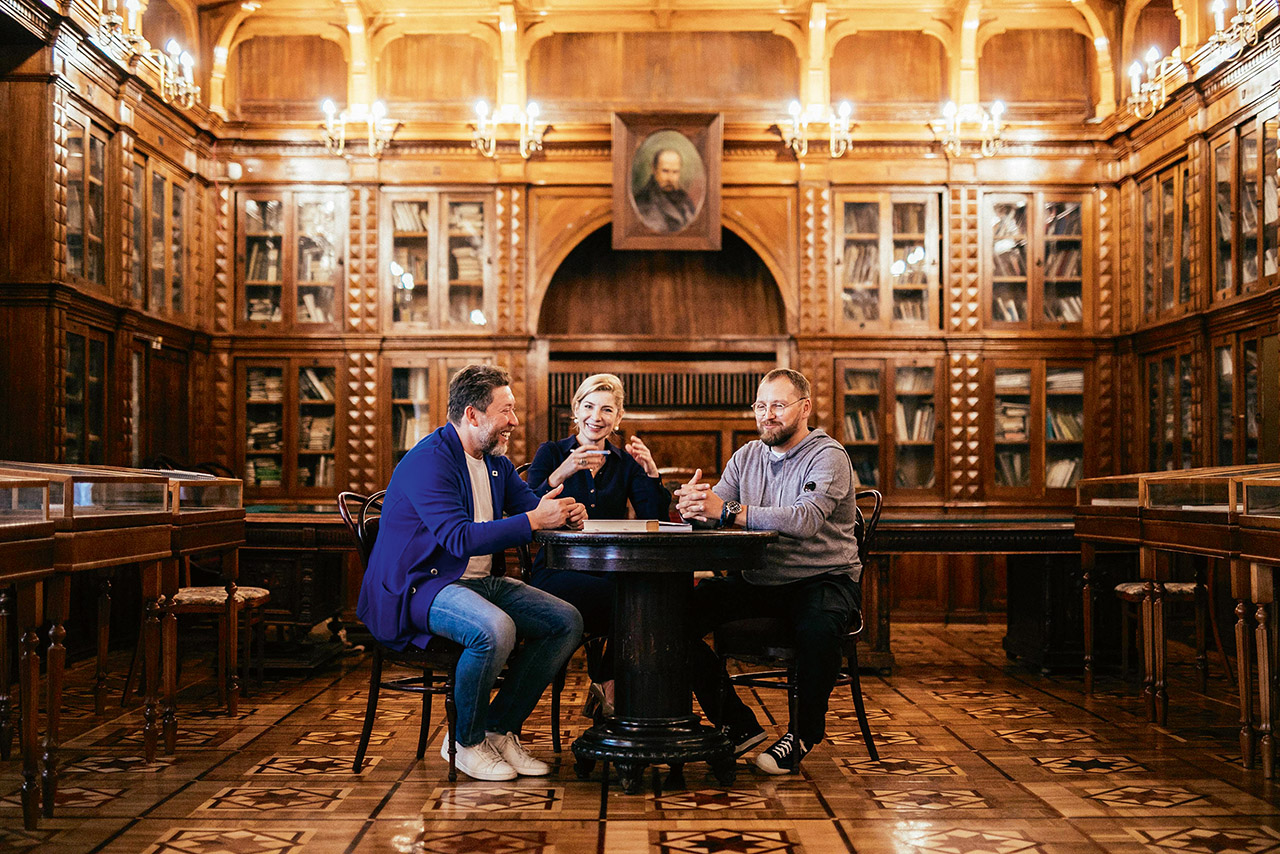
Andrii Zdesenko / Zhanna Kryuchkova / Andrii Fedoriv
The French writer André Maurois (1885–1967), in his book Open Letter to a Young Man on the Art of Living, addresses the younger generation, sharing the wisdom he has gained over a lifetime.
The book is structured into fifteen key thematic sections, in which the author poses questions to himself and provides his own answers. Maurois reflects on the era and the meaning of existence, on women and marriage, on art and leadership, on politics and real life.
Huxley, represented by publisher Zhanna Kryuchkova, has posed twelve of the questions explored by André Maurois in his book to Ukrainian entrepreneurs Andriy Zdesenko and Andriy Fedoriv. We also invite readers to explore excerpts from Maurois’ original responses.
The conversation took place at the library of the National Museum of Literature of Ukraine, located at 11 Bohdan Khmelnytsky Street.
The museum is housed in a historical and architectural landmark from the late 19th century — the main building of the former Pavlo Galagan College, an elite educational institution in Kyiv. The library’s interior, crafted by Italian artisans, has been preserved in its original state.
#1 The dangers of our era…
André Maurois: Of course, I, too, was fond of life at the beginning of the century; at that time, I was young and trusting. But I clearly see that this idyllic picture is misleading. Only a few could look to the future without fear, while most were defenseless in the face of illness and old age.
Truthfully, I don’t believe in a golden age: a human being always remains human — at once a hero and a beast. “We must come to terms with what is and accept what replaces it… I live in the age of airplanes and do not mourn the stagecoach…” (Gabriel Delanne). We are not gods. We have simply acquired demonic power on our small clump of dirt.
What remains is to use this power wisely. We possess the physical means to destroy civilization and humankind, but we lack the moral means to prevent such destruction. One of your generation’s tasks is to put an end to these foolish and childish games.
Andriy Zdesenko: Today’s digital world has many advantages, and in many ways, I embrace it — but I miss tangibility, face-to-face communication, and, ultimately, encyclopedic knowledge drawn from the mind.
I’m an analog person; human relationships matter deeply to me. My children increasingly communicate through gadgets, but to me, that feels limiting.
That’s why I don’t like managing remotely: I need to gather people, feel their energy, inspire them and be inspired in return. In this new paradigm — where a person supposedly no longer needs another — I will not be happy.
Andriy Fedoriv: The Italian novelist Alessandro Baricco begins his book on the history of digitalization, The Game, by reflecting on how we might have lost everything: how a peaceful meal could turn into stress and alienation.
Baricco concludes that the new era is neither better nor worse — it is simply different. The central idea of the book is this: the world used to do everything to seem complex but was actually simple; now it does everything to seem simple but is becoming ever more complex.
On social media, everything appears straightforward — but just try becoming well-known there. The competition is fierce, and self-realization in a world where everything has already been done, and everything is public is far more difficult.
My personal conclusion: we must set goals properly and not adopt the values imposed by the digital world. We must accept the inevitability of digitalization. A person who makes a point of saying they are not on social media loses more than they gain.
But we must remember the ultimate goal — to be happy. And that means remembering that Facebook friends are not real friends, and the greatest luxury today is not publicity but privacy — the ability to go a week without posting a single story.
In the digital world, one must be a surfer who rides the waves — not someone who smashes against the rocks.
Andriy Zdesenko: Yes, true luxury is not looking at the world through the lens of Instagram stories. I often catch myself thinking: «Oh, how beautiful — I should take a photo. What a sunset — where’s my phone?»
Andriy Fedoriv: Absolutely! Two years ago, I was on a sailing regatta in the south of France. That’s when I got into paddleboarding. I woke up at 5 a.m. in the fresh air, lying on the net between catamarans, stood on my board, and glided over a perfectly calm sea past the world’s most expensive yachts.
I had only two things with me: a paddleboard and my swim trunks. As I came out of the water, the sun had just broken above the horizon.
I was haunted by the thought: «Why didn’t you take your phone?» — and then another thought followed: «How great that you didn’t! Now you’ll have to remember it.»
I looked at the scenery and said: «Brain, save this picture, save it — I don’t have my phone!» And that image has stayed with me ever since.
Andriy Zdesenko: Today, you have all the tools at your fingertips, and you simply copy and paste using templates — you start to resemble everyone else. And that leads to a loss of individuality, of the ability to generate ideas and to truly work.
In the past, moving forward required far more effort, hard work, unique creativity, and time invested.
That’s why many people now skip the stage of overcoming difficulties and, as a result, miss out on the feeling of joy that comes with triumph — a feeling my generation grew accustomed to.

#2 Purpose: people live, eat, love, have children, work. But why?
André Maurois: Goethe once answered: «So that the pyramid of my life, whose foundation was laid before me, may rise as high as possible.»
The attempt to make a masterpiece of one’s life — that is a noble pursuit…
You are young and only beginning to build your own pyramid on the foundation you have inherited…
My pyramid did not become all it could have been.
Why?…
I didn’t know how to say no with resolve… I was afraid of upsetting or offending others.
If you wish to create something great — in literature, science, politics, or industry — you must give yourself to creation completely and unreservedly…
Would Proust have written In Search of Lost Time if he had let himself be distracted by trivialities?
Andriy Zdesenko: For me, the essence of life is self-realization in all its forms, daily happiness, love, and the constant discovery of the world — the joy of connecting with my children, family, and close friends.
I haven’t defined any other spiritual meaning for myself. What matters greatly is passing this drive for self-realization on to my children.
Andriy Fedoriv: Life is a stretch of time. Before the moment of death, I want to realize my potential as fully as possible.
And also — to truly feel this planet. When the pandemic began, I had a fleeting thought: «What if we never travel again?»
Then I thought: «That would be sad — but how amazing that I already know what Tokyo sounds like, what a fishing village in Hong Kong smells like, and how the glaciers of Alaska crackle underfoot.»
#3 Education: Aldous Huxley claimed that it is unacceptable to consider someone educated if they have read Shakespeare but do not know the second law of thermodynamics. Is it possible to run a factory, a city, or a country without knowing scientists and their secrets?
André Maurois: You may choose to enter public service, devote yourself to scientific research, or engage in practical work.
Whatever path you choose — a cultural foundation is essential. It is one of the first steps of your pyramid…
I do not at all believe that science will displace art and literature from our society. Science grants us increasing power over the external world, while literature helps to organize our inner world.
Both are equally necessary.
Could a scientist withstand the storm of emotions that overtakes them and maintain the freedom of spirit required for scientific experimentation if art did not come to their aid from time to time?
Andriy Zdesenko: By the way, I actually studied thermodynamics as a physics and mathematics major (laughs). For high-level management, the key is intellect — and that’s not about knowing laws in a narrow field but about one’s overall level of education and culture.
For me, practice matters — but it must be grounded in theory. And that applies not just to physics or math but to music, sports, and business as well.
It’s the rethinking and development of theory that produces exceptional results. There’s an eternal debate between the physicists and the poets: what matters more — technical knowledge or creativity? For me, creativity lies in Shakespeare, and depth lies in the laws of thermodynamics.
But in my opinion, not even deep understanding and knowledge of a subject is enough to truly grasp how a state functions — let alone govern it.
Andriy Fedoriv: The key is balance. You don’t have the luxury of making a polar choice. If you invest only in technology — you won’t have a team, you’ll lack energy in your brand. If you focus solely on HR and PR — you’ll love each other, do teambuilding, and have philosophical conversations, but what will you actually accomplish?
How will you remain resilient to technological, social, and economic challenges if you don’t think systemically?
A state is a vast system — it’s like jazz: there’s rhythm, and there’s improvisation. A great leader is like a phone with two SIM cards: one for the hard sciences, the other for the humanities.
That said, if we look at the statistics of company owners we work with, physicists and mathematicians outnumber humanitarians — in a ratio of about 90 to 10.
#4 Leisure: should you engage in any form of art?
André Maurois: Art gives you what life so often denies — peace, «understood not by the mind, but by the heart.»
The fiercest enemy of inner balance is the imagination. It paints a future filled with misfortune and danger. It awakens memories of the past, immersing us in empty dreams of what could have been — but never was. Art enchants us with visions beyond the reach of our imagination… Art offers the spirit what life withholds from it: a unity of contemplation and inner peace.
Andriy Fedoriv: Let’s first define what we mean by «art» and by «engage in.» You can choose art as a profession, or you can approach everything in life as a creative act.
For 20 years, I did everything to approach the creative business as if it were a traditional one — I built every possible technological beam into it: from financial accounting to strategic planning.
And now I think: «Maybe I should have taken a traditional business and approached it creatively instead?» All of life is creation — and creating gives a person far more energy than consuming.
Andriy Zdesenko: Absolutely, one should engage in art — and the earlier you start, the better. Music played a huge role in my development. Of course, sports and various formal and informal types of education were also important.
But it was music and contact with art that planted the seeds of my love for aesthetics. It fuels me with the energy of creation and creativity. Everything I do, I infuse with aesthetics — from household products and wet wipes to the world of fashion and ideas for office and boutique design. Art is an integral part of my everyday life.

#5 Society of abundance: at first, the law was «By the sweat of your brow, you shall eat your bread». Then, more and more often, it was replaced by another: «By the sweat of someone else’s brow, you shall eat your bread». And are you drawn to the new law: «By the sweat of computer keys, you shall drink your whisky»?
André Maurois: I read the book The Affluent Society by the renowned American professor Galbraith…
And here’s what I think: I don’t believe your generation will live to see two-hour workdays and retirement at thirty. And thank God for that. You would look far too pitiful. I always dreamed of writing A Journey to the Island of the Do-Nothings in the spirit of Swift.
The name of this people supposedly derives — according to scholars — from the English do nothing. The Do-Nothings are people who do absolutely nothing.
Science on their island has reached such heights that a single person, aided by a battalion of computing machines, can manage everything — production, the distribution of goods, and even other people’s leisure.
I would call this dictator the Holopoet — from the Greek, meaning «the one who does everything.»
Andriy Fedoriv: Not at all. Technically, I could already allow myself a few leisure days each month, but I can’t — there are just too many temptations around.
The trendy word craft means feeling life at your fingertips — doing something not because it can’t be delegated but because you don’t want to delegate it.
It’s not so much about manual labor as it is about how you spend your time budget. I bought a motorboat and got my captain’s license. Some friends imagine this as a two-deck yacht, a hired captain at the helm, and them slowly cruising with a glass of wine.
But I see it completely differently: I’m the one at the helm, I feel the water, I know that if I stand up just a bit — the wind will blow off my cap.
The boat and I — we’re one.
Andriy Zdesenko: Self-realization doesn’t involve idle time. I love to work, I love challenges, and I enjoy alternating between intense work and rich, meaningful rest.
I believe that in the future, robots will take over tedious operational tasks, freeing humans for complex creative processes and more effective living. What attracts me is the ability to move quickly around the world, to be in several places at once, and not miss out on unique opportunities. I also look forward to micro-robotics that will «repair» our bodies so we can remain productive right up to the very end. I envision my life as long and filled with intense, vibrant, creative work. A life of «buttons and whisky» holds no interest for me
Andriy Fedoriv: By the way, there are even studies on how long the satisfaction from leisurely consumer pleasures lasts.
Each subsequent purchase brings you less joy than the one before, and you have to increase the dose — like an addict.
#6 On how to lead people: a true leader is capable of taking calculated risks. Who knows — perhaps it is courage that pushes the boundaries of the impossible?
André Maurois: A leader must start from the actual state of affairs and never mistake wishful thinking for reality.
They must assess the situation impartially. The moment they view it through the lens of their own desires — they are lost…
A self-absorbed leader is dangerous. Had Joffre been vain, he would not have ordered a retreat, and the French would not have won the Battle of the Marne. A true leader is capable of taking calculated risks… In 1940, it seemed mad to the British to continue the war; Churchill took the risk — and won. Yet, at that moment, delay would have meant death… An industrialist whose warehouses are overstocked may consider it humiliating to scale back production — but numbers are unforgiving.
Here too, a signal for retreat must be given — and one must wait for the right moment to strike back.
Andriy Zdesenko: There’s no other way. The role of an entrepreneur is to take a chance. Everything I have was built through challenges and risk.
Both the restaurant chain and the fashion boutique network were launched without prior experience in those industries. I’ve never had any guarantees — whatever I started, there was never certainty that it would «take off» and become successful.
Andriy Fedoriv: Risk is the foundation of entrepreneurship. On my channel, there’s an interview with Morgulan Seissembai, where he said a very accurate phrase: «With honest labor alone, you won’t build stone mansions.»
A quantum leap is only possible when you put a lot on the line and take responsibility for uncertainty. Because if you only take responsibility for what is certain — that’s no longer risk. There’s no real value in that, and no one will pay you much for it.
#7 Marriage: is marriage necessary? Is a society without marriage possible?
André Maurois: Today, women have learned to live without financial support from men — the state assists them. For this reason, many young women now act as freely as only men did in earlier times…
To marry or remain single? Remember Panurge:
«If you think it’s better to stay as you are and not seek change, then I’d rather not marry.»
«In that case, don’t marry,» said Pantagruel.
«Yes, but do you really want me to spend my days alone, without a life partner?» objected Panurge.
«Well then, marry — and God help you!» Pantagruel replied…
Is a society without marriage possible — one in which children are raised collectively and sexual freedom prevails? Nearly all of human history suggests: it is not.
Marriage doesn’t belong to a specific country, race, religion, or era.
It is one of those unwritten laws rooted in human nature. «Human offspring» are born weak, grow slowly, and require elders to pass on the tribe’s experience and traditions — hence the need for stable partnerships.
«Most men,» says Dr. O’Grady, «are practically monogamous. I mean that, contrary to the legends propagated by erotic literature, a normal man does not desire all women — he’s like those women who are only sparked by their own matchbox… For someone inclined to monogamy, a normal life is only possible in a monogamous marriage.»
Andriy Fedoriv: I need marriage. I spent about ten years in a happy marriage, and then, at 33, I found myself raising two daughters on my own. A friend of mine, who went through a similar situation, once said: «Man, we’re doing fine — we’ve got kids, freedom, opportunities. Have fun!»
But I know that without marriage, there’s no depth, no multifaceted harmony.
I’m happy to have found my love, and I hope to spend my life with her. For all my innovativeness, I’m a traditionalist. I like the basic values: here I am, here she is, we have children, and we love each other.
Andriy Zdesenko: I believe the institution of marriage will undergo major transformations: childfree lifestyles, non-marriage, partnerships, easier entry and exit from relationships.
But for me, it’s very important to be with someone I love, to understand mutual responsibility, and to build long-term partnership-based relationships.
But what do we mean by marriage: a formal stamp in a passport or a partnership with expanded commitments? In that sense, I’m not for marriage — I’m for family. Family holds immense value for me; marriage, on its own, means nothing.
#8 Money: to be poor and lack the essentials is a great misfortune; yet to be born rich is no less a misfortune…
André Maurois: In such cases, a person grows up without truly connecting with others, without sharing their labor, sorrows, or joys. They live in a desert inhabited by maître d’s.
The «golden youth» often end up failing and falling into poverty.
Those who started from nothing and built their fortune on their own tend to be more humane. They remember where they came from — though, over time, even those memories begin to fade. Eventually, they start thinking like the wealthy…
I wish for you to acquire a moderate fortune — and to earn it through your own work. A billionaire may have good intentions but will inevitably lose touch with reality. For the rich, as for conquerors, the key lies in knowing when to stop. That is a rare gift.
Andriy Zdesenko: I wasn’t born rich, so it’s hard for me to relate to or fully grasp that paradigm. We lived very modestly, and at a certain point, as I grew older, I wanted to be wealthy and successful — that desire gave me, and still gives me, tremendous motivation.
For me, happiness lies in striving toward the maximum — not in terms of money, but in terms of opportunity and space for self-realization.
Money, to me, is energy and scale.
Looking at my children, I wouldn’t say they’re unhappy. There is no happiness in poverty, and I’m against destitution. It’s not necessary to be deprived for your loved ones to achieve something. At the same time, I’ve told my daughter and son that they won’t inherit my fortune — their happiness should come through self-realization. But they’ll always have my support in education and in their own projects — regardless of whether it’s my business or their own initiatives.
Andriy Fedoriv: I grew up in a very wealthy family by Soviet standards — my family belonged to the highly paid creative intelligentsia. My grandfather, who raised me, was an incredibly generous man.
But then, from age 12 to 16, I learned what poverty really is — I remember times when we didn’t even have food. That’s why I started working at 16 — to never be poor again.
I won’t artificially make my children poor. But I don’t spoil them financially: they don’t have branded clothes or expensive entertainment — they have a clear monthly budget. I tell them: «Everything you’ll have is a one-bedroom apartment and a good education — the rest is up to you.»
My eldest daughter remembers waking up at 6 or 7 in the morning and seeing me already working at the computer. We’re a creative family, and my children know they can become whoever they want. The only thing they don’t have the right to do is to waste their lives idly.
#9 Masquerade Ball: life is a masquerade. Should one wear the same mask for an entire lifetime?
André Maurois: That depends on the mask — and on you. If the mask doesn’t suit you, if it burdens you, if you feel it forces you to play a role you weren’t meant for — try replacing it with another. There are countless masks…
Think of Napoleon. What other statesman was so ambitious? What other conqueror — so insatiable?
And yet — how restrained, even modest, he was in reflecting on himself and his fate!
On the island of Saint Helena, from beneath the mask of the emperor emerged the soul of a junior lieutenant — a student who once dreamed of settling in Paris, living on thirty sous a day, and admiring Talma’s acting in Corneille’s plays.
Andriy Zdesenko: At one point, I attended a personal growth training. One of its key takeaways was the importance of learning to cultivate different roles within yourself.
I once made a contract with myself: I am a tough, successful, charismatic male leader — and at the same time, a passionate partner and a loving, caring father. Our ability to realize ourselves in different facets is essential — both for personal development and for happiness, ours and that of those around us.
Andriy Fedoriv: We play different roles. The ability to keep them distinct and set clear boundaries makes life easier. I never thought I — a creative person — would come to appreciate roles and frameworks. I even ask my colleagues: are we speaking now as two shareholders or as friends? A friend-partner often thinks they’re entitled to special treatment or that they can skip doing something. No — as friends, we can go to a bar, but here, in this space, we operate under a completely different paradigm.
#10 Politics: those who avoid engaging in politics are, in a way, saying: «I don’t care about my hometown, my country, or the world».
André Maurois: It’s not necessary to take an active part in political struggles. The only thing I ask of you is to have a broad perspective, to form your own opinions — in short, to fulfill your role as a citizen.
Andriy Zdesenko: No, I disagree. My role as a citizen of my country is to develop people, pay taxes, create jobs — and in doing so, improve the country’s reputation and strengthen the state’s capacity. The saying «If you don’t deal with politics, politics will deal with you» is more about your relationship with the state and society.
Andriy Fedoriv: If that were true, then everyone would have to become a politician — and there’d be no one left to actually work.
A few times a year, I’m invited to enter politics, and I always ask: «Why?» If it’s about money — I won’t earn much legally, and I won’t steal.
Fame? If I want to stroke my ego, I’ve got YouTube. The opportunity to make a difference? From an efficiency standpoint, driving change in government has a lower ROI than doing so through my business. In public administration, a person has to overcome countless constraints they don’t control. In business, you take responsibility and do what you believe is right — and the country benefits from that.
#11 Run-up: everyone needs a running start… Let’s be fair to ourselves. Many young people, if they don’t succeed right away, tend to underestimate themselves.
André Maurois: Choose the pace that suits you. Define what you are capable of. “Every person has their degree of perfection. A horse has one, a human — another,” said Spinoza. A saint has one degree of perfection, and you have another — practice on even fields.
You’ll face obstacles later… Don’t overestimate or underestimate yourself. Clearly distinguish the work you can handle from the work that’s beyond your strength. Over time, you’ll become more experienced and skilled. Don’t lose faith in yourself. And most importantly — never speak ill of yourself. Someone might believe you.
Andriy Zdesenko: Self-doubt is normal for anyone. The key lies in the ratio between belief and disbelief. When belief outweighs doubt — you have the strength to rise and keep moving forward. Belief in yourself must be cultivated — by drawing support from loved ones and mentors, and by following the right examples. And also by experimenting — to discover where your strengths lie, where you excel. Success is about uncovering your talent and the areas in which you can win — and where you are capable of leading.
Andriy Fedoriv: In one of his talks, Konotopskyi said that an entrepreneur’s job is to process negativity because business is just another social game. From morning till night, you receive bad news. That’s part of the rules — and we’ve all accepted them. I separate harmony in the family from success in business. I understand that I must maintain a certain baseline of unconditional income — a level I can’t allow myself to fall below.
I structure my ventures in a way that ensures I’m never at risk of being unable to pay basic bills. That’s why I don’t tie my happiness to tactical wins. In business, I think in terms of a war, not just battles: some battles I’ll win, others I won’t. So my advice to a young person is this: you don’t have the right to lose the war — and you’ll keep going as long as your head and hands are intact. Losing a single battle doesn’t matter.
#12 Real life: alone with yourself on a starry summer evening, take a look into your own soul…
André Maurois: Put everything in its place. Think of those who consider themselves great, of those who have achieved — and even surpassed — success in life, of those bent beneath the weight of relics and medals. Remember that beneath all that glitter, beneath those starched shirtfronts, are just bodies — the same as yours. Respect their age and achievements, but don’t believe they are made of some finer dough than you are…
Andriy Fedoriv: In such moments, I tell myself that the Universe is infinite — and that means there is magic in the world, and that’s something to be glad about. Or I might simply say, «Let’s go to sleep — tomorrow will be a beautiful new day!» — and go to bed.
Andriy Zdesenko: When I look at the stars, I reflect on where I failed to show enough love or say enough, where I made mistakes or acted in anger, whom I may have hurt. It’s a time of inner reflection — my personal work on acceptance and self-improvement, an important conversation with my conscience, with God…
Take a closer look — real life is right beside you. It’s in the flowers in the meadow, in the lizard basking in the sun on your balcony, in the children gazing at their mother with tenderness, in lovers sharing a kiss, in all those little homes where people try to work, to love, to find joy. There is nothing more important than these humble lives. Their sum — that is humanity.
And a word on business:
Andriy Zdesenko is the founder and CEO of the Biosphere Corporation, as well as the founder of Charisma Fashion Group.
Andriy Fedoriv is the founder and CEO of the creative investment company FEDORIV GROUP.
When copying materials, please place an active link to www.huxley.media
Select the text and press Ctrl + Enter


