BORIS BURDA: How to fly while being heavier than air

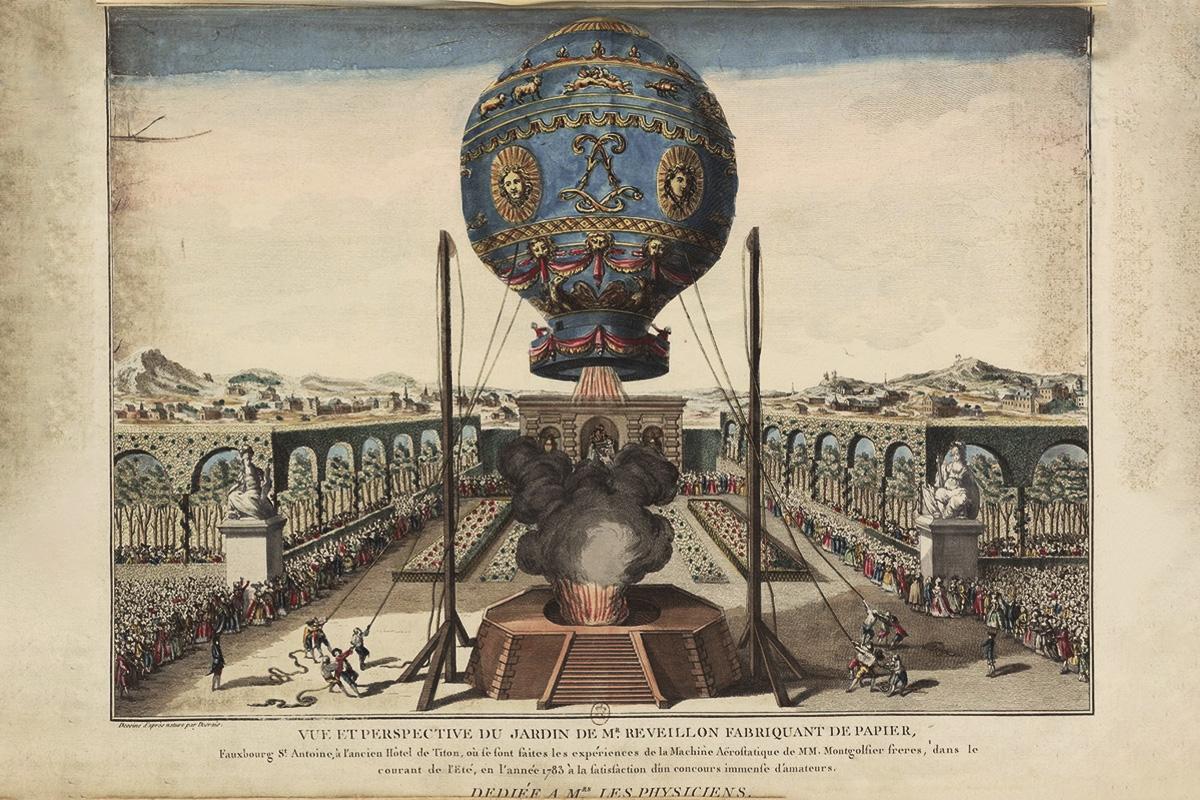
Claude-Louis Desrais. Flight in a hot-air balloon, 1783 / wikipedia.org
ATTENTION — QUESTION!
The wingspan of a Boeing 737-800 is about 36 meters. But this distance became famous in the history of aviation for a completely different reason. What was it?
ATTENTION — THE CORRECT ANSWER!
That was exactly the distance covered by the Wright brothers’ airplane in its first flight.
CAN THIS FLY?
T
he Talking Bug from the Strugatsky brothers’ Tale of the Troika, pondering that one of humanity’s eternal dreams is the desire to fly, was not far from the truth — though he was quite wrong to claim that people dream of flying solely out of envy for insects. In fairy tales, people have been flying since time immemorial (the story from One Thousand and One Nights about flights on a wooden horse was most likely invented a thousand years ago). But since people are born to turn fairy tales into reality, it did not take long for flying to move from fantasy to practice.
A flight of a human on a kite was documented as early as 559 in China. In 852, Abbas ibn Firnas invented a parachute, with which he jumped from the minaret of the Great Mosque of Cordoba and was only slightly injured, and 25 years later, he built something like a hang glider, on which he flew for about 10 minutes and even returned to his starting point — crashing badly but still surviving. However, these ways of flying receded into the background when the Montgolfier brothers launched a hot-air balloon in Paris — an aircraft lighter than air.
Hot-air balloons conquered the skies. The Montgolfières filled with hot air were followed by the Charlières filled with light gases, and in 1852, the first airship — a steerable balloon — took to the air. It seemed that lighter-than-air flying machines could satisfy the passion for flight, and interest in heavier-than-air aircraft diminished — but did not disappear, despite the fact that many scientists began to doubt the possibility of such machines.
Even the great physicist Lord Kelvin, as late as 1895, declared that heavier-than-air flying machines were impossible (but what about birds?). The prominent astronomer Simon Newcomb also denied their existence (though in 1903 he changed his mind, saying that in the future it might become possible — remarkably well-timed!). But perhaps most curious was the opinion of a respected American bishop, who asserted that only angels could fly. And curious it was because the bishop’s last name was Wright.
FROM BICYCLE TO AIRPLANE
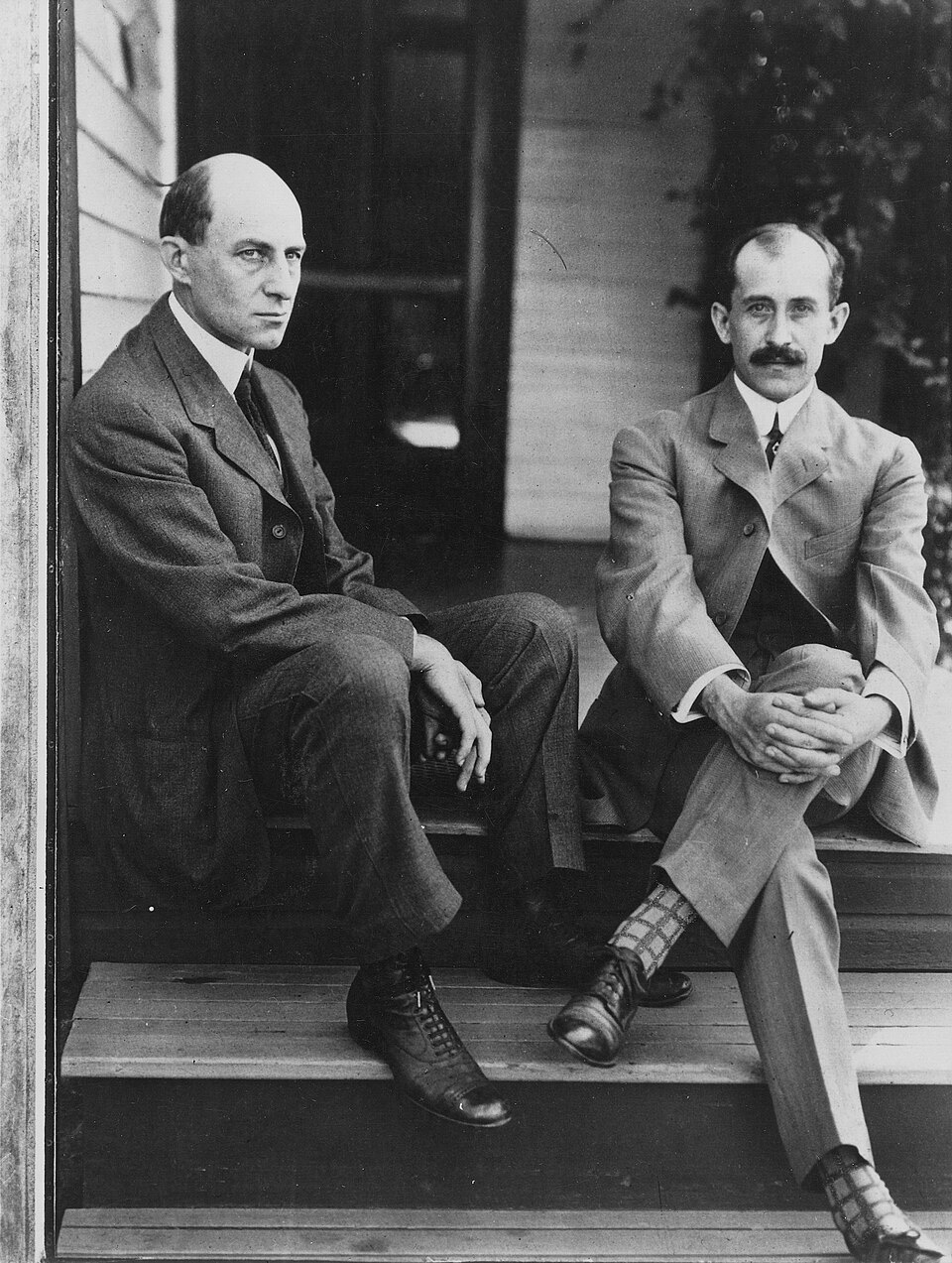
Two of the seven children of that bishop, named after his fellow preachers Wilbur and Orville, grew up not exactly in wealth (their father was a bishop of one of the many small Protestant churches in America), but in love and security — and most importantly, next to a very decent library collected by their book-loving father. Incidentally, contrary to popular belief, Bishop Wright’s children loved working with their hands no less than reading — it turns out the two pursuits combine perfectly well.
Well-read Wilbur was expected to attend Yale University, but before he could finish high school, he was struck in the face with a hockey stick during a game on the ice, losing almost all his upper teeth, which forced him into a long recovery. The one who injured him was later executed for murdering his own mother, father, and brother, but that was of no help to Wilbur. Orville also never completed high school, only to later join his brother in the ranks of great figures in science who lacked formal secondary education.
Back in school, Orville had set up a printing press in their barn, personally designing and building the machine. On it, he and Wilbur printed their own newspaper, as well as taking on jobs for local residents who needed printed materials. Then they became fascinated by the latest invention of the time — the bicycle. First they opened a workshop repairing them, and later began producing bicycles of their own design, achieving notable commercial success.
But the envy toward flies and bees, so scornfully described by the Talking Bug, did not spare even these successful businessmen. It all began with a book about the German glider pioneer Otto Lilienthal, which Wilbur read aloud to Orville while the latter was recovering from typhoid. Lilienthal attempted to fly gliders without any engines, relying on rising air currents. Perhaps this was because he had seen other flight enthusiasts try to use engines in heavier-than-air machines, but all had failed.
Unlike the steam-powered aerial monsters, gliders could lift off (from a hill or a tower), but glider pilots often died — like Lilienthal himself or the Briton Percy Pilcher — due to errors in control. They tried to steer by shifting their body weight, but it clearly didn’t work. Wilbur, however, observing birds, noticed that they changed direction by altering the angle of their wings. This method had been proposed before the Wright brothers, but they were the first to actually make it work.
KITTY HAWK
In 1900 the brothers chose a site for their decisive experiments — the sandy spit of Kitty Hawk in the neighboring state of North Carolina. At first they launched gliders, working out the problems of control. Then they chose a more suitable engine than the heavy, weak steam machine — the internal combustion engine. After that they found the optimal propeller shape, and all the main problems were solved.
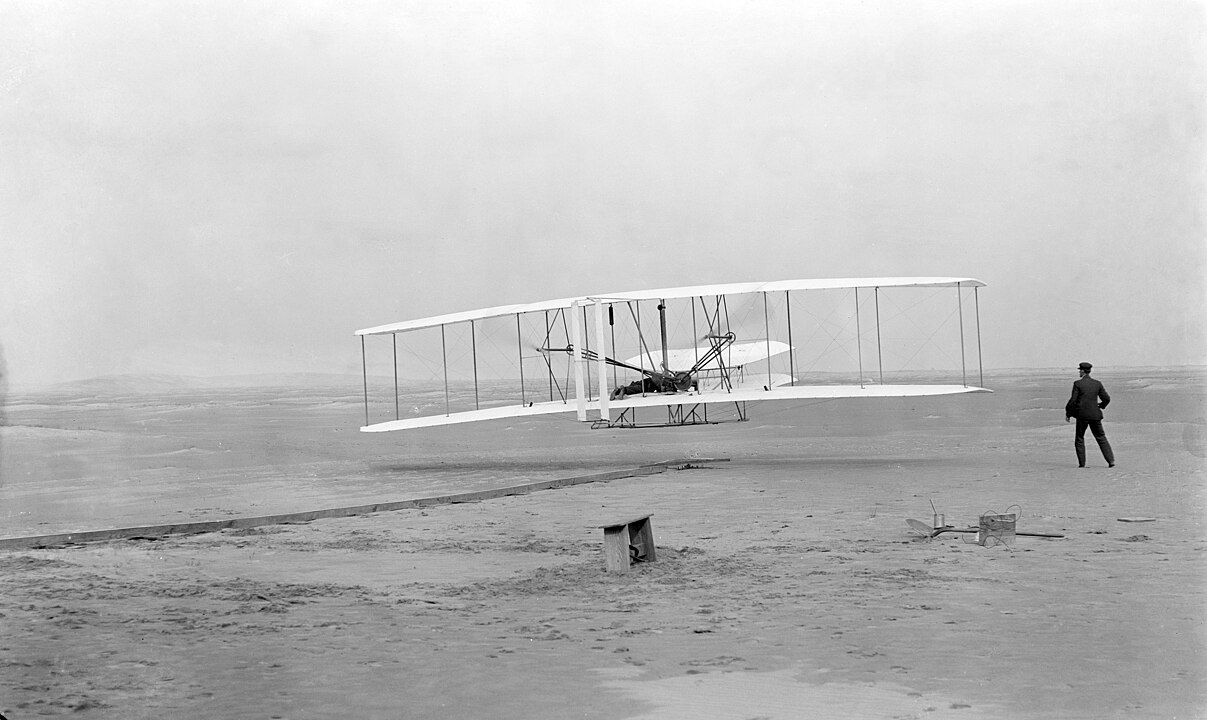
On December 14, 1903, the Wright brothers’ airplane Flyer-1 taxied to the starting point for the first time. They tossed a coin, and Wilbur won the chance to fly first (the Wrights had decided not to fly together, so that the idea itself would not die with both of them). The plane crashed almost immediately, and it took three days to repair it.
But on December 17, they made three successful flights in a row, about 3 meters above the ground, covering distances of 36, 52, and 60 meters. This was already a true flight of a heavier-than-air machine — everything else was a matter of technique. The entire history of world aviation begins with this flight of the Flyer-1, which was only a little longer than a city bus.
Their piloting skills grew, and one day they reached the point where Orville Wright decided to take their 82-year-old father for an airborne ride. Bishop Milton Wright, during the flight, naturally forgot his unfortunate statement and, though he was no angel, nevertheless delighted in being lifted into the air, troubling his pilot son with only one request: «Higher! Still higher!»
THE FIRST FLIGHT?
The Wright brothers successfully developed and promoted their airplanes, patenting — as could be expected from practical Americans — a whole range of technical solutions they had invented. They defended their rights zealously, earning a reputation as litigious. People even joked that if someone jumped in place flapping their arms, the Wrights would immediately sue them.
Yet their priority is still contested to this day. There exists a «Society of Friends of Gustave Whitehead», which claims that as early as 1901 he made a successful flight on an airplane of his own design powered by a steam engine. Several witnesses confirmed this, but there is no documentary evidence, and he did not pursue the development of his achievement. Nevertheless, for more than 70 years this society has been fighting to prove his priority.
There were also mentions of the Russian captain Mozhaysky, a hero in the struggle for national priorities, and of Hiram Maxim, the inventor of the most important weapon of the Civil War — both built airplanes powered by steam engines. But during their tests, these machines could only hop briefly into the air before crashing down. Both inventors abandoned these ideas and chose not to refine them — they clearly knew better…
It was easier to prove the merits of the Frenchman Clément Ader — his Éole, powered by a steam engine of his own design, did take off and fly for more than 50 meters, which was convincingly documented. But his flight was completely uncontrollable and unstable. The French Ministry of War terminated the trials of the Éole for lack of results, but after the Wright brothers’ flights, suddenly proclaimed Ader’s success. Understandable…
So Wilbur and Orville Wright — who only managed to publish news of their flight two years later in the journal Beekeeping Problems (bees fly too, after all!) — ultimately gained recognition for their achievements. And the biography of the Wright brothers in the famous Lives of Remarkable People series, published in 1933, long remained the only book in that series devoted to more than one person. Only in 2011 did The Brothers Strugatsky put an end to this monopoly. Incidentally, it was the Strugatskys who invented the Talking Bug…
When copying materials, please place an active link to www.huxley.media
Select the text and press Ctrl + Enter


