BORIS BURDA: How to Transport Your Belongings More Comfortably


James Pollard. The London–Faringdon Coach Passing Buckland House, Berkshire, 1835 / wikipedia.org
ATTENTION — QUESTION!
Bunin wrote that it is a person’s closest, most intimate companion — especially when traveling — and that choosing it requires a great deal of intelligence, calculation, an experienced and discerning eye, and the ability to foresee and weigh many things. And Greek King George II, who was exiled more than once, claimed it was the most important thing to him. What were they talking about?
ATTENTION — CORRECT ANSWER!
A suitcase.
DISTANT ANCESTORS
E
ver since humans began to travel, they’ve needed something to carry the belongings essential for the road. The first item ancient wanderers used for this purpose was a bag, initially made of hides or leather, later of heavy fabric. However, even in Ancient Egypt, people learned to craft sturdier, more solid containers — it was there that the first chests emerged.
Chests were heavy to carry, but much harder to steal or break into. In addition to stationary chests, which at the time served as wardrobes and dressers, travel chests emerged — manageable in size, equipped with handles, and even lockable with keys. Some antique chests have survived to this day, and still look pretty good.
In the Middle Ages, travel chests received another innovation — a domed lid. When traveling in carriages, they were attached to the back of the coach and exposed to the elements. Rainwater would pool on flat lids, causing the wood to rot, whereas a curved lid allowed the water to run off. Beautifully decorated, sturdy, and reliable, they still please the eye today.
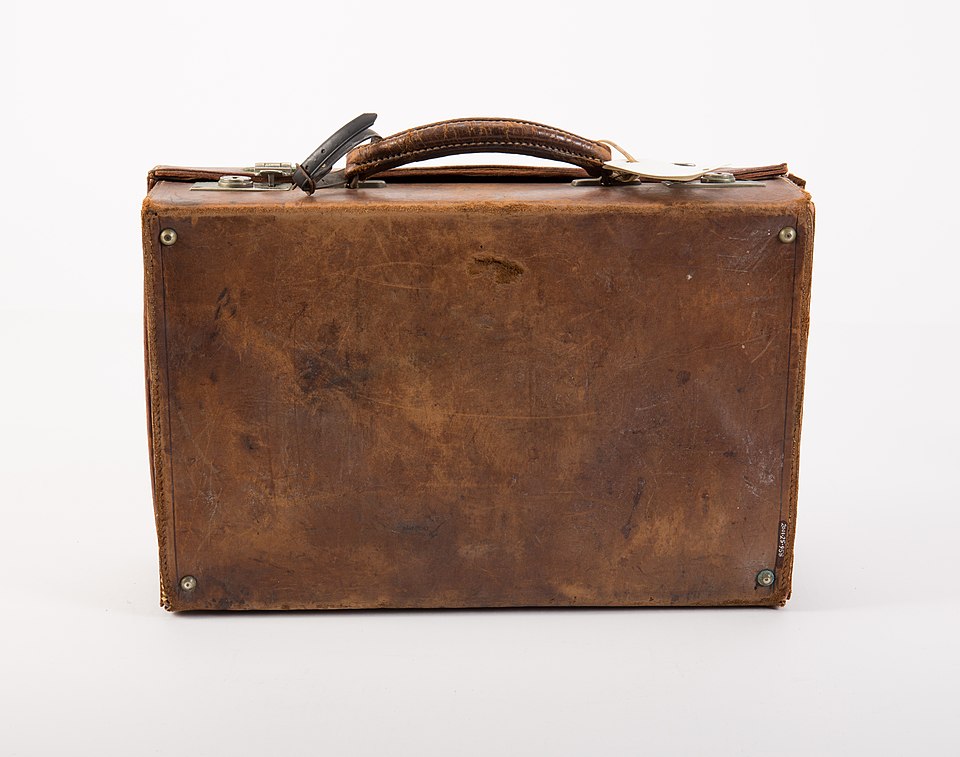
But travel chests had their irredeemable flaws — they were bulky, heavy, and difficult to carry. And people had to travel more and farther. The need for more convenient luggage containers became pressing. Someone had to take the next step — and that person eventually arrived in Paris after walking 400 kilometers on foot.
A RURAL PRODIGY
He was born in 1821 in Franche-Comté, in eastern France, to a carpenter’s family, and from an early age, he learned to use his father’s tools. At age 10, he lost his mother, his father remarried, and it seems his relationship with his stepmother did not go well. Much like Lomonosov, he made the same decision — to walk to the capital in search of a better life.
His journey lasted at least several months — nearly 400 kilometers can’t be covered any faster, especially since, unlike Lomonosov, who had three rubles (enough back then for two cows or a dozen sheep), he had nothing but the clothes on his back. He had to stop and take any odd job he could find — otherwise, he would have starved. But he made it!
He got lucky with work — a trunk maker named Maréchal was in need of a hard-working assistant. The gifted and skilled young villager quickly earned a solid reputation and, by the age of 19, had already become the master’s senior assistant. He spent 17 years at that workshop and became so well known that discerning clients would request their luggage only from him.
Shortly after Napoleon III took the throne, his wife, Empress Eugénie, ordered travel bags from him, and was so pleased that she appointed the talented craftsman her packer. In 1854, he married and opened his workshop at 4 Rue Neuve-des-Capucines — where the sign bearing his name remains to this day: Louis Vuitton.
NEITHER CHEST NOR BAG
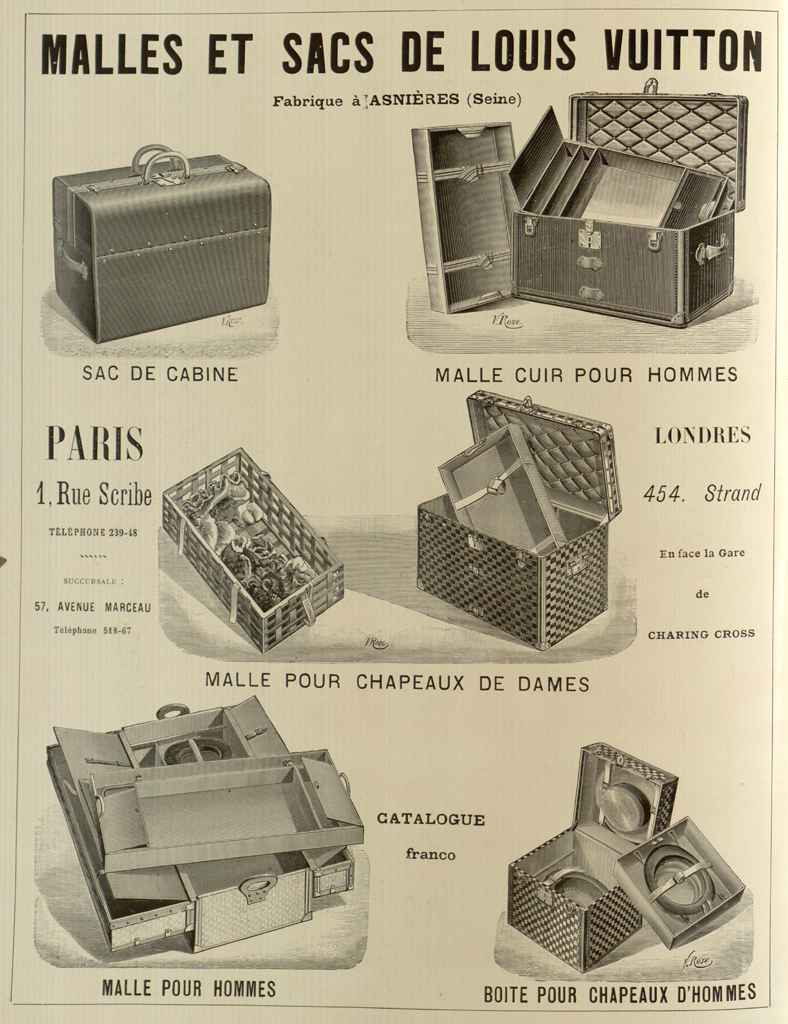
For a true craftsman, doing good work isn’t enough — he wants to do it better than anyone ever has. In 1858, Louis Vuitton created a radically new type of travel container, grandly named the «Trianon». It was no longer a travel bag, nor a travel chest — this was a true suitcase, instantly recognizable.
First of all, no more domed lids that make packing difficult! And no need to fear the rain — the suitcase was covered in waterproof canvas (better than leather, which soaks through and smells like pigskin), and reinforced with steel corners for durability. These suitcases could be safely stacked, placed on a coach roof, or tucked under your feet.
The next major innovation, developed by Louis Vuitton in collaboration with his son Georges, was a unique lock featuring two springs that made unauthorized access virtually impossible. Each lock had a unique serial number recorded in the workshop, so the owner could always order an extra key.
To promote his brand, Vuitton turned to the famous performer Harry Houdini, renowned for escaping any locked space — even the death row cell in Butyrka prison: «Let’s see if you can escape from my suitcase?» For unknown reasons, Houdini declined the challenge — perhaps the fee was too low… However, advertising made it even better.
Vuitton’s suitcases were replacing all other forms of luggage so quickly that a new problem emerged — counterfeits flooded the market. To combat this, Georges designed a signature monogram: a four-petal flower in a circle and a diamond with a four-pointed star. Then, in 1896, the iconic LV logo appeared, created in memory of the company’s founder.
NEW HORIZONS
It was only natural for the Vuitton brand to expand from suitcases to handbags. This shift began in 1934, when Coco Chanel was the first to realize which company could create a truly luxurious handbag for her. That design became the prototype for the Alma bag — now one of the most counterfeited items in the world, rivaling even the 50-euro note.
During World War II, however, the company’s record was far from spotless. It actively cooperated with the occupying forces and even opened a factory to produce busts of Marshal Pétain, turning out 2,500 of them — hardly a flattering chapter in its history. But the experience clearly taught them something: just one month after the Russian invasion of Ukraine began, in March 2022, the company entirely withdrew from Russia.
The LV brand is justly considered exclusive and has helped redefine the perceived value of packaging versus contents—a prime example: the lavish Louis Vuitton skateboard, priced at $62,000. Interestingly, the same skateboard, without the Vuitton case, costs only $2,600. Let that sink in…
The company values its uniqueness so highly that it leaves no room for anyone to obtain its goods at a discount. At the end of the year, all unsold items are returned to Paris and destroyed — «If we’ve put this price on our products, no one is going to get them for less». Think it’s a senseless loss? The company sees it quite differently…
WONDERS OF SUITCASES
Louis Vuitton’s invention found many unexpected uses in life. As early as 1875, the company created a foldable bed-suitcase for the famous traveler Pierre de Brazza (the city of Brazzaville was named after him). And in 1920, three-year-old Isaac Asimov was brought from Belarus to the United States in a suitcase…
A suitcase is not only a container for luggage, but also a means of conveying information. Hotel staff are well aware: a small chalk cross or a sticker placed in a specific spot on a suitcase means the owner is a cheapskate, and no tips are to be expected. If the guest is generous, a sticker is placed on a different spot…
A suitcase can become not only a valuable item but also an engaging hobby. It is widely known that Dmitri Mendeleev relaxed from his scientific work by making suitcases. When asked, «When did the creator of the Periodic Table find time for such an activity?» the answer comes naturally: «Periodically».
As we now know, a suitcase can be worth a lot of money. Recently, at an auction in Dubai Airport, where unclaimed luggage is sold, a forgotten bag was sold for 57,000 dirhams (approximately $ 15,500). What valuable item was inside? That’s just it — no one knows. The suitcase was sold unopened, and buyers at such auctions are driven by excitement.
Suitcases are not only forgotten in Dubai. In Paris, near Gare Saint-Lazare, there is even a monument to such absent-minded travelers, who apparently outnumber those on Basseynaya Street. It’s a pile of suitcases stacked on top of each other. Of course, rectangular in shape — just like Louis Vuitton’s invention — otherwise the monument would have been impossible to build…
When copying materials, please place an active link to www.huxley.media
Select the text and press Ctrl + Enter


