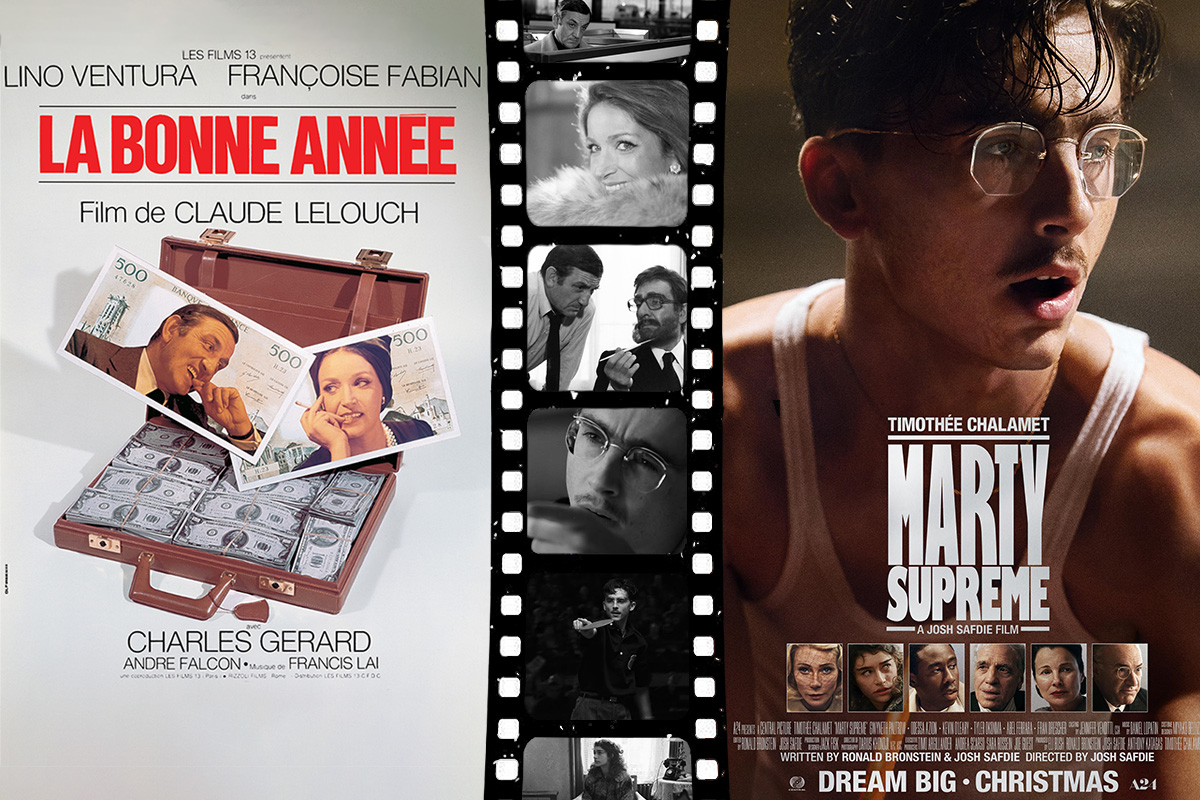
FUTILE RUNNING ABOUT: the films “La Bonne Année!” and “Marty Supreme”

Art design: huxley.media via Photoshop
The first Cinemasophy column of the year is devoted quite literally to the New Year, ticking time, life traps, and futile running about that is mistakenly taken for a career. A veteran of French cinema, Claude Lelouch offers the most sentimental New Year’s tale for men and women who have lost their childlike innocence, disguised as a story of the perfect heist set against the backdrop of a far-from-perfect romance.
American filmmaker Josh Safdie delivers a wild, nervous, unrestrained tragicomedy about the American dream, starring today’s screen heart-throb Timothée Chalamet, to whom moustaches, pimples, and glasses suit remarkably well. The former was long ago entered into every conceivable register of classics, breaking the hearts of even the most sentiment-resistant masters — from Melville to Kubrick. The latter is actively moving toward its Oscars, along the way demonstrating not only impressive box-office returns but also interim victories such as a Golden Globe.
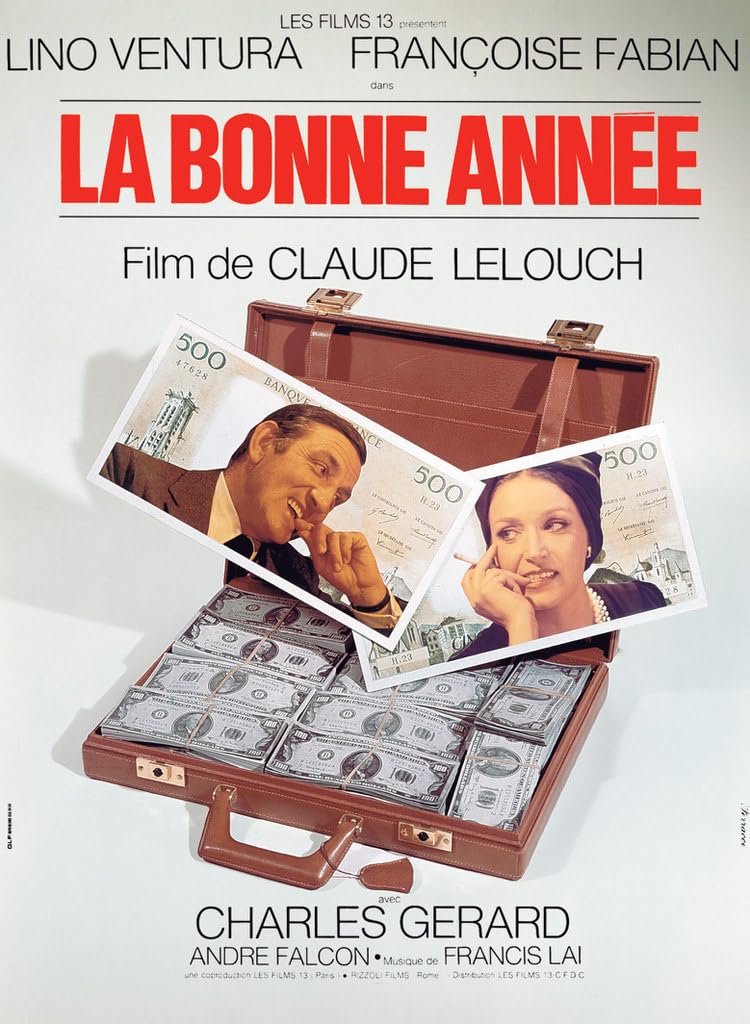
HAPPY NEW YEAR! (LA BONNE ANNÉE, FRANCE, ITALY, 1973)
Director: Claude Lelouch
Cast: Lino Ventura, Françoise Fabian, Charles Gérard, Mireille Mathieu
A
hardened thief, Simon (Lino Ventura), who robbed the Van Cleef & Arpels boutique in Cannes five years ago, is released just before the New Year, ostensibly under an amnesty. In reality, the police merely want to track down his accomplice and the jewels that were never recovered. Simon suspects this. But what he fears is not a police tail, but returning home. Has Françoise (Françoise Fabian) been waiting for him — an emancipated intellectual from an antique shop, whom Simon fell in love with like a schoolboy and who visited him in prison throughout all five years? Pre-New Year and post-revolutionary Paris stands frozen in anticipation of a miracle. At the height of her fame, Mireille Mathieu performs her famous La Bonne Année to the applause of a colorful audience that has filled the iconic Michou casino.
Never belonging to any French cinematic “waves”, director Claude Lelouch has always been considered a darling of fate: having hit the jackpot at the age of 28 with his benchmark melodrama A Man and a Woman (the Palme d’Or at the Cannes Film Festival and the American Oscar for Best Foreign Language Film in 1966), he spent his entire creative life trying to use this “golden hammer” to solve every artistic task without exception. That is precisely why any Lelouch film is, to one degree or another, A Man and a Woman in different guises, not counting the literal sequels to the story, the fourth and final installment of which — The Best Years of a Life — was released in May 2019.
Principally apolitical and pathologically touchy (the director cannot tolerate criticism of his films), Lelouch, long regarded as an excessively sentimental master of the musical melodrama in the face of death, nevertheless managed to create at least one more masterpiece in his life. La Bonne Année! is cinema that is worthy and moving in every sense — a film that captured the Christmas spirit (a holiday made up of hope and sadness) and won the hearts of many great artists, from Jean-Pierre Melville (Le Samouraï) and Peter Falk (who in 1987 produced and starred in the American remake of the film) to Stanley Kubrick himself, who counted Lelouch’s film among his favorites and regularly screened it for his actors before shooting began.
Not swept away by the leftist ideas that at the time had seized the minds of French filmmakers led by Jean-Luc Godard, he is concerned with a person trying to adapt to a world that is new to him — a world in which women, on an equal footing with men, could enjoy sexual freedom. Having described his new film as “a very French comedy of manners”, Lelouch in fact offers us all a story about the perfect heist set against the backdrop of a far-from-perfect romance. Simon — a pragmatist endowed with a magician’s grace and an angel’s sadness — learns to believe in miracles on New Year’s Eve. After all, more than a life sentence he fears finding Françoise not alone at home.
Claude Lelouch fills his New Year’s fairy tale with trademark sentimentality, deftly plays with black-and-white and color imagery (unlike A Man and a Woman, where the use of monochrome alongside color was driven by sheer necessity — he filmed on whatever stock he could get — here it is a concept, designed to keep the viewer from getting confused about the chronology of events), trolls intellectuals, and amuses with a comic prologue in which inmates in a Paris prison are shown A Man and a Woman on New Year’s Eve.
MARTY SUPREME. THE GENIUS OF COMBINATIONS (MARTY SUPREME, USA, FINLAND, 2025)
Director: Josh Safdie
Cast: Timothée Chalamet, Gwyneth Paltrow, Abel Ferrara
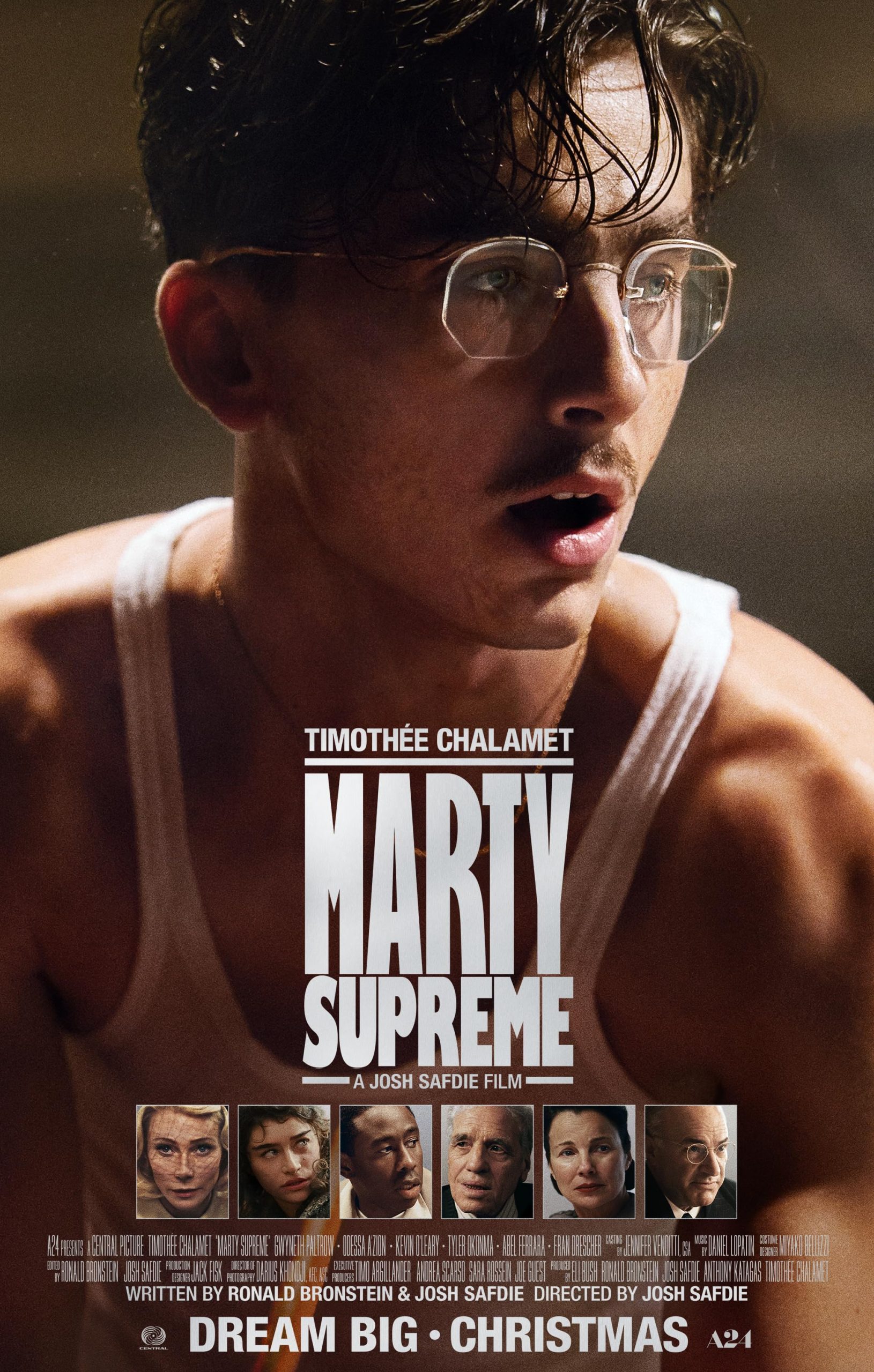
The story of a certain Marty Mauser (Timothée Chalamet) — an ambitious hustler, an upstart, and a master of table tennis who dreams of fame more than of sporting success. Director Josh Safdie, previously making films in tandem with his brother Benny (Good Time, Uncut Gems), sets out on a solo voyage and, through the ingenuous monologues of the protagonist, voices one of the most resilient American myths — only to dismantle it step by step: the allure of big money, fame, and risk crumbles into banal meanness, meaningless running about, and petty greed. Yet it leaves room for hope, embodied by the faintly visible figure of family. A motif that flickered through the best films of 2025 — from Affeksjonsverdi to One Battle After Another.
Marty Supreme is a wild, nervous, unrestrained tragicomedy about the American dream, starring the leading heartthrob of today’s screen, to whom moustaches, pimples, and glasses suit remarkably well. It is also a gripping audiovisual trip about ticking time, a life trap, and frantic running around New York, with a brief stop in Tokyo, Japan. Cinema as an experience in every sense of the word.
Safdie, with fantastic ease, hurls freeze-frames, flaunts ultra-long takes, jokes, teases, and revels in the underbelly of New York and its inhabitants. The hyperrealism that colors the first half of the film shifts slightly toward surrealism by the middle, as happens in life: a devotee of early Scorsese, Safdie wanders among the shadows of Mean Streets, After Hours, The King of Comedy, and Goodfellas. Marty Supreme is, of course, a chemically pure homage to the great master. Marty of the title is not some table-tennis player, Reismann, an American champion and charlatan. Marty is Scorsese.
This film is dedicated to the great author of Taxi Driver, but it belongs to Timothée Chalamet. For his efforts, the actor has already snagged a Golden Globe and has strong chances of winning an Oscar. Chalamet’s character is a chatterbox and an upstart who considers self-confidence a currency no less valuable than any other — like a shark from the 1980s stuck in the 1950s; a kind of Jordan Belfort (the protagonist of The Wolf of Wall Street) of the ping-pong era. Beyond Marty himself and a dozen vivid supporting roles (among which Gwyneth Paltrow’s turn as a fading star and Abel Ferrara’s — a former pornographer and the last mystic of American cinema, the author of the cult Bad Lieutenant, upon whom here a bathtub with a naked Timothée Chalamet comes crashing down — stand out in particular), New York is a full-fledged protagonist of this story.
A dirty, inhospitable yet living city of multi-apartment bug-infested tenements, where at any moment — if not the floor, then the ceiling — might collapse; of nightclubs, back alleys, shoe shops, parking lots, billiard rooms, corridors, reception areas — it glows with an indifferent, dangerous neon. The people Marty encounters along his path — from a loving, pregnant girlfriend ready to do anything for him (Odessa Adlon) to a Black taxi-driver pal — are both funny and endlessly sad.
Safdie deftly borrows genre devices from his great teacher — not only from the thriller, but also from comedy — yet never becomes their captive, making cinema that is entirely his own, unpredictable and gripping. Marty rushes along to the rhythm of its nervous, wonderfully old-fashioned synthesizer score (written by Safdie’s ever-attached composer Lopatin) and an entire avalanche of 1980s hits — from Peter Gabriel to Tears for Fears. And this is despite the fact that the story is set in the 1950s, while everything is filmed with a strong eye on the 1970s. This displacement is deliberate. It is a way of disorienting the viewer by placing them in the position of the character (a person literally thrown out of time), who never finds themself where they think they should be.
Cinematographer Darius Khondji (who has shot films for Woody Allen and James Gray — other masters of discerning great New York tragedies in petty foolishness) captures every nervous breakdown of Marty and subtly senses how his relationship with space changes. The tragicomic New York trip of Timothée Chalamet’s character is crafted with brilliance: it is uncompromising and imbued with a humanism that overcomes the hopelessness of striving. Even complete losers have something to lose; even catastrophe can fail; even the bottom can be broken through. And what remains? That is clear. Family — or a hint of it. This is something Josh Safdie knows firsthand, since after his parents’ divorce he and his brother grew up largely on their own, drifting between Queens and Manhattan.
The story of a small-time hustler moving in high circles and his clumsy attempts to realize the American dream captivates with its humanity. By meticulously recording the loser’s collision with fate, Safdie offers us an exhausting yet optimistic chronicle of humiliating but joyful defeats.
When copying materials, please place an active link to www.huxley.media
Select the text and press Ctrl + Enter