MAGICAL HYPERREALISM: “Days of Heaven” and “Sunset”


Art design: huxley.media via Photoshop
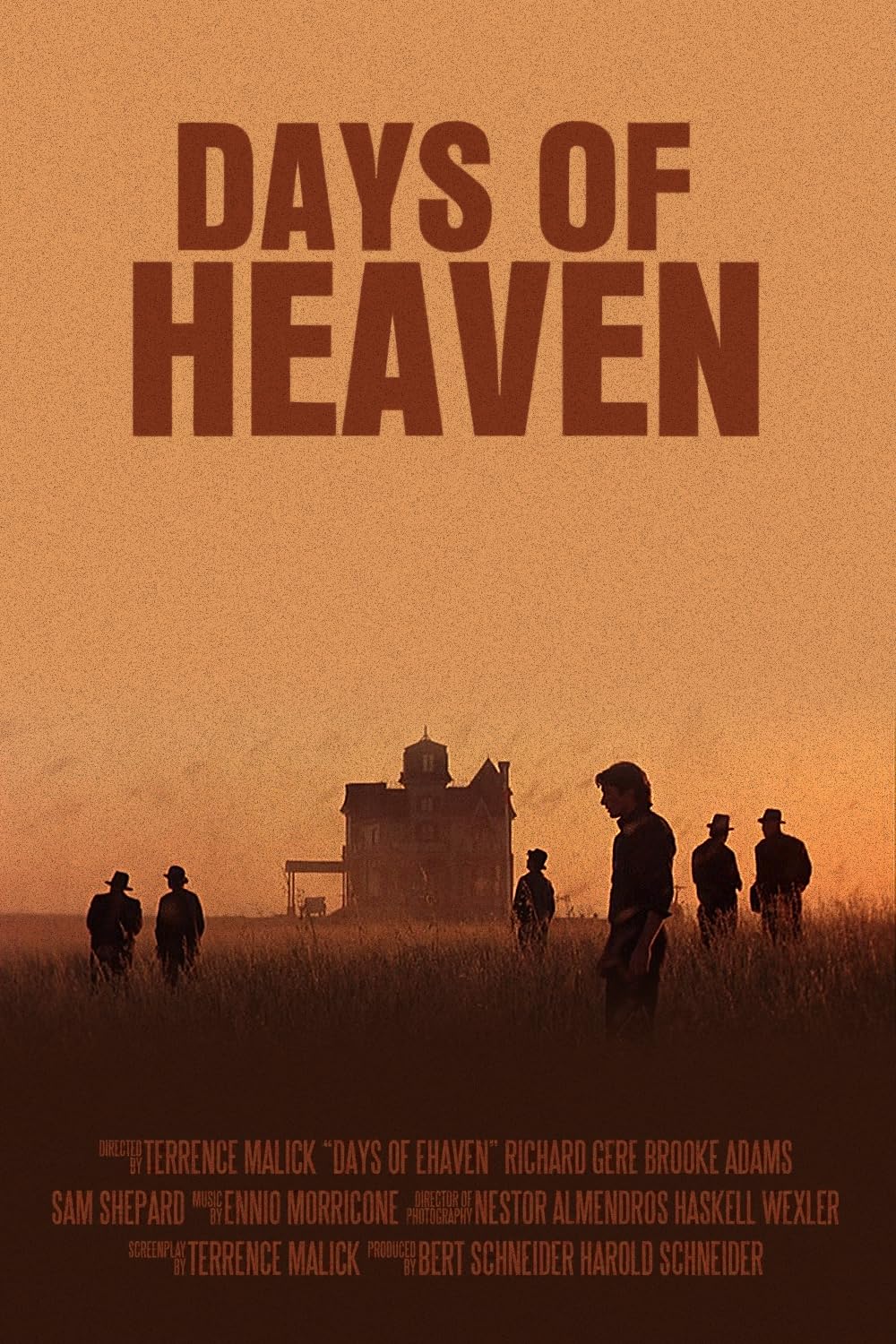
The Cinemasophy column in May offers two more films that are great in every sense — and should be watched one after the other. The first is Days of Heaven (1978), a pastoral drama of painterly beauty by the great Terrence Malick (The Thin Red Line, The Tree of Life), telling the story of an escape from the very inferno of history into an imaginary, Texas-like paradise. A young worker heads there with his beloved and a child after committing a murder in the heat of the moment. The second film is Sunset (2018), directed by Oscar-winning Hungarian filmmaker László Nemes (Son of Saul), about the search for a person lost forever in pre-war Budapest in 1914. Both films quite literally captivate with the magic of painting, echoing the finest works of Andrew Wyeth and Edward Hopper, with their cold, magical hyperrealism and a premonition of death. Not anyone’s death in particular — death in general.
DAYS OF HEAVEN (USA, 1978)
Director: Terrence Malick
Starring: Richard Gere, Brooke Adams, Sam Shepard
A
drama by the great Terrence Malick, set on the eve of America’s entry into the First World War. Bill (Richard Gere), employed by a steel company somewhere on the outskirts of Chicago, kills his foreman during an argument and flees together with his girlfriend Abby and his younger sister Linda to a kind of paradise-like, fantasy-realistic Texas. There, they are hired for the harvest by a young but already terminally ill farm owner (Sam Shepard), who, to his misfortune, falls in love with Abby, believing her to be Bill’s sister. Bill, taking advantage of the situation, devises an elaborate scheme — he marries off his “sister” to the farmer so that, after waiting for his death, they can inherit the entire estate and finally attain the longed-for paradise.
A former philosophy professor who made his directorial debut with the brilliant drama Badlands (1973), Malick, with Days of Heaven, firmly establishes himself not merely as a perfectionist genius, but as a demiurge, a great American artist — a kind of “Faulkner of cinema”, who created his own America with impossibly beautiful and indifferent nature, against whose backdrop people suffer, kill, and die, utterly unnoticed by either heaven or earth. Together with Badlands, forming a kind of protest diptych, Days of Heaven enchants with its magic of emptiness and death, transforming its characters into figures of something close to ancient tragedy. Malick’s film is also a true ode to painting. Visually, it owes much not only to the mastery of cinematographer Néstor Almendros, but also to the works of Andrew Wyeth (Christina’s World, 1948) and Edward Hopper (House by the Railroad, 1925).
The Texas landscapes in the film reflect the cold magical hyperrealism of these great American masters, while the premonition of death — not someone’s death in particular, but death itself — lends the film’s somnambulistic rhythms an intense emotional charge. The wheat fields unfold across the screen as though defying every law of human vision. Malick is a genius precisely because he knows how, through such widescreen imagery (at a time when widescreen cinema was already considered commercially unviable, he shot the film on 70mm stock), to convey the insignificance of human beings on the scale of the universe. The almost ancient Greek passions born of the wanderers’ immorality are shown by Malick as though through fogged glass. The narrator is a child — the worker’s younger sister — and thus the characters’ fall from grace is merely observed, never judged. A child accepts the adult world as a given, and at times even as myth. A myth breathtakingly beautiful in its cream-toned frames, which render the characters captured within them untouchable and beyond judgment in any circumstance. Like a benevolent creator-God, Malick places his fallen characters not so much within historical reality as within an imagined magical country, separated from routine history by the author’s will.
The film’s inner truth and dramatic integrity lie precisely in the fact that its characters reject history from within history itself — they flee from it. Richard Gere’s worker commits murder not merely in a steel foundry, but seemingly in the very inferno of history. Thereafter, he flees not so much to Texas as toward an alternative to social history, into some virgin or semi-virgin land with its endless wheat fields. A land that becomes the magical country invented by the author. It appears as a variation of the classic “American Dream”, with all its promised comforts — a house, money, a car — which Malick’s characters observe with envy in the estate of their wealthy employer. It is precisely for this prosperity that the young worker sets his tragic intrigue in motion. His escape from history is portrayed almost innocently, only so that later he may settle within history once again, though now on another level, still unknown even to the characters themselves.

SUNSET (NAPSZÁLLTA, HUNGARY, FRANCE, 2018)
Director: László Nemes
Starring: Juli Jakab, Vlad Ivanov, Marcin Czarnik

This drama can, with some exaggeration, certainly be regarded as a prehistory to the Oscar-winning Son of Saul (2015). Although the plots appear entirely unrelated, and not only the characters but even the historical periods differ, there remains some invisible connection between them, a kind of telescopic continuity — as though Son of Saul emerges directly out of Sunset. Instead of a death camp on the outskirts of Budapest, Nemes places his narrative in the very heart of the Hungarian capital. The story unfolds in the summer of 1914, on the very eve of the First World War… Austro-Hungary… The orphaned and impoverished young aristocrat Irisz Leiter (Juli Jakab), with her burning gaze and the stubbornness of a terminator, returns to Budapest from Trieste, hoping to secure a position at the famous fashion salon that once belonged to her deceased parents. The salon is now managed by an outwardly disagreeable bearded man (Romanian star Vlad Ivanov), who is preparing lavish celebrations for the salon’s anniversary while reluctantly agreeing to keep an eye on the excessively inquisitive young woman.
Her curiosity — deeply irritating to everyone around her — is connected to her attempt to uncover the mystery of her parents’ deaths and the existence of a brother she never previously knew about. The private narrative of Sunset — about the search for truth, dark family secrets hidden for years behind a beautiful façade, and a brother who, shortly before his sister’s arrival, had also worked in the family shop before disappearing — is woven into a powerful historical context devoted to the sunset of classical European culture. Along with it, in the trenches of the First World War, the very European aristocracy to which Irisz’s parents belonged will soon vanish — a doomed tribe whose members huddle together before their inevitable destruction.
In Sunset, the degree of onscreen unbearable intensity is significantly lower than in Son of Saul, yet the suspense is even greater. It builds slowly and mercilessly, like the very Moloch of the coming war destined to define the twentieth century as the bloodiest age in human history. Director László Nemes deftly shifts the focus away from the detective storyline — the search for a missing person, about whom, decades later, one great poet would write the famous lines, “I lost a man since all had lost him” — toward this all-encompassing atmosphere teeming with deranged coachmen, barefoot monarchs, anarchists, and demonic far-right extremists from secret societies. Within it already lingers the metallic taste of the catastrophe of 1914, set in motion by Gavrilo Princip’s fatal August shots in Sarajevo. Nazism is only a short step away — and with it, the monstrous factories of death.
No one yet knows the terrible word “Holocaust”; Jews are not yet being burned on an industrial scale, but they are already openly hated, and some are even murdered. It seems as though Nemes’s characters here are merely warming up, preparing themselves to stand, a quarter of a century later, beside the camp ovens and gas chambers. Mátyás Erdély’s subjective camera — he also shot Son of Saul — trembling with nervous breath, clings to the chaotically moving heroine with the persistence of a shadow, creating an overwhelming effect of presence, almost documentary immediacy: everything that happens is seen through her eyes. In fact, the camera itself becomes the film’s true protagonist. Everything within the frame is merely the point of view of a young woman obsessively driven to the brink of a nervous breakdown.
Although Sunset, with its nearly three-hour running time, can hardly be called an easy or accessible film, it nevertheless remains wildly beautiful cinema, enveloping the viewer in its mysteries, ambiguities, and dizzying turns. At its world premiere in Venice, the audience applauded for a long time, and the American Academy nominated the young Nemes for a second Oscar in the category of Best Foreign Language Film. This time, however, the director did not receive a second Oscar. At least not yet. Which, in any case, does nothing to diminish the merits of this outstanding film.
When copying materials, please place an active link to www.huxley.media
Select the text and press Ctrl + Enter