MYKHAILO GUIDA’S CHINESE LESSONS: How to Distinguish Art from Non-Art

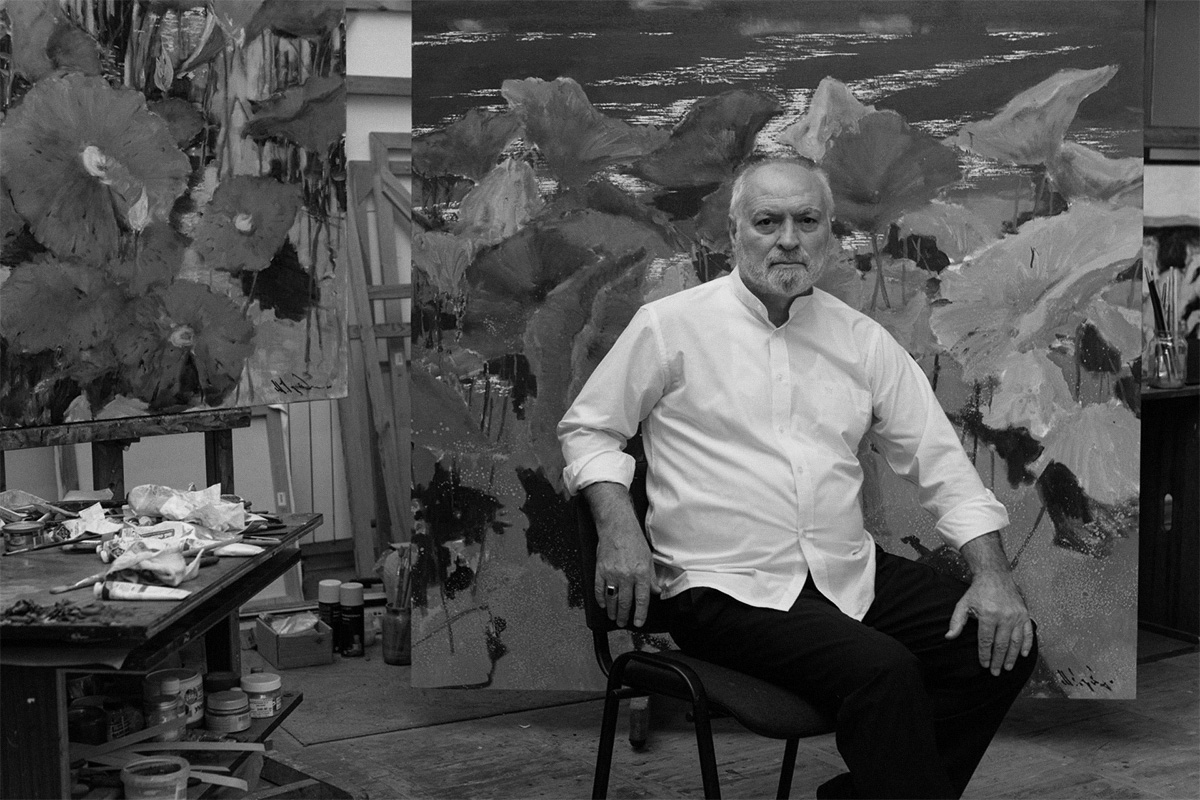
Mykhailo Guida — Ukrainian painter and graphic artist, member of the National Union of Artists of Ukraine
SHORT PROFILE
Name: Mykhailo Guida
Date of Birth: December 18, 1954
Profession: artist
Mykhailo Guida exists in two worlds at once. He is a People’s Artist of Ukraine who ranks among the top ten artists in China, a country of 1.5 billion people, where he has lived and worked for many years. Guida is a full member of the National Academy of Arts of Ukraine, a professor at the Department of Painting and Composition of the National Academy of Fine Arts and Architecture, and an honorary professor at two Chinese universities. He has received the Taras Shevchenko National Prize, the Ilya Repin Prize, the Ivan Ohiienko Prize, and the Tetiana Yablonska Prize. He works in easel painting and graphic art and is an unrivaled master of portraiture. His works are held in dozens of museums, galleries, and private collections worldwide.
Huxley readers were fortunate: because of the lockdown, the artist’s stay in his homeland was unexpectedly prolonged… allowing us to speak with him about what contemporary art is and what criteria determine its “authenticity”.
And, of course, we wanted to hear how someone living at the intersection of two cultural worlds views the state of Ukrainian culture.
A CULTURAL PERIPHERY AWAITING AN “EXPLOSION”
W
hen Ukraine was part of the USSR, Moscow treated it as a cultural periphery. One need only recall the story of the Ukraina Palace. Today it is the country’s principal concert venue. Yet the Kremlin leadership designed and built it in secret, officially as a cinema on the site then occupied by the Volodymyr Market, which was later relocated. Initially, plans even included building it on the foundations of St Michael’s Monastery. On top of that, marble intended for the Palace began turning up as decoration in the country houses of Soviet officials…
The architects were subjected to such relentless pressure that one of them, Petro Zhylytskyi, took his own life by jumping from a bridge into the Dnipro. It was assumed Ukrainians didn’t need a modern concert venue. The attitude toward Ukraine as a cultural periphery affected everything — architecture, music, and painting. Ukrainian art was not a state priority. Ideology, by contrast, certainly was. Censorship existed, and specially appointed officials were tasked with determining how ideologically correct a literary work or painting was. Such a person could walk into an art exhibition and demand that any work be removed if they disliked it or failed to understand it. They were not even required to explain why they had made such a decision.
After Ukraine gained independence, the situation did not improve. Yes, there was more freedom, and Soviet ideology became a thing of the past. But culture and art still did not become priorities of the independent state. Politics, power, commerce — these are what interest people first and foremost. Through this prism, art is regarded as something optional and secondary. As a result, we have virtually no museums and no proper exhibition halls. The galleries that do appear are generally not concept-driven and do not operate permanently. Everything happens by chance, depending on circumstances, and survives through individuals’ enthusiasm. The absence of a coherent state cultural policy perpetuates Ukraine’s image as a cultural periphery. Yet this clearly does not match the country’s cultural potential or the powerful creative energy of Ukrainians — an energy capable of producing a genuine “cultural explosion”.

THE ART MARKET: THE CHINESE EXPERIENCE
Ukraine has no art market — the conditions and institutional environment do not exist. No one is working systematically to create them, and the state has effectively withdrawn from the process. Looking at the Chinese experience, some 25 years ago its art market resembled that of present-day Ukraine. To create one, the Chinese government took a “non-linear” approach. At the initial stage, it allocated enormous sums to bringing cultural treasures that had once been lost back to China. Some of my Chinese students were even involved in this project.
They scoured the world for unique artifacts that had been removed from Chinese territory at various times. In effect, the students acted as detectives and intelligence agents. They studied private collections, museum exhibitions, and storage facilities. They tried to buy back anything they regarded as significant cultural heritage. At the second stage, internationally renowned experts from leading auction houses such as Sotheby’s were invited to China for extraordinary fees. The Chinese are highly pragmatic and in this respect are more like Americans. They follow a simple rule: do not reinvent the wheel. So if they have the opportunity to buy the very best expertise available in a particular field, they buy it.
For example, even the ordinary running tracks and sports fields at the university where I teach were built by Germans hired by the Chinese — simply because the Germans do it better. The same principle was applied to the creation of the art market: they invited the best. Ignoring geopolitical disagreements with other countries, the Chinese have no hesitation in inviting Italians, Americans, or Japanese to work in all kinds of fields — science, technology, art. If a Ukrainian can teach a Chinese person something valuable, the Chinese student will gladly and gratefully learn from them.
UKRAINIAN CULTURE — THE WORK OF LONE ENTHUSIASTS
I believe that, with the support of state programs, Ukraine should create a fashion for Ukrainian art. Being an artist, collector, or gallery owner — and genuinely understanding painting — should become prestigious and socially valued in Ukraine. The appropriate environment needs to emerge. The situation with theatre, for example, is relatively healthy. I see many young people drawn to the stage and attending theatrical productions. Interest in Ukrainian art exhibitions is much lower. It may seem incredible in the twenty-first century. Still, in a large European country, people have very few places to spend their leisure time engaging with culture — Ukraine’s exhibition infrastructure is completely underdeveloped. Unfortunately, we see no state programs operating in this field or even being developed.
Everything that happens in this sphere results from the efforts of individual enthusiasts. Gallery owners have to spend substantial sums to buy or rent premises, assemble a team, design and present an exhibition, and pay staff salaries. At the same time, it should be understood that most significant, serious, conceptually driven projects in Ukraine are non-commercial. And while galleries are running unprofitable projects, they still need some means of staying afloat. We are fortunate that such devoted enthusiasts exist in Ukraine. But this experience cannot be scaled up and produces no systemic effect. Throughout the world, being a collector and patron of the arts is considered honorable and prestigious. In Ukraine, however, both the economy and collecting itself exist largely in the shadows.
People prefer not to advertise who bought what, where, or from whom. In Ukraine, people care more about a painting’s monetary value than its artistic value. As a result, full-scale exhibitions of private collections are rare. However, since around 2014, a new generation of “people with money” has emerged — young Ukrainian entrepreneurs rather than officials with undeclared incomes. Many are entering the market actively and entirely legally, developing an interest in painting and building their collections professionally.
A MUSEUM IS A MEETING PLACE OF PAST AND FUTURE
Throughout human history, no major museum collection has emerged without the will of the governing elite or the country’s leaders. The Louver, for example, was created through the efforts of several generations of French kings. The Hermitage came into being because, beginning with Catherine II, masterpieces and the finest works of art were systematically acquired throughout Europe. One of the world’s finest museums — the National Art Museum of Catalonia in Barcelona — is a consortium of the municipality and the Ministry of Culture. A state without museums is a state without a past, and without a future. In Ukraine, the need to create a Museum of Contemporary Art is not merely overdue — it is long overdue. Ukrainian cultural figures have repeatedly proposed such an initiative. Yet of all Ukrainian presidents, only Viktor Yushchenko showed any interest in the idea, and even then it never progressed beyond a formal expression of interest. The problem strongly resembles the Soviet-era story of building the Ukraina Palace.
People say that it is difficult to find a suitable site for such a building in central Kyiv. Yet we can see that land for business centers and new residential developments is allocated in the most unexpected places. Nor do there seem to be problems with permits or utility infrastructure. Without state support, Ukrainian culture as a system of specialized education, market infrastructure, galleries, exhibitions, and museums cannot exist. At times, even its physical survival can depend on such support.
During the pandemic, for example, the German government allocated €40 million to support German artists. They were among the groups hit hardest by the lockdown. Artists lost the opportunity to exhibit and sell their paintings, and many had no other sources of income. I understand that for Ukraine this sounds like science fiction. But if the state does not begin taking the needs of Ukraine’s “creative class” into account, talented young people — those capable of creative and unconventional thinking — will continue leaving the country. And then Ukraine may have to give up on its cultural potential for a very long time.

UKRAINIAN PAINTING IS TERRA INCOGNITA
You may find it hard to believe, but cultural policy in Ukraine is still regulated by Soviet-era laws adopted in the 1960s. About six or seven years ago, a few minor amendments were made. Overall, however, almost everything remained the same, with only a few exceptions. The rules governing the import and export of cultural property, for instance, were changed. But in general, these laws are far removed from contemporary realities and are clearly outdated. Unfortunately, Ukraine’s ruling elites have distorted ideas about many things: cultural, economic, and language policy, among others. During the Second World War, Winston Churchill famously asked: if we do not invest in culture, then what are we fighting for?
Culture is the foundation of national existence as a whole, including the economy and politics. Can a house remain stable without foundations? It is hardly surprising that throughout 30 years of independence we have been unable to achieve sustainable development and have been swaying from one direction to another. Roads, investment, and jobs cannot function well in a country where culture is in poor condition. The culture of a people is an extremely broad concept, extending from communication at a marketplace to presidential campaign promises. But it is only through painting, literature, and music that culture becomes an instrument of education and influence, a resource for development. All our financial, economic, and even demographic problems originate here — in neglecting what is fundamental and in the absence of an adequate cultural policy.
Ukrainian painting has a remarkable history and great names, although many of them remain little known to the general public. Yet for Ukrainians themselves, it remains terra incognita. Almost no books are written about Ukrainian artists, and hardly any films or television programs are made about them, although they undoubtedly deserve such attention. Take, for example, the Lithuanian artist Mikalojus Čiurlionis. Look at how proudly Lithuanians celebrate him, how carefully they preserve and promote his legacy at the state level. Lithuania has one Čiurlionis, while Ukraine has dozens of artists of comparable stature — yet they remain on the margins of our cultural consciousness. Promoting them, organizing exhibitions, publishing books, and making films about them could easily become commercially successful and generate substantial revenue for the state. The creative industries are a real thing. It is widely known that Britain earns more from music production than from its automotive industry. Ukrainian painting is a gold mine that the state, unfortunately, prefers not to notice.
STRONG CULTURE — STRONG ECONOMY
Ukrainian culture suffers from excessive politicization. In fact, our entire public life is overly politicized. Mentally, we still have not fully freed ourselves from the Soviet legacy firmly embedded in our minds: the habit of dividing painting into “useful” and “harmful”, “correct” and “incorrect”. The dominance of political expediency — whether of the “right” or the “left” — makes it difficult to recognize that the only adequate criterion in art is whether something is talented or untalented. Remember Maxim Gorky’s question: “Whose side are you on, masters of culture?” But genuine art need not be on anyone’s “side”. It has only one task: to stand on the side of beauty, intelligence, talent, and creative exploration.
Ukraine lacks effective communication channels for those who produce and consume cultural values. As a result, no one has a clear picture of what is actually happening in the arts. People here often admire China’s economic and technological achievements and complain: “How is it possible? Why can’t we repeat the Chinese experience?” Yet they forget that culture and the economy are inseparably connected. Patterns of economic thinking become established as cultural norms, and they are formed within the cultural sphere.
China spends enormous sums on informational and publishing support for painting: countless magazines, collections, catalogs, exhibitions. How many new art museums have opened in Ukrainian cities over the past few decades? In China, by contrast, even the mayor of a small, unremarkable town by Chinese standards considers it a matter of honor and prestige to build a museum. It is seen as evidence of concern for the city’s development, a calling card. Even a museum that initially stands empty serves a crucial function: it begins to create an environment around it. Moreover, when new residential neighborhoods are designed in Chinese cities, plans must include a gallery, an art school, and studios for artists. Artists are among the first people invited to hold plein-air painting sessions there.
The idea is that people buying apartments should see that this is an aesthetically pleasing, interesting, and comfortable place to live. Artists work here; there is a cultural environment — not merely a collection of concrete boxes in which one can spend the night. In China, all this operates through state programs. Exhibition space in galleries, which generally cover at least 2,000 square meters, and creative studios are provided to artists free of charge; they pay only for utilities. If an artist in Kyiv considers themselves fortunate to have an 80-square-meter studio, Chinese studios may occupy 300, 500, or even more square meters.

ART “SWITCHES ON” A CHILD’S BRAIN
Clearly, Ukraine cannot currently afford projects of this scale; its economy does not support programs of such magnitude. But we can begin with the simplest, and no less important, place — the school. Look at who teaches art in our secondary schools today. Drawing teachers are often replaced by whoever is available: physical education teachers, vocational training teachers. In other words, children’s drawing skills are being shaped by random people who are completely unprepared for the task and sometimes lack any pedagogical training.
The importance of the teacher and of general education can be illustrated by the following example. On the eve of the Second World War, an ordinary school stood in the small town of Polohy in Zaporizhzhia Region. But one of its teachers was an instructor from the Academy of Arts — a talented educator passionately devoted to his work. Remarkably, of the 28 pupils in the class he taught, many went on to become artists. Some lost their lives in the war, but those who survived made a major contribution to the history of Ukrainian painting.
Unlike the Ukrainian leadership, China’s leadership understands very well that art is indispensable for developing creative and innovative thinking. Chinese parents understand this too. They believe the most important thing is for a child to know how to dance, draw, and sing. That is the foundation on which everything else can be built. The multiplication table is not as important for the formation of thought as irrational, artistic “images of the world” — music, dance, books, and painting. Scientific research has shown that our brains respond by developing more complex neural connections. And for the human species, being more intelligent means being more competitive and gaining an evolutionary advantage. In this sense, it is difficult to overestimate the importance of art for Homo sapiens.
THE DECLINE OF DRAWING SKILLS
The foundations of artistic thinking are laid in early childhood, starting with the first reading primer. Think back: alphabet books used to be illustrated with paintings by outstanding artists. For many people, their first encounter with painting began with Vasnetsov’s The Three Bogatyrs. Unfortunately, that tradition has now been completely lost, and our modern textbooks are almost painful to look at. Children’s drawing skills are deteriorating along with the education system. Today, it is common practice to print outline drawings of cartoon characters and have children color them in throughout the lesson. This is a major problem in itself. And it continues at the level of art studios.
You can often see pupils seated at easels and simply asked to copy an image created by someone else. You cannot teach artistic craft or develop figurative and spatial thinking this way. It is roughly equivalent to teaching a child to read and write in English by spelling English words with familiar Russian letters. As a result, when school graduates become students at an art academy, they essentially do not know how to draw properly. University lecturers are then forced to spend time on the basics — teaching skills that should already be firmly established by the time a student enters the academy — starting with how to draw a “cube” or a “sphere”.
In the past, before entering university, students developed and refined these skills and knowledge at specialized art schools. Students spent five years there and another six at the academy. Eleven years of study is a very serious education, comparable perhaps only to medical training. It ensured gradual development and the structured accumulation of knowledge and experience. But for some reason, art schools began to be merged with other institutions — music, dance, theatre and circus schools, and so on — into so-called “colleges of culture”. As a result, a crucial intermediate stage in the development of a professional artist — between school and university — disappeared from the education system.
HOW CAN THE “VIRUS OF MASTERY” BE TRANSMITTED?
Unfortunately, in trying to copy the European model, our education system is seriously damaging the quality of the artistic environment. The division into bachelor’s and master’s programs has proved unproductive for art education. Online learning is now becoming fashionable. Yet while a lecture on art history can still be delivered online, teaching someone how to draw requires direct contact between teacher and student. Painting cannot be taught on an assembly line. Everything is highly individual and requires live communication. I remember that when I was still at art school, my teacher told me: “Write the word ‘mother’ for me — even with your eyes closed, you could do it without making a mistake. You should be able to draw an ear in the same way, and to do that, you need to study it and know every anatomical feature in detail”. It is virtually impossible to develop artistic skill to that level remotely. It is like a virus — it can be transmitted from one person to another only through direct contact.
Yes, I currently have four graduating students in China who, because of the lockdown, cannot come to Ukraine. We communicate online. But they are, so to speak, already accomplished artists. They send me sketches, and I dictate comments and instructions in response. Even in this case, however, there are major difficulties, made worse by the language barrier. I have a friend in China who is a highly experienced interpreter. His Russian is impeccable, with absolutely no accent, and his vocabulary is so rich that many native speakers would envy him. He earns most of his living translating mining contracts.
Once, while I was giving Chinese students a lecture on perspective — not the most difficult of subjects — he asked me to stop because he could not translate it. The lecture had to be canceled. In the end, the interpreter took three days to study perspective: the terminology and the nuances of the context. Only after that were we able to deliver a proper lecture together. This once again demonstrates that teaching painting requires considerable time and a professional approach.

EUROPE HAS FORGOTTEN HOW TO DRAW
Ukraine has much to be proud of, much to promote and develop. We have many talented artists who are valued more highly abroad than at home. Across the entire post-Soviet space, only a few “realist” schools of painting — realism understood in a creative sense appropriate to the modern world — have managed to survive: in Moscow, St. Petersburg, and here in Kyiv and Kharkiv. In Europe, this academic tradition has largely been lost. Barcelona, Vienna, and Munich all moved away from the professional approach to art education long ago.
The European concept is that technical skill is secondary; what matters most in a painting is the artist’s idea rather than the quality of its execution. An approach in which the level of execution is considered unimportant has, in effect, led to the disappearance of the profession of artist. The criteria for professionalism have become extremely blurred. A situation has emerged in which roughly 80% of those engaged in painting in Europe are amateurs who, by and large, simply do not know how to draw. The Ukrainian school has preserved what has been lost in the West, which is why it is valued around the world. I know of one graduate of our academy who was a fairly mediocre student, mostly receiving average marks. She married, moved to Austria, and now teaches at the Academy of Fine Arts Vienna.
As it turned out, against the general trend, she is the best — the number-one professional. Because in Ukraine she had actually been taught something: how to work with her hands. Or take, for example, my students who completed internships in Barcelona. Fortunately, the whole world is open now, and people can study and compare things for themselves. Our students were extremely surprised to discover that, compared with them, the Catalan professors could barely draw.

PORTRAITURE — A DISAPPEARING GENRE
It must be said that the art of portraiture is rapidly disappearing from the modern world. It is disappearing together with realist painting and being displaced by portrait photography. Even in Ukraine, where the school has survived, only a handful of artists can work in the portrait genre. Yet after the fall of the Iron Curtain, the West did not rush here by accident: enormous numbers of paintings were taken out of our country, works whose true value Ukrainians did not understand at the time. And even today, few people really understand it. Perhaps the particular psychology of how portraiture is perceived in Eastern European countries has also played a role. Here, the perception is highly personalized. A portrait is seen not so much as a work of art with value in itself, but as something like a “painted photograph” of a particular person. That is why almost no one here is willing to buy and hang a portrait of someone they do not know.
Abroad, things are different. In China, for example, my portrait of Parajanov caused a genuine sensation. One might wonder: what does China have to do with Parajanov, a figure about whom Chinese audiences know almost nothing? But they are interested less in the identity of the person portrayed than in how the artist has portrayed that person. Parajanov has an extraordinarily expressive appearance. He was a complex and distinctive personality. I tried to convey all of that in the portrait, which took me a year and a half to complete. The Chinese love Parajanov’s portrait. I have even been asked repeatedly to reproduce the painting — to paint the same portrait again. Naturally, I said that this was impossible.
THE CULTURE OF COPYING
Contrary to popular belief, the Chinese distinguish perfectly well between an artist’s original work and a copy. But one must understand the value that copying has in Chinese culture: it helps transmit the experience of previous generations across centuries. Traditional Chinese painting is based entirely on copying the masterpieces of old masters. Only after you have learned to reproduce a model perfectly, at the highest level of mastery — and in China there are five such levels — may you allow yourself a “free program”. So it was not a desire to deceive anyone, but rather a careful attitude towards the finest examples of art and a desire to learn from the best that created in China the “culture of the copy”, which is difficult for the Western mind to understand. However, it should be said that the Chinese are not alone in this.
For example, thanks to the ancient Romans’ meticulous imitation of Greek models, much of Hellenic art that might otherwise have been lost forever has survived to our time. I have visited enormous workshops where Chinese artists copy all kinds of paintings, from Rembrandt to Klimt. It is quite a complex craft and requires considerable professionalism. China even has specialized schools and colleges that train copyists. So even a “fake” requires skill. It too can be of poor or high quality, professional or amateur. At the same time, more and more people in China are beginning to value a work’s singularity and uniqueness. They always ask: how many repetitions were made — two, three, or more? A reproduced painting still has value, but the smaller the edition, the more highly the work is valued. For Chinese collectors, it matters whether a piece is the source or a “variation on a theme”, an artist’s own copy or one produced by the master’s student.
WHAT DO WE DO WITH THE INFAMOUS “THAT’S HOW I SEE IT”?
A pool of fashionable professions is filling up with young people en masse. We clearly have an oversupply of psychologists, lawyers, journalists, PR specialists, writers, and consultants of every kind. Things are not much better with artists. In general, unprofessionalism — the notorious “that’s how I see it” — is a real scourge of our time. Every year, more and more people around the world present themselves as artists, while genuinely professional and good artists remain few. Why did Picasso’s dove, drawn in five minutes, make such an impact at an international exhibition? Museums and other institutions exist precisely to keep standards of evaluation from blurring.
By Picasso’s own admission, it took him his entire life to arrive at this apparent “simplicity”. In the modern world, however, every process has accelerated, and people are oriented towards instant results. Many are drawn to art, which is a fundamental human need. But they also expect success to arrive immediately. Spending 11 years learning to draw or two years creating a single painting seems absurd to many people today. It is therefore hardly surprising that most contemporary “masterpieces” are designed for one-time use. On closer examination, they turn out to be soap bubbles — fictions unable to withstand the test of time.
The blurring of evaluative criteria is, in fact, a very painful problem. It is not modern people’s fault; it is their misfortune. People today are disoriented and struggle to navigate the rapid flow of contradictory information and trends. That is why an adequate perception of art must be cultivated from primary school onwards. Heads of state and governments should also have advisory bodies made up of genuine professionals. But what are the criteria of professionalism? How do we distinguish good quality from poor quality, art from non-art?

CRITERION 1. THERE ARE NO UNEDUCATED PROFESSIONALS
We can already learn how to distinguish a good artist from a bad one by looking at the work of professional contemporary gallery owners. They do, in fact, have quite specific criteria for evaluation. For example, a gallery owner will always take an interest in an artist’s education. Of course, the history of painting includes natural talents such as Pirosmani or Prymachenko, but these are generally examples of “folk primitivism”. With a solid educational foundation, a professional artist can work successfully in any genre. Sometimes only a very fine line separates such an artist from decorative design work or even from talented amateurism. But believe me, that line exists.
Every kind of art has a right to exist, but nothing should exist at the expense of something else. That is why I am not particularly sympathetic to the position of certain “progressive” figures who declare everything that does not conform to their artistic concept irrelevant and unprofessional. The exhibitions at PinchukArtCentre are often cited as a positive example, displaying the most avant-garde, striking, cutting-edge work. Yet people forget that Viktor Pinchuk himself owns an enormous private collection of classical art, one of the finest in Ukraine. Genres exist for a reason, and it would be good if both viewers and artists themselves understood them. When we talk about relevant contemporary art, we need to understand that some ideas are best expressed in a poster, while others work only through an installation or graphic art. But if those same approaches are transferred into painting, they will not work.
Painting is an organic synthesis of the psychology of perception, the artist’s energy, technical skill, trial and error, and deep conceptual meanings. But when mixing and dissolving genres becomes an end in itself and is interpreted as the “new normal”, painting disappears. You can ask a bartender to prepare a cocktail by mixing ingredients according to a classic recipe — it will be delicious and aesthetically pleasing. But a professional bartender would never offer you vodka mixed with beer and add denatured alcohol for extra effect. Even in abstract painting, it’s easy to tell whether the artist graduated from an academy, and how successfully and diligently they studied there. Such an artist understands what a shape or color mass is, what a line is, the foundations of composition, the relationship between black and white within the picture plane, and so on. As the great dancer and choreographer Ivan Vasiliev said, anyone who can dance classical ballet will shine in any genre.
CRITERION 2. MONEY IS NOT A MEASURE OF QUALITY
The grant system also plays an unadmirable role, forcing artists into narrow frameworks dictated by current trends. They begin to paint what they know they will be paid for immediately. Young artists develop a market-driven mentality that is fundamentally incompatible with genuine creativity as a sphere of freedom, innovation, and experimentation. This has deeply destructive consequences for art. It is especially difficult for a young artist to resist the temptation of a grant, because a grant signals that their work is fashionable. That means they will be in demand, included in an exhibition, and so on. But such predetermined success tells us nothing about a painting’s genuine artistic merit.
The system of art criticism and art history should be structured to offer people a complete cross-section of visual art as it exists today and provide an objective understanding of both its past and its present. When visiting a museum or gallery, a person should be able to see and evaluate different ideas, styles, and genres; compare them; understand art; and trace its development over time. Auction systems, valuations, and rankings are often distorted because what is promoted is what has been paid for. Put crudely, artists sometimes effectively buy their own work, setting astronomical prices for their paintings. This creates artificially inflated demand for works that, in reality, do not enjoy such demand. Some artists end up trapped by their own strategy. They may later be willing to sell their paintings at their real market value, but by then they can no longer lower the auction prices. So by no means is everything that has passed through the filters of grants and auctions a masterpiece worthy of the amount at which it has formally been valued.
CRITERION 3. GENUINE ART IS NOT AGGRESSIVE
It is no secret that there are far more amateurs than professionals. Professionals tend to behave more restrainedly. Amateurs, meanwhile, elbow their way through the professional community because they need to catch the hype, chase the fashion of the moment, and promote whatever is selling right now. A striking example is the paintings displayed on Andriivskyi Descent. Its story began when the future President of Ukraine, Leonid Kravchuk, was still a Soviet official, and I headed the Kyiv organization of the Union of Artists of Ukraine. We spent a long time trying to obtain permission to exhibit our works on Andriivskyi Descent. Apparently, our persistent requests eventually annoyed the Party’s Central Committee enough that we were finally allowed to organize an exhibition there — but for one day only.
The artists took the event very seriously, handling the organization and transportation themselves. The exhibition featured such classics of Ukrainian painting as Yablonska, Lopukhov, Shatalin, Puzyrkov, and many others, as well as young artists. Now compare that with what is exhibited on Andriivskyi Descent today: at some point, an amateur ended up displayed in the same row as Yablonska. An inexperienced viewer could easily draw the false conclusion that their paintings were equally valuable. But you can no longer remove such an amateur from Andriivskyi Descent. They will tell you that they have their own “special” vision, that removing them would be undemocratic, that they are being oppressed, and that they too have a right to creativity. And so on. Andriivskyi Descent has what is popular with the general public, but for the most part it has little to do with serious, genuine art.
It all begins with suffering… Andriivskyi Descent has become synonymous with something of poor quality. Today, if a buyer thinks the price of genuine painting is too high, they are told: “Then Andriivskyi Descent is the place for you!” Unfortunately, all this shapes the taste not only of ordinary people but of the elite as well. Once, I was invited to paint the daughter of a high-ranking cultural official. When I came to his home, I was horrified — every wall was covered with paintings from Andriivskyi Descent. I had been recommended to him as a professional portrait painter. Naturally, he could not possibly have liked my work — his eye had been trained to expect an entirely different level of quality.

CRITERION 4. A PROFESSIONAL IS A PERSON WITH A “HISTORY”
Another criterion of professionalism is an artist’s creative path. How many works have they produced? How consistently do they work? How deeply are they devoted to their profession? Today, a phenomenon has emerged that might be called the “five-painting artist”. A person produces something that, in their own view, may qualify as a masterpiece. But masterpieces are not born in a vacuum. They are preceded by substantial life experience and an intense creative search. This model of artistic practice is quite popular in the West, where self-expression is often encouraged at the expense of professionalism. A person takes a month off from their regular job, rents a studio, and produces a series of paintings at a Stakhanovite pace, then stages a solo exhibition. Afterward, they return to their main occupation — whether at a factory or behind an office desk. Of course, this is an amateur understanding of art. For a genuine artist, painting is the sole profession and means of earning a living.
CRITERION 5. INTERIOR PAINTING IS NOT QUITE ART
According to statistics, the majority of global demand is for “interior painting”. Paintings created and purchased to decorate a space — to provide a “spot on the wall” — account for roughly 80% of the market. This is more about decoration than art. Genuine art is not simply a spot on a wall. It is all rather complex: complex creative tasks, complex problems, complex meanings and ideas, and a complex, highly developed level of mastery. That is why objectively not many people feel the need to go beyond interior decoration and strive for a deeper understanding and analysis of art. Genuine art is, in the best sense of the word, elitist. It requires specialized knowledge, taste, understanding, and substantial investments of time and money — commitments not everyone is prepared to make. That is why I am glad that new collectors and patrons of the arts are emerging in Ukraine. The artistic environment is being restored. Once, Andrei Mylnikov, while evaluating graduation works at the Academy of Arts in St. Petersburg, said something remarkable: “After all, we should not be expected to graduate Raphaels every year”. Of course, a Raphael appears perhaps once every two hundred years. But I am happy that the academy’s students include profound, thoughtful people who take painting seriously. And that gives me hope for the future of the Ukrainian school of art, which is highly valued — and, I am certain, will continue to be valued — throughout the world.
When copying materials, please place an active link to www.huxley.media
Select the text and press Ctrl + Enter