MYKOLA TOVKAILO: “When I Felt the Need to Make Music, I Turned to the Bandura”

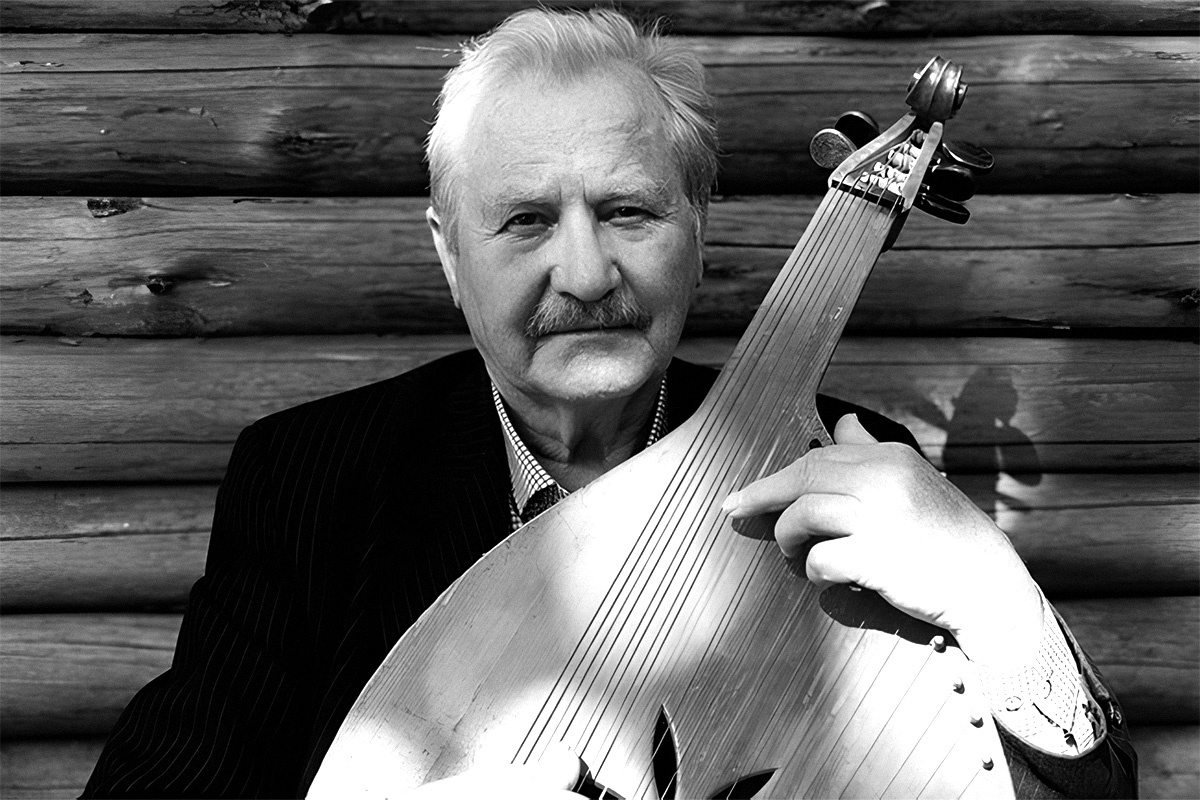
Mykola Tovkailo / kyivdaily.com.ua
SHORT PROFILE
Name: Mykola Tovkailo
Date of Birth: December 24, 1949
Place of Birth: Korovie Village, Khmelnytskyi Oblast, Ukraine
Profession: Archaeologist, Bandura Player
Mykola Tovkailo is a Candidate of Historical Sciences, archaeologist, bandura player, researcher of kobzar traditions, and guild master of the Kyiv Kobzar Guild. He is a maker of traditional kobzar musical instruments: the folk, or old-world, bandura, the kobza, and the hurdy-gurdy.
We discuss archaeology, as well as kobzar traditions, the history of the kobza and the folk bandura, the repertoire of kobzars, and the relevance of ancient dumas in the modern world.
Iryna Mamryha: Mykola Tykhonovych, please tell us about your journey. What led you to archaeology?
Mykola Tovkailo: Throughout my life, I have had to do many different things. Perhaps this is a general tendency among most young Ukrainians who face the question of choosing their path: they lack a mentor who could guide them towards a field of activity that matches their abilities. As a result, they have to search for their place for a long time, as I did. I tried myself in various fields. I studied at a construction technical school but did not graduate because I was drafted into the army. After military service, I was no longer interested in returning there, as I already had other plans. Later, I studied Textile Technology at a technological institute but left in order to apply to the Faculty of History.
A friend and I went to Kyiv and prepared for the entrance examinations. We dreamed of building Ukraine. On May 22, 1972, the anniversary of Taras Shevchenko’s reburial, we went to his monument. Many people had gathered there, but the police began forcing us away. My friend and I were detained and taken to the police station. After that, every path to university was closed to me. Nevertheless, I eventually managed to enter the Faculty of History, although only as a part-time student. Why did I choose archaeology? First, it is a historical discipline. Second, it seemed to me that it was the least ideological field of history, where one could work freely. In reality, however, this was not the case, because specialists there were also subjected to ideological pressure. Eventually, I entered the university and began taking part in expeditions. Today, I have 50 years of archaeological experience behind me, along with numerous works and articles, and several monographs.
І. М.: What do you find most challenging about archaeology, and what inspires you the most?
М. Т.: Every scholar, regardless of their field, is inspired by the search for something new — something that no one has yet discovered. At the same time, archaeology is probably the most demanding of all historical disciplines. Historians have it easier: they can go to an archive or a library, gather information, and begin working with it immediately. Archaeologists, however, must first uncover the information itself. That means moving tons of earth just to find a single valuable fragment. Yet that is actually the easiest part. The greatest amount of time and effort goes into processing the material. A single archaeological feature may yield thousands of finds from different layers and depths. They must all be sorted, described, attributed, subjected to laboratory analysis, and compared. This takes up 80–90 percent of the work. Only then can analytical conclusions be drawn. Archaeology therefore requires an enormous investment of time and effort before any real interpretation can begin. But anyone who enters this profession and is not intimidated by the workload never truly leaves it.
І. М.: What sparked your interest in traditional music, particularly the kobzar tradition?
М. Т.: It’s quite simple — I still belong to the generation that sang. As a child, I had an entire notebook — a songbook — in which I wrote down song lyrics, though without musical notation. Back then, people were not yet “silent”; everyone sang. Later, I became interested in kobzarstvo as a cultural phenomenon and began reading books on ethnography and folklore. When I eventually felt the need to make music myself, I turned to the bandura. At first, however, it was the academic bandura. Living in Kyiv, I joined an amateur bandura ensemble at the Slavutych House of Culture in Podil. There I learned to play and met many remarkable people, including Viktor Lisovol, the author of the song “Nalyvaimo, Brattia, Kryshtalevi Chashi” (“Let Us Fill the Crystal Cups, Brothers”), which many people mistakenly believe to be a folk song. I also met the bandura player Pavlo Suprun, who was blind but possessed a magnificent natural bass voice. Had it not been for his disability, and with the proper musical education, he could have become another Borys Hmyria.
Before long, however, I realized that I was pursuing the wrong path. The ensemble performed lyrical and humorous songs, while I already knew something about the kobzar tradition and felt that this was not its true music. So I began asking whether there were still any authentic kobzars left in Ukraine. Viktor Lisovol then introduced me to Heorhii Tkachenko. He was an extraordinary figure in Ukrainian culture — an artist, architect, and bandura player. After the Second World War, he was the only man in the world who played the traditional folk bandura, also known as the old-world bandura. Heorhii Kyrylovych preserved this instrument and the authentic, unaltered repertoire that he had learned directly from kobzars while studying in Kharkiv in the early twentieth century. At that time there had been many bandura players, until the Communists destroyed them. Incidentally, Tkachenko inherited most of his repertoire from Petro Drevchenko and succeeded in preserving that legacy for future generations. Thus, in 1979, I left the ensemble and became a student of Heorhii Kyrylovych.
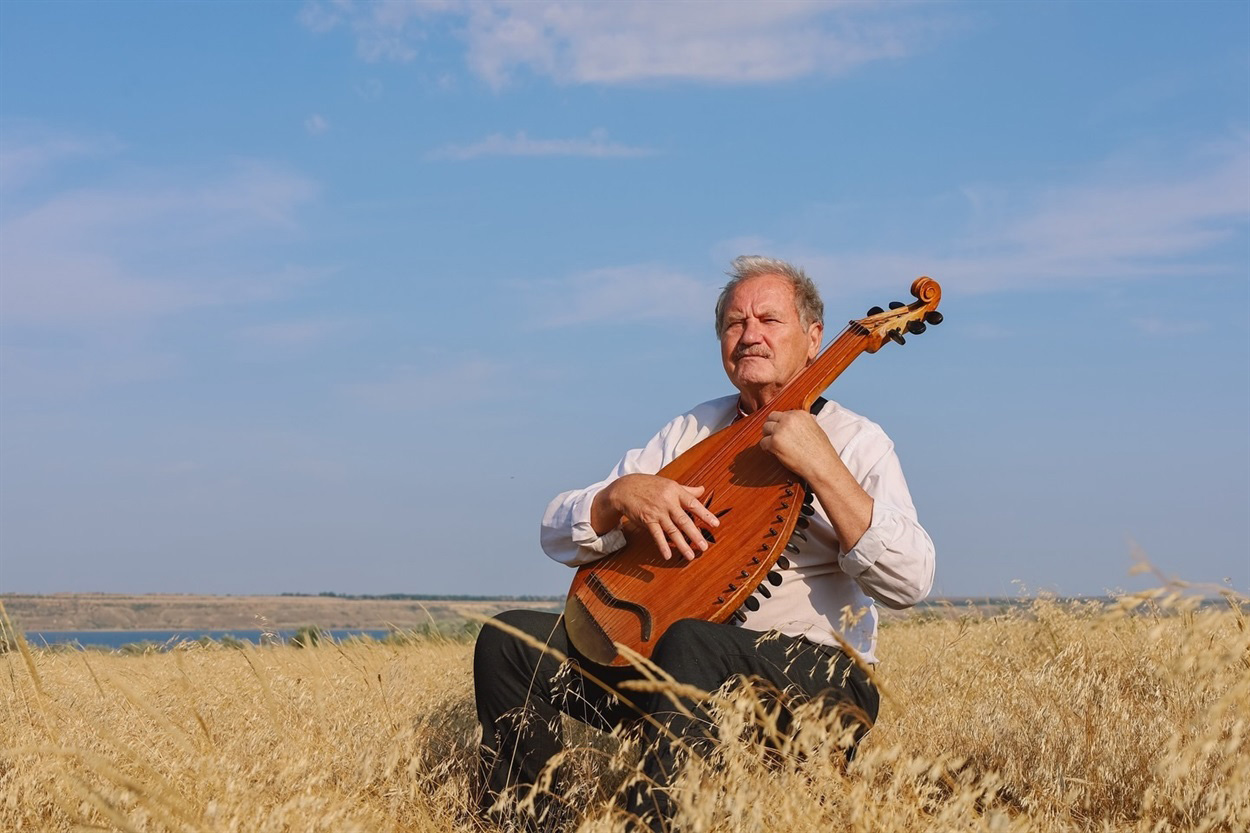
І. М.: Let’s talk about the instruments themselves. What is the fundamental difference between the kobza and the bandura? Could you tell us about their shape, playing technique, and aesthetics?
М. Т.: The traditional folk bandura and the kobza are two distinct instruments, although both were used by kobzars to accompany their singing. The bandura has an asymmetrical body and typically features 21–22 strings. Its defining characteristic is that the strings are not pressed against the neck. The tuning is adjusted individually to suit the performer’s voice — for example, higher for a tenor and lower for a bass. The kobza, by contrast, has a symmetrical shape. It usually has six main strings on the neck and another six treble strings. Here, the melody is produced by pressing the strings against the neck, much like on a lute or a guitar. The treble strings are used primarily to ornament the melody. Both instruments were created by Ukrainians, most likely during the sixteenth and seventeenth centuries, when lute-type instruments were becoming widespread across Europe. Another traditional instrument worth mentioning is the hurdy-gurdy. It came to us from Europe and was widespread from the Iberian Peninsula all the way to the eastern borders of Ukraine and Belarus. Beyond that point, it was no longer part of the living musical tradition (although it was known as the “Little Russian hurdy-gurdy”). In fact, the distribution of the hurdy-gurdy marked the eastern boundary of cultural Europe.
І. М.: Why is it important to distinguish the old-world bandura from its academic versions?
М. Т.: The old-world bandura is the authentic folk instrument played by kobzars of past centuries. Why is it important to distinguish it from the academic bandura? Because they are fundamentally different instruments in terms of construction, playing technique, and aesthetics. The old-world bandura is diatonic. To change the key, the instrument must be retuned. This creates certain inconveniences, but it also preserves its distinctive authentic sound. As a result, the traditional kobzar repertoire sounds natural and genuine.
At the beginning of the twentieth century, however, members of the intelligentsia who had received formal musical education in Europe began searching for a “universal” bandura on which one could “play anything”. Over the course of half a century, many transitional versions appeared: semitones and additional bass strings were added, and the total number of strings steadily increased. By the 1950s, the modern chromatic bandura had finally taken shape. It featured more than fifty strings, a different tuning system, a different playing technique, and an entirely different aesthetic. This instrument began to be taught in music schools and conservatories. But it was not a continuation of the old tradition — it represented an entirely different direction. One could become a bandura player without even being able to sing. As my friend, the musicologist Mykhailo Khai, once said: “There were blind bandura players, but there were never mute ones”. Unfortunately, the academic bandura largely displaced the folk tradition. A vivid example of how the old kobzars viewed these changes is the story of the instrument maker Oleksandr Korniievskyi.
At the beginning of the twentieth century, he was among the first to attempt to modernize the traditional bandura. He added two sharp strings to the instrument and brought it to the renowned Chernihiv bandura player Terentii Parkhomenko. Parkhomenko was so outraged by what he considered a “desecration of the instrument” that he threw Korniievskyi out of his house and forbade him from ever returning. That is how fiercely they protected the old traditions. It is important to understand that once we change the tuning, the playing technique, and the repertoire, we are dealing with a different instrument, even if it is still called a “bandura”. After all, a musical instrument is defined not by the shape of its body, but by its tuning, its method of performance, and the repertoire for which it is intended. The same applies to the kobza. Today there are many so-called “kobzas”, but in reality they are either modified domras or six- or seven-string guitars with oval bodies. They are no longer true kobzas.
І. М.: In one of your interviews, you mentioned the torban and its connection to the bandura. Could you tell us about this instrument and its place in the kobzar tradition?
М. Т.: In Ukraine, the torban was known as the “nobleman’s bandura”. By the nineteenth century, it was no longer part of the folk tradition. Earlier, however, it was played primarily by the Cossack elite. It is known that Hetman Ivan Mazepa played the torban. Another distinguished torban player was Andrii Rozumovskyi — the son of a hetman, ambassador to Vienna, patron of Beethoven, and a gifted musician. He owned three torbans. One of them has survived to this day. I have held it in my hands, sketched it, and taken its measurements. I hope that these drawings will soon be published in Ukraine. Unfortunately, the second instrument was destroyed in 1814 during the Napoleonic Wars, while the third was donated by Rozumovskyi’s descendants to a museum, but its whereabouts have since been lost. As for the instrument’s origins, the torban developed from the European theorbo — a bass lute of the Baroque era. When the theorbo was brought to Ukraine, local musicians felt that it was “missing something”. They added treble strings and altered its tuning so that it could be played in the manner of the bandura. The torban remained in use in Ukraine until the mid-nineteenth century, when it was gradually displaced by the guitar. It was a rather complex instrument, and special schools for torban players even existed. One of the best known was established in the town of Savran in Podillia by Wacław Rzewuski, the son of the last Field Hetman of the Polish–Lithuanian Commonwealth.
І. М.: What did the kobzars’ repertoire consist of?
М. Т.: Kobzars, bandura players, and hurdy-gurdy players were professional itinerant musicians. They formed brotherhoods, most often called guilds, to protect their rights and preserve their tradition. Unlike ordinary folk music, the foundation of the kobzar repertoire was epic poetry — dumas, historical songs, Cossack songs, and ballads. This was the Ukrainian epic tradition, continuing the legacy of the singers who, as early as the princely era, celebrated heroes in song. The second major component consisted of Christian spiritual works: psalms, kants dedicated to the Virgin Mary, Jesus Christ, and the great saints, as well as moral and ethical compositions. Kobzars, bandura players, and hurdy-gurdy players performed dozens of psalms associated with every major church feast.
There are accounts of one hurdy-gurdy player who knew 140 psalms. In addition, the repertoire included satirical and humorous songs, as well as dance melodies. Kobzars were predominantly blind or visually impaired, or they had other physical disabilities. This tradition dates back to the Middle Ages, when the musical profession provided people with physical disabilities an opportunity to earn a living. Kobzars carefully preserved both their repertoire and their tradition. There was, however, a certain distinction between bandura players and hurdy-gurdy players: the former focused more on historical subjects, while the latter specialized primarily in spiritual repertoire. It is important to understand that kobzars were not performers in the modern sense of the word. They did not appear on concert stages; they traveled from place to place. Alongside the traditional bandura players, who belonged to guilds, there were also court musicians.
І. М.: You also make musical instruments. What was the greatest challenge when you first started?
М. Т.: When I became a student of Heorhii Tkachenko, I did not have an instrument of my own. In the late 1970s and early 1980s, there were only two craftsmen in the whole of Ukraine who made banduras. Tkachenko told me: “Either join the waiting list and wait for someone to make one for you, or try making one yourself”. He gave me a blueprint he had designed himself, and I got to work. The hardest part at the beginning was that I was taking on something completely unfamiliar. In Kyiv, I sought advice from a violin maker (unfortunately, I have forgotten his surname), traveled to Pereiaslav to consult the experienced craftsman Ivan Sytnyk, and read specialized literature. Once I began working on my first bandura, I became so absorbed in the process that I would even forget about lunch — I simply could not pull myself away. I truly realized that I had chosen the right instrument in 1979, after a conference dedicated to Hryhorii Skovoroda in Pereiaslav. I had been invited there to perform as a bandura player. It was then that I understood that it is not so important how you play or even what you sing. What matters most is the sound of the instrument itself. Its timbre touches the deepest strings of the Ukrainian soul and brings a person back to their roots.
І. М.: How do the ancient dumas about the struggle against enemies resonate with today’s war for independence?
М. Т.: Very powerfully. The heroic cycle of dumas tells of the struggle against the Horde, the Turks, as well as the Khmelnytsky Uprising and the war against the Poles. Today, when we perform for our servicemen and servicewomen, they become our most attentive audience. After all, we are singing for them and about them. The same themes — honor, glory, death, burial, and brotherhood — remain just as relevant today. There are also everyday dumas that address moral and ethical issues, such as The Widow and Her Three Sons, The Sister and the Brother, and others. These human dramas and values do not change with time. The way they are presented in the dumas — the depth of character and their artistic power — remains, in my opinion, beyond the reach of contemporary composers. The duma is a unique genre, combining recitative and melodic chanting, created by Ukrainians themselves. Incidentally, at the end of 2024, UNESCO recognized the kobzar and lirnyk tradition as an Intangible Cultural Heritage of Humanity. This is an important recognition at the global level. Our responsibility now is not to fail it and not to lose this tradition.
When copying materials, please place an active link to www.huxley.media
Select the text and press Ctrl + Enter


