NADIIA FORKOSH: When a person and technology speak the same language
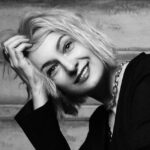

Nadiia Forkosh / Photo from the personal archive
SHORT PROFILE
Name: Nadiia Forkosh
Date of Birth: December 13, 1984
Place of Birth: Kyiv, Ukraine
Profession: Artist
Nadiia Forkosh is a Ukrainian artist working at the intersection of physical and digital art, in the so-called phygital format (a combination of traditional canvases and digital media, including NFT). Her work has gained wide recognition far beyond Ukraine — in Austria, the United Kingdom, and Brazil.
My introduction to Nadiia Forkosh began with her artworks, which I first saw online. The paintings did more than catch my eye — they felt like an open door into another space, where time seems to expand. Later it turned out that Nadiia is also the author of an entirely new book format, in which painting, text, and digital reality are woven together into a single whole.
Svitlana Pavlianchyna: Nadiia, your photographs are incredible. They look very natural, as if movement lives inside them. Do you work with a photographer?
Nadiia Forkosh: Sometimes I come up with the angles myself, and sometimes I ask someone to help. I like it when a shot looks natural rather than staged. When you catch a living moment in the process, it conveys much more than any carefully constructed photo. It speaks about the artist, the idea, the mood.
This is how our conversation began — quiet, sincere, about how art is born, the kind that needs no explanation.
MY WANDERING ART
N. F.: I lived in Ukraine, but it turned out that I didn’t quite fit into the Ukrainian art space. From the very beginning I was interested in the phygital direction — a concept that unites physical and digital reality. My first major exhibitions took place in the United States, at various art venues. Later I signed a contract with a London gallery — they were particularly interested in the idea of combining digital art with traditional canvases.
I dreamed of realizing myself in Ukraine, of opening my own studio, but after the war began I understood that it had become impossible. So I moved to Vienna and received a grant from the Austrian Ministry of Culture. Their interest was focused on physical art — traditional exhibitions and live interaction with the audience. Some of my works are now presented in Brazil and Austria as well. My art, you could say, is wandering — it searches for spaces where it will be heard.
S. P.: How did you bring your art to people? How did it happen that your works were seen in Europe and America?
N. F.: It happened very naturally. I started online with the most basic platforms, such as Shutterstock. It’s a place where everyone is equal: you simply step into an open field and start working. There are no statuses there — no names, no biographies. Only a nickname. Next to you might be a boy from India, a famous artist from Europe, or a beginner illustrator from Ukraine. Everyone is equal. Each person simply creates a product that must speak for itself.
You see, in many ways it’s like a roulette. You create something, believing it is original enough for someone to notice it. That’s how my movement began. It was my first step back in 2006 — honest, without intermediaries or patronage. Buyers found my works on their own. This is how the Spanish company Marqués de Riscal reached out to me. They liked my project and offered to use it as a label for an eco-friendly wine variety grown in Spain. This was the beginning of our collaboration.
I have been drawing since the age of three. It’s a blessing and a curse — there are different ways to look at it. It’s difficult to explain, because art has simply always been with me. I have a scientific degree and two educations: the first in economics, the second in fine arts. At some point I wanted to try combining them — to bring art into advertising, to create something alive in a commercial environment. Some of it worked, but overall I wanted to focus more on pure art.
S. P.: I assume your exhibitions are not entirely traditional either? Are they accompanied by light, music, visual effects?
N. F.: Yes, in London, for example, that was exactly the case. But you know, all of this is «not the format». And the book is «not the format» as well. When you bring it to a publishing house, they say: «Is this a children’s book?» Animation — not the format. An interactive book — also not the format. Doing something that doesn’t resemble anything else is difficult, because then everything falls on your shoulders. You have to find people with open minds, those who are ready to try something new. And that isn’t always easy, especially nowadays. Organizing an exhibition, for instance, requires a lot of effort, resources, and technical solutions. But when everything comes together — it’s incredible. Because the viewer doesn’t just get an exposition, but an experience. They don’t just look — they feel.
S. P.: It seems we are living at a remarkable crossroads of eras. Some people say, «The future belongs only to the digital». Others insist on the traditional.
N. F.: I think there’s no need to divide. They should come together, because that fusion gives birth to something new. Just like a book and an animation: one complements the other. Or how music — digital or live — can enhance the experience of a painting on canvas. All of it is a single expression of a concept. That’s my state. That’s where I live. And I rarely manage to bring it all together at once, but when I do, it’s happiness. The book I’m working on now is a small essay, an attempt to unite all these elements: text, image, movement.
S. P.: I think I understand what you mean. Is it similar to when you read books in digital form for a long time and then suddenly want to hold a real one?
N. F.: Yes, exactly. It’s very similar to what’s happening in art right now. We’ve become used to screens, gadgets, texts on a phone. And then suddenly there comes a moment when you want to literally touch something. You want to feel an object, to return to what is given through live perception. I also thought that bookshelves were a thing of the past, but now I find myself reaching for them again.
S. P.: You want to take the book in your hands, touch the cover, read about the author. Before, I didn’t pay attention to such things, but now I do. It seems to be a trend. Would you agree?
N. F.: A paper book is a tradition, a space where imagination develops. You smell it, you touch the pages — and you’re left with living impressions. That is very important. No digital model can replace it, no matter how vivid it is. I think this understanding comes only when a person is deeply immersed in the digital space and suddenly feels a kind of lack, a desire to touch things again. You see, we perceive the world not only with our eyes. We touch it. We sense smell, texture. These parts of perception are becoming less and less engaged over time — but they are the ones that give us the feeling of real presence.
S. P.: It’s like getting oxygen back — a feeling of freshness.
N. F.: Yes, exactly. So, the interactive book. Imagine: you’re reading a paper book, and then you point your phone at it — and it comes to life. Animation appears, music begins to play, and the idea of the book opens through new layers. It’s a book that opens itself to you completely — not only to your imagination, but to the imagination of the author as well. The book gains another dimension.
S. P.: Is it similar to the feeling when you first put on 3D glasses in a cinema, and enter a completely different world?
N. F.: The difference is that this does not replace reality. You can still touch the paper, feel it, read the text — but now it’s complemented by a new dimension. And this is exactly what I stand for: for the fusion, for the possibility of engaging all senses. I do the same with canvas: the viewer sees it, smells the paint, feels the texture, and then notices that the painting comes alive — movement, music, light appear within it. This is the phygital world — a synthesis of the physical and the digital, in which art reveals itself more fully.
THE MAIN CHARACTER IS THE FREE SOUL OF A CHILD
S. P.: At what moment did the idea of writing a book appear? Or had you had the book for a long time, and this is simply a fusion of elements? What grew out of what, and how did it all come together?
N. F.: Let me put it this way. Why did this particular style emerge? The style of this phygital book was born from my previous experience of combining the digital and the physical in order to express the creative idea as fully as possible. This approach feels natural to me. As for the idea of the book itself, it came from images. At first, I wanted to create a main character who would be absolutely free, not limited by any framework. It’s like the soul of a child — before it has «become someone». Before the environment has imposed on it who it should be or become. The process of defining begins, essentially, when someone names you, gives you a name.
So that’s where I began. The main character (actually, it’s a shadow, so it is neither he nor she) must not have a name. Technically, its name is Mi, but that’s a musical note. The full name — Mira Gishtorum — translates from Latin as «a miraculous act». It’s a sound. And a sound exists only when it is sounding. When it falls silent — it disappears. So Mi is like a designation of a name that, at the same time, does not exist. The character chooses it on its own, already in the process of the story.
In other words, absolute freedom is its most essential quality. Why is it a shadow? Because when we buy any other children’s book or look at an illustration, the character is already predetermined: it has features, clothing, an expression — everything is decided for us. But I wanted to leave only what is essential, to open the very possibility of the character. In this way, I wanted to activate the reader’s imagination so that they, in a sense, become a co-author.
From the very beginning, the reader doesn’t know who this is, but they imagine, interpret, participate. And around this, the dialogues were built — what the character does, where it goes, which figures it meets along the way. If we rewind to the beginning, the inspiration came from shadow theatre. As a child, I played a lot with shadows, watched shadow performances where shapes transform, where light creates the illusion of a new world. That’s probably where it all originated.
I loved experimenting with forms. For example, you create a reflection, change the angle — and a new form is born. In reality, it’s one thing, but on the wall it becomes something completely different. It always felt like magic. I made many sketches. For about ten years, perhaps even more, I collected them — I have entire notebooks filled with drawings. Characters appeared, small images to which I added notes: «the one who waters flowers in the clouds», «the one who got lost on a rainy day and forgot the umbrella», «a room that lives somewhere». These were very simple, almost everyday stories, but they lived their own life, as if in another dimension where everything is possible.

THIS IS SIMPLY A LIVING, CURIOUS SOUL
S. P.: It’s an extraordinary approach — not giving a name, not specifying whether it’s a boy or a girl. Already at this stage, you invite the viewer to imagine something, to become a co-author.
N. F.: Yes, exactly. The character is free. Free even from gender. I don’t say who it is — it’s simply a living, curious soul that appears as a result of shadow play. It travels through the world, it needs nothing. It simply wonders — like a child who sees something for the first time and is enchanted by it. For me, it was important to preserve this pure and primary feeling. This is not a book in the usual sense. It’s more like a sketch of a book, almost a draft. I wanted the viewer to feel that. Lewis Carroll used a similar technique in Alice: he created a topology in which the reader seems to fall from one space into another. It’s the same feeling here: the character is plastic, not tied to a place, time, gender, or details. It is free energy.
S. P.: How does a book become a space where painting, text, and code form a single shape? What is an artistic medium for you today?
N. F.: Today, fortunately, we have the possibility not to divide mediums. We can combine them. What I want to convey is that the physical and digital worlds can be combined fruitfully. Yes, if I just need to send information, I send a message — it’s quick, convenient. But if I want to give a feeling, an emotion, an aesthetic experience — then digital alone is often not enough. Something will still be lost.
S. P.: And what is the balance between the visual, the image, and the text in your book? Where is the artist, and where is the author?
N. F.: A very interesting question. But it’s quite difficult to separate. I love drawing, but it is just as important for me to connect images into stories. I’m equally interested in creating animation and working with text, searching for the precise word. It’s an organic process.
S. P.: I feel that you can’t even call it simply a book. It’s more like a project or, more precisely, another form of expression.
N. F.: It’s not a format — it’s more of a form. It’s like a mix: a bit of music and a painting, sound and movement, text and image. It’s just a way to connect the things that matter to me and see how one complements the other.
S. P.: And what reactions would you like to evoke in your viewer–reader? How do you imagine them?
N. F.: First of all, this book will resonate with someone who has preserved a child within themselves; this book should remind them of that pure experience of perceiving the world. It will help the reader look at things outside the box, to see angles we often overlook. In the book, for example, there is a theme of the path — the road. But it is viewed from different perspectives: as distance, as time, as an inner experience. You simply change the lens, the optics — and the object that seemed familiar becomes something else. That’s what my book can offer. My reader, as I imagine them, is a slightly mad Hatter from Alice, someone who believes that behind the familiar something else is always hidden.
S. P.: Something from childhood… Were you a curious child, sociable or reserved? Were you comfortable alone with yourself and your creativity, or did you share it with those close to you, with friends?
N. F.: I think it was mostly my own world. It required silence and peace. I didn’t need constant communication — it was enough for me to do and see what was happening in my inner space. But over time, as you grow up, you meet people who understand you — and that’s wonderful. Then you gain an additional motivation to create.
S. P.: Are you empathetic, do you feel people, are you interested in what happens to them? Or are you more of a person of creativity living inside your own world and only sometimes stepping out into the external one?
N. F.: I’m generally an open person, but for the most part I prefer to stay alone with my images.
S. P.: Did someone influence your choice, or is it solely an internal decision?
N. F.: My husband, Serhii. He influenced me greatly. Serhii is a creative person, a philosopher. We’ve been together for twenty years.
THE BOOK AS A LIVING ILLUSTRATION
S. P.: Tell me, did the moment of discovering the QR code make an impression on you? When you first saw that you could point a camera and get somewhere further — into another space — did it inspire you?
N. F.: You see, I actually wanted it to be even simpler in the book, preferably without a QR code at all. I wanted the reader to simply point a tablet or a phone at the illustration — and it would come to life. Like an added reality. But I didn’t have the technical capability to implement that, so I decided on the simplest option — a QR code that the reader understands. On the last page there’s an instruction: you just point your phone, and the final illustration comes alive, plays, starts moving, starts sounding. Right now it’s more of a small experiment to show that this is possible, that a contemporary book can be complemented by another dimension.
S. P.: So only the last page comes to life?
N. F.: Yes, only the last one. I just showed what is possible. The book was originally planned to be much fuller, but only the first part has been completed. It explains who this character (Mi) is, why it appeared, how it entered this world. It’s essentially the first sketch of a book, but with the possibility to step outside the frame and see more. This is important to me both as an artist and as a freelancer, because I did everything myself: translation, editing, illustrations, animation, and even the music.
This first part is called Mi. Depending on the language, it includes about forty pages. There are around thirteen illustrations, including the cover. All of them come from one large series that is very extensive and has different narrative branches, but some of the illustrations were created specifically for this book. Shadow Story unites a large collection of illustrations that I have been creating for quite a long time. At the beginning there were many sketches — some of them were published on Patreon. It’s a kind of visual story about how the Little Shadow was created.
Many of these drawings I made in Kyiv, in my favorite café on Shevchenko Boulevard. Sometimes — literally on paper receipts, parking tickets, on anything that was at hand. When inspiration comes, you don’t choose the surface. You draw wherever you can. Then you gather everything into sketchbooks, but something, of course, always gets lost. Some of these early drawings were also published in the children’s magazine Barvinok. In general, when there are many such drawings, they start forming a story on their own. You draw images for ten years, and suddenly they begin connecting themselves, and your task is only to give them a clear shape.
S. P.: And how do you see the future of this book?
N. F.: Shadow Story is a book of a new format or, more precisely, an expanded format. I plan to extend it, perhaps write a second part.
S. P.: Where would you like this book to be seen and heard — in libraries, in stores, at exhibitions? And what do those who have already read it tell you?
N. F.: I’m interested in developing this project, and I would like to keep moving in this direction. I have many ideas for its continuation. As for the feedback — it’s positive. Some readers write that the book is unusual, at times resembling a philosophical parable, at other times — a child’s fantasy. Children feel especially close to the world of shadows because it isn’t overloaded, and each child can see themselves in the character. Adults appreciate the sense of inner resonance. If a person is emotionally open, it responds immediately. Especially if that person is creative.
S. P.: And what did your husband, the philosopher, say?
N. F.: He is my main critic. Without criticism I wouldn’t have anything at all. He knows how to extract from my intuition what I haven’t expressed yet. If he says, «This is unclear», it means I haven’t fully revealed the idea. His critiques help — the best things grow out of them. In this case, he is satisfied with the result.
S. P.: Do you argue or do you listen right away?
N. F.: We rarely argue. He knows me better than I know myself, so arguing doesn’t make sense. I accept his comments, sometimes add something of my own, but overall I trust him.
S. P.: I imagine you have to balance between experimentation and accessibility for the reader?
N. F.: Yes, I think about that constantly. It’s important to me that the viewer understands what I’m saying, what I want to convey. Maybe I’m seeking a kind of creative flexibility, and I see the key to this in communication. It’s very important for me to maintain a dialogue with the reader/viewer, but at the same time I don’t cross my own boundaries: I try not to go against what I feel and see.

USING NEURAL NETWORKS WITHOUT LOSING YOURSELF
S. P.: What is more important to you — aesthetics as form, or meaning as content?
N. F.: Content. Meaning always comes first. Yes, I can look for compromises, because the work must be aesthetically whole, but meaning remains the guiding point. Today we have many tools, neural networks — you can create anything, adjust it, finish it. But I don’t believe that true aesthetics can simply be synthesized. If a person doesn’t invest lived meaning into a work, it loses its value. It becomes just a form without life.
S. P.: But you give the viewer or reader an opportunity to find their own meanings, you don’t point to where they should be?
N. F.: Yes. Imagine I have a pair of glasses and I tell the viewer: «Do you want to see how this looks through my glasses?» They put them on — and they already see it in their own way. I don’t dictate perception. I don’t want to give static images, I don’t want to put the viewer into a frame. That’s why even my character has no name, no gender, no specific features. It is absolutely free — and the viewer is free together with it. This is an exchange between me and the one who is watching or reading.
S. P.: And whose world have you yourself recently touched?
N. F.: It so happened that I am deeply connected to the world of philosophy and actively interested in it. But I am also strongly impressed by the way technology is developing today. Neural networks are indeed a new tool — if you understand them as a tool. Once the appearance of Corel Painter was a revolution for artists: it was the first program that allowed you to mix colors almost as in real life, to work with texture. Now neural networks have made another leap. They are impressive, but I try to approach them cautiously. It is important for me not to lose myself in this, not to let technologies erase the handmade, the alive. I sometimes use them, but I remain focused on what I create manually. In a certain sense, I am in search of this balance — between human and machine, between intuition and algorithm.
ARTIST AS WATER: IMPOSSIBLE TO CONTAIN
S. P.: And what have you personally wanted to see or feel lately? Which exhibitions, which artists inspire you?
N. F.: I read a lot of Huxley. And not only the journal (smiles), but the author himself. His texts inspire me because they are about the future, about something new that hasn’t happened yet. I love science fiction, especially Robert Sheckley. He always managed to invent something that could surprise me. I’m not a fan of strict academicism — I’ve been in that world, tried it, and realized it’s too limiting. I need space. I love exhibitions where music and visual art are combined, where there is breath, sound, energy. Vienna’s atmosphere is, of course, more traditional, but overall you can find something for every taste — from Caravaggio and Bruegel to contemporary experimental painting. So in that sense Vienna is a wonderful place for an artist.
S. P.: You know, it seems to me you’ve found a rare way to speak to the modern generation — to those for whom technology and neural networks have become a second nature. Through projects like your book, you speak to them in their own language. But then the question arises: in a world where the borders between the real and the digital have nearly disappeared, does the artist remain free — or does freedom now demand new forms?
N. F.: We live in the real world, and it imposes its rules on us: what a product should be, who needs it, how to sell it. Yes, circumstances sometimes create boundaries, they even force us to believe that something is impossible. But if a person is truly an artist, they still search for a way. It’s like water: you can try to contain it, to seal it, but it will still find where to seep through. First as a thin stream, then stronger; and if you try to press it down, it will simply burst in all directions. Art is the same — you cannot restrain it. It will find its own way out, take another form, fill a new vessel. That is probably how beauty reveals itself. It cannot be held; it moves.
S. P.: Aesthetics as a form of cultivation… What is beauty for you — a category, an ethical norm, or a way to speak to a person without words?
N. F.: Beauty is a way to speak to a person without words. It’s the ability to understand each other without translation. You see, I work on different platforms, with people from different countries, who speak different languages — but the sense of beauty, like music or mathematics: if your inner settings resonate, if you tune into the same wave — you will understand everything. It’s a special kind of communication that goes beyond an ordinary conversation. It’s not verbal — it’s something much deeper.
S. P.: It seems we’re coming to the conclusion that your project is at once a book, an exhibition, and a dialogue.
N. F.: Yes, exactly. You’ve captured it very accurately.
S. P.: Do you believe that the future of art lies precisely in the fusion of forms — where the viewer becomes a participant and the artist becomes the architect of space?
N. F.: Yes. You’ve formulated a very important point for me. I truly want the viewer not just to look, but to participate. For art to become a space of communication.

S. P.: Then allow me a quick blitz. Which moment in your life would you like to live through once more — not to change it, but to feel it again?
N. F.: There are many such moments. But if I rewind far back… probably childhood. It feels almost like a myth, because everything was different: people, air, time. And there was one moment — the first inspiration. When I first saw an image that seemed to speak to me. I don’t remember how old I was… It was the cover of some magazine, and on it — a painting by Salvador Dalí. Liquid shapes, soft clocks, the shadow of a figure with a thin support…
I looked at it and didn’t understand: is this a dream or reality? Why does it make me so happy, why do these shapes move me so much? That’s when I felt — this is mine. This is the experience I want to share with the reader. It was the first feeling of true inspiration. Like a spark, like magic. Later, of course, there were many different impressions — joyful, anxious, emotional. But that first one — the purest. It probably defined who I would become. And to this day, when I draw, I return to it — to that moment when beauty first spoke to me.
S. P.: What compliment would you like to hear from the world?
N. F.: That the world is not indifferent to my efforts, and that through my drawings it becomes a little brighter.
S. P.: And what will you never allow to be taken from you?
N. F.: The ability to draw.
S. P.: If your soul were a color — which one and why?
N. F.: Blue. Because it is deep. It belongs to both the real and the spiritual.
S. P.: Do you try to notice only the good?
N. F.: Yes. I try to focus on the positive because negativity, forgive my bluntness, simply «devours» energy. So I try to let go of everything unnecessary. Without that, you cannot create anything truly meaningful.
S. P.: What is the difference between silence and quiet for you?
N. F.: Quiet is not always peace. Silence is already peace, because there is no dialogue inside you. It is meditation, working with yourself. When you are silent inside — that, for me, is a state of balance. Quiet is available to everyone, but in quiet there can be a very dense inner dialogue, and then it stops being meaningful for you and becomes just a background. But inner silence — that is rare and powerful. It is the ability to hear yourself.
S. P.: When you are silent, what are you really saying?
N. F.: When I am silent, I feel. I try to hear my intuition — it loves silence and quiet. It is in these moments that I understand what it wants to tell me most clearly. This is important. Not only in creativity, but in life in general.
When copying materials, please place an active link to www.huxley.media
Select the text and press Ctrl + Enter


