TATIANA MIRONOVA: «A gallerist is a calling, not a diploma»

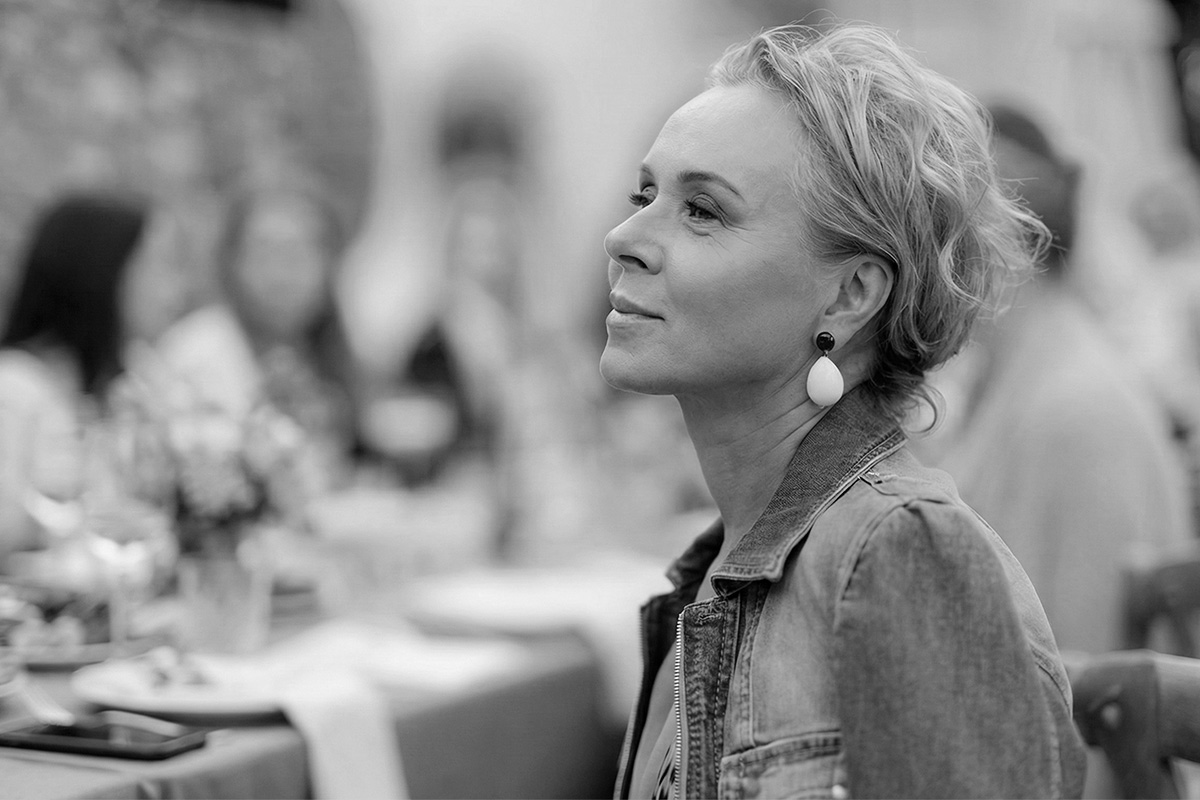
Tatiana Mironova / Photo from personal archive
SHORT PROFILE
Name: Tatiana Mironova
Date of Birth: August 20
Place of Birth: Dnipro, Ukraine
Profession: gallerist, art historian, curator of contemporary art
Tatiana Mironova holds a Doctorate in Art History and a PhD in Philosophy. She has been the Director of the Kyiv Municipal Gallery «Lavra» since 2013, is the founder of Mironova Gallery and the charitable organization UNLIMITED ART FOUNDATION, and the initiator of more than 100 cultural projects in Ukraine and abroad, including within the parallel program of the Venice Biennale. So, let us talk about art, about artists, about the relationship between the artist and the gallerist, about the complex fate of the gallerist and the art historian. About how to achieve success where you expect it — and about much that is unexpected.
Andrii Kostyuchenko: I am curious to know, Tetiana, which of the exhibitions held recently impressed you the most and resonated with the state of your soul?
Tetiana Mironova: I would like to highlight a new project that I personally initiated as its organizer. It is an art festival called Art Kyiv. I am very proud of this project and of my team, of the fact that in such a difficult time for the country, we were able to make it happen and organize it. Gallerists came to us not only from Ukraine but also from abroad. The event took place on the premises of the «Lavra» Gallery.
А. К.: Tell me, how does one become a gallerist, and what does it take? Good academic training?.. Or is it a calling? What, in your opinion, should someone be prepared for if they decide to devote themselves to this field?
Т. М.: I have never met people who deliberately studied how to become a gallerist. People come to this profession from different fields; it is mostly not about formal education but about a calling. At one time, I also did not have a specialized education — I obtained it later… It seems that life itself led me to this profession. Many of the successful gallerists I have encountered along my path were self-taught in the best sense of the word. People with an education, but not necessarily a specialized one… And in any profession, you have to learn throughout your entire life.
I was shaped by my artists; it was they who made me a gallerist, an art historian, and a salesperson. I am now speaking of our well-known artists, such as Oleh Tistol, with whom I spent a great deal of time — he taught me when he was already a successful artist. Of course, this also includes Anatolii Kryvolap, who continues to teach me to this day, and Viktor Sydorenko. They are very different, with very different experiences, and no educational institution is capable of teaching what these people can teach.
А. К.: How does one find their own Marchuk, Tetiana?
Т. М.: I never looked for «my» Marchuk, nor did I deliberately cultivate anyone in particular. Working with artists is not very different from other pursuits: you either resonate with a person energetically and in character, or you don’t. That is, beyond talent, you must be able to feel the artist, be on the same wavelength, understand each other at half a word, just as they understand you. I often say in my interviews that I do, of course, believe in talent; without a doubt, all true artists are God-given talents. And it is hard to argue with that, because they truly are endowed with something unique.
I am talking about real artists who, in addition to talent, also possess an enormous capacity for work. It is precisely those artists who work, work, and work for many years who inevitably achieve something. From people like this, a new Marchuk can emerge. But to say, «I dreamed something here, I painted something extraordinary here»… You know, there are different kinds of people… some come to me and say, «I invented something incredible here… it’s a masterpiece»… and then they disappear.
As for Anatolii Kryvolap… In his interviews, he says that he spent 10 or 15 years sitting in a basement studio, not communicating with anyone, simply searching. And at some point, he suddenly realized: «What I am doing does not satisfy me; I have not discovered anything new». And so he renounced the whole world — perhaps even his own life, life with his family. He personally sacrificed a great deal, and it was a challenge to himself to sit and search. But today he is a star. That said, I am not claiming that everyone must be so self-sacrificing. Above all, it is conscientious, inspired, hard work, and searching. And when you finally catch your star, it is very important not to fly off into the sky, but to remain with people, to understand that only by working inspiredly, in constant new searches, can you stay at this level or rise even higher.
А. К.: And how does an artist approach a gallerist — with what? And where does the collaboration between a gallerist and an artist begin?
Т. М.: It is different for everyone. Today, there are many online courses that say: «We will teach you how to approach a gallerist, how to develop your CV». It is good that today this can be taught. If we speak about the older generation of artists, many of them still do not have proper, well-prepared CVs. And presenting yourself correctly is, in my opinion, very important. It is good when an artist listens to this advice. But here, you know, there is a very fine line… There are many artists who have five or ten works… or who produced those five or ten works perhaps within a month. They call themselves artists, write a beautiful CV, and then we face a situation where, when we see the works in real life — even though they may look wonderful in an online image — they turn out to be nothing at all. So one must clearly understand: being taught how to present a CV does not mean being taught how to paint properly.
I believe that just as artists are looking for good gallerists, gallerists are also looking for good artists. Therefore, artists should not be shy — they should contact galleries, write, present themselves, and work. I have had many cases where artists came to us, we turned them down, then they worked persistently, and we returned to them because we saw their growth. They set themselves a challenge: «They didn’t take me, but I will prove that I can». So there is no single recipe like «How to cook stuffed pike». It is, of course, work, and also a certain amount of luck, a certain intuition — where, at what time, at which exhibition to appear.
One more piece of advice I would like to give to all artists: do not start with very high prices. This is a disease of today’s younger generation who have graduated from universities. If they remain in the profession, they immediately set some cosmic prices. And in fact, it is impossible to sell these works, because they are unjustifiably expensive. One should not compare this with the Western market — there is a certain economic base there, and there are clear rules.
For example, in Germany, an artist with a higher education calculates the price of their painting by multiplying the length by the height, and that, say, costs one thousand euros. And after a year or two, it already costs (per square meter) one thousand two hundred euros. That is, there is a certain gradation, everyone works within this price category. Everything is clear there, everything is laid out. We do not have this; everyone invents a price from who knows where. So it is better not to rush, set a reasonable price, make yourself visible, move forward, raise the price gradually — and then you will be successful.
А. К.: You hold a PhD in Philosophy. Does this professional training help you in your work as a gallerist?
Т. М.: Let’s put it this way: I may not have come to academic work entirely consciously — it happened somewhat by chance. I have a mentor, Oleksii Rohotchenko, a corresponding member of the National Academy of Arts of Ukraine and a very well-known art historian. He always encouraged me, saying: «Come on, you need to go into academia and defend a dissertation». To be honest, it was only thanks to his persistent support, and his constant pushes, that I decided to do it. In addition, I come from a family of scholars: my father was a professor, a Doctor of Chemical Sciences, a Doctor of Technical Sciences, and a member of the London Academy of Sciences. So the predisposition was there.
Ten years ago, I defended my candidate dissertation in art history and received a PhD in Philosophy. The topic was devoted to museum practice. At that time, I was serving as Acting Director of the National Museum, and since I was working in this field, my dissertation focused on studying the adaptation of contemporary art within a classical art museum. It was a very interesting subject, because that was precisely when I was implementing projects in museums.
And this year I defended my doctoral dissertation in art history. This is an entirely different level — it took me ten years to complete. A Doctor of Art History is far more serious and complex. What has it given me? I think a certain additional self-confidence. After all, the more professional a person becomes, the more persistent and determined they are. And at the same time, someone who is constantly developing doubts about themselves much more often. I understand that time flies very fast, decades pass, and I still have so much to accomplish. It seems that with this degree, I have become more demanding and more persistent in the ideas and tasks I set for myself.
А. К.: Every era finds its reflection in the visual arts. How is the present day reflected in contemporary art during the Russian–Ukrainian war?
Т. М.: Since the beginning of the full-scale invasion, virtually all artists have addressed this subject. Young artists especially. Many artists who left the country worked abroad and held exhibitions in different countries. They were invited by galleries. I myself organized several group projects in France. One of them was titled Ukrainian Revival. Several projects were held at the «Lavra» Gallery; we organize them every year. Recently, it was Even There, Flowers Bloom — a project we created together with the United Nations World Food Programme. It was dedicated to the contact zone, where fighting is taking place just a kilometer from residential areas. The people living there photographed their own lives, and their photographs were presented in our exhibition.
People are tired of the negative present, of what is happening to us every day and every night. That is why the focus has now shifted toward positive impressions. Let us recall the Art Kyiv festival we mentioned earlier. There was a feeling as if there were no war, as if nothing had changed… But together with political analyst Mykola Davydiuk, we presented an installation by Anatolii Kryvolap and put it up as a lot in support of a specific brigade. We raised about 2 million hryvnias, and the funds were transferred for the purchase of boats — there was such a concrete request. Of course, we are grateful for every hour, every minute of life to the defenders who give us the opportunity to survive today and to hold such events.
А. К.: And what is the collector like today? How have they changed over the past decade?
Т. М.: The collector has changed; they have become smarter. Today, the internet offers enough visual and educational programs from which they can choose what interests them. And over the past 10–20 years, our collectors have traveled a great deal. They visit museums around the world and understand that art is a value — something that will remain after us for many years. It is a value in which one can invest money and secure those investments by collecting art. I would say that collecting has become more conscious. The art connoisseur more often understands what they want. It may be a beautiful painting for an interior, a work for an office, a gift, or simply a collection with a specific focus, a clear idea of «what exactly I am collecting».
А. К.: Has art changed radically over time, in your opinion?
Т. М.: In our «Lavra» Gallery, there is a mural by the artist APL315 dedicated to the change of eras. It contains a beautiful thought: the world changes, but people always fight for the same ideas.
А. К.: And how are artistic trends changing with the emergence of artificial intelligence, which people are now saying will displace almost everything?
Т. М.: You know, the same thing was said when media art first appeared. When computers began to create images, people said that eventually everything would become virtual… Many people said this — collectors included: «That’s it, there will be no art anymore, only virtual art; put on the glasses and enjoy». Yes, such collectors may make up only about 3% worldwide, but they do exist. And some people are interested in this. These collectors visit each other, put on the glasses, and one shows the other what they have acquired. It is very specific… Artificial intelligence can help, perhaps, to generate an image; it reduces the time needed to search for certain motifs when we describe a particular work. However, further intervention by an art historian is still necessary, because a person has to proofread it and understand how competent it is. I would say that artificial intelligence is more of a help than a source of contradiction.
А. К.: You are a public figure. Where do you find the strength and inspiration to develop art historical work?
Т. М.: Almost every day we wake up to sirens and explosions, knowing that the news is bad. But I come here, see the old works of Maria Prymachenko, and immerse myself in this world. Then I have negotiations about museum exhibitions, my manager calls… There are many tasks and ideas — I simply do not have enough time. Just yesterday I was speaking with the director of an art fair, saying that the year is coming to an end and it might be time to rest, and she already outlined such plans for this exhibition for next year… The more you take on, the more everything accumulates, turning into a snowball — some large empire. And becoming the owner of such an empire is, for me, the main idea, an honor, and my desire.
А. К.: Investment in art is an extremely important and necessary thing. Who is the contemporary investor? Do we have patrons today on the level of Bohdan Khanenko?
Т. М.: Without a doubt, we do. Collectors with powerful collections. And I understand that these collections are intended both for families and for public spaces. Some want to create their own private museums, others want to support regional towns… There are collections that are currently hidden away… And the better and more objective the legislative system for investment in our country becomes, the sooner we will see these collections publicly. Who is an investor today? It is you and me. Very different people invest, each according to their means, but they already understand that art must be purchased thoughtfully. So I would say that investment is spreading.
А. К.: What do you think is needed for the «Lavra» Gallery, which you have been directing for 12 years, to become one of Kyiv’s key cultural locations?
Т. М.: Of course, we have a clear vision of what this venue should become. This is reflected in my five-year development program for the «Lavra» Gallery. «Lavra» is an urban complex: we have works of art exhibited in indoor halls as well as pieces displayed in the gallery’s outdoor spaces. We operate with a much broader and more contemporary range of artistic practices. We have an exhibition department and a street art museum, since «Lavra» has hosted street festivals; there are beautiful murals by some of the most renowned Ukrainian muralists. We also collaborate with the Museum of Contemporary Art, which complements all the key «Lavra» exhibitions with its works. This is a space for art from the last thirty years — from the 1990s to the 2020s — and an opportunity to present visitors with a contemporary cross-section of Ukrainian art.
On the premises, we also have a museum hall. Naturally, we carry out exhibition activities. In November, we opened an exhibition by sculptor Anatolii Kushch dedicated to his 80th anniversary. He is the author of the Independence Monument on Maidan and an academician of the National Academy of Arts of Ukraine. In addition, the «Lavra» Gallery runs a residency program, within which we provide promising young artists with the opportunity to work with us over the course of a year. For visitors, there is an added option: they can see the artist’s temporary studio and observe the creative process. At the end of the residency, we present an exhibition project prepared by the artist.
We have had several residents; at present, two are working with us — Iryna Maksymova and Valentyn Metyk. They are fairly well-known artists in their respective fields. This is precisely the path recommended to us by the Department of Culture, as they are familiar with residency programs abroad. It is a good opportunity to involve artists in active collaboration. Another direction, as I mentioned at the beginning of our conversation, is Art Kyiv (previously called «Art Market»). These are the main areas of our activity. And this is no longer just the work of a gallery — it is the work of a large cultural center, a cultural cluster operating within and alongside such renowned historical sites as the Kyiv-Pechersk Lavra itself and the Arsenal.
А. К.: And finally: what do you dream of, and what would you like to wish to artists and their admirers?
Т. М.: Peace. That they have the opportunity to work without thinking about whether tomorrow will come. Today we all share one dream — peace. And for myself, in addition to this, I would like to see the «Lavra» Gallery in five to ten years as a large museum complex, the leading Ukrainian institution of contemporary art with the best projects, and for what I dream of to become reality.
When copying materials, please place an active link to www.huxley.media
Select the text and press Ctrl + Enter