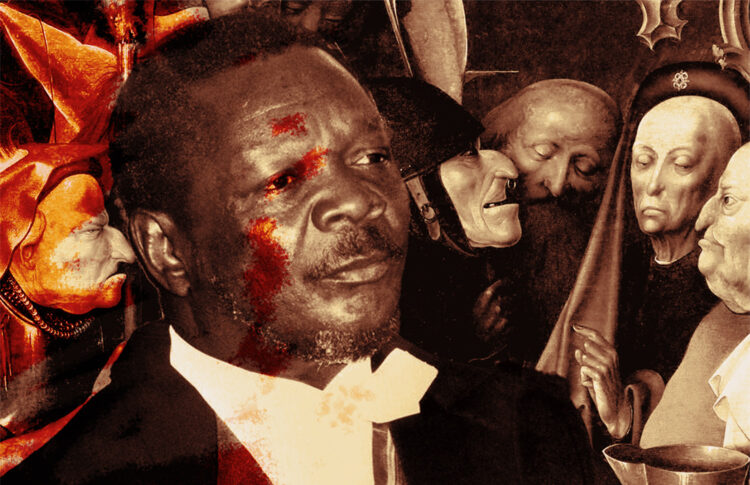
ОH, LOVE: a philosopher and an abbess united by a mortal sin


Art design: huxley.media via Photoshop
THE PATH OF THE PHILOSOPHER
N
ot long ago, I once again reread one of the books I loved since childhood — Hard to Be a God by the Strugatsky brothers (as Dumas the Younger rightly said, the books that are read belong to the present, while those that are reread belong to the future). This time I noticed that the book has two epigraphs. The second one, from Hemingway’s A Farewell to Arms, I immediately remembered, but the first I even read twice — the work was unfamiliar to me. Here is the text: «Those were the days when I learned what it means to suffer, to be ashamed, to despair». The signature — Pierre Abelard. When I first read Hard to Be a God as a fourteen-year-old boy, I had no idea who that was.
He was born in Brittany in 1079, when royal power was gaining strength in France and neighboring states, the first universities were beginning to open, but the power of the Catholic Church had become almost absolute. His father was a knight, and as the eldest son, Pierre was to inherit his titles and estates. But he became fascinated by learning and passed his birthright to his younger brother Raoul. He decided instead to pursue a different kind of career — that of a scholar.
At that time, it was not as it is now. There were only two universities in Europe: Bologna and Oxford. The third — the Sorbonne in Paris — would not open for another century. So, first came schooling, and then one had to join the circle of a renowned philosopher or theologian and learn from him whatever one could. From the age of eleven, Pierre attended the well-known Chartres school, where he studied the trivium . Later, he studied under the master of liberal arts Roscelin of Compiègne — with whom he would later engage in sharp polemics — as well as other learned men.
In 1100, Abelard came to Paris to study under the archdeacon of the Paris cathedral, Guillaume de Champeaux (whom he would later also clash with — clearly, his temper was quite something), and a year later he became a teacher himself — first in Melun, then in Corbeil. By 1110, he founded his own school of rhetoric and theology at the Abbey of Saint Genevieve in Paris. He left it, then returned — as was fitting for a man of great learning and a difficult character, whom his colleagues even compared to a wild rhinoceros.
ALMOST UNBELIEVABLE
There is hardly anything to be said about his personal life at that time — no one saw or knew anything. Marriage was forbidden for clerics and those aspiring to become them. Occasional encounters, often of a commercial nature, with young women from lower social classes existed in that sphere but were silently overlooked.
It is, therefore, somewhat surprising that in Paris of that era there suddenly appeared a 17-year-old girl who drew the attention of the local scholarly community. At such a tender age, she already possessed knowledge of the main languages of medieval science — Latin, Ancient Greek, and Hebrew — studied dialectics, and read ancient authors. Not every seasoned cleric of advanced years could boast such erudition. Her parents had died early, and her mother’s brother, Canon Fulbert of the Cathedral of Saint-Étienne, took it upon himself to care for her.
Abelard also heard about this young prodigy, and when Fulbert suggested that he continue teaching Héloïse, Abelard readily agreed — and asked for a very modest fee. To become the tutor of such a gifted being, and moreover a young woman, was flattering indeed. Fulbert gave Abelard full authority in instructing his young ward — including the right to use corporal punishment, which was then recommended as a means to help knowledge sink in more effectively.
A MORTAL SIN
The distinguished teacher and his young pupil, of course, held their lessons in private. Which meant that, when corporal punishment was deemed necessary, it was the mentor himself who was to administer the rod? Indeed, the rod was there — Abelard mentioned it in his letters. But was it truly only punishment, if in one of his letters to Héloïse he wrote: «With threats and blows I forced you to lie with me»? Be that as it may, the nearly forty-year-old cleric, theoretically bound to lifelong celibacy, and the young, emotional girl half his age entered into an intimate relationship. And, as one might expect, they liked it.
Fulbert fully trusted Abelard, and the two lovers, consumed by passion, had unlimited opportunities to fall into mortal sin — for that is precisely what it was, since adultery ranked among the deadly sins along with such truly terrible ones as pride, greed, envy, and wrath, as well as the somewhat more debatable sloth and gluttony. A mortal sin differs from other sins in that it inevitably condemns the sinner to hell unless they repent, sincerely seek absolution from a cleric, and fulfill all the penances imposed — sometimes extremely harsh ones.
Perhaps it was precisely the constant threat of exposure hanging over them that made their love so passionate and emotional, at times exceeding all imaginable boundaries of that era. They lived only for each other, hardly noticing the world around them and scarcely thinking about the dangers their passion might bring.

THE SECRET REVEALED
It was clear that sooner or later those around them would learn of their affair, and the whole world would come crashing down on them. Fulbert, who had placed complete trust in Abelard, suddenly caught them, so to speak, in the act, when they were «entwined like Mars and Venus». The respectable canon’s anger knew no bounds — I am still surprised that at first he demanded that the sin of adultery be covered by marriage, as a progressive man, refusing to insist on something far worse.
Meanwhile Heloise informed her beloved that their liaison had not been without consequence — she was pregnant. He immediately sent the girl to the town of Le Pallet to the care of his sister Denise, in whose house she gave birth to his son, who received the rare name Astrolabe. Fulbert’s insistence on marriage only grew stronger. Pierre brought Heloise back to Paris, and there they were married — at dawn, in the presence of the smallest possible number of people, practically without publicity.
By forcing them into marriage, Fulbert at the same time closed off any possibility of a church career for Abelard. All teachers, all philosophers were supposed to be clerics — which meant marriage was forbidden for them. Fulbert, by then full of hatred for Abelard, announced the news of his marriage to Heloise, and was not very surprised that Abelard refused to confirm it. «Where will he run?» Fulbert thought — Heloise will expose him anyway, and she will be believed.
But no — Heloise also refused to confirm the marriage, even though this ruined her reputation. She, too, did not want to harm the man she loved. Fulbert, not having expected such an affront, flew into a rage — for him Abelard was by now not merely an unpleasant fellow but a bitter enemy who had to be struck as hard as possible, regardless of anything.
ANOTHER LIFE
Thugs hired by Fulbert bribed Abelard’s servant, broke into his bedchamber at night, and inflicted a terrible mutilation upon him — one that forever barred his path to the higher ranks of the Church and gave rise to the French argot term abelardiser — «to abelardize», meaning «to castrate».
The villains were caught and punished with the same cruelty they had inflicted on Abelard — and, in addition, were blinded — «an eye for an eye» in the truest sense of the phrase. And Fulbert? Oh no, of course not — he was merely stripped of his position as canon for two years, nothing more. After all, he had not wielded the knife himself, and for a respected son of the Church, such a punishment was as dreadful as castration and blindness for a layman — who could fail to understand that?
Abelard’s worldly life seemed to have come to an end — he became a monk, for monasticism was not a sacred order, but rather a way of life. Soon after, Héloïse made the same decision — all other men in the world simply ceased to exist for her. Yet life was not over: Abelard continued to write, astonishing the scholarly world of his time with the boldness of his ideas.

FROM BOOKS TO HYMNS
At times, his ideas were even too bold: in 1121, at the Council of Soissons, his work Introduction to Theology was declared heretical and ordered to be burned. Abelard later said that when his book was burning, he felt no less pain than when Fulbert’s thugs had mutilated him. Yet he still had supporters — soon after, he received permission to live outside the monastery walls.
After that came his main work: Yes and No — 157 pairs of quotations from the Bible and from the writings of authoritative theologians that openly contradicted one another. The very idea carried a dangerous suggestion: that even the most venerable Church Fathers should not be blindly trusted, and that their words could be questioned through the texts of Holy Scripture itself. It is astonishing that he did not face even harsher persecution for this work…
Abelard withdrew to Burgundy, where he founded the Abbey of the Paraclete (the Comforter — one of the names of the Holy Spirit), which soon began to attract his students and followers. And in 1129, he offered refuge there to Héloïse and several nuns who had been driven from their convent by internal Church intrigues. It was for them that Abelard — who also revealed himself as a poet and composer — wrote six laments, one of which has survived (you can listen to it below), as well as several other musical works that have not.
A MONUMENT TO LOVE
Yet the greatest literary monument this remarkable romance left us is the correspondence between Abelard and Héloïse — not even his autobiography, which he quite aptly titled The Story of My Misfortunes. You must read it yourself — there is no point in retelling it, for everything there is deeply personal, about the history of their relationship and their reflections upon it.
One feels a certain dissonance between the profoundly sincere and trembling Héloïse and the somewhat rational Abelard — perhaps there is a purely physiological explanation for this, born of the horror Abelard had to endure?
Most revealing of all is how they address each other in their early letters. Abelard calls Héloïse «my dearly beloved sister in the Lord», while Héloïse writes to him: «To my lord — from his handmaid; to my father — from his daughter; to my husband — from his wife; to my brother — from his sister». The difference is plain to see.

THE FINAL CHAPTER
Héloïse’s ecclesiastical career was not without its challenges, yet overall it was successful — she became the second woman in the history of the Church to hold the position of abbess and to actually fulfill its duties. Abelard’s fate, however, took a darker turn: he had made an implacable enemy in Bernard of Clairvaux, who would later be canonized as a saint.
Bernard organized a disputation that Abelard at best did not win, and succeeded in having him condemned by a council of bishops — though it was said that the verdict was rendered late at night during a banquet when everyone was completely drunk. But what comfort is that? In July 1141, a papal rescript confirmed Abelard’s second condemnation. Setting out for Rome to appeal the decision, he fell ill and was forced to stop at the monastery of Saint-Marcel, where he died on April 21, 1142.
Yet he did not find peace. He was buried in a monumental tomb built especially for him, but two years later, at Héloïse’s request, his remains were moved to the chapel of Petit-Moutier, near the cemetery of her abbey. Héloïse lived another twenty years, respected by both clerics and laypeople, in part because, like Abelard, she composed beautiful musical works.
She died on May 16, 1164, and was buried in Abelard’s tomb, as she had wished. According to legend, when Héloïse’s body was placed in Abelard’s grave, his arms opened to embrace her. There is no need to ask whether it truly happened — the very existence of such a legend makes it impossible to let go of.
POSTHUMOUS JOURNEYS
After the French Revolution, the monastery was closed, and the remains of Abelard and Héloïse — which had already undergone several adventures — were transferred to the Père Lachaise Cemetery in Paris, where they rest to this day. In the early 19th century, burial plots at Père Lachaise were not selling particularly well, so the graves of Molière, La Fontaine, several other notable figures, and finally Abelard and Héloïse were moved there purely for promotional purposes.
Since then, countless visitors have come to their tomb — from Mark Twain, who wrote about their story in the mocking tone of a small-town American reporter of his day, to thousands of lovers wishing to see the perfect symbol of eternal love — one that endures even beyond the grave.
Perhaps some of them also reflect on these two extraordinary people, forced by the prejudices of their time to endure terrible suffering for their love. Perhaps they even wonder — how much of that still exists today? And maybe they decide — quite enough…
When copying materials, please place an active link to www.huxley.media
Select the text and press Ctrl + Enter