OH, LOVE: The Heretic Pharaoh and the Most Beautiful Woman on Earth

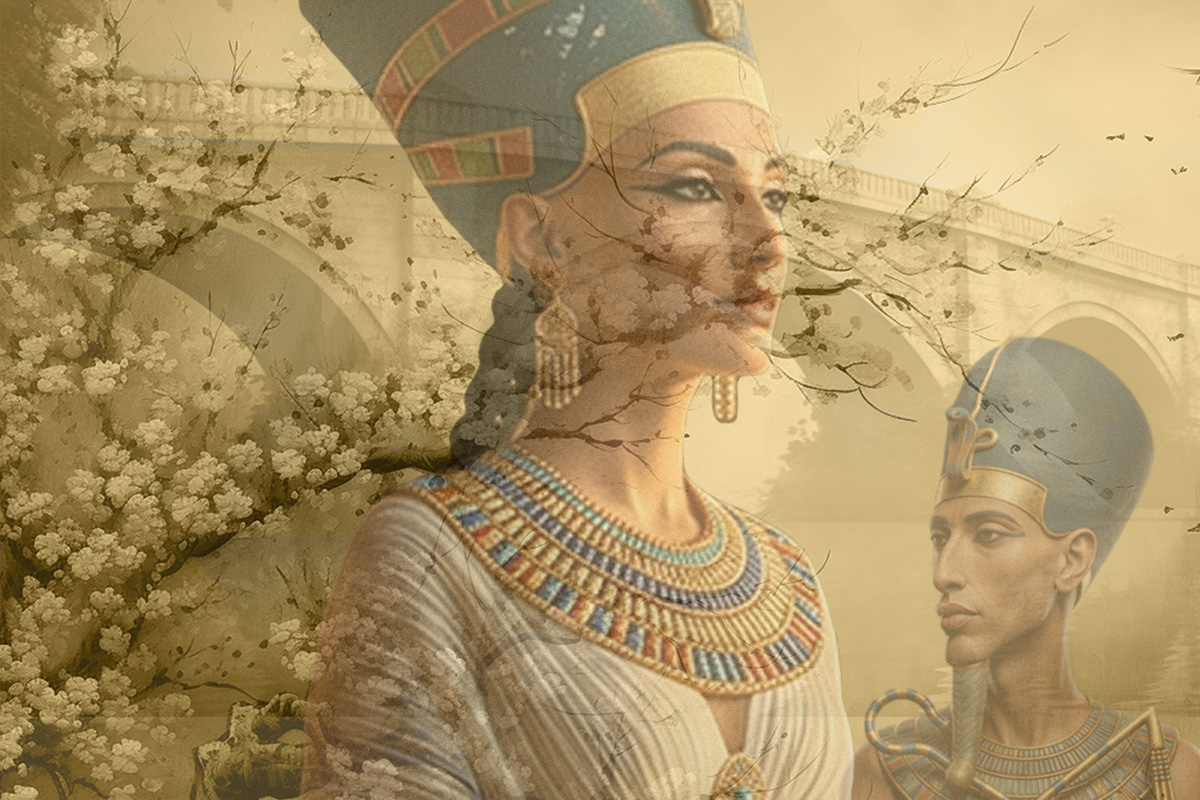
Art Design: huxley.media via Photoshop
RACE AGAINST TIME
M
odern people leave behind an astonishingly rich trail. Documents, photographs, videos, the memories of contemporaries, attempts to recover and reconstruct those memories, and, if the person was anything but ordinary, both truthful and fictional accounts of their deeds, historical writings, archaeological excavations… The list is endless. Only time erases these traces — the great force that turns everything into nothingness. The farther a person’s life recedes into the past, the more effectively time does its work. One Pushkin scholar once complained that there are as many as twenty days in Pushkin’s life about which no reliable information has survived. What a disgrace… But do you happen to remember the birthday of the author of The Tale of Igor’s Campaign? Of course not — even his name has been forgotten. All that remains are conjectures, each more fanciful than the last.
And bear in mind that, in this respect, women have fared even worse than men, since matriarchy is more myth than historical reality. Just try to answer this: who is the earliest beautiful woman remembered by history? Most likely, everyone will arrive at the same answer. Yet virtually everyone knows her today — she simply could not escape notice. It has been little more than a century since German archaeologists discovered her bust among the ruins of a sculptor’s workshop, and by now, it would be hard to find anyone who does not know her name. Nor are there likely to be many who would argue over whether she was truly beautiful or whether beauty is merely a matter of taste — there is remarkably little disagreement. The archaeologist who unearthed the image of this celebrated beauty summed up her appearance with perfect simplicity: “There is no point in describing it — you simply have to see it”.
THE GREAT HOUSE
By the way, what exactly did this earliest of legendary beauties do for a living? What position did she hold? Why, she was a queen, of course! How could it be otherwise? If the king is the most powerful man in the realm, then surely only the most beautiful woman would do for him. Incidentally, that seems entirely plausible. Especially considering that, according to what we know, she herself was not born into the royal family. But she became part of it — and what the king desired usually came to pass. Besides, this was no ordinary king. Whenever his name was mentioned, even in passing, it was customary to add ankh wedja seneb — “life, prosperity, and health”. Nor was he called a king, monarch, or sultan. He was to be addressed by the grand descriptive title Great House. In the language of his country, that was Per-O. Passing through Hebrew before reaching us, Per-O eventually became “Pharaoh”. Now you know exactly which country we are talking about. Ancient Egypt — the civilization in which the world’s first unified monarchy emerged more than five thousand years ago. It is with this civilization that most textbooks on the Ancient World begin. Mine do as well.
WHO WAS HE?
The Ancient Egypt we are about to discuss was by no means the earliest phase of that civilization. The three famous pyramids had already risen from the desert a thousand years before. That earlier era is known as the Old Kingdom. Our story, however, unfolds toward the end of the Middle Kingdom, roughly a century after the reign of the great warrior pharaoh Thutmose III, who, during his fifty-eight years on the throne, conquered Nubia to the south and Syria, Palestine, and Phoenicia to the north. Under his rule, the distance between Egypt’s southern and northern frontiers stretched to some 3,500 kilometers. It was to Pharaoh Amenhotep III, who ruled Egypt at that time, and his beloved wife Tiye, that one of our protagonists was born around the middle of the fourteenth century BC (give or take half a century). At birth, he was named Amenhotep IV — a man unique in many respects and, in the eyes of his contemporaries, not merely a man at all, but the living god of the land of Ta-Kemet, known to us today as Egypt. Let us not argue with them — they would hardly understand us.
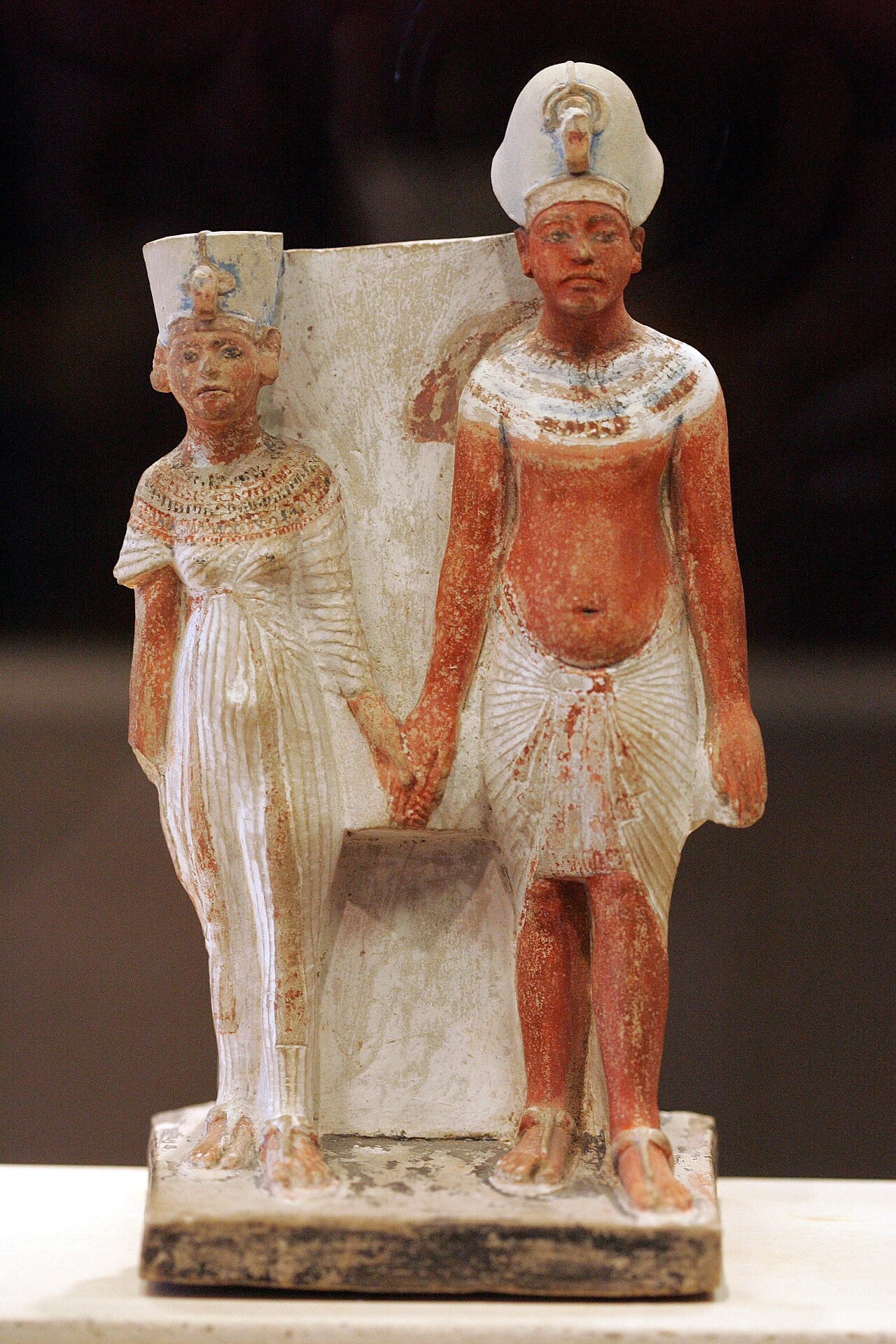
His childhood was perfectly ordinary, as royal childhoods tend to be. It is often difficult to tell who shaped whom more — the tutors or the princes they were meant to educate. But when a prince marries, that is another matter entirely. Most historians agree that the groom was somewhat older than the bride. Yet her identity remains uncertain. Was she an Egyptian noblewoman or a foreign princess? The argument for her foreign origin rests largely on the translation of her name, Nefertiti — “The Beautiful One Has Come”. But this evidence is far from conclusive. Nor do the theories linking Nefertiti to the families of the future pharaohs Ay and Horemheb offer much beyond the fervent wishes of their proponents. Still, one fact is beyond dispute: the two entered into a lawful marriage according to the customs of the time. In theory, it belonged to a polytheistic and polygamous society, yet for many years it proved no less monogamous than that of the most devout Catholic. And, as fairy tales would have it, they lived happily ever after.
FROM GODS TO GOD
For the first couple of years of his reign, our Amenhotep IV was every inch the traditional pharaoh. He ruled and governed as the many Egyptian gods saw fit, signed diplomatic documents with his radiant name enclosed, for greater honor, within a cartouche — that elegant oval frame — defended, as best he could, the state borders that had been stretched to their limits by his predecessors, and faithfully performed the duties expected of a pharaoh as high priest. Most likely, these were the rites of the composite deity Amun-Ra and, naturally, of Horus, who personified the reigning pharaoh himself. Had Amenhotep remained the same Amenhotep as his many predecessors and successors — his name meaning “Amun is pleased” — there would have been little reason to tell his story. But then, not immediately, but somewhere around the third to fifth year of his reign, something truly extraordinary began to happen.
Egypt, of course, had no shortage of gods, many of them taking the forms of animals and birds: Horus the falcon; Anubis, the jackal-headed god of the underworld; Thoth, the sacred ibis and god of wisdom; Sekhmet, the lioness goddess of war and vengeance; Seth, with the head of a mysterious desert beast, god of rage and sandstorms; and countless others, from Sobek the crocodile to Bastet the cat and the sacred Apis bull. Some were benevolent, invoked for protection and mercy. Others were feared and appeased in the hope that they might cause a little less trouble. Altogether there were more than seven hundred of them — far too many to pray to individually, and always enough to explain whatever misfortune had befallen an unfortunate Egyptian. Needless to say, this bears little resemblance to the great religions of today. Christianity and Islam, like Judaism from which they emerged, are monotheistic: they recognize only one God. Humanity did not arrive at such a remarkable idea overnight. So, who was the first to embrace the concept of monotheism? I hope you’ve already guessed.

A GREAT REFORM — AND ITS DISAPPEARANCE
He did not have to invent a new deity from scratch. What he needed was not so much intellectual brilliance as organizational skill and determination. The god he elevated to the role of creator and sustainer of the universe already existed within the vast Egyptian pantheon. As early as the Twelfth Dynasty, one of Egypt’s best-known literary works, The Tale of Sinuhe, mentions not only Ra, the Sun God, but specifically Aten — the personification of the sun’s radiant disk. So what made this reform revolutionary? Simply this: every other deity in the Egyptian pantheon was declared either nonexistent or, at best, irrelevant — which amounted to much the same thing. The old gods were no longer worshipped. No sacrifices were offered to them. Any hope of state patronage vanished. The countless temple festivals that had played such an important role in the economy disappeared into history. Unsurprisingly, the reform brought with it countless personal tragedies, financial ruin, and social upheaval. But there was little anyone could do about it.
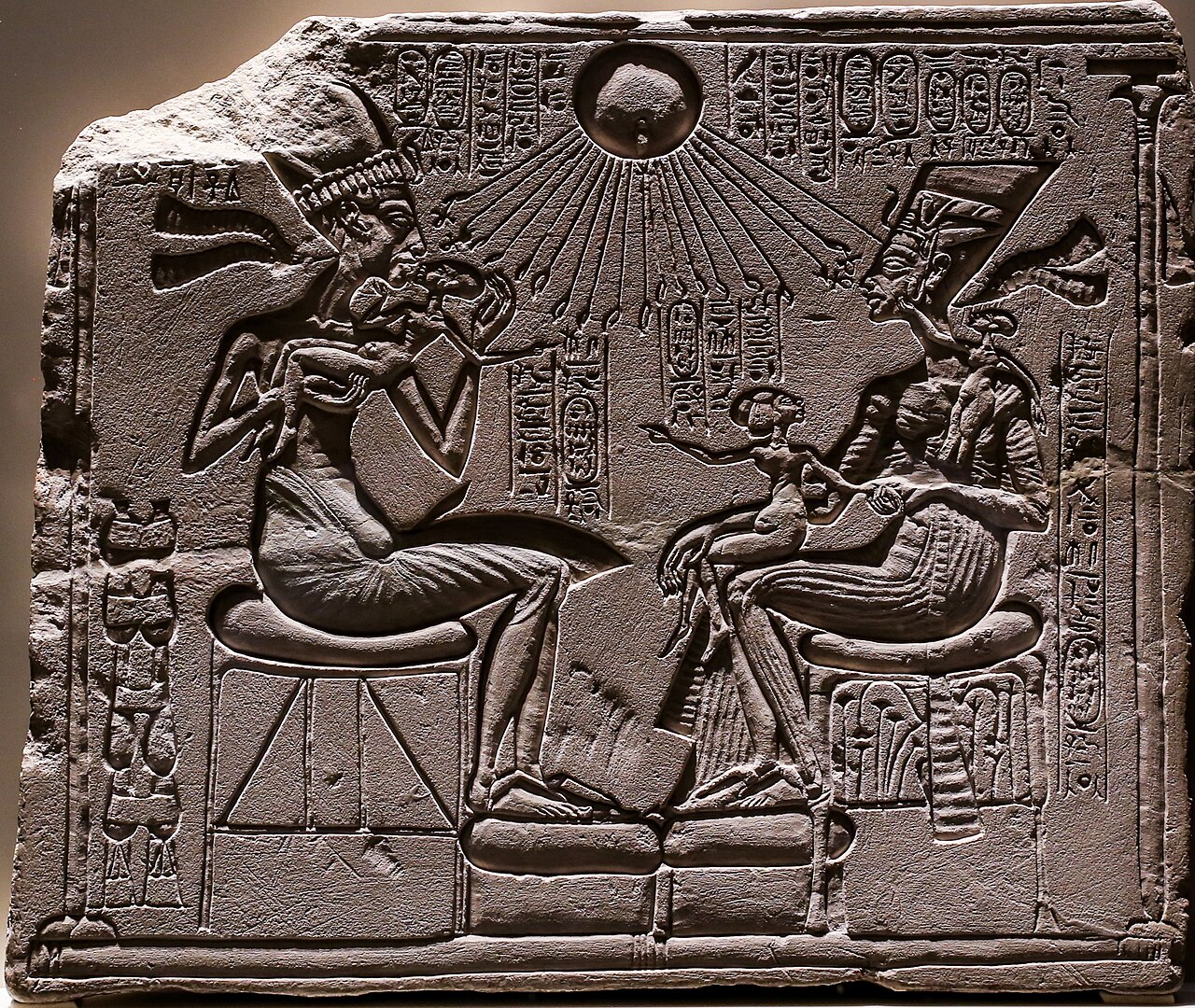
At the same time, an entirely new religious infrastructure was taking shape around the worship of Aten, centered in a newly founded city. Today it is known as Tell el-Amarna, but in its own day it bore the name Akhetaten — ”Horizon of Aten”. There, construction proceeded at remarkable speed. The great temple of Aten, Per-Aten (“House of Aten”), rose with a façade stretching some 700 meters — the equivalent of seven football fields. The pharaoh even changed his own name. No longer was he Amenhotep (“Amun is pleased”); he became Akhenaten — “He Who Is Beneficial to Aten”. Nefertiti expressed no less devotion to Aten herself. Then again, what choice did she have? Still, it is entirely possible that she sincerely shared her husband’s convictions. At least during the early years of the new religion, the two appear almost inseparable, publicly presenting a united front.
AN UNEXPECTED CONSEQUENCE
As so often happens, the first years following the introduction of a new ideology brought a weakening of old ideological constraints and artistic conventions. That was only natural: the old prohibitions had lost their authority, while the new ones had yet to be firmly established. Artists portrayed Akhenaten and Nefertiti not only during official ceremonies but also in moments of rest, interacting with their children and absorbed in one another’s company. Their faces are animated, their expressions natural, their emotions rendered with striking realism. Such images bear little resemblance to the rigid ceremonial portraits of earlier pharaohs — or of those who came later. The depictions are so lifelike that certain physical features suggest Akhenaten may have suffered from the genetic disorder now known as Marfan syndrome. His unusual height, elongated face, broad hips, and prominent abdomen are all clearly visible in surviving portraits. So did this seemingly perfect royal romance endure throughout their lives together? Unfortunately not. And the reason was one of enormous importance to any monarchy: succession.
Akhenaten and Nefertiti had six children — and every one of them was a daughter. This did not necessarily prevent succession to the throne. During the same Eighteenth Dynasty, the female pharaoh Hatshepsut had ruled Egypt for two decades. Yet in more than two thousand years of Egyptian history, such cases occurred only twice. A more conventional solution to the succession crisis was highly desirable. Nefertiti’s name disappears from official records, though not from history itself. Some scholars believe that, under the name Neferneferuaten, she briefly ruled Egypt before the accession of Tutankhamun. As for Akhenaten, he had no shortage of women at court, so the kingdom was unlikely to be left without a potential heir. Yet the instability caused by a religious revolution imposed from above had become too great. Before long, Akhenaten died, though no one knows exactly why. In the end, the cause hardly matters. It is clear enough that he simply lacked the strength to overcome every challenge at once.
WHAT HAPPENED NEXT
After Akhenaten, several weak pharaohs followed one another in rapid succession. During the reign of one of them — Tutankhamun (who was originally named Tutankhaten, but under whose rule the old beliefs finally consigned the religious reforms to oblivion) — all of Akhenaten’s reforms were abolished. They even abolished Akhenaten himself, simply erasing an entire chapter from Egyptian history. Mentioning his name became forbidden. There had never been such a pharaoh — end of story. Akhenaten’s new capital was swallowed by the desert sands. The inscriptions reading “Aten” inside royal cartouches were replaced once again with “Amun”. Sculptors returned to doing everything they could to portray majesty and reverence for tradition rather than physical likeness. Before long, all that remained of the rebel pharaoh was a few vague lines in obscure legends. As for the most beautiful sculpture of a woman ever created, it lay abandoned for thousands of years in a heap of rubble on the site of the former workshop of a sculptor named Thutmose the Younger. (His name was discovered only because it happened to appear on a pottery shard found in the same pile of debris. Otherwise, even the artist’s identity would have been lost.)
For more than three thousand years, she was nowhere to be found. And now, for well over a century, she has once again been with us — and you would be hard-pressed to find anyone who has never seen her. It turns out that it takes surprisingly little: remove the old prohibitions for a brief moment, hesitate just a little before proclaiming new ones, and art will take care of everything on its own. We, meanwhile, will look on in amazement, understand very little, and comfort ourselves with the thought that, in reality, things are not nearly so simple. But how likely is it that the world’s first experiment in monotheism did not disappear without a trace? That Moses was, in fact, a priest of Aten who led his fellow believers — both native Egyptians and members of other nomadic tribes (perhaps relatives of the Hyksos, the nomadic people who ultimately suffered final defeat in Egypt) — out of Egypt, crossed the Red Sea with them, and brought them to the Promised Land? Such views have been expressed by the Egyptian priest Manetho, who preserved the lists of Egypt’s kings from first to last, by the great Sigmund Freud himself, and by many others. But perhaps we should leave that discussion for another time. The question is far too serious to settle in passing.
When copying materials, please place an active link to www.huxley.media
Select the text and press Ctrl + Enter


