ОH, LOVE: The Very Good Bad Marriage of a Stonemason’s Son and the “Red Mare”

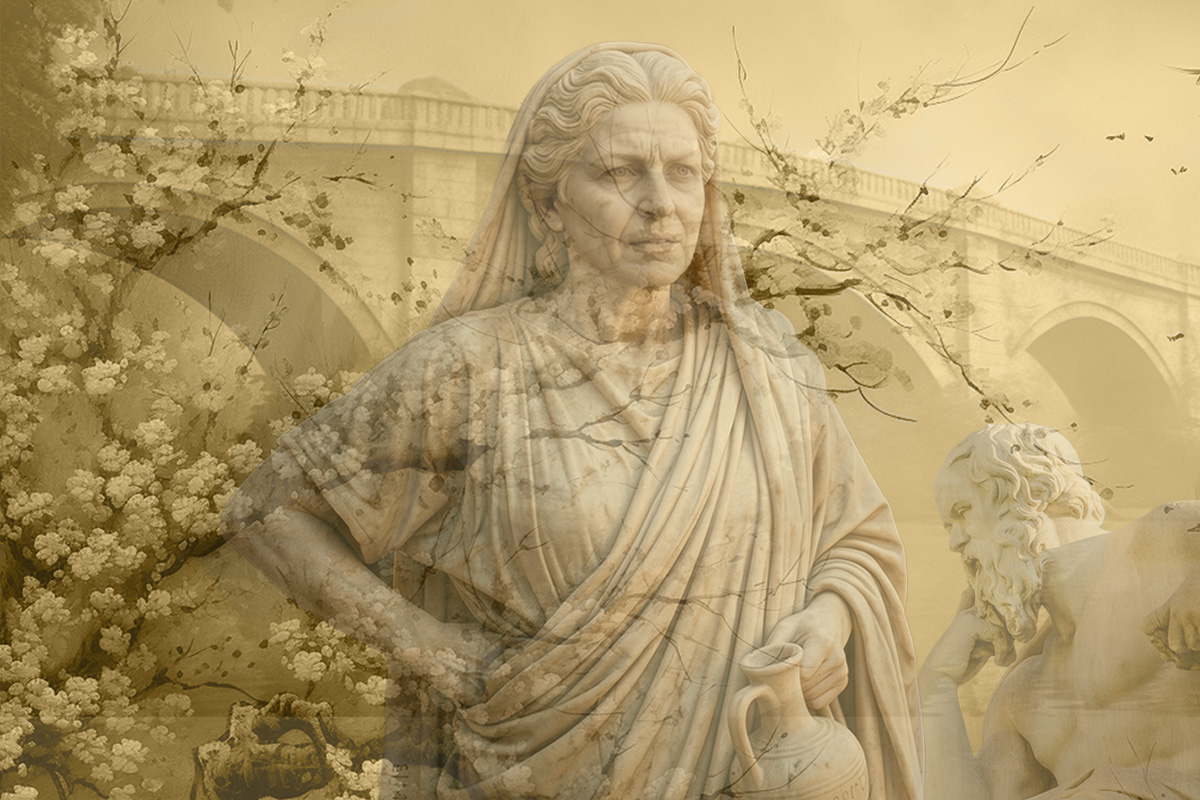
Art Design: huxley.media via Photoshop / Gemini
WAS HE EVEN REAL?
D
ebating this married couple is easy: whatever you say about the husband, your opponents can always reply that it is untrue — and, moreover, you will never be able to prove them wrong. After all, there are serious doubts that he ever existed on this planet at all. Who exactly was this philosopher Socrates, if not a single work written by him has survived? Interestingly, the quotations cited by Plato give rise to the image of one man — a metaphysician and almost a mystic — while the quotations preserved by Xenophon allow us to confidently infer a completely different figure: a man of extreme practicality and even earthiness. Then there is Socrates in Aristophanes — a sophist, a charlatan, and an outright fraud. So what is this, yet another Socrates? No, it is more likely that the name Socrates became a kind of folkloric construct that each of these authors filled with whatever content suited his purposes. Besides, the ancient Greeks even had a special literary genre known as the “Socratic dialogue”. If we can call any detective story a “Sherlock Holmes tale”, does that mean Sherlock Holmes was a real person? Well then, have the opponents of Socrates’ historical existence convinced you? Let me add that among them are such highly respected and influential scholars as the Swiss philosopher Olof Gigon and his equally esteemed German colleague Friedrich Schleiermacher. Shall we believe them?
IT SEEMS HE REALLY DID EXIST
Personally, I cannot. The fact that Socrates appears differently in the works of different contemporaries seems perfectly natural to me. To Plato, he was a revered teacher; to Xenophon, a contemporary and colleague, controversial in some respects and highly respected in others; to Aristophanes, a political opponent and a target of ridicule. Are you really surprised that each of them portrayed Socrates differently? Yet a thinker as significant as Aristotle, who was born after Socrates’ lifetime, presents him in his writings as the very real mentor of his own teacher, Plato, carefully distinguishing between what Socrates actually said and what was merely attributed to him. That, too, is an argument in favor of Socrates’ reality. And here is another one: was the great Athenian trial of Socrates, which ended with a death sentence, real or not? If it was, it is difficult to believe that Athenian bureaucracy would have left no trace of it. As it turns out, references to the trial do exist — and far from being isolated ones. So Socrates was a real person, and that means he had a personal life as well. What do we actually know about it?
PRE-PHILOSOPHICAL YOUTH
For the sake of simplicity, let us assume that he was born in 469 BCE into the family of the stonemason Sophroniscus and the midwife Phaenarete. It appears that the family was not among the poorest, though by no means wealthy. According to the famous classification of all Athenians into four classes established by the lawgiver Solon, Socrates was clearly not a thete, a person with an annual income of less than 200 medimnoi of grain (roughly a little over 28 liters of grain per day — certainly enough to avoid starvation, though hardly enough for luxury; such men could serve in the army, but only as slingers or rowers on a trireme). Nor did the family seem affluent enough to belong to the class of hippeis, whose income of 300–500 medimnoi enabled them to serve in the cavalry and maintain a horse.
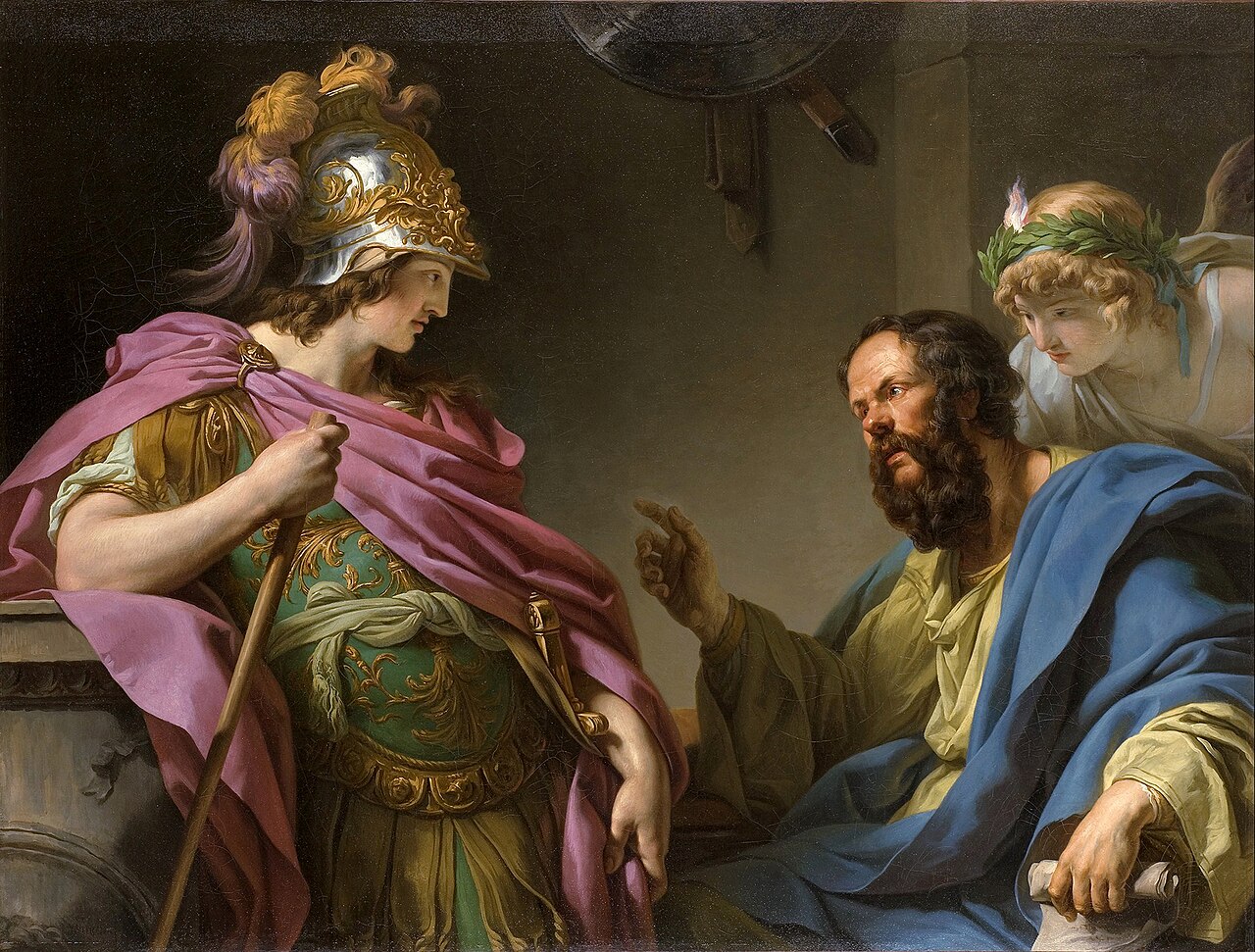
Most likely, he belonged to the zeugitai (200–300 medimnoi) — those wealthy enough to own a yoke of oxen. They were precisely the men who formed the backbone of Athens’ military might, the heavy infantry, purchasing their own full set of equipment: a sword (either the straight xiphos or the curved machaira), a three-meter doru spear, an anatomically shaped hippothorax cuirass (or, at the very least, a linothorax made of layered linen), a fully enclosed Corinthian helmet, greaves, armguards, and a massive round hoplon shield. It was because of this shield that they were called hoplites. Socrates, as befitted his social standing, became a hoplite. He fought exceptionally well. During the lost Battle of Delium, he retreated with such composure and dignity that the general Laches, who was present there, remarked: “Had the others retreated as Socrates did, the enemy would never have dared pursue them”. And during the siege of Potidaea, when the young aristocrat Alcibiades was wounded and faced capture, Socrates saved him and even managed to preserve his weapons.
NOT ONLY WOMEN
At this point, we can begin discussing Socrates’ personal life. Greek sources treat his intimate relationship with Alcibiades as an unquestionable fact, seeing nothing sensational in it whatsoever: in Hellas, such relationships were considered entirely normal. This famous pair, however, managed to surprise even their contemporaries. According to convention, an experienced and older erastes (lover), taking the active role, would become attached to a handsome and very young eromenos (beloved), who not only accepted his advances in a more passive role but also learned wisdom, culture, and practical life experience from him. A kind of training course for young men. Yet with Socrates and Alcibiades, even this was not quite as people expected — at least not in the eyes of their contemporaries and fellow Greeks. According to Plato’s Symposium, it was Alcibiades who, as a passionate erastes, pursued intimacy with Socrates, while Socrates, cast in the role of the younger eromenos, remained rather cool toward all these advances. But let us not dwell too much on this aspect of love — even the Greeks themselves did not find it entirely sufficient.
AN UNEQUAL MARRIAGE
Among the Greeks, it was considered proper to marry no earlier than the age of thirty to thirty-five. The brides, however, were often as young as fourteen; by eighteen, a young woman was already considered almost past her prime. Socrates married very late, at about fifty years of age, and his wife was, as custom dictated, considerably younger — perhaps by as much as thirty years. At least someone, bless his generous soul, was willing to marry an “old maid” of twenty! Incidentally, Xanthippe most likely came from the relatively noble family of the Bouzygae, to which the great Pericles himself belonged. But what, one may wonder, was Socrates’ financial situation like? Early in life, as already noted, it was quite respectable. He was a solid zeugites, capable of purchasing the expensive equipment required to serve as a hoplite. I imagine it was important to his wife that the family should not live in want, and she had every reason to expect that. Yet during roughly the last twenty years of his life — which, as it happens, coincided with the years of his marriage — Socrates radically changed his attitude toward material wealth. He charged no fees for his teachings, despite having many students. He completely abandoned the family trade, his father’s stonemasonry workshop, and on principle, sought no other source of income.

A SCANDALOUS REPUTATION
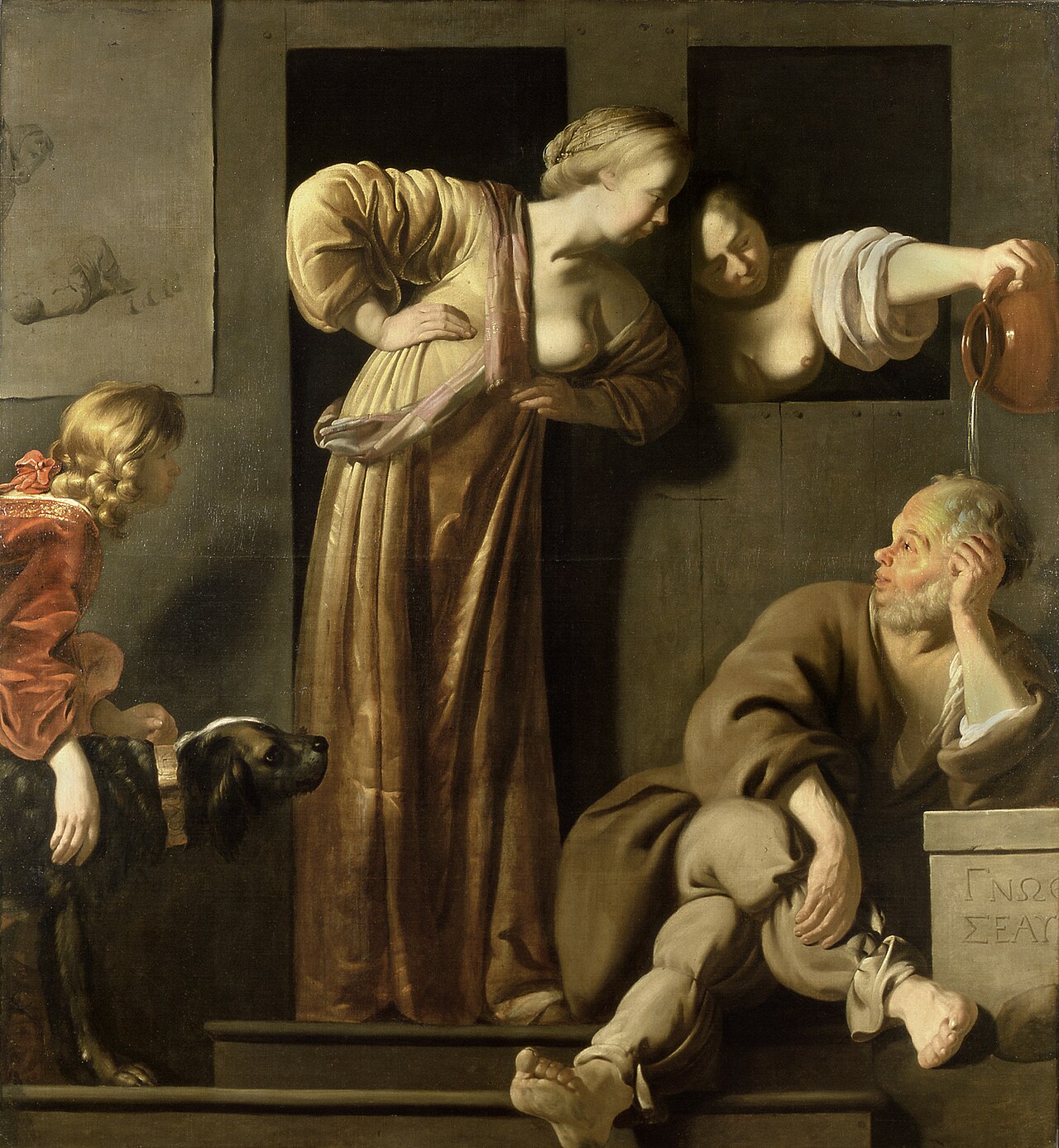
How could his wife possibly have liked that? Naturally, she expressed her dissatisfaction, showering Socrates with scolding and endless arguments. On one occasion, after berating her husband and seeing no noticeable reaction, she dumped a bucket of water over him. Socrates merely replied that after thunder, he had expected rain. What can you do with a man like that? Immortalize him, perhaps. Xanthippe Abusing Socrates in the Presence of Alcibiades by Reyer van Blommendael, housed in the Musée des Beaux-Arts de Strasbourg, depicts precisely this moment. It is said that Socrates changed profoundly after his friend Chaerephon asked the Delphic Pythia whether anyone was wiser than Socrates, and she answered simply: “No one”. With characteristic caution and humor, Socrates explained the oracle’s praise by saying that he knew that he knew nothing, while others did not even know that. Yet neither witty paradoxes nor considerable fame can be eaten or drunk. Socrates was not utterly destitute — he owned a house, and he was supported by friends, many of whom were very wealthy. His close friend Crito discreetly made sure that Socrates’ children did not go hungry and that Xanthippe had fewer reasons to nag her husband. And before long, Socrates had three sons: Lamprocles, Sophroniscus, and Menexenus. The second was named after Socrates’ father, as it was extremely common to name a child after a grandfather. Perhaps Xanthippe’s father was named Lamprocles? There happened to be a well-known Athenian of that period named Lamprocles, a celebrated flute player. Could he have been Xanthippe’s father? Anything is possible…
WHO WAS XANTHIPPE?
But what, exactly, does the name Xanthippe mean? The name Socrates is usually translated as “preserving power” or “preserving might” — the latter interpretation fitting remarkably well with the power of his intellect. The name Xanthippus also appears throughout history. For example, Xanthippus, the father of the great Pericles, bore it, as did the brilliant Spartan commander Xanthippus of Sparta, who led the armies of Carthage during the First Punic War and inflicted a devastating defeat upon Rome. But what does the name actually mean? The Greeks had countless names containing the element “hipp”: Philip, Hippolytus, Pheidippides, Hippocrates, Archippus, and Melanippus. The reason is simple: hippos means “horse”, an animal of enormous importance in Greek life. The same applies to the names Xanthippus and Xanthippe. Their meaning is “yellow horse” or, more naturally, “red-haired horse”. So not only was Socrates married to a “red mare”, — her hooves could kick quite painfully. Was it deserved or not? Let me answer immediately: she had every reason to be angry. Children must be fed, treated when ill, and educated, and nowhere in the world has that ever come free of charge. But did her methods accomplish anything?
Not in the slightest. Socrates continued to live exactly as he always had. It was her responsibility to find another, more effective way of conveying her dissatisfaction to her husband. Instead, she continued to scold and quarrel, achieving only one thing: more than two and a half thousand years later, her name has become synonymous with a shrewish and scandalous wife. Hardly a useful legacy. Although there was, at least, one unexpected benefit. In the Latin alphabet, there was once a peculiar problem. In phonetic alphabets, each letter is represented by a word: A for Alpha, B for Bravo, C for Charlie, and so on. For a long time, the letter X had very few convenient word associations. It therefore proved useful to designate it as Xantippa, and this practice persisted for quite some time until, thanks to Wilhelm Conrad Röntgen, an alternative appeared: X-ray.
HE ALWAYS HAD AN ANSWER
Xanthippe’s attacks had little effect on Socrates — except perhaps to sharpen his gift for irony and his stoic composure. There is certainly something memorable in his reply to a student who asked, “Should one marry?” Socrates answered: “By all means, marry. If you get a good wife, you will become happy; if a bad one, you will become a philosopher”. Once, Socrates was asked why he had married a woman with such an unbearable temperament. He replied: “Anyone who wishes to become a skilled horseman chooses the wildest horse. Once he has mastered it, all others are easy to ride. Likewise, if I can endure Xanthippe, I can get along with anyone”. That sounds plausible enough. Xanthippe seems to have taken every opportunity to embarrass her husband, preferably in front of guests. On one occasion, Alcibiades brought Socrates a magnificent gift — a huge and delicious pie. But Xanthippe rushed in, found fault with some trivial matter, threw the pie onto the floor, and trampled it underfoot. Alcibiades could not contain himself and asked Socrates, “How can you tolerate such behavior?” Socrates replied by asking how Alcibiades tolerated the loud cackling of the geese on his estate. “They provide me with meat and eggs”, Alcibiades answered. “And Xanthippe”, said Socrates, “provides me with children”. It is difficult to argue with that.
THERE MUST HAVE BEEN SOMETHING MORE TO IT…
How, then, did they remain together for twenty years? Why did they not separate? Divorce was a perfectly established institution in Athens. It would seem that this peculiar relationship — a wife employing every possible form of pressure and a husband responding with stoic humor — became their normal way of life. Yet there must have been something else in this marriage, something beyond the constant skirmishes. When Socrates was accused of impiety and corrupting the youth, and in the trial of 399 BCE was sentenced to death by a narrow margin (280 jurors voting for conviction and 221 against), Xanthippe worried deeply about her husband. She visited him constantly during the lengthy interval between the verdict and its execution, naturally accompanied by their three children, and she appears to have grieved sincerely over the fate awaiting him. The philosopher, however, remained true to himself. When Xanthippe lamented that he was about to die innocent, he replied: “Would it be better if I were dying guilty?”
After the execution of Socrates — which he could easily have avoided by escaping, yet chose not to — we know almost nothing about the remainder of Xanthippe’s life. Apart from some rather absurd rumors claiming that she sold notes left behind by her husband to other philosophers, who then passed them off as their own writings. I do not believe a word of it: Socrates wrote nothing down. Yet in modern times, Xanthippe has not been forgotten. An asteroid bears her name — and with the relatively prestigious low number 156. A crater on the planet Venus is named after her as well. Not to mention a rare species of African shrew and a newly identified variety of tick. How many of us can claim that even a tick has been named in our honor? And remember one more lesson from Socrates and Xanthippe: no matter how bitterly you and your spouse may quarrel, when you part forever, there will be much you regret. Perhaps even enough to make you weep. As Xanthippe wept for Socrates.
When copying materials, please place an active link to www.huxley.media
Select the text and press Ctrl + Enter


