THE CHOJECKI ESTATE — A FAIRY-TALE PALACE ON THE IRPIN

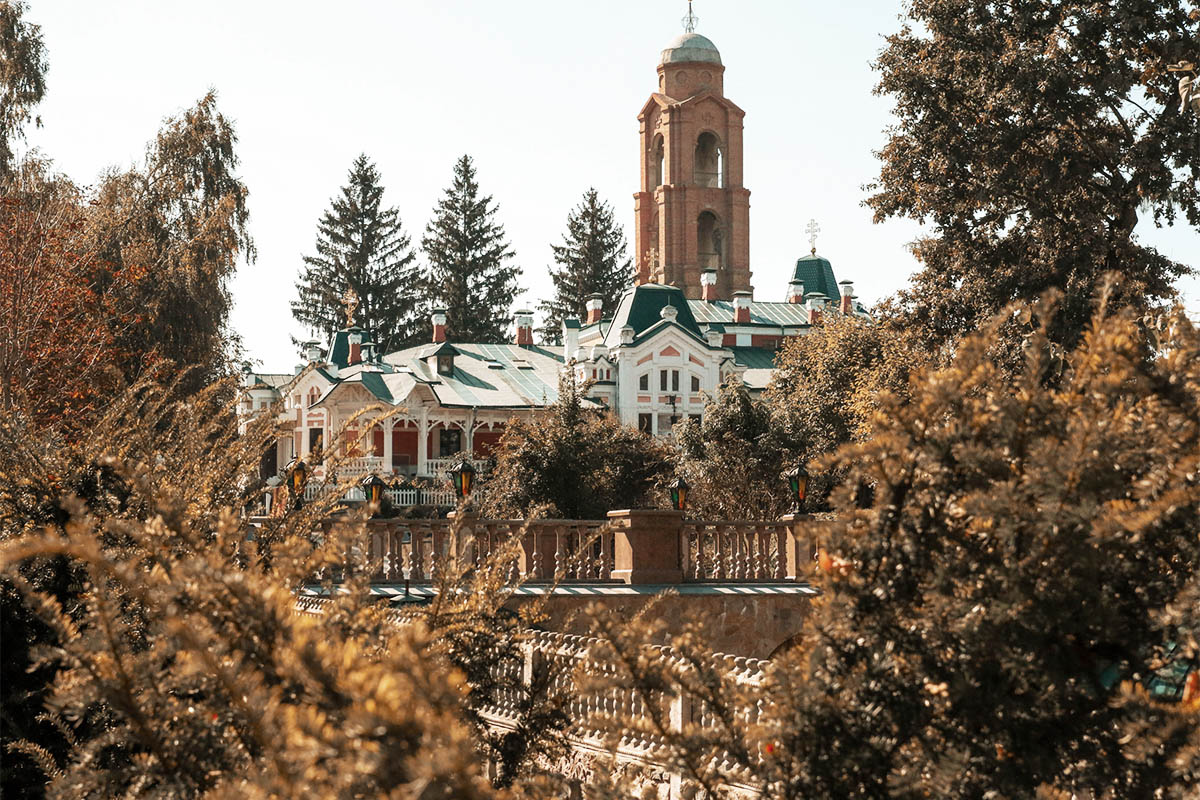
The Chojecki Estate / bachyla.com.ua
Above the picturesque banks of the Irpin River, winding like a silver ribbon, rises… a palace, a true fairy-tale palace. It seems to have been transported here from another era, from another country. Something modern? Not at all. This is a building with a long and rather complicated history. During the Soviet years, it housed a school; during the Nazi occupation in World War II, it served as a German headquarters. Today, the estate has been transferred to a men’s monastery. Before that, however, it stood abandoned in ruins — without floors or a roof, overgrown with wild shrubs… That was my lyrical digression about the village of Tomashivka, located near Fastiv, some 70 kilometers from the center of Kyiv. The estate itself is truly luxurious, its architecture unquestionably refined. Here, in the open air, one can admire original sculptures of animals and angels, cages with live birds, blooming flowerbeds, and finally, frescoes with biblical motifs — all of this can be seen with your own eyes at the Chojecki Estate.
LAND OF THE KYIV METROPOLITANS
T
his settlement on the left bank of the Irpin River was first mentioned in chronicles in 1676. For a long time, Tomashivka was an estate of the Kyiv metropolitans — first Orthodox, later Uniate. So let us learn about them as well. There is a version that the village was named in honor of Tomasz, who led a detachment of rebels and was killed in a battle with noblemen in these very lands. However, the lands on which Tomashivka arose had belonged much earlier, already in the 1580s, to Kyiv Metropolitan Onysyfor (Mykhailo Petrovych Hrynkovych-Divochka). From the forest lands of this area, he received half of all income from production, from timber cutting, hunting wild animals, and fishing, to beekeeping.
By 1596, these were already lands of the Kyiv Pechersk Lavra. Evidence of this is a royal charter granted to Nykyfor Tur, Archimandrite of the Lavra. Later, by royal decree, the estate passed to the Uniate metropolitans — Mykhailo Rohoza and his successors: Hypatius Pociej, Velyamin Rutkovsky, Raphael Korsak, and Antin Seliava. During all this time, however, the lands of Tomashivka had not yet been settled. Under Semen Palii, tenants of the Uniate metropolitans were expelled from the estates, and the peasants paid taxes directly to Palii himself. The region where Tomashivka is located was then called Liberated Ukraine. From 1714 to 1795, it once again belonged to the Uniate metropolitans. The exception was the years 1730 to 1742, when Tomashivka was attached to the Romaniv Starostwo. Its center was the village of Romanivka on the Unava River. At that time, the starosta there was Kyiv castellan Kazimierz Shchetsky.
FAMILY NEST
And in 1795, after the annexation of Right-Bank Ukraine by the Russian Empire, the village was granted by order of the empress to Prince Hryhorii Dolgorukov. Yet these lands interested him little, and fifteen years later, in 1810, he sold Tomashivka, together with the neighboring villages of Didivshchyna and Holiaky, to the Pole Jan Nepomucen Chojecki. From that moment, the true history of Tomashivka began. The Chojecki family knew estate management well; they built extensively and on a grand scale. Over the course of a hundred years, thanks to them, several estates appeared along the banks of the Irpin River, and nearby, they erected a Catholic church in the village of Didivshchyna. However, none of these structures has survived to the present day. It was in Didivshchyna that the Chojeckis’ main family residence stood for a long time.
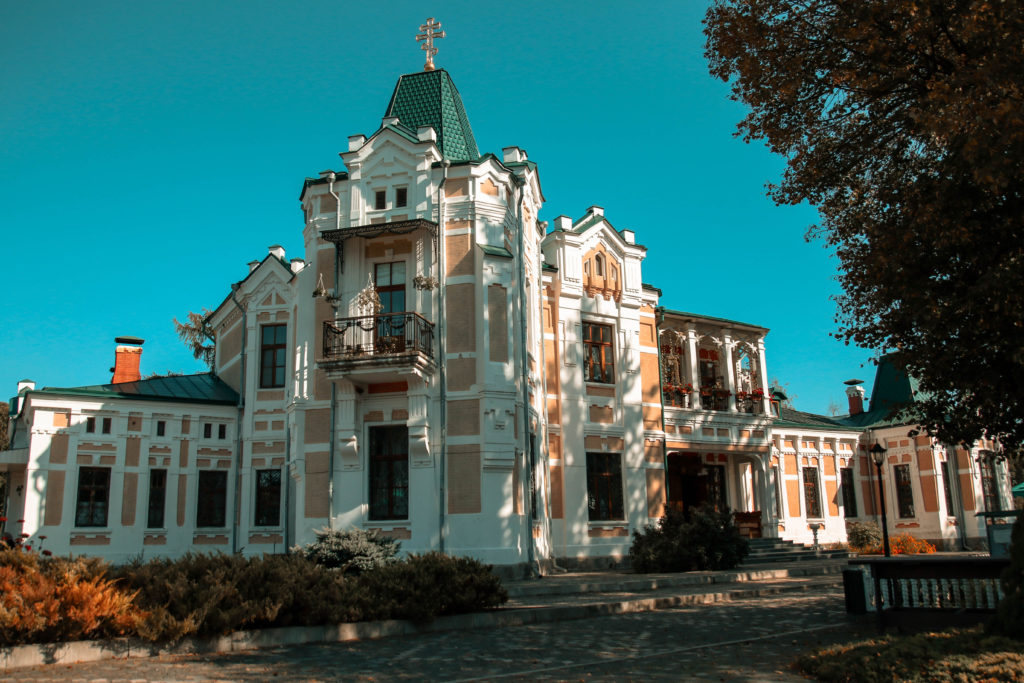
The palace residence in Tomashivka was conceived and built between 1903 and 1910. The author of the project was Kyiv architect Valerian Kulikovsky . The building in Tomashivka was designed in accordance with the architectural fashion of the time, in the Art Nouveau style. Hence, its variety of angles, curves, projections, balconies, pediments, cornices, columns, a veranda with wooden ornamentation, and shifting heights: in some places two stories, in others only one.
Precious stained-glass windows adorned the altar section, with gilded wood carving, hand-molded ceilings, and marble floors. Tiled stove-fireplaces heated the entire former estate. The palace walls were decorated with paintings by renowned artists, including portraits of the owners themselves — the Chojecki family. In the rooms, the interior was embellished with expensive mahogany fittings. According to modern experts, the Chojecki Palace is one of the most remarkable examples of estate architecture in the Kyiv region from the beginning of the last century. The estate has been recognized as an architectural monument of national significance.

CHURCH AFFAIRS
Some ninety years passed after the appearance of the final version of the palace, and in 2000, the estate complex in Tomashivka was transferred to the monks of the Holy Vvedensky Monastery for the establishment here of the men’s monastery of the Deposition of the Honorable Robe of the Most Holy Theotokos in Blachernae. This follows the tradition of venerating the Mother of God that developed in the lands of Kyiv. The story is as follows. According to tradition, the Most Holy Theotokos, during her earthly life, gave her garment to a pious Jewish maiden with the command to pass it on before her death to another equally virtuous young woman.
In 474 AD, two noble Byzantine dignitaries set out on a pilgrimage to the Holy Land. On the Feast of the Annunciation, they arrived in Nazareth and stayed overnight in the house of a Jewish Christian woman. Seeing a room filled with burning candles and fragrant with incense, they became curious about what was there. Thus, they learned that inside a small ark was kept a precious relic — the robe of the Most Holy Theotokos. The Byzantines prayed long for the Lord to show them how to make the relic accessible to the people. And the answer came — to make a chest identical to the one in which the robe was kept. In short, those Byzantines deceived the hostess: during the night, they secretly took the holy ark, replacing it with a copy, and brought the Robe of the Mother of God back to their homeland, where it was placed in the Blachernae Church dedicated to her.
A MARVELOUS LANDSCAPE PARK
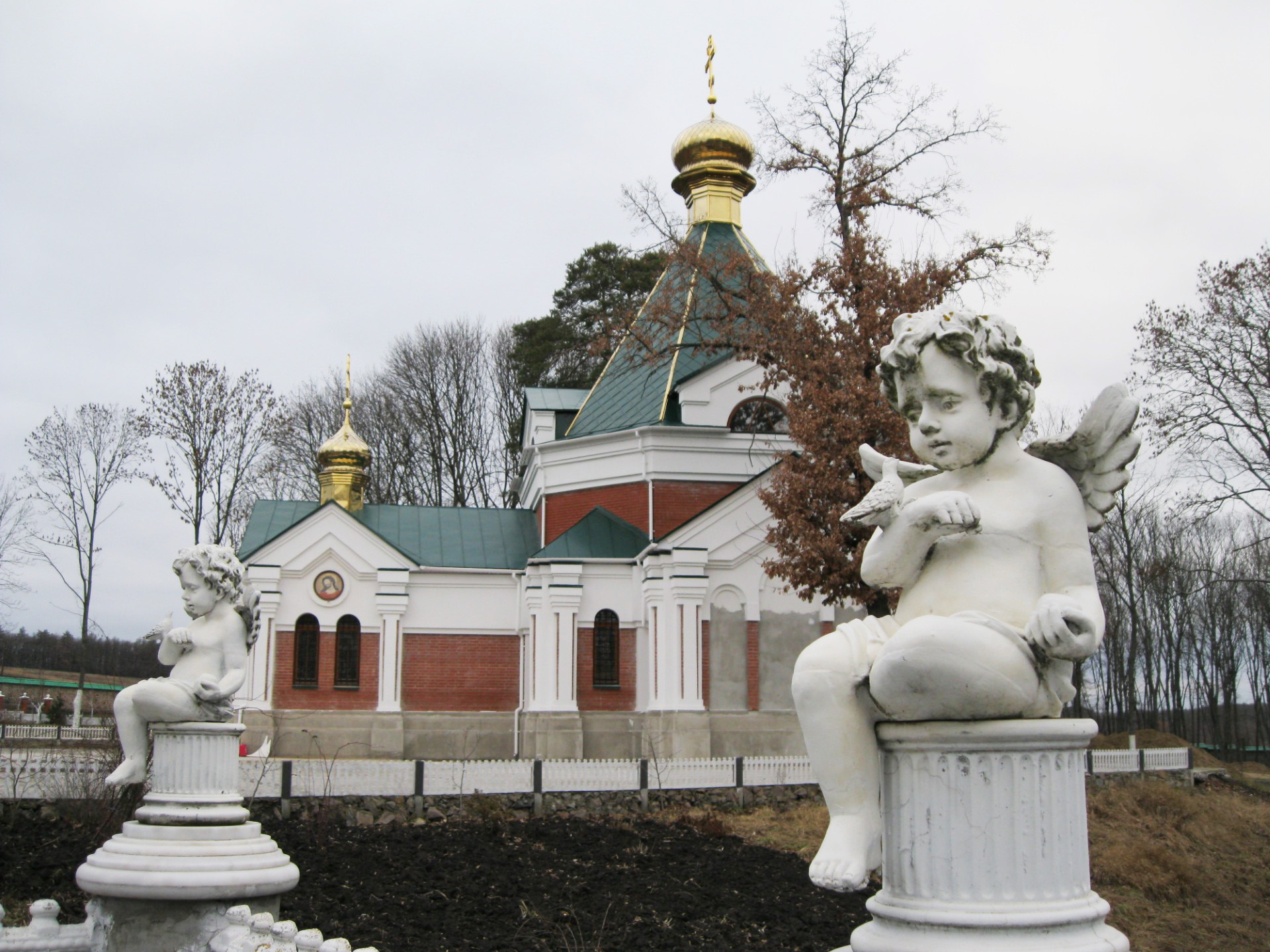
Long ago, taking advantage of the naturally favorable landscape surrounding the palace, the Chojecki family also laid out a magnificent park. During the Soviet period, it fell into decline, but the current custodians of the Chojecki Estate — the monks — approached this task with love and care. Here, one is impressed by the thoughtfully placed and expressive elements of park sculpture: lions, angels, and more. Not only modern works can be seen, but pieces dating back to past centuries as well. Behind the main building, in the rear courtyard, aviaries open for visitors’ delight, both adults and children, with birds such as ostriches, pheasants, peacocks, and others. One may also unexpectedly encounter a llama or an alpaca. And to make everyone feel a little safer, a stone wall with towers rises around the estate…
When copying materials, please place an active link to www.huxley.media
Select the text and press Ctrl + Enter


