PHILOSOPHER MARINA PREPOTENSKA: Philosophical Praxis in Paris. The Synergy of Creativity

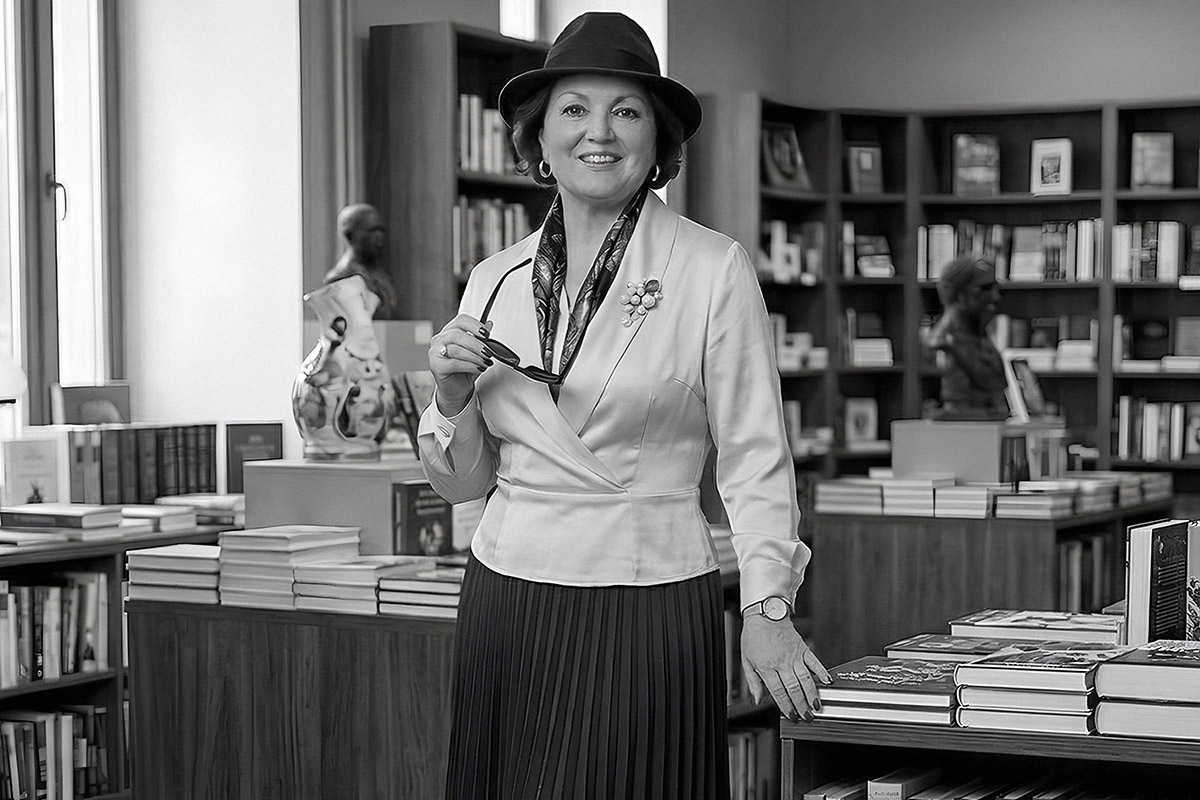
Marina Prepotenska / Photo from personal archive
SHORT PROFILE
Name: Marina Prepotenska
Date of Birth: March 25
Place of Birth: Kyiv, Ukraine
Profession: Philosopher, Writer, Journalist
Marina Prepotenska, Doctor of Philosophy, visiting professor at the Sorbonne University Panthéon-Sorbonne (Paris 1), member of the National Union of Writers of Ukraine and the National Union of Journalists of Ukraine. She lives and works in Paris. She is the founder and host of Europe’s first Franco-Ukrainian café-philo (philosophical café), as well as the co-founder of the joint project “Multipotentialite People” together with the Literary Club of Paris. Author of 11 books and more than one hundred scholarly articles. Member of the bureau of the Franco-Ukrainian Association Ukraine pour tous, the International Association of Philosophical Art (AFI), and the World Federation of Poets Poetas del Mundo. Head of the French branch of the Research Institute of Ukrainian Studies at Taras Shevchenko National University of Kyiv. Ambassador for France in IDA (International Diplomatic Alliance), Director of the French Representative Office of IDA and of the Ukrainian-English publication Ambassador. Correspondent for Ambassador magazine and the Ukrainian magazine Woman. Laureate of international competitions in author’s song and poetry.
Among her distinctions:
- 2024 — 1st Prize at the International Festival “Ukraine Unites the World” (jury chaired by Ada Rohovtseva)
- The book eCOLogy of the Soul (2023) — recipient of the National Union of Writers of Ukraine literary award “Golden Chestnut Branch”
- 2025 — Honorary medal of the National Union of Writers of Ukraine “For Service to Art”
We speak with Marina about life and art, her radio broadcasts and original songs, philosophy, France and Paris, café-philo, and the Sorbonne University Panthéon-Sorbonne (Paris 1).
Andrii Kostiuchenko: Your most widely discussed achievement in recent years is the Franco-Ukrainian philosophical café, the first in Paris and in Europe. But I would like to begin elsewhere. You once hosted a series of live author programs on Ukrainian radio — Words and People and Controversy. What was most interesting about them? What has stayed in your memory?
Marina Prepotenska: I do not rank achievements by the loudest or greatest, before or after moving to France. The main thing for me is to remain myself wherever I may be, to find within myself the strength and energy to create and to unite people. Our philosophical café is specifically Franco-Ukrainian: French participants are always present, and we hold meetings in both Ukrainian and French. Thank you sincerely for mentioning the radio. For me, it was an invaluable experience of public presence and of discovering unique interlocutors. On the program Words and People at Radio Culture, which at that time was listened to by Ukrainians across the Western diaspora, communication with listeners was so lively that it was sometimes difficult even to keep to the main theme. Yet this inspired me and strengthened my faith that your word is heard, and that unity and polylogue among Ukrainians around the world are possible.
At the Maidan studio, in the program Controversy, we spoke about life’s contradictions, and we managed to immerse ourselves both in psychological depths and in philosophical heritage. Over time, a regular audience formed, which is always valuable for a journalist. In general, live broadcasts are also the art of finding the right key to every guest. I believe this educated me in terms of inner freedom and sensitivity. My deepest gratitude goes to my mentor in radio journalism, Ms. Natali Maievska. At the same time, for many years I worked as a professor at the Department of Philosophy of Kyiv Polytechnic Institute, and taught my own courses at several other universities — practical and academic rhetoric, anthropology, and urban sociology. Incidentally, I am also the author of the textbook Rhetoric: 10 Key Topics, which has already gone through three editions.
A. K.: Mrs. Marina, you are a professor at the Sorbonne University Panthéon-Sorbonne (Paris 1). How do the philosophical traditions of France and Ukraine differ? And how interested is French society in philosophy today?
M. P.: Yes, for a certain period, I was a visiting professor-researcher at the Sorbonne University Panthéon-Sorbonne (Paris 1). Unfortunately, invitations for specialists from non-EU countries are limited by contracts. I was invited by the Faculty of Arts to a laboratory where scholars were researching the artificial and real nature of the city. My doctoral monograph, Homo Urbanus — The Megapolis Human, resonated in many ways with the research ideas of the group. I also gave presentations to my French colleagues about ecocide in Ukraine during the war, about the historical and cultural traditions of Ukrainians, and other topics.
At the Sorbonne University Panthéon-Sorbonne (Paris 1), I gained invaluable experience and felt that inherently French liberté — freedom of scientific thought and creativity. This freedom is expressed, among other things, in trust toward doctoral students. There is no rigid control or endless compulsory coursework as we often have at home. People have their dissertation topic, their own ideas, and work independently, mainly in libraries — not only on computers, but also with paper archives, books, and primary sources. They periodically attend conferences and report on their progress twice a year. I should note that within the educational process here, it is impossible to imagine a student or doctoral candidate “borrowing” content from AI and then presenting it as their own essay or term paper. That would be nonsense. Plagiarism is prohibited one hundred percent.
Beyond this, in Europe, researchers who hold academic degrees, publish their own books, and teach at universities are regarded as part of society’s elite and are surrounded by respect. Their achievements are also meaningfully monetized. Professors are simultaneously civil servants, with all the corresponding benefits and privileges. As for philosophy, French society does not merely take an interest in philosophy — it produces it. The philosophy of postmodernism was born directly here. I am not even speaking of the giants of the past, such as Jean-Jacques Rousseau, René Descartes, Voltaire, Michel de Montaigne, Blaise Pascal, and thinkers already known from our own era — Jacques Derrida, Michel Foucault, Jean Baudrillard. One could say that Paris breathes philosophy. Once a year, the city hosts the so-called UNESCO “Night of Philosophy”, which attracts thousands of admirers of philosophy, both French people and visitors to the country. By the way, our café-philo has already taken part in one of them.
A. K.: You are a poet. Do you allow poetry into your philosophical work?
M. P.: For me, true poetry is philosophical, and genuine philosophy is poetic. For poets, like philosophers, are seekers of meaning, only they express their thoughts and feelings in rhythmic form. In turn, philosophers have, since ancient times, used artistic means in their reflections, especially metaphors. Let us recall Francis Bacon’s “idols of the mind”, or Blaise Pascal, who described the human being as a “thinking reed”, or John Locke, who said that every newborn person is a tabula rasa (“blank slate”)… This is philosophy rising to the heights of artistic creativity. And besides, both I and my listeners enjoy poetic recitations during classes.
A. K.: And now let us return to your achievement — the Ukrainian café-philo in Paris. It seems everything began with Socrates, with his philosophical banquet in antiquity… And please tell us about Marc Sautet as well. What kind of format is this? Who comes there?
M. P.: You are absolutely right about public philosophy, which is in fact more ancient than academic philosophy — that is, philosophy within university walls or academies. As is well known, Socrates shared his thoughts through dialogues during walks with his students in the outskirts of Athens. In Ancient Greece, the tradition of the symposium (a philosophical conversation over a meal) emerged — the prototype of future philosophical cafés. In Ancient Rome, public baths also had special spaces where people philosophized while entertaining themselves with singing and poetry. Let us also recall the tradition of French salons that flourished in later centuries, where not only artists, poets, and musicians gathered, but philosophers as well. And then, ultimately, philosophical cafés.
Café-philo was born in Paris in the early 1990s. For many years, philosophers held meetings at the Café des Phares on Place de la Bastille. The tradition was founded by Marc Sautet, a French philosopher, expert on Friedrich Nietzsche, and advocate of public philosophy and philosophical counseling. Cafe-philo is, in essence, a gathering of an intelligent public to discuss important life questions, drawing on ideas from philosophy and other humanities fields of knowledge. The tradition of philosophical cafés has long spread across the world. Today, they exist in all major cities on nearly every continent. Personally, besides Paris, I had the opportunity to study the experience of café-philo in Stuttgart, the homeland of Georg Wilhelm Friedrich Hegel. In the basement of the philosopher’s apartment-museum, there is an outstanding German café-philo, where their discipline, precision, and strict discussion schedule prevail. The Paris project began to materialize in March 2024.
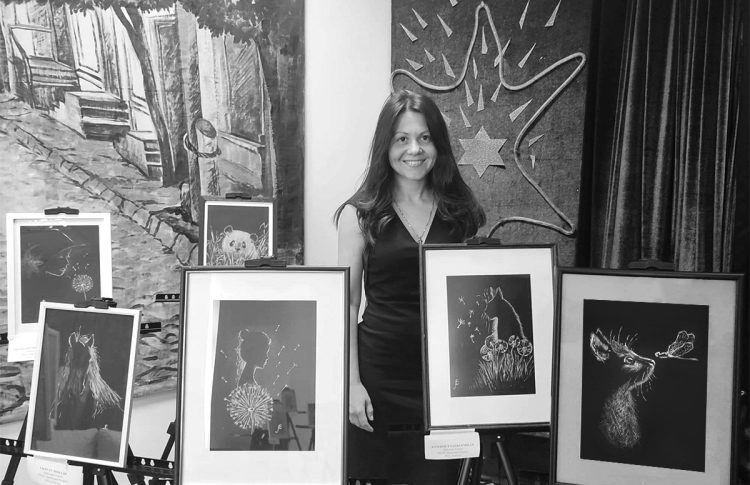
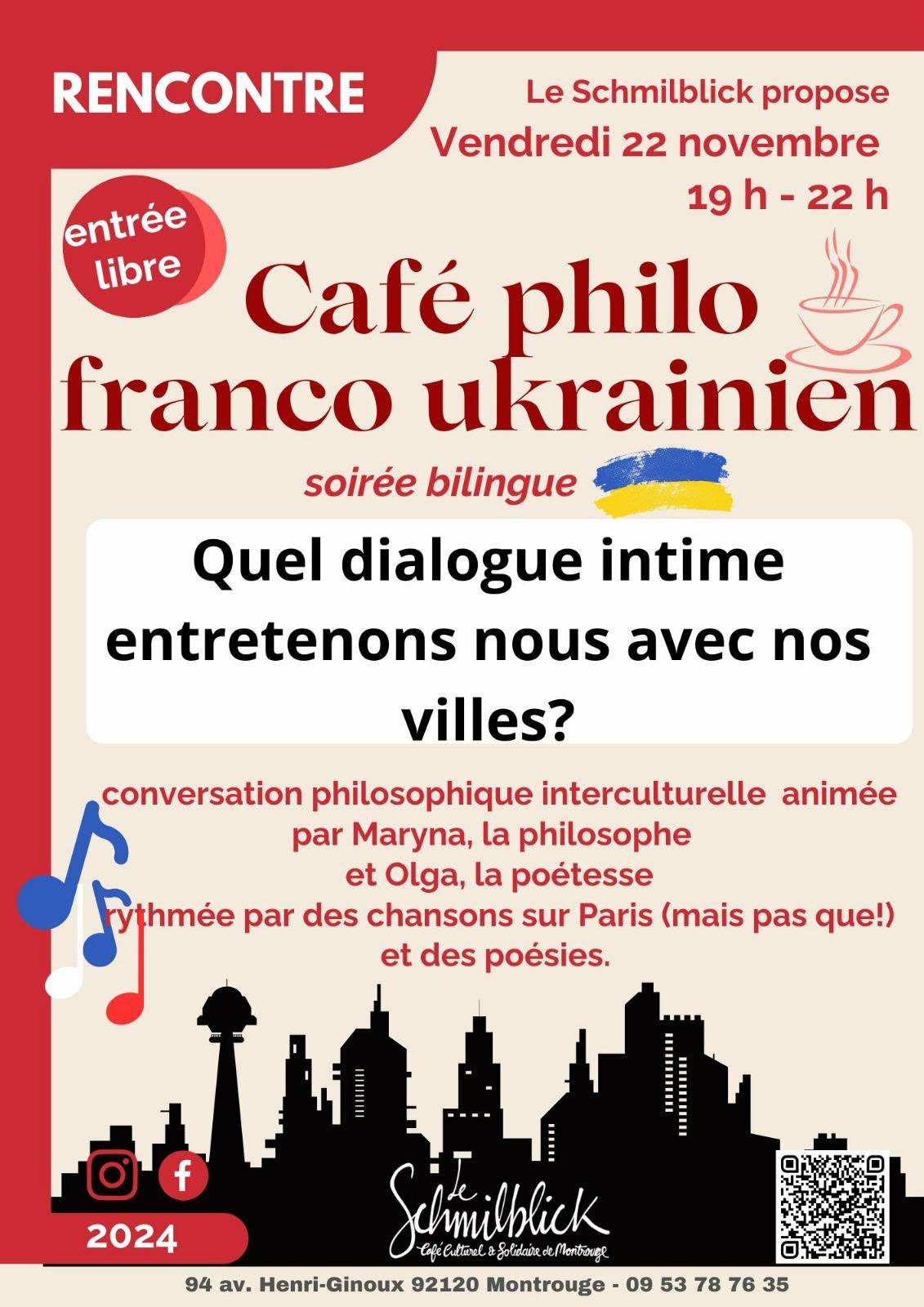
Our café-philo is not so much a heated dispute as a format closer to a talk show. My longtime Parisian friend Olha Lalazhel, an expert in Eastern philosophy and translator, and I host the meetings in Ukrainian and French. Alongside interactive discussion, we feature poetry, songs, music, and exhibitions of artists’ paintings — yet all these artifacts serve to reveal the specific theme of each meeting. Over these two years, a stable group has formed: Ukrainians in Paris who were born here or have lived here for many years, a group of Ukrainian refugees, and our French friends. Members of Franco-Ukrainian associations also participate, and new attendees continue to come. It is gratifying that several media outlets have already covered our activities, and café-philo.ukr.paris is gaining popularity.
A. K.: You hold a doctorate in philosophy. What brought you to this discipline? Genes? Did you play philosophers as a child? And one more thing: for you personally, is philosophy a science, an art, or creativity?
M. P.: For me, philosophy is science, art, creativity, and a way of life. How did I come to philosophy?.. Such intentions were always within me. I even wanted to enter the Faculty of Philosophy, but in those days, during the Soviet era, philosophy faculties mainly admitted young men after military service. So I entered the Faculty of Philology at Taras Shevchenko National University of Kyiv. Later, however, I became acquainted with unique Kyiv philosophers, in particular Nazip Khamitov, now a corresponding member of the National Academy of Sciences of Ukraine. Under his influence, my interest in philosophy flared up again, especially in its public dimension — in the forms of the essay, the philosophical novel, philosophical poetry, and philosophical media programs. In other words, I began to move mentally and emotionally toward such a choice. And then difficult life trials were added to this path… It was precisely after them that philosophy drew me in forever. I began teaching a number of disciplines at the Department of Philosophy of Kyiv Polytechnic Institute, writing my candidate dissertation and later my doctoral dissertation. I defended the first at the Institute of Philosophy of the National Academy of Sciences of Ukraine, and the second at the Institute of Education of the National Academy of Sciences of Ukraine. In the end, I spent many years at the Institute of Philosophy among highly extraordinary personalities. There were fascinating lectures and discussions there — useful and unforgettable to this day.
A. K.: You are an ambassador for France and director of the French representative office of Ambassador magazine. What kind of publication is it?
M. P.: Ambassador magazine is the platform of the International Diplomatic Alliance (IDA). The Alliance is a diplomatic conglomeration that is rapidly gaining momentum, bringing together active Ukrainians from countries across the world and becoming increasingly popular and influential internationally. Through the pages of the publication and through our events, we present Ukraine as a heroic state, as a European country with ancient cultural and diplomatic traditions. We participate in sessions of the European Parliament, and our magazine is present in the Vatican City as well as in European embassies. It exists in both print and online formats. The President of IDA and Editor-in-Chief is Olha Fabytska, a unique personality and a creative leader with rich life experience.
A. K.: Your academic research concerns, among other things, communicative philosophy and psycho-speech correction. Interesting — in the second field, are you closer to a psychologist or to a speech therapist?
M. P.: My academic research concerns the fields you mentioned, as well as the philosophy and anthropology of the city. As for psycho-speech correction, it is based on the achievements of practical psychology, practical rhetoric, and the acting school I once completed. At times, speech therapy techniques are indeed used as well. In general, psycho-speech correction is about rhetorical image, voice placement, speech culture, and clear diction, overcoming stage fright, public speaking, and also communicative algorithms for effective interaction within the discourses of dialogue, debate, and conflict. I would add that before the war, for about a year and a half, I worked as a speechwriter in the Department of Culture of our city hall, where together with young leaders I helped prepare the rebranding of notable Kyiv locations and their presentation: “Chernobyl as a Tourist Zone”, “The New Hydropark”, “Montmartre Kyiv-Style”, and so on.
A. K.: Philosophy, poetry, and also the author’s song. Which of these gives the first impulse, which comes first? After all, you have achieved success in every direction…
M. P.: I do not reflect on the question of what exactly gives the impulse. In many ways, it is an irrational process. The creation of songs, poetry, and any artistic texts remains a great mystery to me. Inspiration, the muse… She comes without asking, and then disappears again into some unknown portals. Philosophy, perhaps, is a way of life — an endless search for meaning. And I am glad that this takes place in unity with other seekers of truth, just like myself.
A. K.: Your teachers… Who or what inspires you in such an undeniably multifaceted work?
M. P.: First of all, I was shaped by my parents — blessed be their memory. They were wonderful, intelligent people who gave me an excellent upbringing in an atmosphere of unconditional love. I did not especially enjoy school, although I studied brilliantly. I must confess that I do not really like disciplinary spaces at all. Perhaps there was some stormy spirit within me, and it shaped me as well. Yet creativity is, without doubt, the only space of absolute freedom. My teachers have also been books and travel. I began traveling the world very early. So, of course, these are museums, architecture, and above all — people. My own family, colleagues, friends, circles of scholars, seminars, conferences, online meetings, concerts… All of this creates a creative egregore and inspires me to share it.
A. K.: And finally: what would you wish for yourself and for all of us — something good and kind?
M. P.: First and foremost, I wish for peace and health. I also wish everyone to be themselves and not to be afraid of “scattering” their energies — that is, to engage in everything that truly interests them. By the way, my second Paris project, Meet the Multipotentialites, is precisely about people who have several callings and realize themselves professionally in each of them. One of our recent Paris guests, Ukrainian writer, athlete, champion of knightly tournaments, and traveller Yurii Hruzin, said that when a person is a multipotentialite and has several dimensions of self-realization, they may never become famous or very wealthy, but they will certainly be happy. And that is exactly what I wish for all our readers.
When copying materials, please place an active link to www.huxley.media
Select the text and press Ctrl + Enter