«SCAN» YOUR PARTNER: Will Science Be Able to Unravel the Mystery of the Kiss?

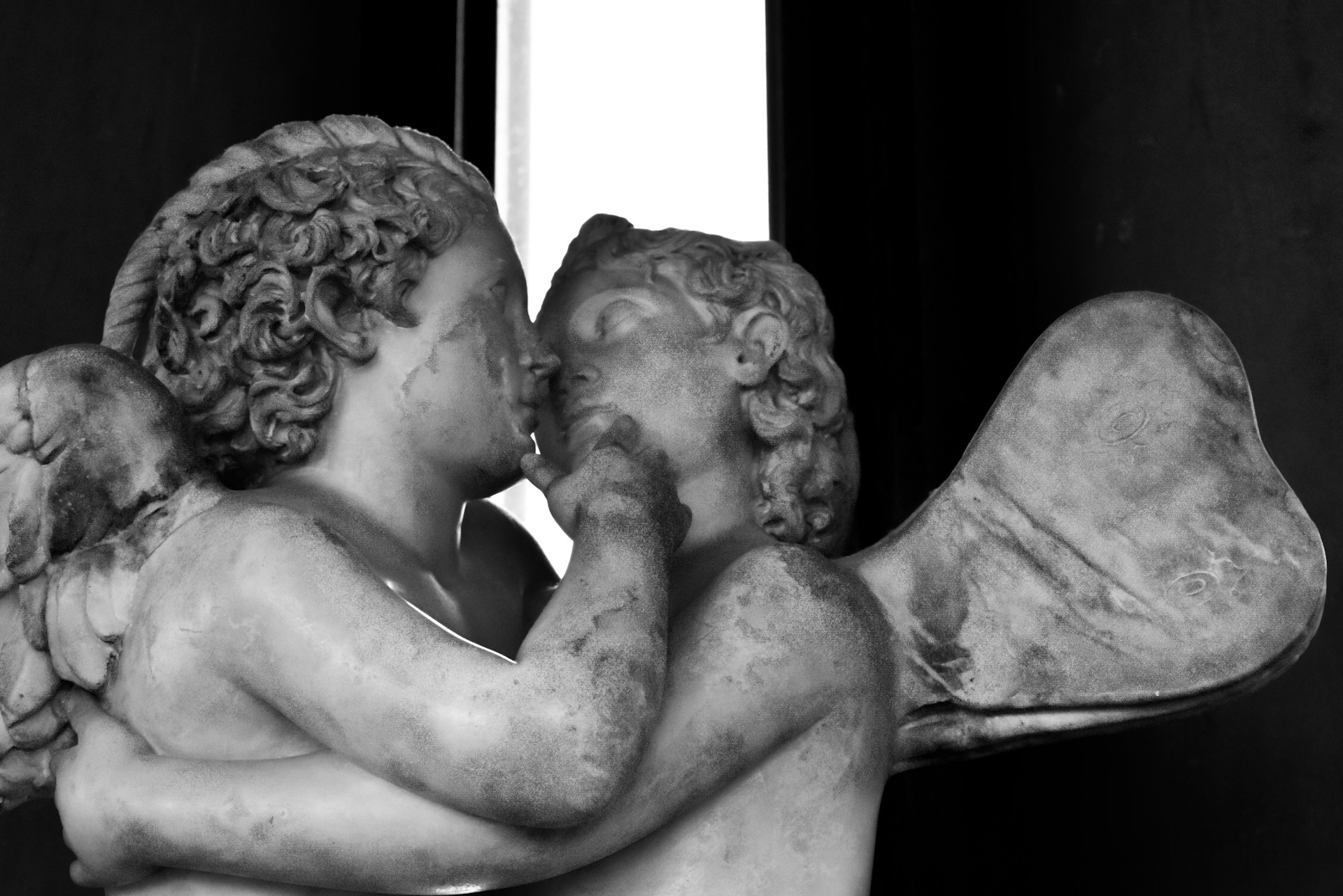
Photo by Emma Fabbri on Unsplash
On average, each person spends 336 hours of their life doing this, burning 6.5 calories per minute. Husbands who do it before leaving for work live five years longer, earn more, and are less likely to get into accidents. This activity strengthens the immune system, prevents wrinkles from forming, and reduces the risk of tooth decay. And yet, strangely enough, 10% of people worldwide flatly refuse to do it. Have you guessed what we’re talking about? Of course — kissing!
THE SCIENCE OF KISSING
A
n entire science has grown up around the kiss — philematology, from the Greek word phílēma, meaning «kiss». And this is by no means a curiosity, but a fully fledged scientific discipline. After all, philematologists study one of the most ancient forms of interpersonal contact, which emerged in the course of human evolution. Although 21 million years ago, when the common ancestor of modern humans and great apes gave rise to the first kiss, no such thing as a «personality» yet existed. In fact, «personality» is an idea exclusive to Western European culture, which appeared no earlier than the 17th century.
As this idea developed, a notion emerged that personality phylogenetically first arose in primitive society alongside a certain type of social contact, and in modern society is ontologically formed at approximately the age of 14. It follows that the kiss is a form of the most complex and ancient social contact — one that appeared before personality, society, language, and culture. So what, then, is a kiss?
The journal Evolution and Human Behaviour offers the following scientific definition: a kiss is a non-aggressive, goal-directed oral-to-oral contact involving some movement of the lips or oral parts, without the transfer of food. It must be said, this doesn’t sound very romantic… Somewhere around here, apparently, runs the boundary between science and art. Can you imagine Shakespeare describing the kiss of Romeo and Juliet in such terms? Neither can I! Yet this does not stop philematologist scientists.
THE KISS IN THE ANIMAL WORLD
They have found behavior that fits the scientific definition of a kiss in a wide range of living creatures — wolves, albatrosses, prairie dogs, squirrels, cows, and snails. As for bears, they actually kiss «with tongues». Are bears inclined toward a human-type «romanticism»? That is difficult to determine. Although we recall that in primitive beliefs the bear figured as perhaps the most anthropomorphic character of all. And these archaic notions are not without certain biological grounds. For example, humans and bears have virtually identical stomach acidity. The same level of acidity is found in hyenas and raccoons, whereas in our «relatives», chimpanzees and gorillas, it is much lower. This suggests that bears not only kiss like humans but also eat like humans. Some scholars have even put forward the theory that early hominids were scavengers. That is, our ancestors were originally so cunning and at the same time so lazy that they fed on the meat of animals killed by other, predatory species. And when choosing an object for a kiss, they were not particularly selective either.
A KISS MILLIONS OF YEARS LONG
Evolutionary biologists at the University of Oxford’s Faculty of Biology applied a broad evolutionary approach to the study of kissing. First, they discovered that Neanderthals, who became extinct 40,000 years ago, also kissed with pleasure — both among themselves and with anatomically modern humans, with whom they periodically interbred. Researchers found the same type of bacteria in their saliva, which they exchanged through contact. Of course, the primates familiar to us, such as chimpanzees, bonobos, and orangutans, also kiss members of their own species. But the ancestors of modern humanity displayed a far greater diversity of sexual behavior than we can observe in the animal world. At a certain point, not only biological but also cultural evolution became involved in shaping this diversity.
Perhaps that is why the kiss, seemingly studied inside and out, continues to remain a mystery to us. Take, for example, the fact that it is not a universal human behavior at all — kissing is practiced in only 46% of human cultures. In Mongolia, for instance, men do not kiss their sons as a sign of affection but sniff their heads instead. Kissing is not liked by everyone — ethnographers began to notice this feature of humankind as early as the late 19th century. Thus, the Dane Kristoffer Nyrop wrote about Ugro-Finnic men and women who bathe naked together in a sauna but consider kissing to be something terribly indecent. And the Frenchman Paul d’Enjoy noted that for the Chinese, a kiss on the lips is as repulsive as cannibalism is for us.
THE KISS — AN IDEAL «SCANNER»
But the oddities do not end there. After all, in neither the human nor the animal world do kisses offer any obvious advantages for survival or reproduction. At least, scientists have not yet been able to establish this conclusively. Which means philematologists still have plenty of work ahead of them. They must answer many questions. Why do we kiss? What emotions do we experience while doing so? How do kisses affect relationships? Which hormones are released into the bloodstream? Why does the heart start beating faster during a kiss? Why in some countries kissing is the norm and appears in rituals and etiquette, while in others it is considered the height of indecency? How are kisses connected to the feeling of happiness? How do they affect cortisol levels, productivity, immunity, and even life expectancy?
The answers to these questions are far from abstract — they are quite practical. The point is that a kiss functions simultaneously as a diagnostic tool, a social glue, and a neurochemical catalyst. When we kiss, we exchange millions of bacteria and pheromones with our partner. During a kiss, our body seems to «scan» another person, assessing how genetically compatible they are with us. In nature, such mechanisms of information transfer are well known. Insects, for example, release pheromones to signal danger, the presence of food, or readiness to reproduce. The problem is only that humans are not insects, and the very existence of pheromones in humans remains an open question.
«AND YOU SAID YOU WERE A ROMANTIC!»
Some scientists believe that in humans, the role of pheromones may be played by steroid hormones released with sweat. In pigs and rodents, the perception of pheromones is handled by the so-called vomeronasal organ. According to various estimates, it is present in the nasal cavity of 15–25% of people. It is not very clear why at most a quarter of humanity is sensitive to pheromones. However, if humans do have pheromones after all, then a kiss is the best thing nature could have devised to manage attraction and passion. It is no coincidence that the more we kiss, the more this activity seems to «draw us in». Which is hardly surprising, given that about 30 muscles and 5 pairs of cranial nerves are involved in the act of kissing. At the same time, the brain receives an incredible amount of information from the lips, tongue, cheeks, and nose — data about the partner’s temperature, taste, smell, and movements.
If one were to outline on a diagram of the cerebral cortex the areas that receive tactile information, a particularly large portion would be occupied by the area associated with the lips. A kiss is a complex combination of the release into the bloodstream of the hormones oxytocin and cortisol. The former is involved in the formation of social bonds as well as in childbirth, while the latter plays a role in stress responses. Interestingly, kissing lowers cortisol levels in both sexes. Oxytocin levels, however, rise in men but, on the contrary, decrease in women. It turns out that for women, kisses alone are not enough to trigger emotional attachment or sexual arousal. They also need an appropriate context — what we usually call a «romantic atmosphere». So God forbid you ever hear from a disappointed partner: «And you said you were a romantic!»
THE MYSTERY OF THE MERGING OF SOULS
According to surveys conducted in the United States, 59% of men and 66% of women end relationships that seemed serious immediately after the first kiss. Apparently, the brain, having read all the information about a potential partner through the kiss, signals: «Stop! This is not the person you need! Don’t make a mistake that will cost you too much!» It turns out that a kiss is a kind of compatibility test — something that is reflected even in language. What we know as a «French kiss», the French themselves call a «kiss of the soul». It is believed that when you touch the lips and tongue of your beloved with your own, your souls merge. The ancient Romans were firmly convinced of this. And here we come to the main question: is science capable of explaining the meaning of a kiss rationally once and for all?
The fundamental impossibility of this was already spoken of by King Solomon, whom the Bible considers one of the wisest men on earth. He confessed that he could not comprehend just four things: the way of an eagle in the sky, the way of a serpent on a rock, the way of a ship in the sea, and the way of a man to a woman’s heart. And if scientists fail to fully unravel the secret of love and the kiss, perhaps that is for the best. After all, it is much more interesting to live in a world where there is room for mystery and mysticism! Though certainly not for women of the Victorian era, who wore a pin in their mouths to avoid an accidental kiss. And only if you do not suffer from philemaphobia. It turns out there is such a dreadful condition — a panic fear of kissing.
Original research:
- A comparative approach to the evolution of kissing
- Ape ancestors and Neanderthals likely kissed, new analysis finds
When copying materials, please place an active link to www.huxley.media
Select the text and press Ctrl + Enter


