WHEN THE AUTHOR MATTERS MORE THAN THE TITLE: «Repulsion» and «Deconstructing Harry»

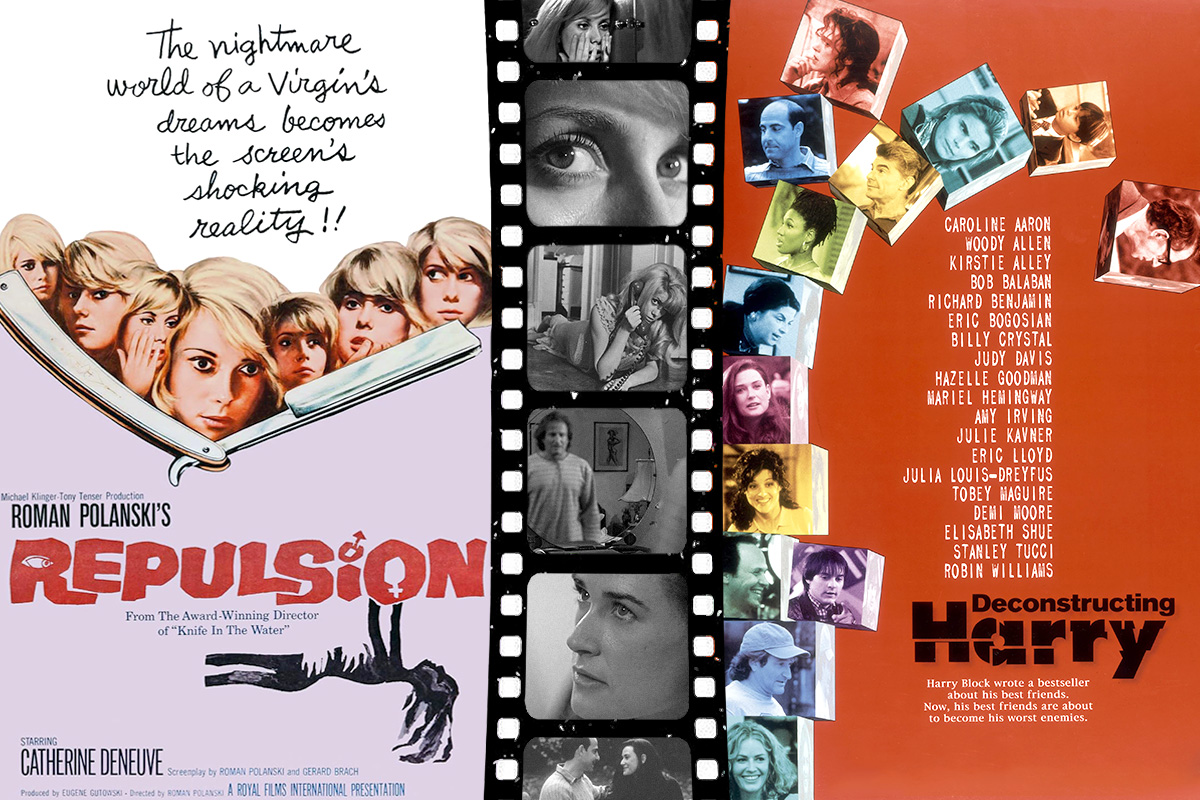
Art design: huxley.media via Photoshop
The Cinemasophy column presents two films this July in which the author matters more than the title. Roman Polanski and Woody Allen could adapt a telephone directory or the instruction manual for a handheld vacuum cleaner, and it would still deserve attention. Despite a number of important differences, these two directors have much in common — perhaps too much: their age, their Jewish heritage, their ability to remain private while constantly in the public eye, their dictatorial directing methods, their dramatic relationships with women and the resulting legal battles (the #MeToo movement turned both filmmakers into embodiments of patriarchal sexual permissiveness under especially aggravating circumstances), their fundamentally pessimistic worldview, their fusion of sensationalism with profound psychological insight, their deep fascination with the nature of audience perception, and, of course, the solitude that allowed both directors, as auteurs, to grow old far more gracefully than the overwhelming majority of their contemporaries. Not a single film by either Allen or Polanski feels like an antiquarian relic. Each speaks to today’s audience in a language it instinctively understands. Roman Polanski’s Repulsion, made sixty years ago, feels more contemporary than contemporary culture itself, with all its Instagram-driven visual conventions, while Woody Allen’s Deconstructing Harry (1997) is a timeless neurotic comedy about what truly matters, created by a consummate hypochondriac. Neither filmmaker can ever be exhausted by repeated viewing. Which is precisely why their films deserve to be revisited. Every single time, without fail, they reveal themselves as an entirely new film.
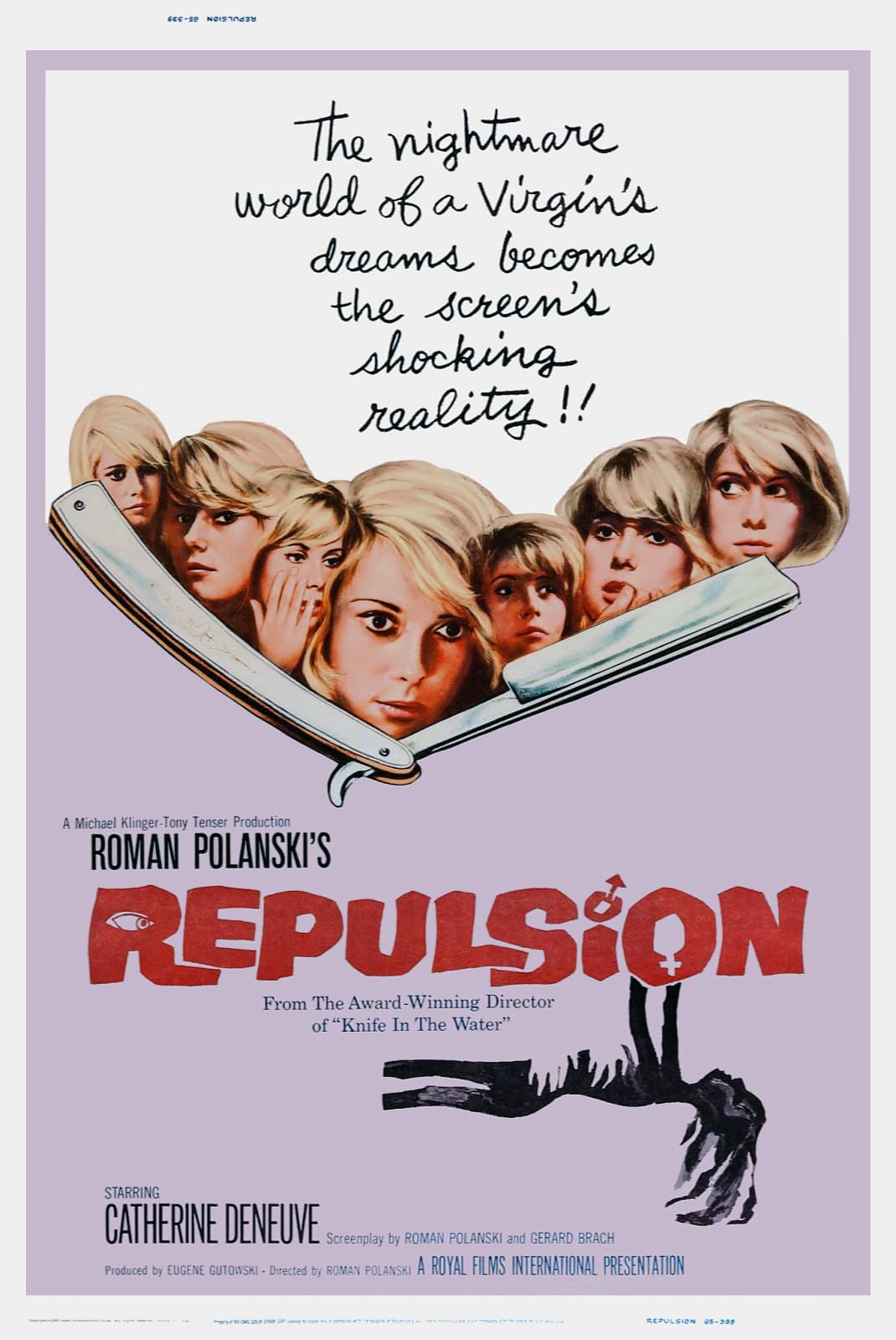
REPULSION (UK, 1965)
Director: Roman Polanski
Starring: Catherine Deneuve, John Fraser, Yvonne Furneaux, Ian Hendry
T
wenty-one-year-old Carol (Catherine Deneuve, brought here fresh from The Umbrellas of Cherbourg) is a manicurist who has moved from Belgium to London and shares an apartment with her older sister, Helen. Much to Carol’s obvious displeasure, Helen is involved with a married man named Michael. Carol herself has attracted the attention of a persistent and charming suitor, Colin. One day, after giving Carol a ride home, Colin tries to kiss her, prompting her to rush inside and immediately brush her teeth. When Helen and her lover leave for a holiday in Italy, Carol is left alone — and rapidly descends into madness. After accidentally injuring a client, she stops going to work, locks herself inside the apartment, where she begins to suffer terrifying hallucinations, while corpses start appearing within its walls. This is Roman Polanski’s first film made outside the socialist bloc, the British debut of the future director of Rosemary’s Baby (1968) and The Pianist (2002): a domestic horror story about a young woman, an apartment, schizophrenia, and murder.
As is often the case with great works of art, Repulsion came into being out of practical necessity. Having fled Poland, Polanski failed to establish himself in Paris and moved on to swinging London, where he quickly agreed — for a humiliatingly modest fee — to direct a low-budget film financed by a company specializing in cheap soft-core pornography. An admirer of Luis Buñuel, whose films would soon feature his companion Catherine Deneuve, Polanski opens Repulsion with an extreme close-up of Carol’s eye — a direct homage to Buñuel’s legendary Un Chien Andalou (1929) — and closes the film with the same image. In the final shot, it appears within an old family photograph that has surfaced several times throughout the story: the young Carol, still a child, gazes back with unmistakable hostility and madness.
The overwhelming sense of revulsion that consumes Carol — a servant to other people’s beauty and a prisoner of her own — is, above all, sexual in nature. She perceives every signal coming from the men around her as aggression, as an assault on her body. For much of the film, Carol wanders through the apartment in her nightgown, while the apartment itself gradually begins to change its physical dimensions. (It was constructed on a soundstage as a movable set, allowing the cinematographer to exploit wide-angle lenses to unsettling effect.) Polanski later joked that psychiatrists praised the film as an extraordinarily accurate clinical depiction of schizophrenia, whereas he and his co-writer Gérard Brach had, according to him, simply invented everything over the course of a couple of days. Perhaps that is true. In Repulsion, Polanski keeps expanding the boundaries of the repulsive until they come to reflect the entire surrounding world.
Today, that world is unmistakably our own. Rotting food, mountains of unwashed dishes, hair clogging the sink, a gloomy London trapped in perpetual construction, cracked pavements everywhere. All of this speaks far more directly to our own era — with its obsession with personal boundaries and the atomization of society — than to the age of drugs and rock and roll in which Carol actually lives. She is simultaneously a woman and a child. The latter wages war against the former — and wins. Carol refuses to mature sexually, refuses to become the kind of woman society expects her to be. In a sense, Polanski created an exaggerated feminist protest that assumes a tragicomic, pathological form. Repulsion is a horror film about walking into your bathroom one morning and discovering a stranger there — someone who has violated your personal space and therefore instantly becomes a potential threat.

DECONSTRUCTING HARRY (USA, 1997)
Director: Woody Allen
Starring: Woody Allen, Judy Davis, Stanley Tucci, Demi Moore, Robin Williams, Tobey Maguire
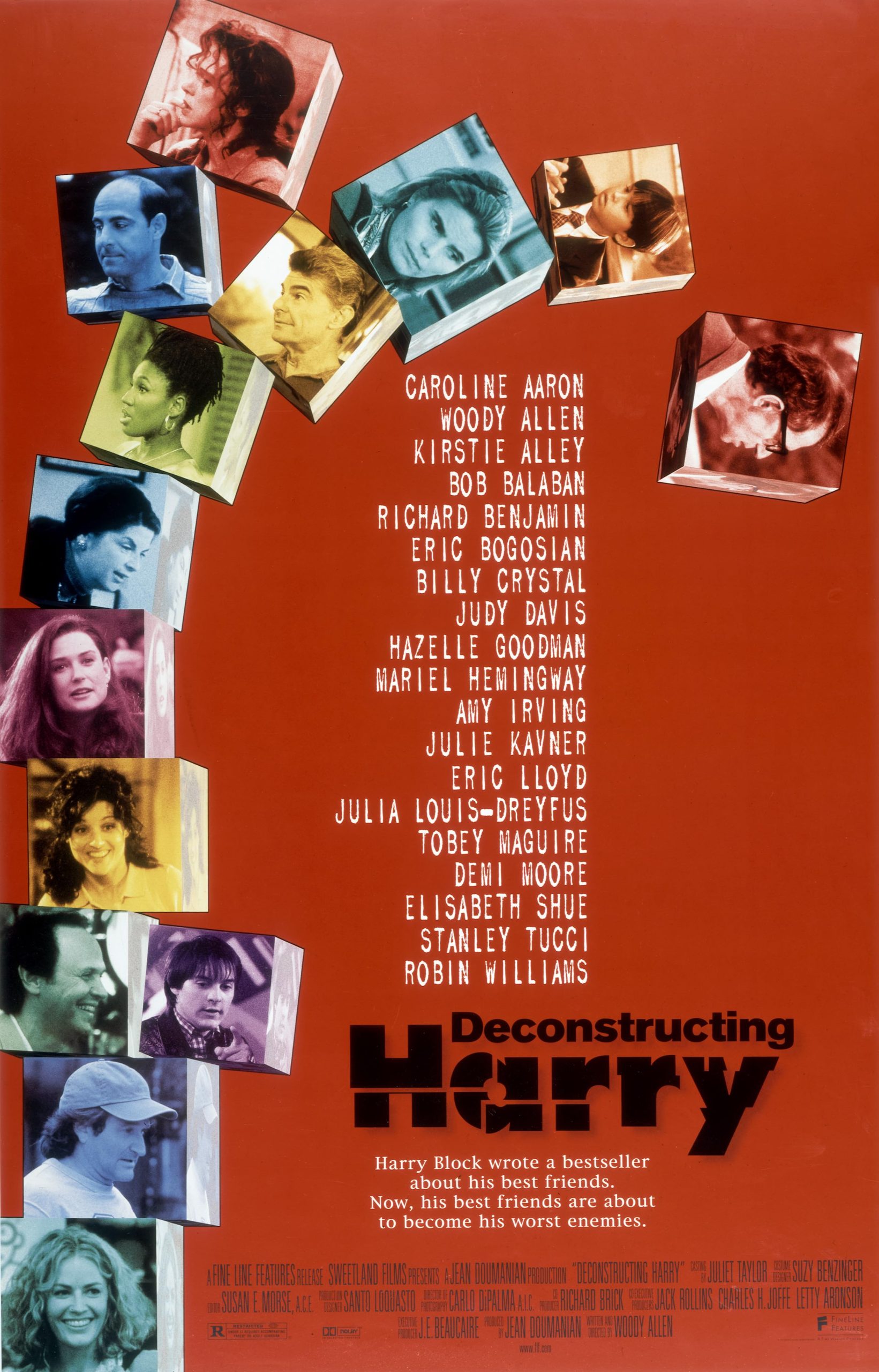
Find a couple of free months and watch one Allen film a day, disregarding chronology and any ranking according to the “great versus forgettable” principle, and it will not be hard to notice that certain devices, lines, and jokes recur again and again throughout the director’s body of work. It is like a stand-up routine whose numbers are shuffled at the performer’s discretion. Here are just a few recurring plots and structural elements: the dim-witted female student and her older Pygmalion-like friend; the hypochondriac in psychoanalysis; the middle-aged man in search of a muse. Everything turns and returns to where it began. Allen’s nostalgic, black-and-white Danny Rose reappears in the 2000s as the magician Splendini (Scoop, 2006), repeating the very same lines: “You’re all wonderful people. Seriously, I adore you!” Yet this repetition conveys not an exhausting sense of hopelessness, but rather a soothing Buddhist stability. Allen repeats himself, but, characteristically, never becomes tiresome.
Deconstructing Harry is yet another Woody Allen film that effectively serves as a self-remake of both Annie Hall (1977) and Manhattan (1979) — the latter two unquestionably deserving the label of masterpieces, alongside Zelig (1983) and Stardust Memories (1980). Deconstructing Harry is not a masterpiece, but it is astonishingly good. It radiates a warm, intimate glow. The film functions as a portal into the much-discussed auteur universe of Woody Allen, where one can experience firsthand his recurring signature devices, familiar turns of phrase, and narrative patterns. The plot type here is “the hypochondriac at the doctor’s office”. In Woody Allen’s universe, there are, as a rule, only two true protagonists: his beloved Manhattan and Woody Allen himself. He represents a unique example of perfect harmony between an author and his lyrical alter ego. A small, stooped, bespectacled Jewish intellectual, obsessed not so much with sex itself as with the implications of the amusing word libido, wanders from one woman to another, from one psychoanalyst to the next, under an endless succession of names.
Here, Woody Allen calls himself Harry Block. As always, he is a neurotic: a successful writer who cannot bring himself to begin his next novel, despite having already spent the entire advance. Harry’s relationships with his many lovers and friends are hopelessly tangled. He recounts all of this to his psychoanalyst on the eve of receiving a literary award. Yet he cannot decide whom to take with him to the ceremony: his current girlfriend is marrying one of his friends; that friend has suffered a heart attack; his ex-wife, a psychiatrist, refuses to let him take their son. So Harry recruits a Black prostitute, with whose help he abducts his own child.
Deconstructing Harry is a serious film, laugh-out-loud funny, remarkably compact, and strikingly economical. The “godfather of intellectual glamour”, Woody Allen, once remarked that films inevitably reflect their creators’ rhythm of life and even the peculiarities of their metabolism. It would be difficult to find a better description. Self-irony has always been one of Allen’s greatest strengths — the foundation of his deeply personal, almost confessional films, regardless of genre. Deconstructing Harry is a tragicomedy infused with absurdity and satire, featuring an ensemble of major stars (within Harry’s fantasies, Woody Allen assumes the faces of Stanley Tucci, Robin Williams, and Tobey Maguire). Allen creates his unmistakable atmosphere not only through a literary mode of storytelling — with its constant digressions, flashbacks, and leaps forward — but also through the film’s visual texture, crafted by the great cinematographer Carlo Di Palma, renowned for, among many other works, Michelangelo Antonioni’s Blow-Up (1966). The result is something suspended between a tragedy with a happy ending and a comedy with an unhappy one.
When copying materials, please place an active link to www.huxley.media
Select the text and press Ctrl + Enter