FROM A SOLDIER’S DIARY: memories that cannot be erased

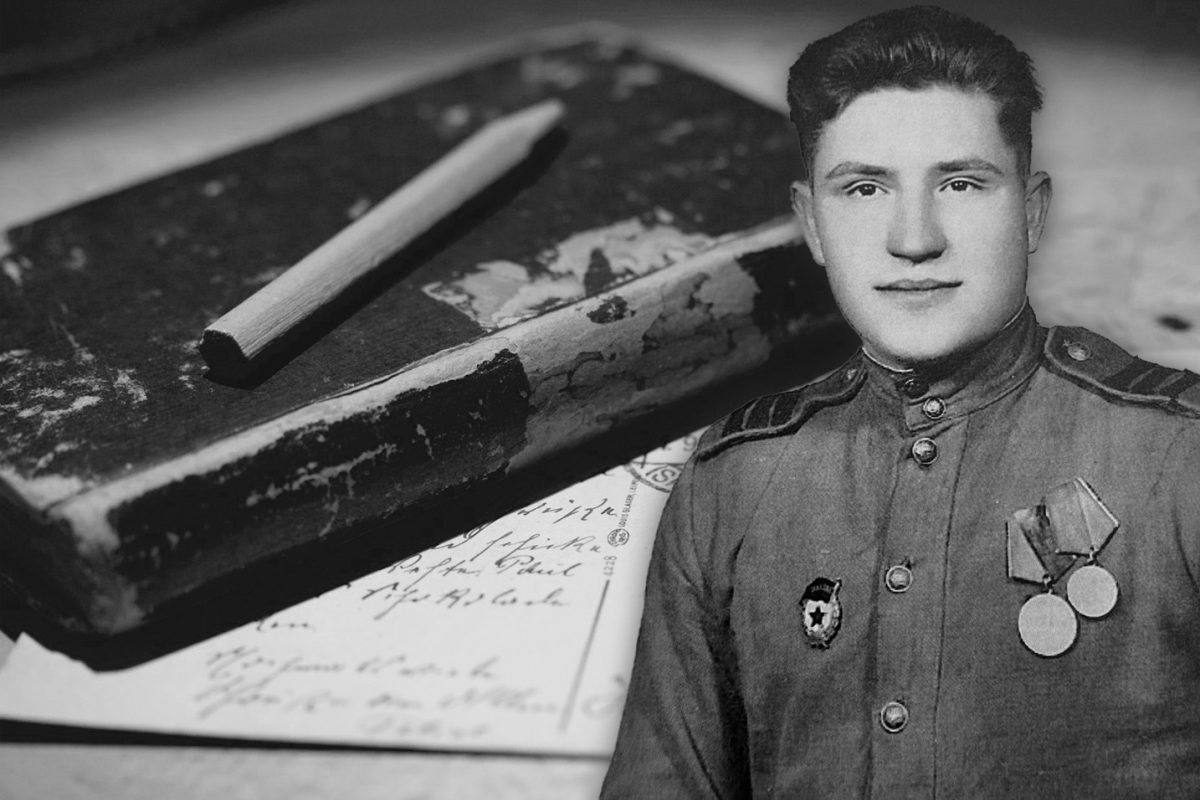
Heorhii Petrovych Savenko / Photo from a personal archive
Heorhii Petrovych Savenko was born and spent his entire life in Ukraine, in the city of Dnipropetrovsk. In October 1941, he volunteered for the front. He served throughout the war as part of an airborne rifle regiment, ending his military journey in May 1945 in Prague. After demobilization, he continued his service until 1948, and then became a surgeon, saving lives in peacetime for more than forty years.
Strong in spirit, modest, honest, and deeply decent, he not only performed surgeries but also painted landscapes, which he later gifted to friends and family. He is remembered as a man of high moral character and exceptional dignity.
Fragments of his personal diary have made their way to the Huxley editorial office — memories recorded decades later, echoing with the living intonation of the 20th century. These texts are not merely a chronicle of war, but the portrait of a man who walked through it. A memory that cannot be fabricated.
UNDER KRYVYI RIH
F
ierce battles were raging near Kryvyi Rih. We had very few men. We would come into villages, take all the men — straight from the streets, without weapons, without training — and send them into battle. Near Sofiivka, all the commanders in my unit were killed; only a handful of experienced fighters remained. Already after dark, they brought in the newly mobilized — scraped together from wherever they could. Each had a white cloth sack with provisions slung over their back. I was appointed commander. Not because I wanted it — there wasn’t a single officer left, all had been killed. The newcomers were not even recorded by name. I tried to explain what and how, and gave them a crash course. I told them:
— Do not sleep while on duty. If you’ve been given a weapon, do not part with it. Take off your sacks. Into the attack — without them. Follow orders, do not run back.
But they all did things their own way. They listened, but did not hear.
In the mornings, the Germans would usually launch an attack — and by the end of the day, almost everyone would be dead. Seeing the losses, the command kept reinforcing this direction. But the Germans were so well dug in that whoever was sent in, all were cut down. From this horror, panic began. Kryvyi Rih changed hands several times. Once, after leaving the battle, I and a few other “old hands” simply got lost. We didn’t know who was where or which direction our lines were in. Ragged, hungry, exhausted. We walked wherever our eyes led us.
Suddenly, we saw a building that looked like a former school. No people in sight — everyone was asleep. Quiet. My friend, Misha Zinchenko, and I peered into the rooms. Everywhere, someone was sleeping right on the floor. And in one room, two or three officers. There was a table, food, drink left behind. We went to the table. Ate, drank. Looked: the officers were snoring in their boots. We took ours off, put theirs on, and left. We attached ourselves to that unit. In the morning, a commotion: the commander’s boots had been swapped for rags! Misha and I exchanged glances — we had to return them. Otherwise, we’d be found out if we were going to join them.
Misha — a former repeat offender — went and quietly slipped the stolen boots back. Somehow, he got hold of another pair — put them on me.
And covering 50 kilometers in a day — not a problem. Even while hiding.
THE CROSSING AND HUNGER
I crossed the Dnipro near the village of Nedaiivody. The Germans were heavily fortified there as well. We began the crossing with a company, and it grew into a division. Everyone kept going… But those who survived did not stop. I cannot tell all of this. After Kryvyi Rih (it was taken in November), desperate battles began. Often, without communication, without clear coordination. Every day — at the limit. Life was hungry. A constant search for food. Everything that could be found was used. Local residents hid food, belongings — buried them, disguised them as graves. There were many standing graves — real and fake. Soldiers, starving, would dig them up — searching for anything edible. And sometimes they would find a jar of lard. And sometimes — a coffin. A dead body. Hunger is a terrible thing. We were truly starving.
IMPOSSIBLE TO FORGET
During one of the transfers to another sector of the defense, we were transported in ordinary railcars — dirty, cold. We were hungry, exhausted, falling apart. At one of the stations, our train stopped next to another — there were women there. We immediately noticed: emaciated, pale, sick. Many had diarrhea. People felt no shame — they sat right by the cars, in full view of everyone. Shame had left along with their strength. Someone said, “These are people from Leningrad. After the full blockade. After absolute hunger”. And then our soldiers began silently pulling out the last of what they had from their bags. Everything anyone had — bread, hardtack, a piece of lard — all of it was given away. No one ordered it, no one reached for gratitude. They simply gave. I later said, “This is impossible to forget”. And indeed — it is impossible.
SALT, THE MARKET, AND CORN
During transfers, when the train stopped at a station, the soldiers — forever hungry — would immediately descend on the local markets. With no money, no soap, no salt, no thread or needles — and those were the real currency back then. They would eat up everything around: stalls, shops, and vegetable gardens across the whole area. Once we stopped and noticed some mounds, like little hills. We came closer and saw: salt. A lot of it. It turned out that in earlier times this had been a transshipment point. And within a minute, all the soldiers had taken as much salt as they could — some into their packs, some into their caps, some just under their coats. They stocked up so much that the train could not move.
We stood there. Railway workers ran about, trying to figure out what was wrong, looking under the cars, at the tracks. But the soldiers had already understood: overload. And kept silent. There was plenty of salt — no one noticed it was missing. But the train had to move — we were out in the open, and German planes could appear at any moment. In a hurry, they brought a second locomotive, coupled it, and quickly got us moving. After that, they only stopped us out in the open fields — so that no one would strip anything bare.
But the fields were something else, too. Some soldiers from Siberia had heard that the corn here was delicious, that there were watermelons, melons… Once we stopped right in the middle of a cornfield. The Siberians were the first to jump out and started chewing on the corn stalks. Just the stalks, as they were. Then they chewed, disappointed, and said, “It doesn’t chew”.
People laughed at them for a long time. And later, when the ears had ripened, they still didn’t know what to do with them or how to eat them.
A CRACKER AND THE ROAD
Once, a soldier had his cracker stolen. It was an extraordinary incident. A cracker was not just food. It was life. They began to search. Several newcomers had arrived, and one of them broke. They searched him — and found the cracker wrapped in a footcloth. He was shot on the spot, without unnecessary words. But that was not the only trouble. The Germans gave us no peace, though they no longer acted as before. At that time, we were building a road. The task was difficult: we had to go quietly, stealthily, deep into the forest, to a place where the sound of an axe could not be heard. We cut down powerful pines and dragged them by hand to the construction site. The main thing was not to reveal the very fact that a road was being built, that trees were being felled. Everything had to remain unnoticed. And we were already so weak that we went to relieve ourselves in pairs — because one could simply collapse. And then a comrade would support you. Perhaps catch you, perhaps carry you.
CRUCIFIED
Once, a group — about twenty men — went into the forest at night to cut trees. In the morning, they were gone. The sergeant major grew concerned and sent someone to find out what had happened. At the place where they were supposed to be laying the logs, they found signs of a struggle, scattered belongings. They understood: the Germans had captured them. Taken them all. Soon word came from the observers: in front of the forward German trenches — posts. On them, all our men had been crucified. All except the commander. The commander, apparently, had been spared to be shown as a traitor. Our men said, “They tortured him. Buried him. He was a good lad. A Cossack”.
Life then was unbearable. It is astonishing that anyone survived at all. The body was exhausted — hard labor, without food, without rest, without warmth. The Germans had a clear advantage — they had plenty of ammunition, stronger artillery, and above our front line — their aircraft. Constantly. And the hunger… The hunger was always there. People went mad. They would climb out of shelters — as if on purpose, to be killed. Some inflicted wounds on themselves. All such cases — especially wounds to the arms or legs — immediately went through the special officers. Investigations, interrogations…
But then the hunger ended. We began to enter Hungary…
When copying materials, please place an active link to www.huxley.media
Select the text and press Ctrl + Enter