OH, LOVE: The Four Marriages of the Killer Queen and Her Terrible Death

Art design: huxley.media via Photoshop
ANOTHER GREEK GOD
As a rule, the history of medieval Europe is covered only briefly, which is understandable — most are convinced that such knowledge will be of no use in later life. And yet, it is fascinating… A multitude of small but defiant states — which only towards the 19th century joined larger countries, often by force, primarily Germany and Italy — lived bold and uninhibited lives, performing deeds that are hard to believe today. One might wonder: was love back then like a bird’s wings, impossible to catch, as Carmen sang much later? It seems it was not Eros who reigned in that era, but his cunning brother Anteros — the god of requited love, and also the avenger of spurned feelings and the disdain shown toward them. Examples abound, and here is one of the most striking.
THE FIRST MARRIAGE — BETWEEN CHILDREN
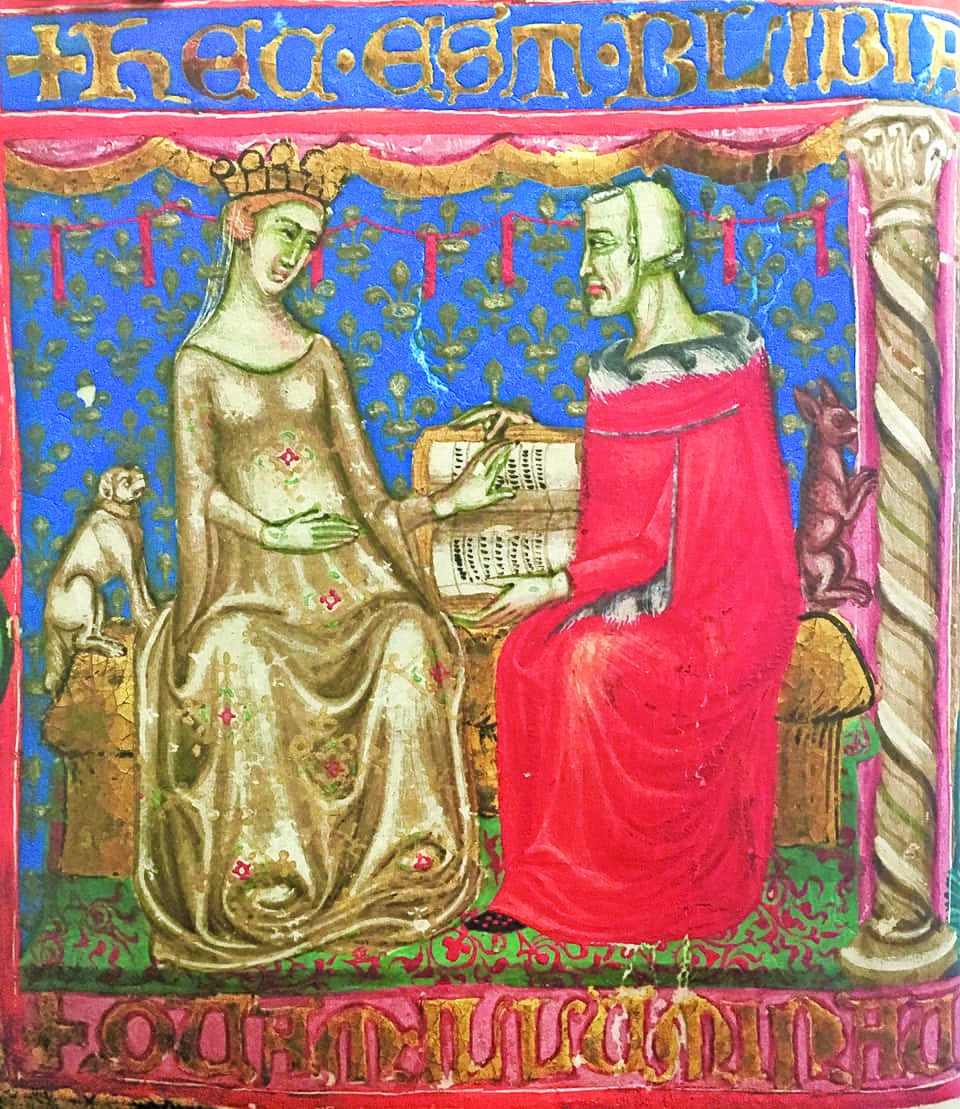
I believe that at the birth of Princess Joanna, the granddaughter of Robert the Wise, King of Naples (did you know such a kingdom existed? After all, the entire south of Italy belonged to him), the most favorable fate was predicted for her. She had wealth, lands, and a high title; she could even become queen (and she did, for lack of other legitimate heirs). And a husband of the most royal blood — Prince Andrew of Hungary (betrothed since the age of six: royal children are married off with difficulty and well in advance, but always to their equals). They shouldn’t have done that: the god Anteros is even less angered by stubborn denial than by total indifference.
The first-generation heirs of Robert the Wise did not live long, so it was the turn of the second — his granddaughter Joanna. He had to decide who would take the throne of Naples: his granddaughter, her husband Andrew (also of royal blood), or should they rule jointly? Moreover, the decision had to satisfy them and not overly bother the most powerful man on the Apennine Peninsula, Pope Clement VI… Well, if the spouses love each other, surely they can agree? Precisely — they wouldn’t, for they were married as children without their opinion or consent being asked.
Having barely reached what we consider the age of majority, Joanna could not stand her husband and took revenge through frequent affairs (at such a young age!). And it wasn’t limited to affairs — chroniclers of the time confidently accuse Joanna of poisoning a noble lady, Agnes de Perigord, using a «nutritional enema» (fashionable in those years). This is not to mention that having grown up in the refined Neapolitan court, where Boccaccio and Petrarch were active, Joanna openly considered Andrew boorish and uneducated. He himself did not hesitate to threaten her publicly.
Pope Clement, as suzerain, made a decision: to crown Joanna alone. Andrew’s mother, Elizabeth of Hungary, came to Naples and spent vast sums on bribes for the nobles who held influence (perhaps even for the Pope himself?), and it yielded results — the Pope announced that Andrew would now be crowned as well. Elizabeth left satisfied, yet sensing complications, she left her son an amulet protecting him from sword, dagger, and poison. But Joanna simply could not allow this — Anteros, among other things, drives one to extremes. On September 19, 1345, in the Castle of Aversa, assassins burst into Andrew’s chambers. They needed no sword, dagger, or poison — they simply strangled him with a silk ribbon embroidered by the Queen’s own hand (some write he was thrown out of the window). That was that; besides Joanna, the Pope had no one else to crown.
THE SECOND MARRIAGE — BETWEEN ACCOMPLICES
Almost everyone who recounts this story places the blame for the murder on the King’s two cousins. One of them, Louis of Taranto, was already her lover at the time; the other, Charles of Durazzo, was eventually accused and executed, though only five years later. The Neapolitans were in shock — they were used to abuses of power, but the scale of this crime horrified them. Joanna’s throne began to tremble; on the streets, people openly shouted: «Down with the Killer Queen!» If only for appearances, Joanna launched an investigation.
Quite a few secondary and arguably innocent people were found, including Joanna’s close friend, Donna Concha, whom everyone loved. They were subjected to long and agonizing torture (naturally, they confessed to everything), then handed over to the mob for «entertainment», and finally thrown into a bonfire lit in Naples’ main square. Shortly before this, Joanna managed to marry Louis of Taranto, demonstrating by this act that she did not consider him guilty of anything. But there was the Pope, Joanna’s suzerain — what would he say?
Remaining silent on such a bloody affair would have seemed unconvincing. Especially when the King of Hungary, Louis I the Great, decided to avenge his brother, occupied Naples, and only withdrew because of a plague epidemic. But the following year, he took Naples again, demanding justice. Then Joanna insisted on a personal meeting with the Pope in Avignon (which was her property at the time), where, by all accounts, she completely convinced and even charmed him.
After some brief deliberation, the Pontiff delivered an astounding verdict. Read closely: Joanna was indeed involved in the murder, but she was not guilty, as she had acted under the instigation of the devil! For such crimes, people were usually burned and their ashes scattered, but here — do as you wish, direct all complaints to the devil, and burn him instead! At the same time, the Pope recognized the legality of the marriage between Joanna and Louis of Taranto, even though they were first cousins — well, such things had happened before. How could this be? Quite simply: Joanna sold her city of Avignon to the Pope for a symbolic sum, and this deal would play a role yet.
For some time after this, the Kingdom of Naples lived in relative peace. Louis of Taranto was a reasonably capable ruler, assisted by the wise advisor Nicola Acciaioli, and everything would have been somewhat tolerable if not for Anteros — unable to strike the adults, he turned his attention to the children. Thus, the children of the ill-fated couple did not last long in this world. Their own relationship also deteriorated: Louis initially was publicly rude to his wife, and then, also in public, resorted to physical violence. But in 1362, he died. From what — the chronicles remain silent. Perhaps it was simply an illness…

THE THIRD — BETWEEN STRANGERS
Being an unmarried queen was unbecoming, and in 1364, Joanna married for the third time. It is clear that there were no feelings in this marriage, nor even a hint of them — the bride and groom essentially met at the wedding. It was entirely a matter of state calculation, and here Anteros revealed another of his qualities: a peculiar sense of humor. The chosen one was the titular King of Majorca, James IV the Bold, who appeared in this drama, at best, as an operetta character. He practically ran to the wedding from an iron cage in Barcelona, where he had been held until 1362 by the powerful Peter IV of Aragon, who had his own opinions on who owned Majorca.
According to the terms of the marriage contract, husband number three took no part in governing the Kingdom of Naples. The primary goal of this union was to produce heirs for Joanna, but nothing came of it, and the spouses saw each other very rarely. It is almost hard to believe they were even married. The wretched James, having spent a significant portion of his life in an iron cage, behaved erratically and was extremely cruel to his wife, even in public. However, an heir to the throne was desperately needed, and she risked herself. It reached a point where several family members had to spend the night in the royal chambers to provide some measure of safety for her. Joanna was openly advised not to share a bed with such a dangerous madman, but she hoped for an heir. Unfortunately, it was in vain — her only pregnancy ended in a miscarriage.
Fortunately, James did not interfere in the affairs of Naples, as he had promised; he was entirely occupied with unsuccessful attempts to reconquer Majorca. No one saw any benefit from this — he was an incompetent warrior and quickly fell into the captivity of Henry of Trastámara. Joanna had to ransom him for the exorbitant sum of 40,000 florins (half of what the Pope had paid her for Avignon). The newly ransomed property did not linger in Naples but rushed back to Spain to fight his captor, where someone finally poisoned him. Joanna was far enough away, otherwise many would have thought heaven knows what. Though, who can say…

THE FOURTH — BETWEEN A SPONSOR AND A CONDOTTIERO
The new Pope, Urban VI, reopened Joanna’s case and decided to confine her to a monastery. In response, she contacted several cardinals and, alongside them, initiated the Great Schism of 1378 — a rift in the Catholic world where another Pope, Clement VII, established his papal throne in Avignon, the very city Joanna had sold. Initially, Joanna, realizing that she was unlikely to bear a child at her age, declared Duke Charles of Durazzo as her heir — not her brother-in-law executed in 1350, of course, but a man from a different branch of the lineage. Having secured these rights, Charles of Durazzo wished to exercise them; furthermore, the vengeful Louis the Great had forgiven nothing and skillfully, almost incessantly, turned Charles against Joanna.
Meanwhile, Clement VII demanded a new move from Joanna against Urban VI’s camp, and she was no longer in a position to refuse him. She had to strip Charles of Durazzo of his inheritance rights and appoint Duke Louis I of Anjou — a Frenchman and, therefore, a member of the Avignon party — as her heir. In retaliation, Urban VI excommunicated Joanna; even at a time when this punishment had become somewhat devalued through frequent use, it remained quite serious. In her place, he naturally appointed Charles of Durazzo, who dreamt only of realizing his acquired rights as quickly as possible.
To find protection, and for that reason alone, Joanna married for the fourth time in her life — to Otto of Brunswick, a sovereign duke and, by his true profession, a condottiero: the leader of a mercenary troop fighting strictly for money. Strangely enough, the spouses lived without conflict; Anteros did not even wake up — you couldn’t find a trace of love here even under a microscope, and he was frankly bored.
In those years, Hungary was a much stronger and more influential state than the Kingdom of Naples, and Charles of Durazzo, supported by Louis the Great, led his troops toward Naples. Otto of Brunswick remained loyal to his wife and offered resolute resistance to Charles, but the forces were unequal — he lost the war and was taken prisoner. Joanna endured a siege in the Castel Nuovo for some time but was eventually forced to surrender. For six months, she lived as a captive, treated with outward respect, but persistently pressured with one demand: to return to her previous decision regarding the succession of the Neapolitan throne — not Louis of Anjou, but Charles of Durazzo!
AND THIS IS CERTAINLY THE END
But Joanna, apparently, decided to hold out until the end, counting on military aid from Louis of Anjou. She was too late — Charles’s patience ran out first. On May 22, 1382, Joanna was strangled by his order — whether between two feather beds, with a red scarf, or, like Andrew of Hungary, with an embroidered silk ribbon — a detail many remembered all too well… The distinct signature of Anteros: while his twin Eros opens thousands of paths, Anteros, the god who avenges the disdain for love, prefers simple and final solutions. Like an embroidered silk ribbon… And Charles of Durazzo earned one more right — to write to Louis the Great: «Your commission has been fulfilled». He read those words just a couple of months before his death.
When copying materials, please place an active link to www.huxley.media
Select the text and press Ctrl + Enter


