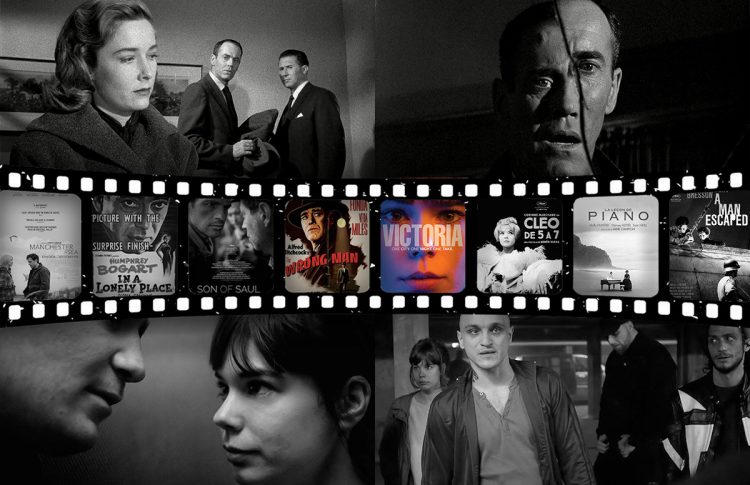
THE NATURE OF WEAKNESS: “La Jetée” and “Manchester by the Sea”


Art design: huxley.media via Photoshop
The nature of our weakness and vulnerability, the fragility of the human inner world in the face of external challenges — this is the central theme of the Cinemasophy column for June. The two films featured here — La Jetée (1962) by French director Chris Marker and Manchester by the Sea (2016) by American director Kenneth Lonergan — are, in essence, about the same thing. These films differ enormously in genre (science fiction versus tragicomedy) and style: the former consists almost entirely of static black-and-white photo stills, while the latter envelops the viewer in cold, colorful seaside panoramas. Both can be boldly described as daring statements shedding light on the darkest corners of human nature.
LA JETÉE (FRANCE, 1962)
Director: Chris Marker
Cast: Jean Négroni, Jacques Ledoux, Hélène Chatelain

A
science fiction masterpiece, this short experimental film woven from monochrome still photographs (which later inspired Terry Gilliam’s 1995 cult sci-fi 12 Monkeys, where Bruce Willis and a young Brad Pitt fight against a deadly virus that wipes out 99% of Earth’s population by 2035) by the great Chris Marker proves that in cinema, frames don’t necessarily need to move to make the audience feel and empathize with what is happening on screen.
The story unfolds in a near post-apocalyptic future where the surviving humans are forced to live deep underground. The unnamed protagonist (Jean Négroni) volunteers for a dangerous time travel mission to help scientists identify the causes of the devastating war in the past. Along the way, he is haunted by two childhood memories — the murder of a stranger and a chance encounter with a mysterious woman.
By the time the protagonist uncovers the connection between these memories, it is already too late, and everything repeats itself. Resembling a half-hour walk through a contemporary art gallery, with Hitchcock references (a man and a woman examine the cross-section of a sequoia trunk, just like in the iconic Vertigo from 1958), La Jetée captivates not so much through its visual imagery as through its soundscape, composed of abstractions and human whispers.
Here, the sound is responsible for the journey through time, presented as a metaphysical navigation of memory and space: the deeper the hero dives into the layers of his past, the clearer and denser the sounds become. In the film’s only motion scene, Chris Marker shows the beautiful sleeping woman suddenly opening her eyes — the very woman from the protagonist’s memories, which, over the course of 28 minutes, become your own.

MANCHESTER BY THE SEA (USA, 2016)
Director: Kenneth Lonergan
Cast: Casey Affleck, Michelle Williams, Lucas Hedges, Kyle Chandler

A perfect film for grey, overcast days. In it, Casey Affleck beautifully broods amid the cozy small-town landscapes of America. This double Academy Award-winning drama (Best Actor and Best Original Screenplay), directed and written by Kenneth Lonergan — who also penned the script for the eccentric comedy Analyze This and the epic Gangs of New York (earning him two Oscar nominations) — transforms the story of an ordinary man into a deeply melancholic tragicomedy. It’s about a sensitive, oddball janitor who returns to his hometown, Manchester-by-the-Sea, to raise his orphaned nephew and confront the ghosts of his past.
Casey Affleck, already known for portraying reserved, somewhat mysterious characters (notably his role as the shy assassin of legendary Jesse James in The Assassination of Jesse James by the Coward Robert Ford, 2007), delivers a performance here that embodies pure loneliness — a small man living in an unkempt basement apartment in Boston.
The death of his beloved older brother Joe (Kyle Chandler, seen through generous flashbacks) suddenly leaves him with the responsibility of raising Joe’s sixteen-year-old son, Patrick (Lucas Hedges — Redford from Moonrise Kingdom), as specified in the will. Thus, the quiet, socially withdrawn Lee Chandler — depressed, heavy-drinking, and prone to bar fights — reveals a huge heart and a deep desire to care for someone in this world.
Expecting to stay only a few days to bury his brother and bring his nephew back to Boston, Lee ends up getting “stuck” in his hometown. Due to the frozen ground, his brother’s body is kept at Sea until spring. Lee looks after his nephew, spies on his ex-wife Randi (Michelle Williams), whom he still deeply loves, and obsessively sifts through the wreckage of his past.
The uniqueness of this intimate masterpiece (filmed for a modest $9 million by Amazon Studios) lies in the fact that it is perhaps the most… humorous film ever made about grief.
Manchester by the Sea pretends to be a drama about the struggle for reconciliation with the past — yet Affleck’s character suffers not because he cannot forgive others, but because he cannot forgive himself. The film gently subverts the cliché of a charmingly immature man forced to grow up while caring for a child. Above all, it tells a delicate story of profound loneliness.
One among countless faceless loners inhabiting small and large American towns. People living entirely alone, without family, friends, or loved ones. Many outstanding films have been made about them — masterpieces even, from Taxi Driver (1976) to Joker (2019). But while those characters had some form of self-expression (Travis Bickle’s journal in Taxi Driver, stand-up comedy in Joker), Affleck’s character has nothing.
He is essentially mute, like Chaplin’s Little Tramp. He clumsily expresses himself through the contrast between his impassive face and barely perceptible gestures (one of the film’s most striking scenes is shot entirely from the far side of a hockey rink — you can’t hear what the characters are saying, but you read everything through their body language), through the music, and through the overall atmosphere of the snowy fishing town.
At first, he may seem like a surly but harmless simpleton. Yet part of the film’s power lies in how we witness him gradually lose his innocence. And what replaces that lost innocence is captivating.
Director Lonergan, working from his own screenplay, paints a compassionate portrait of a man angry at himself and the world, depicting his day-to-day life week after week, month after month. As we descend into Lee Chandler’s mundane routines, we witness him slipping deeper into his wounded past.
This janitor — in his solitude — becomes first a ticking-time-bomb sociopath, then a schizoid recluse, and finally, a tender eccentric. Thus, despite its overwhelming gloom and despair, Manchester by the Sea is a story of a man slowly going mad, only to stop himself at the very edge — the edge of earthly illusions.
The story is told with such an authentic atmosphere of small-town daily life that it takes on the dry tone of a dark comedy. Lonergan, with his sharp ear for drama, skillfully amuses with everyday details and small humiliations that turn tragedy into farce — for example, when paramedics repeatedly struggle to fold a stretcher to load it into the ambulance. At times, the humor verges on pitch black.
Manchester by the Sea behaves like a traditional, almost old-fashioned drama set in the real world but allows itself every freedom with its characters. The film feels like a slice of life in all its splendor and horror, gripping the viewer not only with what has just happened but with the constant urge to see what lies ahead. That’s one side of it.
On the other, it captivates with a kind of northern poetry — snowy, salt-soaked urban imagery accompanied by the warm, vintage sounds of old soul music from smoky jukeboxes. The seascapes, painted by cinematographer Jody Lee Lipes, heighten the drama of comedic scenes and vice versa, multiplying the weakness and vulnerability of human nature with the unpredictability and absurdity of behavior.
Manchester by the Sea is the kind of film you’ll want to rewatch with someone else, to revisit the emotions you experienced during your first viewing — listening again and again to Casey Affleck’s heartbreaking line: «I can’t beat it. I can’t beat it».
When copying materials, please place an active link to www.huxley.media
Select the text and press Ctrl + Enter