VICTOR MALAKHOV: on the Paradoxes of Ethics, Moral Revolution, and «Windows of Being»

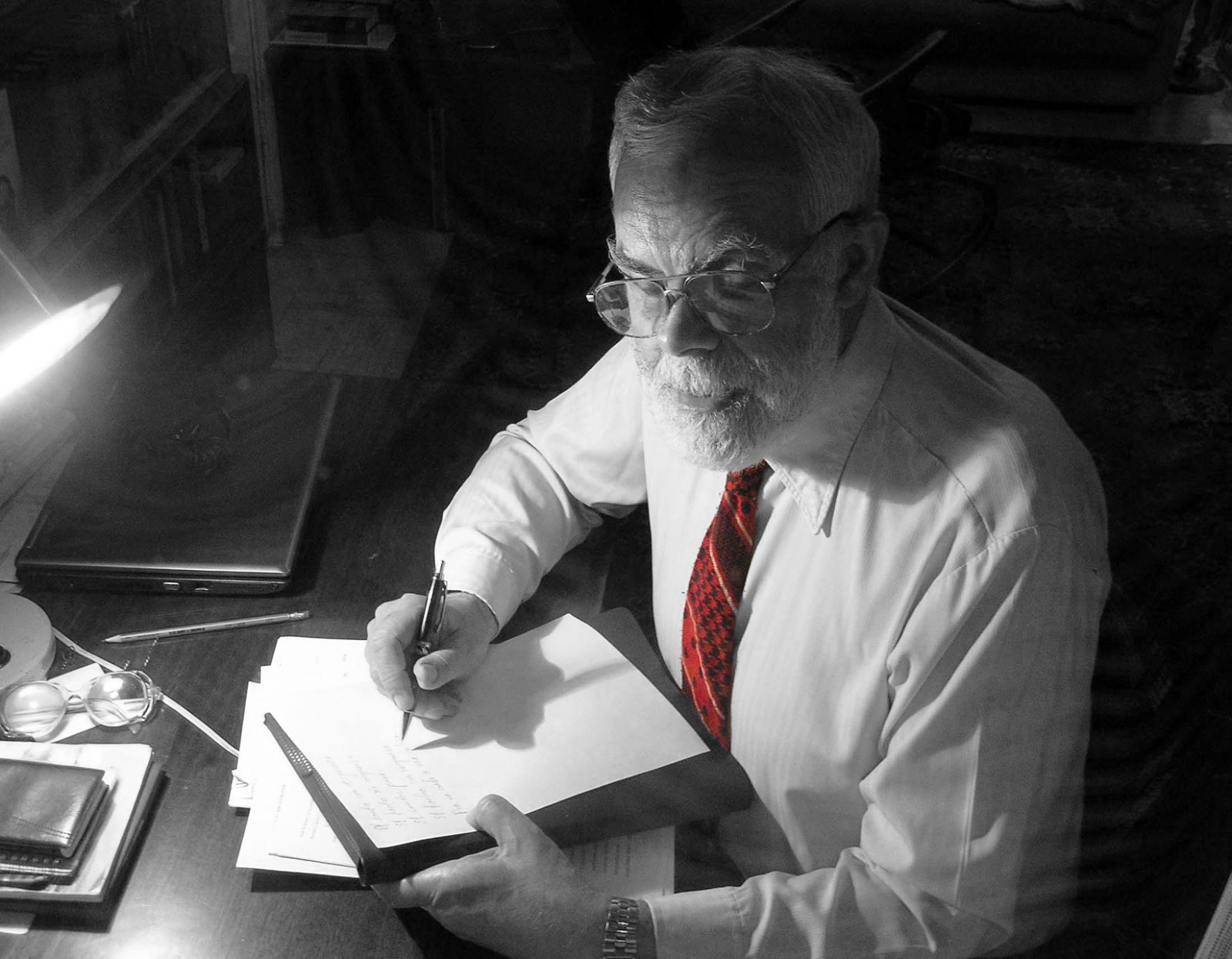
Photo from Viktor Malakhov’s personal archive
Viktor Malakhov is an outstanding Ukrainian philosopher, Doctor of Sciences, professor at the Kyiv-Mohyla Academy, and chief research fellow at the Institute of Philosophy of the National Academy of Sciences of Ukraine. Alongside questions of ethics, Malakhov explores issues related to human identity, communication, and the relationship between the «I» and the «Other.»
He currently lives in Israel. Yet several generations of Ukrainian students have been shaped by his textbooks, books, and lectures on the philosophy of ethics. Viktor Aronovych shared some of his reflections on the pressing questions of our existence and time with the readers of our almanac.
WHY ETHICS, AFTER ALL?
A
conversation about ethics is always a conversation about the fundamental problems of our existence — questions that, by their very nature, cannot help but concern each of us. I cannot imagine what could be done to ethics to make it uninteresting to a human being.
Back in my fourth year of studies, I decided that I would devote myself to philosophical ethics, and I have never once regretted that decision. In the 1960s and 1970s, Soviet philosophy experienced a «period of aesthetics,» naturally, grounded in Marxist theory.
Aesthetics was the most popular discipline among students at the time, with numerous books being published on the subject. The most engaging and in-demand student circle at our philosophy department was, unsurprisingly, the aesthetics club. Aesthetics was taught by excellent specialists and true enthusiasts.
Ethics, on the other hand, remained on the periphery of philosophical inquiry and was rarely taken seriously. Even in my student years, I realized that the constructive core preserved in Marxist philosophy was linked to the philosophy of activity.
A vivid expression of this was the work of Henrikh Stepanovych Batishchev, The Active Essence of the Human Being. According to this popular «activity-centered» concept of the time, the idea of transformative action served as a kind of key to understanding human beings, the specificity of their consciousness, cognitive activity, and communication.
In essence, the idea of activity appeared as a kind of philosophical perpetuum mobile. Through activity, a person constantly develops themselves; with each new turn, new horizons open up, new needs arise, which in turn prompt further transformation of existence — elevating the process of self-development to a new level, and so on endlessly.
Thus, it seemed that the entire world of «human matters» could be explained. But there remained something that could not be derived from this framework of understanding. Ethics could not be deduced from activity. Love, for instance, was not something that could be described in the vocabulary of activity.
And generally, when we try to describe the Other using the categories of objectification/de-objectification, the result is somehow vulgar.
It was then that I realized that in order to continue in philosophy, I needed to focus on ethics. So ethics, for me, began with the problem of love — not with the modality of obligation or the categorical imperative, although those are undoubtedly important.
My interest centered on how to describe, in philosophical terms, our relationship to the Other — such feelings as love, compassion, pity, and shame.
GENETICS AND THE PARADOXES OF CONSCIOUSNESS
There is a scientific field called the sociology of morality. Since the 1960s, some interesting publications have emerged in this philosophical niche. For instance, The Genealogy of Altruism (Ethics from the Perspective of Human Evolutionary Genetics) by Vladimir Efroimson. This work discusses the formation of social instincts embedded at the genetic level and how they manifest themselves.
Overall, this kind of scientific research is not my field. What interests me most is morality as a problem of human consciousness. For a person, the set of ethical issues may appear as something paradoxical — something that makes one pause in astonishment and seriously reflect.
Merab Mamardashvili once said that philosophy, as such, begins with such a pause. Imagine someone who seems to be living a successful life, building a career, and everything is going wonderfully. And suddenly, this «successful person» (a term I personally find quite vulgar) feels that their life is empty, that something essential is missing.
But where is this essential thing to be found? What kind of life orientation is needed to overcome this inner void? In contemplating these matters, it is useless to rely on scientific knowledge about genetically predetermined instincts or any kind of social determinants.
One must find something capable of filling the existential void of the self. Thus, from within myself, from my consciousness, I begin to chart a path toward understanding the Other. Then comes the stage of real intersubjective experience. There is a paradox: the structure of our inner certainties does not align with what is given to us externally.
For example, as reasonable people, we understand that there is an objective order of things; virtually everything in external reality tells me that I am a conditioned being. Starting with genetics, my existence is determined by various factors.
And yet, internally, I am somehow convinced that I am free! So convinced, in fact, that this very belief in freedom can be used to manipulate me. In the modern world, we witness a vast number of manipulations that appeal precisely to human liberty.
Are you a free person? Then you must act in such and such a way — that is, in a manner acceptable to the manipulators.
THE RIDDLE OF SUBJECTIVITY
Here’s another example. We all know that people are mortal. Yet philosophy was born from the question — why does a person refuse to accept their own death? Something within us fiercely resists this natural course of things.
How can it be? At some point, the light of consciousness emerged within me, and a thinking self was born — how is it possible to imagine that it will suddenly disappear? What in my inner experience can truly testify to the inevitability of my nonexistence?
This question has nothing to do with DNA structure or the properties of proteins involved in sustaining life. It pertains solely to the inner self-construction of my consciousness, of my subjectivity. Ethics, as a philosophical discipline, in my view, deals precisely with such questions — with the problems, paradoxes, and mysteries embedded in human subjectivity.
Why, for example, do I «feel compelled to do good»? No matter how a person acts, they always seek some justification for their actions and inevitably end up convincing themselves that they are «doing something good.» Why is that?
Why can’t I come to terms with death? Why must I love someone — anyone? Why can’t I let go of asserting myself as a free being? These are ethical questions that arise from the very nature of human subjectivity.
It is no surprise, then, that since ancient times, ethics has been considered one of the core philosophical disciplines. At its heart lies a series of fundamental philosophical ideas that inevitably confront anyone seeking to realize themselves as a thinking being.
«HEIDEGGER’S ‘DEATH’ AND LEVINAS’S ‘INSOMNIA’»
For the philosophy of the human being, death is not a final revelation or an answer to all questions — it is a problem that torments human consciousness. Philosophy has long sought different ways to overcome this existential difficulty, trying to understand how a person can live with the awareness of the finitude of their existence. Heidegger believed that it is precisely the awareness of one’s finitude that makes a person truly human.
On the one hand, for the human being (whom Heidegger calls Dasein — »being-there»), there is nothing more authentic, more certain, and true than the existence to which they belong. On the other hand, a person realizes that their being is a «being-toward-death» — sooner or later, it will come to an end.
In Being and Time, Heidegger refers to two fundamental facts — the only ones available to us in this regard. First, death will inevitably come for us; we cannot shift this fate onto someone else. Second, its arrival will be unexpected.
Heidegger wrote passages of terrifying vividness in which he describes the inescapable footsteps of death. A person is given the capacity to hear them. But no one knows when death will come. One must realize oneself in the face of this fundamental fact — that one is a mortal being, that the time will come when one will no longer exist. One must build one’s finite life and take responsibility for it.
So thought Heidegger. But his student — and at the same time one of his main opponents — Emmanuel Levinas thought otherwise. Levinas argued that a person is not terrified by death as such. The true horror is not that being is finite. The horror lies in the depth of being itself, when we realize we are locked in it like in a prison cell with no exit.
Levinas, who considered the Holocaust the defining event of his life, knew what he was talking about:
There are situations when life becomes far more terrifying for a person than death. When suffering unbearable physical or emotional torment, a person begs for death but cannot escape the circle of agonizing existence.
An everyday analogue of the horror of existential hopelessness, for Levinas, is insomnia. It has long been said that Sleep is the younger brother of Death. But humanity also knows the younger sister of Immortality — and that is insomnia: a state from which no conscious effort can lead to sleep. This, according to Levinas, is the true model of horror.
THE TURN TOWARD THE OTHER AS THE GUIDING AXIS OF CONSCIOUSNESS
The ethical orientation is, in some way, embedded within human consciousness. It is a constitutive axis of consciousness, not merely one of its incidental components. To a large extent, it is precisely our relationship to the Other that prompts us to navigate existence, to take action, to realize ourselves in some way. In this sense, the relationship between ontology and ethics is quite revealing.
Emmanuel Levinas, already mentioned in our conversation and, in my view, one of the most significant philosophers of the 20th century, argued that European philosophical thought is ontological at its core. It is in this ontological sense that Heidegger reactivated it.
However, not only Heidegger’s philosophy, but also what is traditionally called «metaphysics» in the European tradition, essentially represents a form of ontology. A classic constituent of European ontology is the principle of conatus essendi, or the «persistence in being,» which originates in Proposition 6 of Part III of Benedict Spinoza’s Ethics: «Each thing, as far as it can by its own power, strives to persevere in its being.»
Ethics offers an alternative to this «persistence in being.» When a person acts under the influence of ethical motives, it means a turn toward the Other. In doing so, even to the slightest degree, the Self lets go of itself, of its concerns about self-realization. Where I relate to the Other solely as a means of affirming myself, that relation is not ethical.
Ethics is born when the Other appears to me as an end in themselves, and I forget myself for the sake of the Other. To varying degrees, we can see this in all expressions of sacrifice, friendship, and love. Naturally, we can go further and distinguish, alongside the ontological and ethical, also religious or mystical dimensions of human existence.
In any case, it is clear that the ethical dimension is intrinsically present in human consciousness — it is not some peripheral zone one enters by accident.
ONTOLOGICAL BURDEN AND «BEING-IN-RESPONSE»
As a conscious being, a person always finds some way to form a meaningful relationship with life. I believe the ethical axes of consciousness can be traced across a wide range of phenomena. Much of a person can be explained by physiology, psychology, genetics, or social heritage.
And yet, there remain for us clear and pressing questions of a spiritual and ethical nature. No matter how burdened a person may be as a being-in-the-world, they are inevitably called to respond to a certain appeal. In this sense, human existence is always, in a way, a «being-in-response.»
People seek ways to answer this call — and this, in essence, is what characterizes their existence as human. These answers may be radically different, reflecting the vast range of how people experience the burdens of being.
For example, a person struggling with mental illness may not find the paths that might seem obvious to others. Each person’s path is their own, and at times it can be extremely difficult. Still, I believe that for every individual — no matter how unique their existential burden may be — there is a certain supra-ontological horizon of human existence, a horizon of higher spiritual meanings that calls them toward being-in-response, toward participating in those meanings to the best of their ability.
Every person bears their own ontological burden. But through the openings in ontology, we glimpse a kind of «guiding stars» — sources of light that reach out to us. We may be mistaken about the direction in which we must move toward goodness, light, and beauty. But when we look at the light, we cannot be mistaken in recognizing it as light.
And such «primary phenomena» of human spiritual orientation, in my view, go beyond the bounds of any possible ontology. From this, it follows in particular that — regardless of what a person may be as an ontological being — as a self-aware subject, they are inescapably within the gravitational field of ethics, of its spiritual principles. The call of goodness is something a person is capable of hearing even before asking any question about the existential conditions of their own life path.
«DEEP COMMUNICATION» AND THE PROBLEMS OF DIALOGUE
If we speak of what was truly alive and creative in Soviet philosophy, then, as I’ve already mentioned, it was probably the «activity-based» conception of the human being — essentially a continuation of early Fichte’s line: you are what you do! But we can try to step outside this paradigm and look at the human being not only as a predominantly active creature, but also as one who communicates with others.
Such a path was taken by one of my teachers in philosophy, Henrikh Stepanovych Batishchev. At first, he was a fervent adherent of the «activity-based» approach, but later he moved to the position that a person cannot be understood apart from communication with others. Developing these views, he formulated an original theory of «deep communication.» According to Batishchev, in the course of business or functional interactions, we are always oriented toward communication within certain boundaries.
That is, I understand what I must say to another, what I am not obliged to reveal, and what is better to hide and keep to myself. But deep communication — the foundation of all genuine interaction — begins only when a person is willing to open themselves to the Other in their entirety. This includes, as Batishchev emphasizes, both the real and virtual levels of one’s being — everything they know about themselves, and what they do not yet know.
Otherwise, we get a truncated, fragmented kind of exchange, devoid of creative potential. That is no longer communication in the full sense, but rather a more or less efficient transmission of information from sender to receiver.
Now, regarding the relationship between the concepts of «communication» and «dialogue.» These are often still used interchangeably. But listen to how the word «dialogue» sounds — especially in today’s political discourse, where it is perhaps used most frequently: everyone calls on one another to engage in dialogue, blames opponents for disrupting dialogue, proclaims that dialogue is still possible — or already impossible…
It’s not hard, I think, to feel that at the very core of the concept of «dialogue» there is a certain potential for manipulation — something cold, that separates participants in this kind of exchange. I don’t mean to diminish the venerable meaning of the term, which arose for good reason in antiquity, at the dawn of European civilization.
However, the etymology of the Greek word dialogos suggests an event that is primarily semantic, rather than fully human. At best, a dialogue may lead to mutual understanding, problem-solving, or broadening the perspectives of its participants. But no dialogue, by itself, can rescue a person from existential loneliness or serve as a foundation for real human connectedness.
In contrast to dialogue, communication in the deeper sense implies a real mutual relationship between whole human individuals — it is directed toward the formation and affirmation of shared being between them. Once again, the very etymology reveals the essence: communication is what creates communion — a real communion of real human individuals. Batishchev’s concept of deep communication, in my view, should be understood precisely in this light.

SILENCE — ANOTHER FORM OF DIALOGUE
I must say that at the Kyiv-Mohyla Academy I had the opportunity to teach a special course called «Ethics and the Philosophy of Dialogue» to master’s students for two decades. Based on that course, I published a book (Malakhov V. A. Ethics of Communication. — Kyiv: Lybid, 2006). The topics covered in the course turned out to be quite broad and diverse.
We discussed the history and essence of the philosophy of dialogue, and the relationship between dialogue and communication. Among the more specific issues, we explored, for example, the question of whether every dialogue can be modeled after a discussion. A discussion is always an intellectual duel, where we break spears over a thesis: some defend it, others try to refute it.
As such, discussions are necessary — without them, the development of scientific knowledge would be impossible. But heaven forbid people should model every dialogue, every attempt at mutual understanding, after a discussion! There is also a fascinating issue regarding the role of speech and silence in communication. This was explored by such remarkable philosophers of dialogue as Martin Buber and Mikhail Bakhtin.
We speak of communication without words. But how is it possible? Where do the prerogatives of language end in human interaction? Throughout the last century, there has been a strong tendency to interpret human communication solely in linguistic terms — linguistics, semantics, linguistic pragmatics, and so on.
But there is another extremely important layer of communication — and that is silence. It is what connects people beyond the use of language. An irreplaceable role is also played by the «language» of direct touch, of tenderness, of gesture; this, too, must not be forgotten.
COMMUNICATION AND PHILOSOPHICAL «RHYMES»
The theme of communication is inexhaustible. In the 20th century, in addition to Buber and Bakhtin, it was explored by Karl-Otto Apel, Bernhard Waldenfels, Henrikh Batishchev, Emmanuel Levinas, and many others. Here, by the way, is an interesting subject for reflection: in the 20th century, we see two distinct philosophical traditions — the Western European and the Russian (in its Soviet framework).
It would seem there was a wall between them: different schools, different conceptual languages, not to mention the Iron Curtain… And yet it is striking how philosophers, nonetheless, often arrived at the same core issues — particularly in their reflections on the phenomenon of communication. I find this extremely compelling. One could compare early Buber and early Bakhtin. It’s unlikely they knew anything about each other. And yet we find astonishing parallels between them. Or take Batishchev and Levinas, for example…
Communication is one of the most significant problem areas of 20th-century philosophy — an inheritance it passed on to the thinkers of our own century. Perhaps now, with the experience of postmodernism behind us, we are better equipped to grasp the full depth of the difficulties involved in understanding the human being as a dialogical creature.
Jean Baudrillard, for instance, offers a thought that is hard to ignore. He writes that dialogue, in and of itself, is a terrifying thing for a person. Because it is frightening to live knowing that someone is constantly calling you to respond…
DIALOGUE WITH THE ALTER EGO IS NOT COMMUNICATION
Levinas believed that internal dialogue is not genuine communication. Speaking with our alter ego is not the same as speaking with the Other. Communication begins when I encounter another person as an autonomous, existential whole — a being rooted in existence in a way entirely different from my own. This being has its own strategy of conatus essendi («persistence in being») and life perspectives that do not coincide with mine. Try figuring out such an Other! That’s quite different from settling matters with your inner self.
In Soviet philosophy, with regard to this topic, there was a vivid opposition: Batishchev vs. Bibler. For Henrikh Batishchev — whom I’ve mentioned more than once — communication was always interaction with a being ontologically distinct from oneself. Incidentally, Batishchev believed in the existence of a supra-human level of being that connects us with the Universe. And therefore, there is also the possibility of human communication with that level.
For his part, Vladimir Solomonovich Bibler focused his research precisely on dialogue as a semantic, logos-based event — one that can very well occur within a single human consciousness, when a person, as we say, debates or converses with themselves, but that may also unfold, of course, in the format of collaborative discussion. Bibler persuasively revealed the enormous role such «thought-dialogue» plays in the development of scientific knowledge.
It is striking, however, how distant Bibler and Batishchev were from each other as thinkers. Both were contemporaries, both representatives of Soviet philosophy — and yet how little they had in common! Even though, in essence, their quests were rooted in the same fundamental issue: the relation to the Other… Both worked within a shared foundational tradition, but realized two completely different possibilities for its development. Even today, the branches of that tradition — represented by the names of Bibler and Batishchev — remain far apart.
«MORAL REVOLUTION» AND THE WAR ON THE PAST
Having spent many years studying ethics, I find myself watching the ongoing «moral revolution» of the modern world with a certain unease. To be honest, I have not yet fully formed my stance toward it. Nevertheless, I will allow myself to share a few reflections.
You see, the older I get, the more I feel within myself the inclinations not so much of a conservative as of a reactionary. I believe that any meaningful understanding of societal change is impossible without a deliberate pause — some delay, and even a degree of spiritual resistance. In my view, it is perfectly natural that the loud events of the present provoke a reaction in us: we want, so to speak, to test them, to ask whether the direction we’re being led in is truly right for us.
It seems to me that many people today feel an unconscious urge to resist what is being imposed under the banner of yet another — this time «moral» — revolution. At the same time, I am fully aware of the inner logic behind it. One must understand the position of those who feel they are the heirs to centuries of oppression and injustice inflicted upon their ancestors.
We are speaking not only of social injustice, but also of deeply personal grievances related to various forms of inequality — racial, gender-based, and so on. I can accept that such grievances naturally spark a desire for change in human society. On the other hand, I am convinced that we must show respect for the human experience we already possess. It should not be cast aside in the name of any ideals that present themselves to people today.
We are the heirs of a single, shared human history. We have no other. This history is a complex mixture of many things. Yes, it contains injustice, cruelty, inequality, and the abuse of people by one another… But at the same time, it holds acts of bravery, boldness, sacrifice, and heroism.
If we attempt, with a pharmacist’s pedantic precision, to separate one ingredient of history from another, we risk ending up with a tasteless dish — something repulsive to consume. That is why I reject the war on the past that is so often imposed on us today under the banner of the struggle for distilled justice and egalitarian purism.
We must learn to respect history and to value it as it is. Its unique and enchanting wholeness is a treasure that can so easily be trimmed, disfigured, or lost. And it may well be that history, in its unique and unrepeatable entirety, is wiser and deeper than our most «advanced» contemporaries. This is the assumption I would start from.
Here is a telling example of the kind of «revolutionary» attitude toward the past that I fear: the current zeal for toppling monuments — both physical monuments and those erected in our memory and in our hearts. Monuments are torn down, and the memory of people is trampled — people who, as it turns out, were allegedly homophobic, promoted gender inequality, or engaged in supposedly undemocratic behavior in the eyes of today’s unwavering moralists.
But what if tomorrow the Great Vegan Revolution takes place, and people decide that eating the flesh of living beings is a terrible crime and barbarism? Will we then begin to erase from history the memory of all meat-eaters? And who will be left in it?
HOLISTIC PERCEPTION OF HISTORY AS A VALUE
Yes, here lies a paradox: the history we have inherited is, at once, uncompromisingly real and, at the same time, extremely vulnerable, fragile, and — if I may say so — delicate: careless, clumsy hands can not only mutilate it, but sully and distort it beyond recognition.
History is like the breath of our ancestors, frozen on the living glass of human memory. Are we truly ready to smear that trace with the greasy fingerprints of our own hands? To put it in more sober, pragmatic terms — if we handle our own history too freely, we may well face the threat of losing our human identity.
That is why, no matter how noble today’s «progressive» ideals may appear to some, we cannot sacrifice our history and culture for their sake. We cannot sacrifice Columbus, Shakespeare, Jefferson, Pushkin…
Take Alexander Sergeyevich, for example. If one wishes, how many «compromising» facts could be pinned on him: he chased after women, gambled, occasionally drank too much, fought duels, racked up debts… scandalous! Ah, Alexander Sergeyevich…
So I would urge you not to forget: the obvious intellectual short-sightedness of such accusations masks something far more dangerous — a willingness to discard the good and the light we have inherited from our historical experience, that very inheritance which, in fact, makes us cultural beings.
Alas, neither Shakespeare nor Dostoevsky would survive the moral catechism of our current age. And yet we cherish them, value them as a whole, without omission — precisely as they were. In general, the topic of today’s «moral revolution» still calls for deep reflection.
Some aspects of it, in my opinion, may be worth agreeing with — others, worth challenging. But when we argue, there’s always the risk that someone will argue themselves into a corner. The essential thing is that the full meaning of differing perspectives be uncovered and taken seriously.
I, for one, have serious doubts about the moral validity of the hypertrophied idea of formal equality — even, for example, the formal equality of men and women. Of course, when it comes to the protection of human rights in all its dimensions, the demand for such equality is clearly vital for the modern mind and must be upheld with full, unequivocal conviction.
Yet we must remember the line beyond which the uncompromising demand for equality degenerates into a reckless preaching of universal sameness. Should we turn a blind eye to the remarkable distinctiveness of gender differences within the human species — differences that have given so much to culture and art, and to the spiritual development of humanity as a whole?
A holistic view of the world requires the ability to respect and cherish everything unique — everything that grants each of us our individuality and value in the eyes of those around us. This applies not only to gender, but also to the differences among peoples, languages, and cultures — each of which contributes its irreplaceable offering to the treasury of shared human existence.
HUMAN «RESILIENCE» IN THE DIGITAL AGE
There are certain elements of communication that don’t fade within virtual interaction — in fact, they become more visible. Threads remain that people can still grasp, even when the overall conditions of communication change radically. Take, for example, the human gaze. It seems to me that, in one way or another, virtual video communication even highlights the importance of a living human gaze.
The gaze is, in general, a fascinating theme for philosophy. Jean-Paul Sartre once said, not without reason: the Other is the gaze. Our entry into the field of another person often begins precisely with the recognition of their gaze’s presence in our lives. When someone looks at us, peers into us…
Such components of communication, even in today’s digital age, still — thankfully — persist, and have not lost their relevance. At the same time, let me recall something we’ve spoken about earlier: in principle, communication is something our being must be entirely involved in.
Meanwhile, all technological means of communication single out only partial dimensions in which we can interact with others. And so, no matter how dynamically forms of remote, virtual communication may evolve today, the human being always retains a need for closer human contact — a longing for such connection.
I see that quarantine and lockdowns have only intensified this need. When a spring is compressed, its impulse to return to its natural form grows stronger. Our human identity endures so long as we preserve this very «resilience» — the ability to return, again and again, to the natural form of existence proper to human beings, even when distorted by circumstances.
In general, the importance of this «resilience» cannot be underestimated; its power should not be ignored. You know, it seems to me that the 20th century — despite all its horrors, and perhaps paradoxically even because of them — became an era in which this very human resilience, this core humanity, revealed itself with the most harrowing clarity.
How things will unfold in the 21st century is still hard to imagine. But I believe that, under these conditions, the task of the older generation is to transmit into the unknown and unpredictable future at least a dotted line tracing how human identity once revealed itself to them. This includes the experience of communication.
Yury Karlovich Olesha once posed a question: which line of 19th-century Russian poetry seems to him the most precious? And he settled on this line by Afanasy Fet: «In my hand — what a miracle! — your hand…»
I hope that the understanding of how deeply meaningful whole and authentic communication is for a person will continue to permeate the culture of the 21st century — despite all the unforeseen changes and turns the future may hold.
CULTURE AND LINGUISTIC SELF-DETERMINATION
I find it very important the idea expressed by Yuri Mikhailovich Lotman, who said that any culture benefits from the coexistence of different languages within it. Above all, this makes a culture deeper and more three-dimensional, enabling it to perceive and comprehend reality in its many facets.
After all, each language sets its own framework for interpreting existence — ranging from the most general to the most specific themes and narratives that arise in human experience. Moreover, the presence of multiple languages within a culture enhances its creative potential.
In a culture of this kind, the issues of internal translation and self-interpretation are constantly on the agenda. Such a culture is continually confronted with creative tasks that prevent it from becoming stagnant and activate its capacity for self-development.
In today’s world, the problem of language can be viewed from different angles: political, ideological, institutional, or national interests… However, in my conviction, the central perspective must remain that of real human individuals — the living speakers of a language.
If we lose that immediate human perspective, we lose everything. It is essential that people — as they are, not as someone wants them to be — have the freedom to express themselves in the language they prefer. And this may not necessarily be their native or mother tongue.
Each person may have their own unique path toward linguistic self-determination. It is important to create and expand opportunities for this kind of self-definition, rather than forcing people into linguistic restraints. One extra breath of freedom never hurt anyone.
And if the goal is to raise the profile of a particular language in human interaction — well then, make people want to learn it, let them be drawn to it. That’s a far more reliable and appropriate path than any coercive measures.
LANGUAGE IS CREATIVITY, NOT COERCION
In Ukraine, I had a rather curious teaching experience. For over ten years, I spent several weeks each year teaching ethics courses in two very different places: in Luhansk, at the Volodymyr Dahl University, and in Ostroh Academy in the Rivne region. I became quite familiar with the mindset, attitudes, and linguistic behavior of students in these two very different cities.
While living in the quiet, historic town of Ostroh, surrounded by a natural Ukrainian-speaking environment, I would sometimes lose the very sense that communication could happen any other way. For me and for the Ostroh students, it felt completely natural. To impose any other linguistic practice on them would have been an act of barbarism. But the same applies to the Luhansk students, the majority of whom were Russian-speaking.
That’s why I believe that coercive methods achieve little in this area — except to harm the human soul. Learning another language is a great blessing, but to do so, that language must be attractive to the person; there must be a stimulus for free and willing engagement with it.
Let me share another personal example. My family spoke Russian, but my parents enrolled me in a Ukrainian-language school, and for that I am immensely grateful. I still remember the sense of delight I felt upon hearing Ukrainian spoken creatively and freely.
It was a living language environment, not a strained, artificial language imposed like a mask just because some directive required it. I sensed the charm of the Ukrainian language — its inherent artistry, its subtle politeness, the humor it exuded. I remember the genuine joy we felt in class when reading Kotliarevsky. It was an incomparable pleasure.
Recently, my wife and I tried watching Paradzhanov’s Shadows of Forgotten Ancestors in a Russian-dubbed version. Alas — it was a completely different experience from the original… I was present at the film’s legendary premiere — the one where Vasyl Stus spoke — and from that day on, I have carried with me a lifelong sense of the formidable power and beauty of the Ukrainian word. I know what heights Ukrainian lyrical poetry can reach. I believe that it is precisely this kind of living experience that can make a language genuinely attractive to people.
LANGUAGE AS A CULTURAL BRIDGE
In general, language — like culture as a whole — is hardly suited to be spoken of in terms of possession or someone’s exclusive rights. «I’ll ban it if I want to, allow it if I choose…» Jus utendi et abutendi in this delicate realm runs up — putting it mildly — against serious limits.
Many likely remember the recurring, absurd attempts to determine «whose» Nikolai Gogol is every time a round-number anniversary comes up. Is he a Russian writer or a Ukrainian one? Good heavens — you want to say: «Take as much Gogol as you can possibly carry!»
In Russian literature, since the time of Dostoevsky, the phrase has circulated: «We all came out from under Gogol’s overcoat» — and not without reason. But can something similar be said about the post-Gogol period of development in Ukrainian literature? To what extent was he embraced by it, how much did he answer its inner needs, become a participant in its creative polylogue? — now that would be something to reflect on…
Gogol is a writer of such magnitude that the light of his work can illuminate the life of anyone — for those who truly need it. That, in my view, is the point — not the question of «whose» he is. Incidentally, it was thanks to Gogol that the life, customs, and manners of his Ukrainian compatriots entered Russian literature so vividly and enduringly. These are now integral realities of Russian culture, part of the Russian experience. And from the standpoint of Ukrainian patriotism, I think there is much here to be proud of.
There is a certain phenomenon in the current linguistic situation in Ukraine that puzzles me. I’m referring to the rather large number of people who speak Russian (perhaps often because they simply don’t know another language), yet at the same time declare their rejection of Russian cultural tradition and «Russianness» as such.
It seems to me that something is amiss with this kind of linguistic practice. Let me repeat: language and culture cannot be treated as someone’s exclusive property. Language, by virtue of our using it, is a bridge — it connects us to another culture, to its traditions, its values, the experience it has accumulated. Learning another language is akin to a declaration of love for the human community that speaks it.
Despite the conflicts and horrors currently tearing at the relationship between Ukraine and Russia, it remains crucial to preserve this fundamental connection — one that allows us to hope that one day we may reach mutual understanding again, on some new and perhaps deeper level. Every language is a connecting thread that nourishes human hope for the future; to cut such threads is both painful and, I would say, a sin.
LANGUAGE AS A MORAL TASK
When I began working at the Kyiv-Mohyla Academy in the early 1990s, we, the faculty, faced the challenge that Ukrainian philosophical terminology at the time was still insufficiently developed and implemented. Of course, some terms had come down to us from the 19th century, others had appeared in the 20th.
Back in the 1970s, under the leadership of Volodymyr Illarionovych Shynkaruk, a Philosophical Dictionary in Ukrainian was compiled at the Institute of Philosophy in Kyiv. For that time, it was a true achievement. It was the first comprehensive introduction of Ukrainian philosophical terminology into academic use. But by the 1990s, that dictionary was already significantly outdated, and many terms needed to be revised or replaced.
In this context, we at Mohylyanka — including myself — saw it as not only a professional but also a moral duty to help students develop the ability to speak Ukrainian on philosophical subjects. This was no easy task.
I remember once, in the late 1990s, one of the Academy’s patrons, a representative of the Ukrainian diaspora in Canada, attended a philosophy seminar. The students were presenting on complex philosophical topics — on Husserl’s phenomenology, for example. Hearing their Ukrainian speech, the guest from Canada was moved to tears: he simply could not have imagined that such a thing was possible, that Kyiv students were already discussing such matters in Ukrainian!
I should add that in the years that followed, the development of Ukrainian philosophical terminology accelerated significantly, and major efforts were devoted to this task. I especially want to highlight the preparation — under the auspices of the Institute of Philosophy of the National Academy of Sciences of Ukraine — of the new Ukrainian Philosophical Encyclopedic Dictionary (2002), as well as the multilingual project organized by the Dukh i Litera publishing house in collaboration with French initiators: The European Dictionary of Philosophies: A Lexicon of Untranslatables. But that is a vast and separate topic, deserving its own discussion.
WHAT LANGUAGE DOES UKRAINIAN PHILOSOPHY SPEAK?
Some 35–40 years ago, at our Institute of Philosophy, we had rather intense discussions about what exactly should be considered Ukrainian philosophy — and, accordingly, what ought to define the subject of research for the department on the history of Ukrainian philosophy. We had remarkable experts in this field, such as Vilen Serhiyovych Horskyi, Valeria Mykhailivna Nichyk, and their talented students.
The outcome of those debates was the conviction that Ukrainian philosophy cannot be identified solely by linguistic criteria, since its thinkers wrote — and indeed, thought — in different languages. Take, for example, Pamfil Yurkevych, who wrote in Russian, yet without whom it is impossible to imagine the history of Ukrainian philosophy.
In general, it is probably unwise to confine any sufficiently distinctive philosophical culture within formal boundaries — be they linguistic, territorial, denominational, or otherwise. What matters is to sense and understand the spirit of the whole that distinguishes a given culture — and the only way to do this is through meticulous research, a careful immersion in the world of texts and ideas that constitute that culture.
And of course, one must always keep in mind: in this delicate realm, nothing can be cut off and discarded with scissors. The fact that a certain thinker or writer belongs to one tradition does not preclude them from also belonging, in some respects, to another.
If we fail to understand and acknowledge this seriously, then even in the field of the history of philosophy, we will be doomed to a humiliating and pointless game of «tug-of-war,» much like the already-mentioned squabbles over that ever-inspiring topic: whose Gogol?
«PHILOSOPHICAL UNTRANSLATABLES» AND THE «HOUSE OF BEING»
We know from Heidegger that language is the «house of being». But can we conclude from this that behind each language stands its own distinct mode of being? That a multitude of languages reveals to us a kind of pantheon — a collection of different «beings» that exist independently from one another? Such a thought may arise at times when reading Heidegger, especially when paired with the suspicion of a latent paganism in his philosophy.
However, the famous Heideggerian thesis can also be interpreted differently: that behind all languages lies one and the same unified human being — one in its essence, despite all its modifications and variety, in every moment of its historical destiny. If we take this as our premise, we are offered the tempting possibility of seeking and discovering hidden correspondences between different languages.
To search for that which is internal, deep — what allows even the most diverse languages to resonate with and enrich one another — for each of them describes its own facet, its own angle of the shared human «house.» To realize this possibility, at least in part, is precisely the idea behind the international project of the Lexicon of Untranslatables, initiated by the French philosopher and researcher Barbara Cassin, whom I’ve already mentioned.
Today, in various countries — including Ukraine — dictionaries of such philosophical «untranslatables» are being published. The principle is as follows: a word is taken in the form in which it originally arose and gained meaning in its native language, and it is not translated into other languages, but rather interpreted through them — within the collective semantic space they form together.
For example, Heidegger’s Dasein, which in Russian is usually rendered as «being-there,» «here-being,» «presence,» and so on. Since it is impossible to translate Dasein adequately, the dictionary includes an entry explaining how this word is understood in the broader European and global context, unpacking the nuances embedded in its meaning.
WHAT IS THE DIFFERENCE BETWEEN «СТЫД» AND SHAME?
I had the opportunity to contribute one of the entries to the Ukrainian edition of this dictionary — a piece on the concept of стыд (shame). In English, стыд translates as shame; in German, die Scham. In both cases, we find an Indo-European root that means «to hide,» «to conceal,» or «to bury» something.
The Slavic word стыд (styd) originates from студити — to chill or make cold — and carries a deeply untranslatable nuance of inward shyness, of a soul’s timidity. A person feels a chill when entering a realm foreign to them, when breaking away from the familiar, well-lived-in environment.
The community is a «warm» world, one that binds people through living ties. When a person breaks these bonds, they are overcome with discomfort, experiencing a kind of spiritual chill. Interestingly, in Old East Slavic texts, стыд is a widely used term. And, as we can see, it does not mean quite the same thing as shame or Scham.
There are well-known statements by Hegel and Marx claiming that shame (die Scham) is anger turned inward. But стыд, precisely as стыд, is bashful — it doesn’t behave that way. It’s something that makes your ears burn with embarrassment. But how do you express this in another language?
Hence the task: to interpret both our стыд, the English shame, and the Greek αἶσχος in such a way that their full meanings — the entire conceptual and emotional complex behind «shame» — become accessible to people of different cultures and nations.
Or consider the East Slavic word правда. It’s clear that правда is something other than simply «truth» (istina) or «justice.» Unlike istina, pravda can be fierce, ominous, terrifying. The word правда contains, not coincidentally, an echo of расправа — retribution. And yet it also refers to something authentic, something into which a person pours themselves — something they may declare, in a moment of crisis, about life itself.
LANGUAGES AS «WINDOWS OF BEING»
If behind each language stands its own distinct mode of being, then so-called «untranslatables» pose no particular problem. Want to enter the world of the ancient Greeks? Learn their language, settle into it comfortably — your search is complete.
It’s a different matter when you realize that the problems faced by all human beings, regardless of their linguistic or ethnic background, resonate with one another in essential ways. When you understand that the ancient Stoics and Levinas, Kant, and Dostoevsky were all, fundamentally, thinking about the same thing — about the human being, about you. And then arises the need for careful interpretation of words and texts.
That’s when it becomes necessary to examine the nuances expressed by a particular Greek term. What are its semantic boundaries? How does it interact with Slavic, Hebrew, English, or some other terminology? That’s why, in my view, the meaning of Heidegger’s statement about the «house of being» should not be taken as advocating separatism among the existential worlds behind each language.
After all, all languages are part of our shared human inheritance; in their deepest essence, they are reunited with one another. Each of them is more like a window in the «house of being» — our common human home.
When copying materials, please place an active link to www.huxley.media
Select the text and press Ctrl + Enter


