WRITER IRYNA RUDYKA: on the meaning of culture and education in times of trial


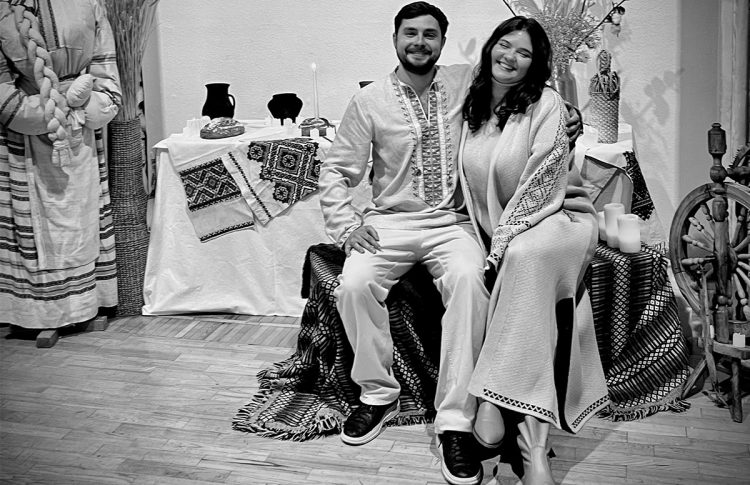
Iryna Rudyka / Photo from the personal archive
SHORT PROFILE
Name: Iryna Rudyka (pen name — Ingigerda)
Date of Birth: December 5
Place of Birth: Kostopil, Ukraine
Profession: specialist in learning and human capital, writer
Iryna Rudyka (pen name — Ingigerda) is an expert in the development of educational and cultural projects, a soft skills development trainer, an educational program methodologist, an ambassador of the Life Long Learning concept in Ukraine, a mentor, a poet, and a public figure. She is the author of the children’s book Smachnenka Abetka (Yummy Alphabet (2023), the only fiction book in Ukraine printed in the Rutenia typeface, and the art book Ulamky (Fragments (2024). She is also one of the translators from Crimean Tatar into Ukrainian of the collection Qırım öz tüsüni alır / Crimea Will Reclaim Its Color (2024). Her creative life encompasses poetry for children and adults, literary projects, the creation of cultural and artistic events, and the development of Literaturni Zabavy — an initiative born of her idea and love for living literature. Our conversation will be about time, creativity, resilience, love and inspiration, unbreakability, and much more.
Andrii Kostiuchenko: First of all, Ms. Iryna, I would like to understand what, among everything mentioned, is most important to you in these difficult times. And secondly, Ingigerda is a queen, if I am not mistaken. Looking at you, one can hardly argue with that. Or can one?
Iryna Rudyka: Everything I am engaged in — culture, art, education, civic activity — truly matters. And now, especially so. It is extremely important for me to develop all areas of my work and, whenever possible, to combine them. It is a great happiness to teach through creativity and, at the same time, to create while teaching. This is beneficial both for me (I remain in motion, do not lose my inner voice or the sense of what I do) and for the entire field of education, which today needs change. As for Ingigerda, her origin and mission: thank you for the compliment and the comparison (smiles). Ingigerda did indeed have royal roots; I am an ordinary woman, but for me, this pen name and title are rather symbols. Symbols of the right to a voice, to choice, and to responsibility for what you create and how you live.
А. К.: Time. What do we know about it? How do we live with it? And where exactly do we get it from — could you tell us?
I. R.: This is a question from the realm of philosophy, in which I am not as strong as I am in creativity. But I do have my own view on it. So, speaking of time as a substance placed at the foundation of being, I reflect on it as something external — something we ourselves create, define, and fill. Yes, time does not wait, does not stop, does not return, yet at the same time it can always be felt and measured through what we do, what we feel, how we grow and change. I know this for sure! I live in such a way that in every moment there is room for creativity, for learning, for important matters, for social projects, close people, and small joys. And where do we get time… Probably in the willingness to notice it, in priorities… and in the decision not to spend it on what does not add life — that is the whole secret.

А. К.: Thank you. The project you initiated, Literaturni Zabavy, began even before the full-scale invasion, and you have managed to sustain it up to the present day. What does it mean to you today? And what makes it unique?
I. R.: Literaturni Zabavy is a project with a four-year history, on whose stage the voices of more than 150 contemporary Ukrainian authors have already been heard. I conceived and implemented it myself. In fact, that is the secret of its longevity and sustainability. Today, Literaturni Zabavy is a meeting ground for Ukraine’s creative avant-garde — those who create contemporary literature, music, theatre, cinema, and visual art — and those who are interested in them. It features weekly author evenings with live broadcasts, performances, presentations, an open microphone, and creative networking. Here, literature steps out of books into dialogue with living people. A particular uniqueness of the project lies in the formation of cultural heritage: recordings of event broadcasts are preserved and, sooner or later, will become an asset and a subject of study of Ukrainian culture during wartime, just as we do today with materials about the Sixtiers or the Executed Renaissance. Recordings of all project events can be viewed on our YouTube channel.
А. К.: Your level of activity and involvement in various projects, events, and performances before diverse audiences of different ages is truly impressive. Moreover, having experience in writing books, you went further and became a co-organiser of book fairs and exhibitions. Why do you need this?
I. R.: Yes, this is another direction in which I began working in 2025, combining the instinct of an artist with the experience of a manager. And it genuinely interests me. Incidentally, it was precisely the experience of organising Literaturni Zabavy, as well as knowledge of publishing processes and the people within this environment, that helped me run two major Poverkhy festivals already. The expertise I have gained allows me to consult and mentor similar events, to grow, to seek new formats, and to support the creative community. For me, this is a natural continuation of working with literature.
А. К.: As a writer speaking to a writer. Let us return to your own books. And let us begin with Smachnenka Abetka. Why did you not choose any other typeface for printing besides Rutenia? What is the story behind it?
I. R.: This story is truly worth telling. It was 2022 when I finally realized that a book with children’s names and their favourite foods and drinks had to come into being. At that time, I was actively exploring publishing processes, looking for formats to realise the idea, and searching for people who could help with illustrations and editing. But we all remember what 2022 was like… And it was precisely then that fate brought me together with Vasyl Yakovych Chebanyk — a renowned Ukrainian calligrapher, graphic artist, and the creator of the Rutenia typeface. He not only inspired the idea of creating a book in this unique font but also fully supported the concept.
A great gift was his personal involvement in creating the inscription for the cover: Vasyl Yakovych personally, using a simple pencil and drafting tools, produced the text sketch exactly as we see it now. From that moment on, the book became unique, special, truly native — intrinsically Ukrainian. Today, Smachnenka Abetka is the only book in Ukraine printed exclusively in the Rutenia typeface, without a single Cyrillic character. At the same time, it does not merely teach the basics of grammar but also develops creative thinking and imagination, helping children to discover the world through graphic images, language, and play.
А. К.: A methodologist — that sounds beautiful. And I am also curious about how exactly you help children acquire «soft» skills. It is a pity I no longer qualify, and my skills will remain «hard».
I. R.: Let us start with the basics. «Hard» skills are professional abilities required for a specific job — what is taught in colleges and universities. «Soft» skills are additional abilities and personal qualities that help build a career, interact with people, and remain flexible. These skills do not oppose one another; on the contrary, they reinforce each other. This is precisely what the Life Long Learning concept is about: it is never too late to learn, and learning is always worthwhile. There is time and opportunity for this, Mr. Andrii! Specialised trainings, courses, mentoring support, various educational literature, and games can help here. The main thing is inner readiness and the desire to move forward.
А. К.: Then I am ready. I am starting to move. And where do you find inspiration? What or who inspires you to do good things, who or what helps you endure?
I. R.: Inspiration is an unpredictable thing, and I myself find it interesting to explore its nature. It can appear suddenly: through people, events, a visual image, a memory, some object, or even something tasty. Over time, I have learned to notice my «entry points» into this state and even to consciously evoke it — in order to cooperate with it rather than wait. There is only one condition: the physical body must be in good shape. When you are exhausted, there is simply nowhere for inspiration to settle. And what is important — inspiration is needed not only in creativity but in any activity where you want to do something alive and honest. So let us nurture inspiration, because it gives wings!
А. К.: Do your two degrees — in economics and medicine — have any influence on your work?
I. R.: Undoubtedly. It was there that I gained a solid foundation and «hard» skills that have repeatedly proven useful and largely shaped my subsequent professional choices. An education in economics taught me to see processes systemically, to think strategically and on a large scale, and to treat resources responsibly. Medical training taught me to work with people, the body, and limits, to make quick decisions, and not to panic in critical situations. Under current circumstances, I consider basic medical education, or at least serious first aid knowledge, not merely desirable but necessary — as an element of personal maturity and care for others.
А. К.: What connects you with the Crimean Tatar language, and what developments do you have regarding Ukrainian? Additionally, I would like to hear about the Life Long Learning concept…
I. R.: My connection with the Crimean Tatar language comes through my experience as a translator in the collection Qırım öz tüsüni alır / Crimea Will Reclaim Its Color, where I was one of the translators. It was an important and very valuable experience for me — both as a writer who was working with literary translation for the first time, and as a Ukrainian who knew much about Crimea but was able to understand it much more deeply precisely through the poetic lines of contemporary Crimean Tatar authors. It was attentive, slow work with an interlinear text and dictionaries, discussions with colleagues, and reflections on every word, so that it would be as accurate as possible while remaining alive and close to the original.
For the Ukrainian language, I have done not so much so far, but I can be proud of the educational course Modern Ukrainian Language. It makes it possible to learn, revise, or recall linguistic fundamentals and at the same time to understand the innovations of the 2019 spelling reform in a gamified, accessible format. In fact, this is how the Life Long Learning concept («learning throughout life») is realised for me: through the creation of educational and literary products, work with language, and also through personal example. At present, I myself am studying, mastering the foundations of Ukrainian national and civic identity, and I consider this process to be just as continuous as learning a language.

А. К.: How did you come to writing? How was the writer Ingigerda born?
I. R.: My creative path began back in early adolescence. It started with poetry and black-and-white graphics. The first rhymed lines were dedicated to my mother: «My dear mummy, know that I pray for you…» And then came trembling experiences of unrequited affection, treacherous friendship, bodily sensations. My graphics have always revolved around the human being, mostly a woman. I accompanied these «images» with favourite quotes from books, songs, or lines from my own poems. It was at that time that the idea came to me to use a pen name as a personal, recognisable, precise, and fitting mark of my authorship. Ingigerda was the one and only — and deeply «mine» — so from idea to realisation it was but a moment, from which, for over 30 years now, I have proudly borne the name of a remarkable Scandinavian woman who played a significant role in the development of Kyivan Rus.
А. К.: And what hobbies do you have, Ms. Iryna, that might surprise us, and what is missing from this turbulent life?
I. R.: My hobbies are quite simple and down-to-earth: I love reading, knitting, walking a lot, and also collecting. I have a collection of old postcards, calendars, photographs, and even pinecones. Perhaps this is a way of preserving memories of places, time, and moods — the small things that life is made of. And anything or anyone can surprise me. After all, wonder is about the unexpected, and even more so about inner openness. With age, you realise that the ability to be amazed is not a trait of childhood but a conscious choice of an adult. Even something familiar — morning coffee, a well-known route, a long-read book — can suddenly speak differently if you do not pass by automatically. I would put it this way: if something in this world still surprises me, it means I am alive, attentive to myself, to the world and to people, and have not lost curiosity about the simple things that fill this existence. And there is one thing missing now — peace and calm, and with them stability, prosperity, and well-being. And, of course, people — those we will never meet again in this life.
When copying materials, please place an active link to www.huxley.media
Select the text and press Ctrl + Enter