SYBE SCHAAP: Ukrainians are doing the work that Europeans should have done themselves!


Author: Rob Vos / tubantia.nl
What are the dangers of the «resentment trap» for Ukraine? Why should Ukrainians renounce hatred towards Russians after the war? Why does Putin need a war with Ukraine? Is a civil war in Russia possible?
Dutch philosopher, writer, and member of parliament Sybe Schaap answers these and other questions in our almanac.
Schaap is a respected scholar of post-Soviet countries, post-totalitarian societies, Nietzschean thought, and neo-Marxism. One of his books is titled The Poison of Revenge. Our conversation explores how Ukraine can find an antidote to historical grievance — and ultimately prevail.
You’ve studied Nietzsche’s philosophical legacy for many years. In his book On the Genealogy of Morality, Nietzsche introduced the now widely used term «ressentiment» (from the French ressentiment — grievance, spite, indignation). Can this concept help us understand Ukrainians’ current attitude toward Russia?
R
esentment begins when you feel unhappy. This reaction naturally leads to the question: «Who is to blame?» As a result, you forget what actually happened and immediately project your feelings onto the person you believe is responsible. So resentment is not a reaction to specific events, but always to people whom you see as the cause. It is personalized hatred.
The intensity of resentment doesn’t necessarily reflect the actual state of affairs. This feeling can easily be amplified by small things that particularly strike a nerve. These details then start to grow in importance in your eyes. You can’t stop thinking about them. They haunt you day and night.
Of course, at some point, you must realize that this cannot go on, and something needs to be done. Sooner or later, you have to return to a normal state. But when you are consumed by resentment, you don’t realize that.
Thus, resentment is a reactive emotion driven by a desire for revenge. You form a clear picture of who is to blame for your suffering, and it becomes extremely difficult to control your attitude toward that person.
 Ukrainians’ hatred toward those who attacked their country is entirely understandable. In your view, is there any way for our nation to change this reaction?
Ukraine must fight Russia, but at the same time, it should not hate Russians. Admittedly, a reaction of hatred is entirely natural under such circumstances. We can see that Putin has built an infrastructure of hatred around Ukraine. But we shouldn’t emulate him or cultivate this feeling toward Russians. Hatred won’t help.
Take, for example, the Gospel of Jesus Christ. He says: if someone wishes you harm, do not respond in kind. Nietzsche, though far from being a Christian, insists on the same principle.
This idea has its roots in ancient Greek thinkers, and later it was embraced by Enlightenment philosophers. They all speak in unison: when you’re overwhelmed by negative emotions, you must try to control them, rise above them, and not become like your enemy.
I truly hope Ukrainians are strong enough to endure. Right now, they naturally hate the Russian army. But after the war, this reaction will need to be recalibrated.

Why, in your view, does Putin need this war?
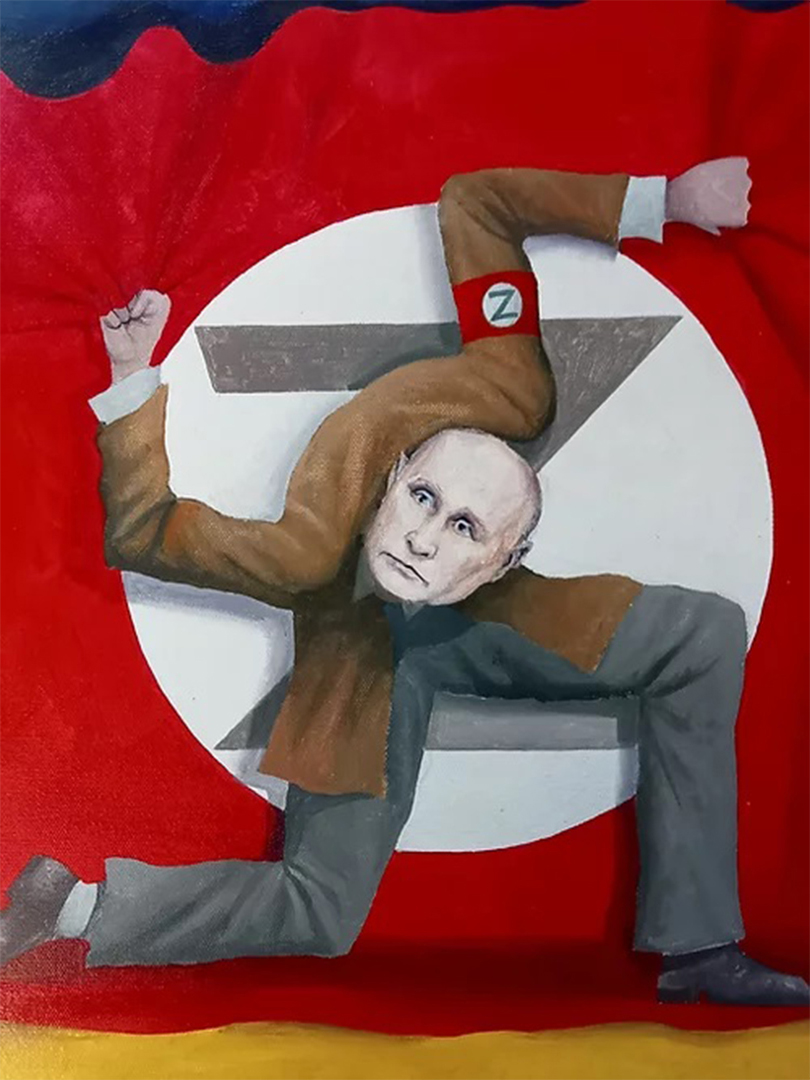
Putin is driven by ressentiment. He has repeatedly stated that he considers the collapse of the Soviet Union the greatest catastrophe of the 20th century. He cannot come to terms with it — and that is the source of his grievance.
What truly motivates him is revenge. He sees that your country is becoming more free and multi-directional compared to Russia, that it is moving toward the West. He perceives Ukraine’s chosen path as a threat to himself, and therefore your country has become the object of his hatred.
His goal is to destroy Ukraine.
But what Putin is doing now only worsens the situation for Russia itself. After the invasion, even Russian-speaking citizens of Ukraine began to identify fully as Ukrainians. Only a small number of marginalized individuals still believe they would be better off as part of Russia.
Putin has, in fact, succeeded in truly uniting the Ukrainian people.
I believe that until recently, no one could have imagined a war of such scale in Europe in the 21st century. Do you think this indicates that armed conflicts are inevitable in human history?
Human nature contains both good and evil. No matter how noble and radiant a person’s qualities may be, their darker side never truly disappears. Nietzsche illustrated this powerfully through his concept of the eternal return. Evil returns. And although we witness this cycle from time to time, we have no reason to succumb to fatalism.
Human nature is like a coin — with good on one side and evil on the other. But unlike a coin, it can fall on both sides at once. We must learn to keep this in balance. The Western world needs to rediscover the equilibrium between good and evil.
Can we already draw any lessons from this catastrophe?
In the Dutch water management authorities, where I had the honor to work, there is a traditional saying: «Please, Lord, give us our daily bread. And also, from time to time, a small flood».
Why do we need a small flood? Because it serves as a warning: greater disasters — devastating floods — may lie ahead. When no flood occurs for 20 years, people forget that danger exists.
Then they start asking: «Why do we even need water management authorities in the Netherlands?» The answer is: so we can anticipate threats and prevent them in time.
Do you believe it is currently possible to end the war through diplomatic means?
You cannot trust the Russians or any agreements with them. For them — even during the communist era — these were just pieces of paper. They don’t even read what they sign — it simply doesn’t interest them. That’s why Ukraine must continue the fight until it wins. The worst possible move would be to say at the negotiating table: «Alright, we’ll stop the war and accept the situation as it is now».
The result would be a frozen conflict, like the one we’ve seen in Donbas since 2014, or as it has unfolded in Moldova and Georgia. Georgia is a clear example of how paralyzing a smoldering war can be for a country. Russian aggression halts its development.
Ending the war on such terms would create a permanent zone of tension in Ukraine. And that means Western investors will always hesitate to invest in your country — because a new war could break out at any moment.
What should Ukraine focus on after the war ends?
You must be ready to face new challenges. War is always reactive: there is an enemy, and you are forced to resist. After the war, you need to become proactive, not reactive. It is a good sign that Zelensky is already setting the task of preparing for Ukraine’s postwar recovery.
By the way, when you fall into the trap of ressentiment — nurturing a grievance against Russians — you remain in the realm of reactive responses: «We know exactly who we are against». During war, this is understandable. But after the war, you must ask a completely different question: «What are we for?»
The task of Ukrainians is to answer this — to figure out what to do with Ukraine next. Of course, what has been destroyed must be rebuilt. But what comes after that?
After World War II, Germany was punished in a rather peculiar way: all export goods produced by Germans had to be marked «Made in Germany». Ten years later, this label was no longer seen as negative — it became a mark of exemplary German quality. There is much to learn from the Germans.
Russia often voices its concerns about NATO’s eastward expansion. In your opinion, does NATO truly pose a real threat to Russia?
NATO is a defensive alliance, not an offensive one. It has never invaded foreign territories. The organization consists of around 30 very diverse countries, and the only goal that can truly unite them is self-defense.
So even if individual NATO member states might have offensive ambitions, the alliance as a whole cannot pursue such goals. It is absolutely unimaginable that all 30 countries would come together and decide to conquer someone.
Do you believe this war could become a turning point in Russia’s history?
I’m not sure things will improve after Putin. If you recall, when Gorbachev stepped down and the Soviet Union collapsed, a near-civil war broke out in Russia almost immediately. Oligarchs, gangsters, and politicians directly linked to the KGB were all vying for control. Yeltsin failed to manage this chaos. Unlike him, Putin managed to strike deals with the oligarchs, the criminal underworld, and the KGB. And just like that, the civil war stopped.
But neither the criminals nor the oligarchs disappeared — and the KGB figures gained political power. As a result, Putin is now probably the richest man in the world. If he leaves, and the ruling class decides not to preserve the regime, Russia could easily slip back into the 1990s. And that would mean the country could once again find itself on the brink of civil war.
Do you believe that the changes Ukraine has undergone in recent years will lead it toward a brighter future?
In Ukraine, a new generation came to power after the last elections — one that did not grow up under communism. They are not tied to old structures; they were raised differently from previous generations. These are people who have chosen to act differently…
So yes, of course, we place our hopes in them.
Select the text and press Ctrl + Enter


