REVELATIONS IN SCIENCE: suicide before departure to the USSR

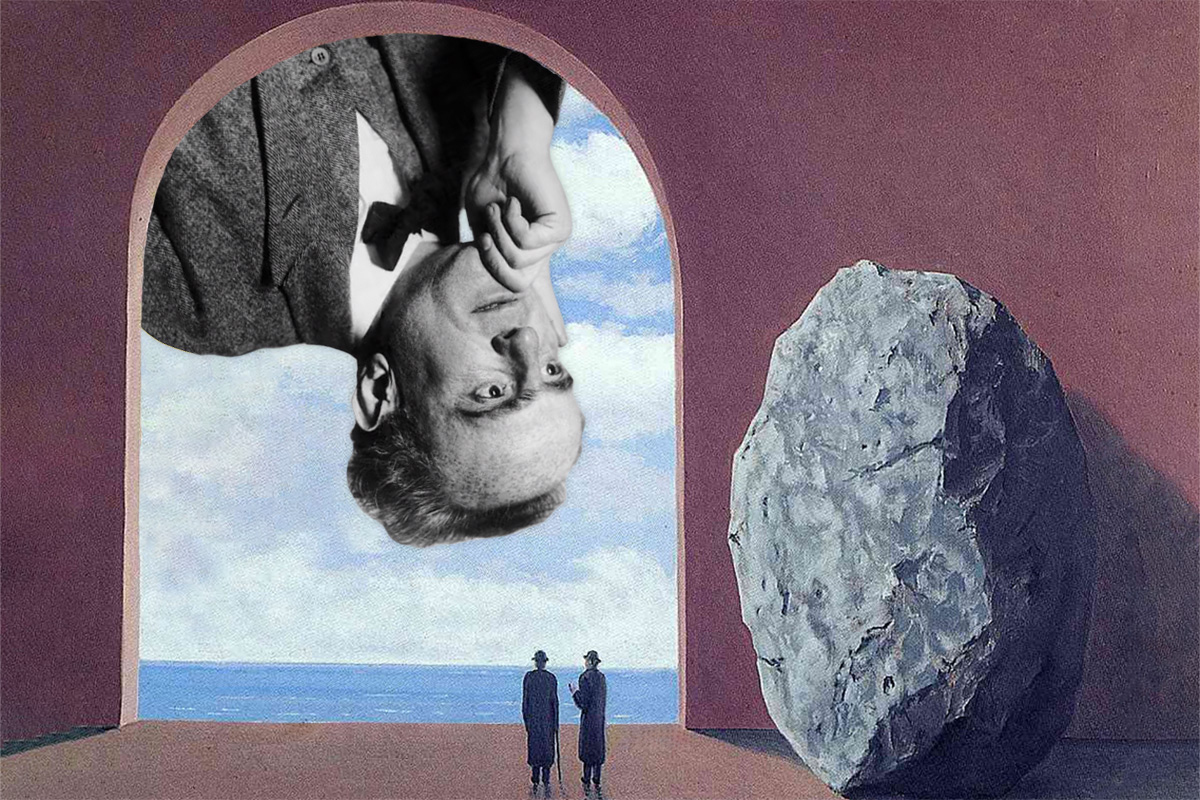
Art design: huxley.media via Photoshop inspired by René Magritte’s painting Portrait of Stephy Langui, 1961
If an error in science is not really an error but a deliberate distortion of the truth for the sake of fame or money, then after being exposed, the culprit usually remains calm and unshaken. More often than not, they do not accept criticism, accuse the exposers of bias, and, since there is usually no criminal punishment for scientific misconduct, continue living whatever life they can, hardly suffering any moral consequences — well, it didn’t work out, so be it. I have already written about such cases — both the budget milker Petrik and the data falsifier Schön carry on as they can, seemingly feeling no guilt at all. But the drama of the Austrian biologist Paul Kammerer (1880–1926), exposed for falsifying experimental results, ends with the ultimate acknowledgment of guilt — suicide. At the same time, his guilt is still not considered unequivocal, and in recent years, there has even been talk that his exposure was not as clear-cut or straightforward as it once seemed. So what is this story?
LAMARCK OR DARWIN?
P
aul Kammerer was born into a wealthy family and had the opportunity to pursue all his interests in education and career choice, which, like many talented individuals, were quite diverse. He began by studying counterpoint at the Vienna Conservatory and even composed several songs that were later performed. But his passion for zoology prevailed. From childhood, he kept a «living corner», essentially a private zoo, and after graduating from the University of Vienna, he went on to work at the Institute of Experimental Biology — first as an assistant (his supervisor noted that Kammerer maintained the vivarium impeccably), and after defending his dissertation in 1904, he became a Privatdozent at the University of Vienna. Soon, he married (incidentally, a baroness!), and wished to name his daughter Lacerta (Latin for «lizard»).
At that time, many biologists were pondering who was right: Darwin or Lamarck? Darwin believed that organisms change under the influence of natural selection, where the fittest survive. Lamarck, on the other hand, argued that living beings adapt to environmental conditions and change in order to survive better within them. The third participant in this great debate, the monk Gregor Mendel, was for a long time not included in it. This question also captured the interest of Paul Kammerer, who sided with Lamarck. He set out to prove his position through numerous experiments on amphibians.
SALAMANDERS AND THE MIDWIFE TOAD
Among his subjects of interest were salamanders — amphibians that live primarily in caves. The common salamander is black, its body covered with numerous yellow and orange spots (quite beautiful!). Kammerer raised some groups of salamanders on black soil and others on yellow. He had an almost artistic skill in breeding amphibians — today such techniques are well established, but at the beginning of the 20th century, his results were truly remarkable. He conducted his experiments for 11 years! And then reported that salamanders raised on a black background became darker, while those on a yellow background turned more yellow. According to the views of the time, this clearly supported Lamarck’s theory. Even more intriguing results, it seemed, were obtained by Kammerer with the midwife toad.
These animals mate not in water but on land, with the male holding the female using his forelimbs. To prevent the female from slipping out of his grasp, males have so-called nuptial pads — rough, swollen patches of skin on their front legs. Kammerer set out to force midwife toads to mate in water by making the air in the terrarium sufficiently warm and the water cool, much more suitable in temperature for these toads. Driven by the heat of the air, the toads mated in water, but the clutch did not adhere to the male’s legs; the eggs sank to the bottom of the tank and mostly perished. Kammerer managed to save only some of the eggs and raise them into toads. Thus, there was just a single specimen of a midwife toad with clearly developed nuptial pads — not much to prove anything with only one example!

GROUND FOR CONFLICT
Events unfolded rather slowly — the four years of World War I were hardly the best period for biology. Many of Kammerer’s collections were lost. Was it really such a disaster if the phenomenon itself existed? The experiments could simply be repeated and everything proven again. But there was no rush to do so. In 1923, Kammerer arrived in the United Kingdom, bringing with him his collections intended to prove his case (including that very single specimen of a male midwife toad with nuptial pads). His lectures were a success — after all, not everyone claims to refute Darwin! But the renowned British biologist Bateson was so negatively disposed toward Kammerer’s theories that he simply ignored him. It did not interest him… It should be noted that Kammerer’s phenomenal success also had a political dimension. In his views, he was, to put it mildly, a socialist.
Soviet scientists largely became supporters of Kammerer due to the proximity of his views to the official Soviet doctrine. The matter went so far that the scientist was preparing to move permanently to the USSR in order to continue his work there at the Communist Academy, to which he had even bequeathed his scientific library. It was precisely in the USSR that his ideas were in particularly high demand. After all, Kammerer was arguing for the validity of Lamarck’s theory, and at that very time, Trofim Lysenko was beginning to promote his own ideas, which, in later years, came to be described as microlamarckism. Such influence on the minds of the global scientific community could only be welcomed by Lysenko. Thus, in at least one country in the world, the attitude toward Kammerer’s scientific work could hardly have been more favorable. But he did not manage to cross the border into the Land of the Soviets in time.
SENSATIONAL EXPOSURE
In 1926, access to Kammerer’s collection was granted to a highly respected researcher, the distinguished herpetologist Gladwyn Kingsley Noble. His conclusions can hardly be described as merely sensational — they were devastating, first and foremost for Kammerer’s scientific reputation. They did not concern an erroneous theory or a misinterpretation of data, but outright falsification, blatant fraud! Those very nuptial pads of the midwife toad, which were so crucial to supporting Kammerer’s theories, turned out to have been simply drawn with black ink!
It was not difficult to establish that the results had not been falsified by Kammerer himself, but by his trusted assistant. Why? If this was done with his boss’s knowledge, it is hard to imagine anything worse — the offense is clear. If it was done on the assistant’s own initiative — again, why? It is difficult to assume that such a crude and obvious forgery would not be exposed. Perhaps the real aim was to destroy Kammerer’s scientific reputation? All of this happened literally on the eve of his departure to the USSR — and what if the intention was to disgrace him precisely for that reason? In any case, Kammerer never denied the very fact of the falsification. Moreover, he did not have much time to respond — only six weeks.
A HAPPY ENDING IN CINEMA — BUT NOT IN LIFE
On September 23, 1926, on the slope of Mount Schneeberg, a road worker found the body of a well-dressed man with a pistol clutched in his hand. In his pocket, a letter was discovered, addressed to whoever would find the body. He asked that no religious rites be performed at his funeral and that his body be given for autopsy at an anatomical theater. There was also a separate request to his wife not to wear mourning after his death. An unmistakable suicide — but for what reason? Was it remorse after such a devastating exposure? Or, on the contrary, the horror of an innocent man facing the total loss of his scientific and personal reputation, which he could not defend?
It was precisely the second version (that Kammerer was innocent and that everything was the work of his enemies) that formed the basis of the Soviet film Salamandra, released in 1928. The screenplay was written by the People’s Commissar of Education Lunacharsky himself, the film was directed by Grigori Roshal (who later directed, among other works, the first screen adaptation of the novel And Quiet Flows the Don), and it was produced in collaboration with the German studio Prometheus-Film. The role of the progressive scientist’s wife was played by Lunacharsky’s own wife, Natalia Rosenel. According to the film, various reactionary forces — from Catholics to fascists — attempt to destroy the progressive biologist, who sympathizes with the USSR and the oppressed classes in his country. But they fail to kill him; his scientific theories are vindicated, and the film concludes with a standard happy ending — the hero departs for the USSR, where he will surely be protected.

UNEXPECTED CHANGES
However, the very fact of the falsification of experimental results is undeniable. But what if the experiment were repeated — without any manipulation — and we simply observed what would happen? After all, any serious research is subject to verification, and it is carried out by scientists from different countries: if the results differ, it becomes clear that something is wrong. As it turned out, no one managed to replicate Kammerer’s experiments, and scientists were not particularly eager to try — the very fact of the fraud had deeply angered the scientific community. Perhaps the blame lay with a foolish assistant who wanted the nuptial pads on the specimen to look more impressive? But then another question arises: could they have appeared at all? For a long time, this entire story was remembered as a clear case of falsification, but now alternative interpretations have emerged… In recent years, much has been said about epigenetics — a branch of genetics that studies how external factors, without altering the DNA itself in experimental animals, can nonetheless change gene activity.
It has already been proven that such changes can be inherited over several generations. For example, if the scent of bird cherry is paired with an electric shock in laboratory mice, their offspring — and even their grandchildren — will develop a fear of that smell. So was Kammerer right after all? Not quite — epigenetic changes are reversible and usually disappear within 3–5 generations. Moreover, cells possess powerful defense mechanisms that prevent epigenetic changes from manifesting in future generations and persisting for long. Nevertheless, in theory, such mechanisms could have led to the appearance of nuptial pads in midwife toads. Of course, Kammerer explained this phenomenon using the incorrect theory of Lamarck, but what else could he have assumed at a time when electron microscopes did not yet exist and so much of what we know today was still unknown? Yes, phenomena like those described by Kammerer could have existed — but whether there was anything real behind them, rather than something merely simulated with black ink, can no longer be proven.
AND YET…
What remains most unclear is something else: did Kammerer know about the falsification? And if he did not, then who was responsible and what was their aim — to glorify Kammerer or to destroy him? In any case, such attempts are both criminal and pointless — a scandalous experiment will inevitably be repeated, yielding completely different results, and everything will come to light. Ignoramus et ignorabimus — we do not know and will not know. Could it really have all been mere coincidence — political disputes, a rare experiment, and the falsification of results? Incidentally, this too was among Kammerer’s scientific interests — the collection of coincidences, seemingly random at first glance, but who knows… He even published a book, The Law of Series, in which he presented more than 100 sequences of coincidences, allowing him to propose a «theory of seriality». Interestingly, Einstein himself, after reading the book, described the idea of seriality as «interesting and by no means absurd».
From a scientific standpoint, however, we have moved a little closer to the truth — it is now clear that Kammerer’s general conclusions were incorrect. It would have been better to arrive at this without tinting specimens with ink and without suicide. Perhaps Kammerer would have gone to the USSR, become a supporter of Lysenko — clearly a secondary one, since he lacked Lysenko’s skill in dealing with ignorant authorities… But sooner or later, everything would have come to light anyway. The laws of nature cannot be reshaped to suit those in power, and discovering what they are sometimes comes at the cost of tragedy. Though tragedies are better avoided — by not creating experimental material with Chinese ink…
LITERATURE
- Iordansky N. N. Neo-Lamarckism // The Evolution of Life. — Moscow: Akademiya, 2001. — 425 p.
- Soyfer V. N. A Ruined Talent. Kontinent. — 2005. — No. 123.
When copying materials, please place an active link to www.huxley.media
Select the text and press Ctrl + Enter